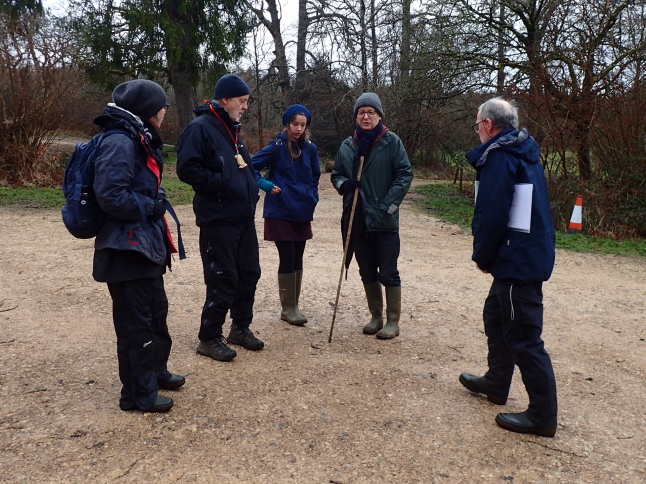
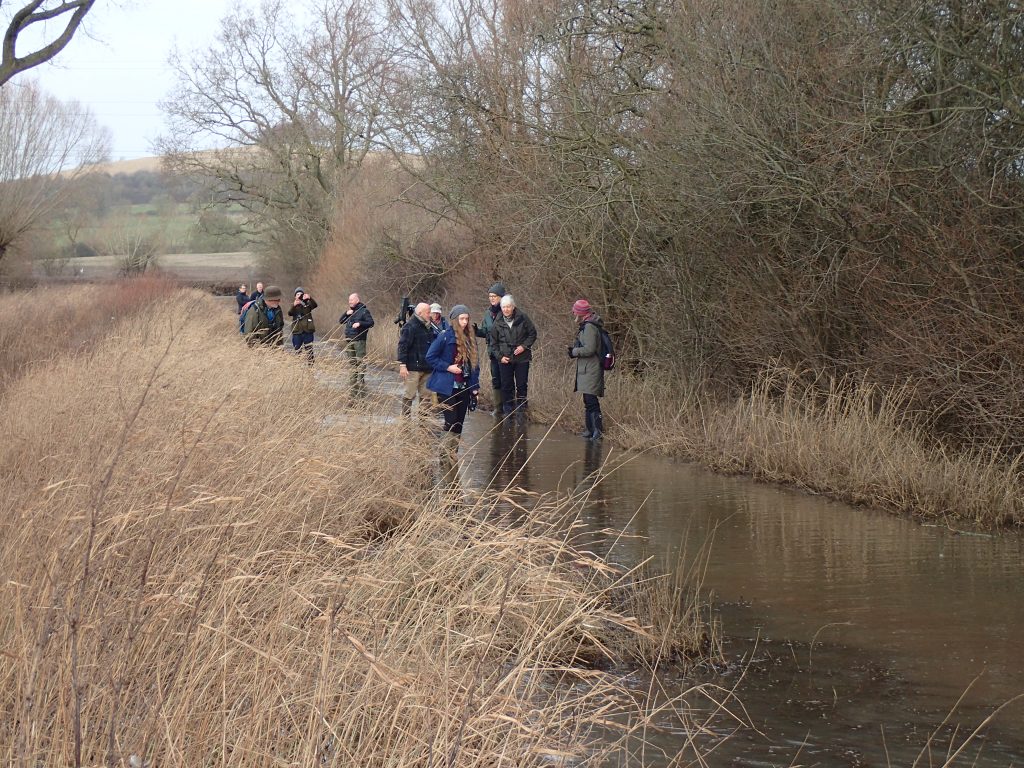
Just over a dozen members met at the Gloucestershire Wildlife Trust’s (GWT) Ashleworth Ham reserve this morning, in the wake of named storm Jocelyn which had passed breezily through the previous evening, leaving a very pleasant morning – mild, windless and quite bright with good light for watching waterbirds. The meeting had originally been planned for mid-December but had had to be postponed because of the unusual series of major flood episodes, which have occurred since October 2023: the early first one in October/November (following storms Babet and the Ciaran),the second in mid-December following heavy snowfall higher up the Severn catchment in North Wales, and the third and highest in the first half of January as a follow-up to storm Henk. These three really big floods in such a short period had caused heavy flooding, and the Ham Road leading to the reserve had been impassable, with water several feet deep for weeks on end.
“Such deep flooding, here and at the other GWT reserve across the Severn at Coombe Hill, was paradoxically not to the ducks’ liking: if the water is too deep, dabbling ducks cannot reach down to the grass to feed and the height of the flooding had seen an exodus to other sites where flooding was not quite as deep, notably Mythe Hook above Tewkesbury and the Longdon basin just in south Worcestershire. One of the aims of this morning’s session was to check on whether the waterbirds had returned from these sites now that flooding was lower. At first sight only a few swans, geese and ducks could be seen on the floodwater, still fairly deep. There was a group of 18 wintering Mute Swans, which had clearly spent the night on an island where they were safe from foxes; many of them were last year’s cygnets which could be identified by the brown feathers in their plumage, but a couple were pairs of adults, the principal of which lost no time in throwing their weight about with puffed-up wings and chasing off other adults, a sign that they were beginning to hold territory, with breeding in mind. About 100 wintering Canada Geese were present (together with a Greylag x Canada Goose hybrid (or “Canlag”), feeding on the water’s surface, no doubt getting ready to move away in the near future to breeding areas in the Midlands and further north. Among the ducks (most of which will have come from breeding areas across central and northern Europe, as fa as Russia) the soft monotone of Teal could be heard from under all the flooded hedges, suggesting that there could be good numbers present, together with the louder whistle of Wigeon; a few elegant Pintail and heavy-billed Shoveler also showed, with the odd Gadwall, Mallard and Tufted Duck. Also present was a flock of 150 Lapwings, undoubtedly wintering birds from further east, probably continental Europe; good to see a reasonable flock of this species, whose local breeding population has decreased sharply in recent years. Initially, it didn’t look as though there were more than a few hundred ducks present, until a couple of shots from a nearby pheasant shoot flushed all the birds from the water and flooded fields behind the hedges, and we realised that a good two thousand ducks had been hiding on site, the majority Teal (probably 1200) and Wigeon (perhaps 700) with about 50 Mallard, 20 each Pintail and Shoveler and five Gadwall. They flew round, high in the air, providing a fine spectacle, before returning to the water, where we were able to study them at leisure from the hides overlooking the reserve.
“Among other birds present were a Buzzard and a few passerines, mainly small flocks of Great and Blue Tits and the inevitable crows – rather little birdsong as yet, just the odd Robin and Wren. Nothing unexpected, but a good selection of the typical wintering species of this major floodplain reserve, which in a few short months will be welcoming a variety of breeding birds, many of them currently south of the Sahara. The floods had only very recently revealed the bare ground in the meadows, but from a public footpath we were able to see that the array of plants found on the rich hay meadows were already beginning to appear with leaves of buttercups already showing through.