Cinderford Northern Quarter – Site Investigation Works

Andrew Bluett and Mike Smart attended a briefing organised by Homes and Communities Agency and the Forest of Dean District Council at the council offices in Coleford on Friday 9th May regarding further site investigation works to be carried out at the CNQ site over the next few weeks.


The geophysical engineering contractor and professional ecologists lined up, under the watchful eye of the promoter, Homes and Communities Agency, to give the presentation which illustrated and described archaeological and geophysical investigation works to be carried out.


The archaeological works are intended to locate and seek more detail on former industrial remains including tramways and the like in various areas;


The geophysical investigations are aimed at locating a high pressure gas main that crosses the site, the route and details of which are apparently completely unknown, the detail of the limits, depths etc. of the opencast excavations and any other physical difficulties under the proposed development areas. The means of carrying out the geophysical investigation will include the use of 4 – 6 “low impact” drilling rigs and a variety of testing methods on a number of pre-determined lines, primarily across the site around the lake and between it and the Newtown/Steam Mills settlement areas to discover the characteristics of the ground below.


The works are to be carried out under a “European Protected Species” licence granted last week because of the known presence of the European-protected Great Crested Newt, and will commence on Monday 12th May, lasting for approximately 6 weeks.


Ahead of any work to be carried out we were assured that ecologists (from TACP, Cardiff – “Our Vision is the Future”) going ahead of the machines on hands and knees would carry out a “fingertip search”. There will be resident ecologists on site throughout the duration of the works who will monitor all species that may be affected, specifically the Great Crested Newts, reptiles and ground nesting birds. Species not specially protected like the Great Crested Newt would be subject to RAMs (Reasonable Avoidance Measures) which it was suggested would include 10 metre exclusion zones.


We were also advised that excavations would not in any single case last for more than a full working day, that spot boards and traffic mats would be placed to protect the ground and species under the working areas, that all spoil would be reinstated in the reverse order from which it is extracted and that there would be a full “audit trail” of documentation covering the ecological management protocol.


It was stated that ecological and archaeological information would be made public via the planning portal on the FoDDC web-site.


It is regrettable that this work is to be carried out at this time of year, in the midst of the breeding and reproductive season for most of the species inhabiting the site. Andrew Bluett advised the meeting that there were ground nesting Tree Pipits in the work area last year and that it was likely to be so this spring. On Sunday 11th May a discussion with Rob Husbands and a site visit confirmed that there were at least two Tree Pipit nests on the site in 2013 and that two singing males are currently present along with at least two Chiff Chaffs and five Willow Warblers. We are of course also fully aware of the habitation by the various reptiles, amphibians and invertebrates across the area.


Andrew Bluett has postponed the next proposed GNS site visit to the 17th May so that any effects of the first weeks-worth of this work might be observed.


GNS will be considering the issues of the proposed land swap and the hybrid planning application over the next few days and in consultation with GWT will decide what comments we will make on both of these issues. We have received some information and comment already from specialists and will take these thoughts into account before making our own comments.

IMG_0191 Tr Pipit
Singing male Tree Pipit, CNQ site, 11th May 2014

Field Meeting – Woorgreens Lake & Crabtree Hill – 19 April 2014

Andrew Bluett was joined by Juliet Bailey, Ingrid & Colin Twissell, Des Marshall, Tiz Butler, Rob Curtis, Daphne Lane and Trish Bluett together with seven guests from Painswick Bird Club for a field meeting of general interest at Woorgreens Lake and Crabtree Hill in the Forest of Dean.

The day started bright but by 11.00am had clouded over and whilst it remained bright it was decidedly chilly with an easterly wind predominating. By the end of the visit conditions had improved somewhat and were reasonably warm in the sunshine but still required the wearing of fleeces!

The walk commenced from the start point near Kensley Lodge, led towards Woorgreens Lake and around the south and east sides of the lake, then to the Forestry road along the south side of Crabtree Hill. Taking the main track we visited the heathland on the top of the ridge to view the landscape then returned to Kensley Lodge and the “Cathedral Window” before going back to the start point.

The cold ambient temperature meant few insects and no reptiles other than a decomposing Toad or Frog in one of the drainage ditches but birdlife was plentiful. Nuthatch and Blue & Great Tits were close to the car park in the Oak woodland and on the lake were Canada and Greylag Geese, Mallard, Tufted Duck, Mandarin, Little Grebe, Lesser Black Backed Gulls, Heron, Coot and Moorhen. A female Reed Bunting was seen in the sedges and reeds, Willow Warbler, Chiff Chaff and Blackcap were all singing. Overhead and in the Alder trees Siskins and Redpoll were seen and heard and Swallows were hawking for insects over the water.

On Crabtree Hill several Tree Pipits were singing rather half-heartedly, Linnets were in evidence, a Great Spotted Woodpecker was seen/heard briefly. Other birds noted were Chaffinch, Blackbird, Goldcrest, Carrion Crow, Robin, Wren, Song Thrush, Tree Creeper, Jay, Wood Pigeon, Coal Tit and Buzzard.

Butterflies were represented by Green Veined White, Orange Tip and Speckled Wood.

Viewing across Woorgreens Lake

a IMG_1278

Heron

a IMG_1274

Willow Warbler

a IMG_1280

Linnet

a IMG_1282

GNS No 6

GNS No 1


Woorgreens & Crabtree Hill Meeting Saturday 19th April

Andrew Bluett will be leading a meeting of general interest this Saturday, 19th April at Woorgreens and Crabtree Hill in the Forest of Dean – possible early Damsels and Dragons, Spring migrants, butterflies and flowers.

Meet at the car park near Kensley Lodge for an 11.00 am start, SO 628 125 – see the attached map below.

Forest Meeting Map

Cinderford Northern Quarter visit 12th April 2014

Andrew Bluett was joined by Colin & Ingrid Twissell, Nick Christian, Simon Glover and Councillor Andrew Gardiner for the third visit to the Cinderford Northern Quarter development area.

Andrew Gardiner was able to show us LiDAR (Light Detection & Ranging) aerial photographic images of the area which depict details of the ground contours and irregularities across the site. The significance of these images amongst other things is that they show depressions in the ground indicating the positions of some of the numerous shafts and holes resulting from past mining activity.

Simon Glover had previously made some exploratory visits to parts of the site seeking these depressions and evidence of “sink-holes” or collapse where some subsidence is in progress.

As a result of both the LiDAR images and Simon’s findings the party was able to locate and examine a number of the surface depressions, some of which showed recent evidence of movement, no doubt aggravated by the heavy rainfall and flooding that had affected Gloucestershire and many other areas in the late winter.

The CNQ site has been the subject of a detailed mining & excavation investigation by expert Paul Morgan, and whilst there is some disagreement regarding his findings, there is no doubt that historically the site has been extensively mined both with shafts and by opencast extraction and has been the site of opencast clay extraction for the local brickworks. It is believed that there is a significant aquifer under the area which could aggravate the deterioration of the ground in some areas. Estimates vary but the belief is that there are over 130 uncapped shafts on the site and could be more than twice that number.

The weather was bright but cloudy and chilly so no reptiles were evident; bird life was much the same as on previous visits but with the addition of some of the first of this spring’s Willow Warblers, newly returned from their southern winter quarters. Siskin & Crossbill were seen and heard overhead and a new addition to the species list was Pheasant. Ingrid Twissel had identified another species of fungus, the toxic and scarce (in southern areas) Gyromitra esculenta.

Staring into the abyss – Andrew Gardiner looking down into a former pit shaft that shows evidence of very recent subsidence.

IMG_1608a34

Field meeting at Forthampton Oaks

The latest GNS field meeting took place on 30 March at Forthampton, just across the Severn from Tewkesbury. The main point of interest was the Forthampton Oaks Key Wildlife Site, listed as a KWS because of the rare invertebrates found in the oaks by GNS recorders in the past.  The oaks are very aged, some of them dead, on the top of a ridge overlooking the Severn, but the parkland surrounding Forthampton Court supports a large number of healthy oaks in the hedgerows and open country.

There is a variety of different habitats within a small compass, including the old brickpits at Lower Lode, a series of arable fields, and low-lying hay meadows along the river.  Signs of the recent gales and heavy flooding were apparent, with a number of trees down and high water marks showing just how far the flood had extended.

Among the birds seen were: on the brickpits at least 20 Cormorants loafing in the trees, several of them in bright nuptial plumage, while on the water surface a pair of Mute Swans were already building a nest, and about 20 Tufted ducks and a Great Crested Grebe were present; over the arable, half a dozen Lapwings were beginning their spring aerial display, an increasingly rare sight in the Severn Vale, while a Shelduck may have been looking for a nesting hole and two Egyptian Geese sat placidly by; in the parkland, the highlight was a singing Lesser Spotted Woodpecker; in the hay meadows a pair of Curlews were holding territory and participants listened to their lovely bubbling song; along the river bank, about 20 Sand Martins had already returned from their African wintering sites, and singing Chiffchaffs were everywhere.

This early in the season, botanical interest was limited, but there was much blackthorn in flower in the hedges; Ground Ivy, Dandelion, White Violet, Daisy, Lady’s Smock and Lesser Celandines were out, and a very aged Black Poplar was admired.  Weeds in the arable included Chickweed, Red Dead Nettle, Shepherds Purse and Groundsel.  The most interesting plant, besides the oaks and the poplar, was the dried stems of Thorn Apple which probably came in with maize seed; this may be a first record for the hectad, as there are only 11 dots for the county in the Bishop “Flora of Gloucestershire”.  The Lichen Recorder felt that the site deserved another, more leisurely visit.

Thorn Apple
Thorn Apple

On the way back, the eight participants admired a lovely view of Tewkesbury Abbey, framed in trees behind a long reach of the Severn.

GNS will liaise with the Key Wildlife Sites database (managed by the Gloucestershire Wildlife Trust) to ensure that information on this important site is up to date.

Are these flying ants?

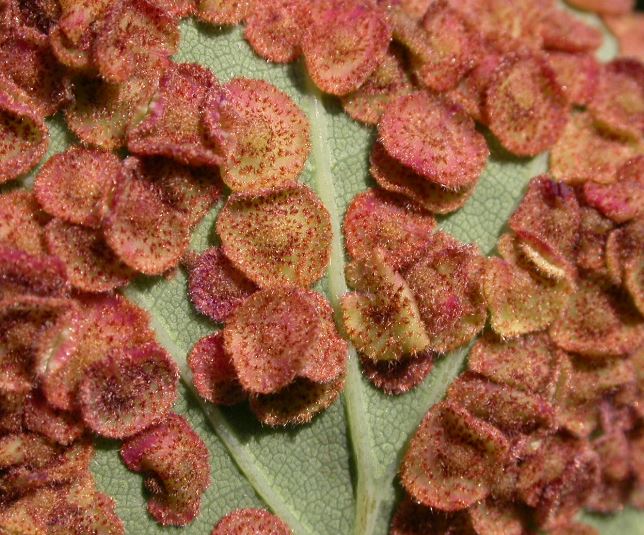
This question was put to me this weekend as hundreds, if not thousands, of little black winged insects (approx. 3mm long) settled on the white walls of our house and are doing so again today. These are the parthenogenetic, or agamic, generation of a gall wasp (Neuroterus quercusbaccarum) that lives on oak trees (Quercus). The warm weather has encouraged them to hatch and swarm. This generation will lay its eggs on oak catkins, producing little round galls that each house a single larva. Later in the year this larva will turn into the sexual generation (male and female) of the wasp which lays its eggs on oak leaves and produces spangle galls. These galls fall off in the autumn and shelter the agamic generation through the winter prior to hatching the following spring. These gall wasps do not bite or sting.   

The gall wasp Neuroterus quercusbaccarum
Neuroterus spangle galls on underside of oak leaf (6-8mm diameter)


Forthampton Oaks and Brick Pits 30th March

Mike Smart (01452 421131) will be leading the next scheduled GNS field meeting on Sunday 30th March to the banks of the Severn to Forthampton Oaks and Brick Pits. Meet at Lower Lode Car Park, – SO 878 317 on the West side of the River – for 11.00am to 1.00pm.

Suggest wellingtons and warm clothes unless Spring shows its face again.

NB – the clocks change overnight of the 29th/30th so be sure to set your alarm to the correct time.

What are Gloucestershire’s top 10 plant galls?

Is not something I have ever been asked, but should it be on the tip of your tongue, here is the answer:

1 – Aceria macrochelus (155 records). A mite producing largish pimple galls on the upperside of Field Maple leaves.

2 – Aceria aceriscampestris (151 records). A mite producing small pimple galls on the upperside of Field Maple leaves.

3 – Neuroterus quercusbaccarum (57 records). A gall wasp producing common spangle galls on Oak leaves.

4 – Pontania proxima (54 records). A sawfly producing bean shaped galls on Crack Willow and White Willow leaves.

5 – Hartigiola annulipes (37 records). A fly producing “lighthouse” galls on Beech leaves.

6 – Aceria cephaloneus (36 records). A mite producing pimple galls on Sycamore leaves.

7 – Aceria eriobius (33 records) . A mite producing an erineum (a felt-like gall) on the leaves of Field Maple.

8 – Aceria pseudoplatani (28 records). A mite producing an erineum on the leaves of Sycamore.

9 – Phyllocoptes goniothorax (27 records). A mite producing narrow rolls on the edges of Hawthorn leaves.

10 – Iteomyia capreae (25 records). A fly producing pimple galls on the leaves of Sallows.

Maps of the 10 species, in alphabetical rather than rank order, are in this XPS file, which should open in most modern versions of Windows. The maps show records at 10km resolution for the two Glos. vice-counties.

https://www.dropbox.com/s/aw7qrw85bam8r31/galls%20top%20ten.xps

Robert Homan, Plant Gall Recorder

Gloucestershire Naturalists’ Society AGM 2014

The Gloucestershire Naturalists’ Society AGM is due to take place on Friday 21st March 2014 at Watermoor Church Hall, Watermoor Road, Cirencester.

The business meeting will be followed by light refreshments and a panel discussion relating to naturalists, wildlife and the planning system, particularly in Gloucestershire.

A copy of the Draft Agenda is below for information – please come along, support the business end of the Society, meet the Executive Committee and have the opportunity to comment on any aspect of the Society’s activities.

AGM 2014 Agenda (Proposed)

Cinderford Northern Quarter 16th March 2014

Andrew Bluett and Mike Smart visited the Cinderford Northern Quarter again for the second in a series of site visits and were joined by Colin Twissell (former Amphibian & Reptile Recorder), Ingrid Twissell (current Odonata Recorder), Mervyn Greening (Bird Ringer, Dormouse expert), Simon Glover (Forest of Dean Conservation Officer for Butterfly Conservation) and Derek Foster (Meadows Group and Dean Natural Alliance).  (Apologies were received from other invited specialists).

The intention is to carry out a series of visits to the site through the coming months, to add to the wildlife records for the site, to monitor changes both changes through the seasons and as development progresses (assuming that it does so) and to raise awareness of the site and the wildlife that inhabits and uses the area. This was the first of these planned visits.

We again met in front of Steam Mills School at SO 646 159, walked across to the CNQ site and took a route through the grassland area, along the north side of the lake and up to the Northern United Colliery buildings, returning along the west and south sides of the lake.

In spite of the good weather there were no reptiles to be seen but other species’ activity was commensurate with the onset of Spring.

The flooding in the trees just to the west of the Steam Mills road was still deep and widespread, the outflow had reached a point where the track now sat as a barrier preventing further drainage into the brook so that the water will only dissipate once the ground allows for soak-away and the temperature and breezes encourage evaporation.

Butterflies were much in evidence with Brimstone, Small Tortoiseshell, Peacock and Comma recorded. Other invertebrates noted were White Tailed Bumble Bee, Gorse Shield Bug and Seven Spot Ladybird. Mammals were absent as is usually the case but Wild Boar and Muntjac had left evidence of their presence on and around the site.

Conversations with fishermen produced a list of species including Common and Mirror Carp, Barbel, Bream, Roach, Tench and Perch occupying the lake. In the water there were a number of Common Toads beginning their mating activity and a number of Freshwater Mussel shells were noted around several of the fishing platforms; clearly something is predating these, removing them from the water and crushing the shells to access the flesh within. Brown Lipped Snails were noted in the grassy areas.

Birds were the most numerous vertebrate taxa in evidence, Siskin, Robin, Long Tailed, Great and Blue Tit, Carrion Crow, Jay, Buzzard, Jackdaw, Green Woodpecker, Bullfinch, Meadow Pipit (overhead), Magpie, Tufted Duck, Moorhen, Coot, Mallard, hybrid Duck, Wren, Goldcrest, Goldfinch, Hawfinch, Canada Geese, Black Headed, Common and Lesser Black Backed Gulls were all recorded. One of the first of the incoming Spring Migrants was a Chiff Chaff singing strongly.

Skip to content