Biodiversity Offsetting

In GNS News (March 2014) I have published an article entitled Biodiversity Offsetting – the new planning buzz-word. As promised in the article, copies of the Green Paper, the Wildlife Trusts’ response and overview are below for those who may wish to read more.

Also below is a copy of the article from GNS News for those who do not receive the magazine.

Comments or queries are always welcome.

Andrew Bluett

Biodiversity Offsetting

Biodiversity offsetting green paper

Biodiversity Offsetting TWT Nov 2013

biodiversity_offsetting_july_2013_final


GNS News – March 2014

The March issue of GNS News is on its way to you now. There are many interesting articles as usual – thank you to the recent contributors.

Look out for two important inserts: an invitation to the GNS Cirencester Brach’s 50th year celebrations (details included within), and information on how to receive the soon-to-be-published provisional Red Data Book of Gloucestershire Bryophytes by Richard Lansdown.

20140317 GNS News

Atlas of Dragonflies in Britain and Ireland

The new “Atlas of Dragonflies in Britain and Ireland” is due to be published in May 2014. This is a full colour book of approximately 400 pages from the British Dragonfly Society that maps the distribution of all 56 species of damselflies and dragonflies in Britain and Ireland.

Copies may be ordered on-line from FSC Publications at £20.00 plus postage. This special pre-publication offer is very good value but the offer ends on 31st March 2014.

Order your copy now using the following link – http://is.gd/odonata

dragonflies-atlas

Posted on behalf of the Gloucestershire Odonata Recorder, Ingrid Twissell.

The Gloucestershire Tetradder No. 27

Gordon Kirk, while organiser of the BTO Bird Atlas fieldwork in Gloucestershire, issued a regular newsletter, which he called the “Gloucestershire Tetradder”. Now that the national Atlas, like the “Birds of Gloucestershire”, of which Gordon was one of the co-authors, is completed and published, he intends to continue producing the newsletter with the same title – even if we are no longer surveying atlas tetrads. Here is the latest version. Please send any comments direct to Gordon.

GlosTetradder27 (PDF file)

Baby Rabbits

Signs of spring. Baby Rabbits on my lawn in Standish. There is a burrow in the shrubbery, and a hole, that we keep trying to block but always gets re-excavated, that comes out in the lawn itself. We’ve seen up to 5 kittens simultaneously over the last week, which is the usual number here, so probably represents the entire litter. Anne McBride’s book Rabbits and Hares (Whittet Books 1988) says 5 is the average number in a litter.The photo was taken with my DMC-LX5 camera through a telescope, which I join together using a ring of plastic from a cut-off calking tube. Not high-quality digi-scoping, but it works for me.

small20140304_134655_1100568


Grundon Hide

Now that the floodwaters are on the way down, the boardwalk by the towpath at Coombe Hill Canal is now accessible, but members should know that the new Grundon Hide has floated away, so care must be taken at this site.

20140304 Coombe Hill Canal

Posted on behalf of John Sanders.

Wood Hopper discovered in Gloucestershire

Arcitalitrus dorrieni (Amphipoda: Talitridae) has been found in a compost heap in Cirencester. While digging post holes to replace a storm-damaged fence in Cirencester last week, I had to move some old compost out of the way. As I did so, a small being hopped around over the surface. First thoughts were that it was a large springtail but second thoughts were it was too large and too shiny, and it behaved like the sandhoppers you find on beaches. Investigation proved it to be a shrimp about 8mm long, very dark brown in colour and glossy. After the initial hopping around it played dead before trying to crawl back into the substrate. With one exception, all shrimps in this country are found in water courses and lakes. The exception is A. dorrieni, a species described as new to science in 1924 from the Scilly Isles. After some years it was found on the Cornish mainland where it has spread slowly through South Devon and part of Dorset. Outlier populations were subsequently discovered in Bristol and Kew. More recently it has been found in South Wales and Inverewe gardens in Northwest Scotland and a very few other sites.

It is now known to originate from Australia and was most likely imported with plants from that region. This particular compost heap has not been disturbed for several years (being a student house) and, from the numbers seen, the population appears to be well established. In the Southwest and Inverewe the species is found in woodland leaf litter.

English names for this species are Wood Hopper, Land Hopper and Lawn Shrimp. Not being a freshwater species it has been adopted by the British Myriapod and Isopod Group as an “honorary woodlouse” and distribution records end up with them. As county recorder for the Group I would be interested in any records or specimens that people think might be this species.

Land Hopper from Cirencester, 8mm long

Dean Natural Alliance

“A new group has been established in the Forest of Dean to encourage conservation of nature in the Forest.  The Dean Natural Alliance held its inaugural meeting in Soudley Village Hall on Monday  24 February.  Their immediate concern is conservation of the Cinderford Northern Quarter, and the meeting heard a number of presentations about the importance of the area, in many cases by naturalists who are long-standing members of GNS.  David Priddis emphasized the importance of the site (recognised by establishment of an EU Special Area of Conservation) for the Lesser Horseshoe Bat, one of the rarest bats in Britain.  Simon glover spoke of the importance of the area for butterflies, and in particular for Dingy Skipper, Grizzled Skipper, Grayling (sadly now extinct in the area) and especially for Small Pearl-bordered Fritillary.  David Dewsbury spoke of the unusually rich reptile and amphibian fauna: Great Crested Newt, Smooth and Palmate Newts, Common Frog and Common Toad are all present, the only missing amphibian is Natterjack Toad; while among reptiles Adder, Grass Snake, viviparous Lizard and Slow worm are all present.

DNA aims to raise public awareness of the importance of this and other sites in the forest.  Anyone can join as an individual at £5 per annum.  Their website is www.deannaturalalliance.org and their next meeting is on 10 March.

GNS looks forward to cooperating with DNA in the future.”

(Posted by Andrew Bluett on behalf of Mike Smart)
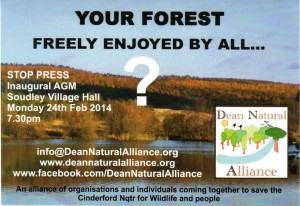
DNA Flyer002

See also the attached article –

DNA Article The Forester 19 2 2014


The Gloucestershire Naturalist No. 24

The latest edition of The Gloucestershire Naturalist (No.24) has been published and will be posted out shortly. John Sanders is a new contributor to this magazine and, having studied Gloucestershire’s gulls for some years, has now been studying Curlews on the River Severn. He writes about their movements through colour-ring observations. John Harper describes the discovery of a spider species new to Gloucestershire. The county’s flora and fauna also receive attention from the many recorders, contact details for whom are given at the back of the magazine.

20140225 TGN24 cover

CONTENTS

Editorial
Notes on Contributors
Gloucestershire Botany Report 2012, Mark & Clare Kitchen
Amphibian and Reptile Report 2012, Colin Twissell
Grasshoppers Crickets & allies in Gloucestershire 2012, John Widgery
Spiders in Gloucestershire 2012, David Haigh
Odonata Report for 2012, Ingrid Twissell
Colour-ringed Curlews on the Lower Severn, John Sanders
Colour Plates
Zygiella stroemi – a spider new to Gloucestershire, John Harper
Hoverfly Report 2012, David Iliff
Ladybird Report 2012, David Iliff
Terrestrial Heteroptera (Land Bugs) Report 2012, John Widgery
Gloucestershire Lichen Report 2012, Juliet Bailey
Wildlife Recording In Gloucestershire
County Recorders
Notes for Contributors

Flooding Around Gloucester

Needless to say the flooding around Gloucester and throughout the Severn Valley is having its effects on people and the infrastructure as it usually does. Similarly, there are effects on wildlife with Swans and Ducks particularly showing up in places where there is normally no water for them to utilise.

One of the more tragic effects is that of terrestrial animals being forced out of their normal haunts in search of dry ground and food; on the morning of Saturday 15th February on the Gloucester Northern by-pass, Mike Smart and Andrew Bluett discovered the body of an Otter (Lutra lutra) that had fallen victim to a collision with a vehicle whilst crossing from one flooded area to another.

Skip to content