Waders and Common Gulls

Contributed by John Sanders.

Black-tailed Godwit

There has been much talk in the national news about the early return of some of our autumn migrants and winter visitors, Black-tailed Godwits in particular. The theory goes that the summer weather has been so wet and cold that nesting attempts have failed, and birds have abandoned their breeding grounds to start their autumn migrations earlier than usual. This may be so, but the unseasonal weather in Britain has been blamed on the jet stream passing directly over the country. It is difficult to understand how this relatively narrow band of fast moving air can have affected the weather over the whole of Northern Europe. It is to be hoped that counts of juvenile birds will be made in the autumn, in order to discover just how unsuccessful the breeding season has been.

Common Gull PU93

I have been monitoring the Common Gull roost on the estuary at Purton, just south of the New Grounds at Slimbridge, for several years now. It is one of the few places in the County where I can check the birds for colour rings. When they are feeding and loafing on pasture the grass obscures the rings, and when they are following the plough they move so quickly that I cannot keep up with them. Even on the estuary it can be difficult, the birds are often too far away to read the codes on the rings. It requires a calm and sunny evening to have any chance of success.

I made my first visit to the estuary on 11 July, and saw just the odd one or two first-summer Common Gulls. They were obviously non-breeding birds, and had probably spent the whole summer on the river. However, on 19th there were already 450 in the roost. This is not a particularly early date, the birds normally start arriving after the middle of the month. Most were adults, with a few first-summers. It is usual for the juveniles to appear several weeks later. They were resting on a sand bar, a long way out, and as I panned my telescope through the flock I could see two white colour rings, but could not read them. By a stroke of good fortune, the incoming tide pushed the birds much closer to the river bank, and I quickly read the first ring, JP43. Any four digit code starting with the letter ‘J’ has to be from Norway, and sure enough this bird had been ringed as a nestling near Trondheim in 2004. It has been a regular in the Purton roost, gulls are great creatures of habit. The second ring was not so easy, it was old and worn, but at my third attempt I obtained a clear view, PU93. My heart missed a beat, could this really be. I checked again and, sure enough, there was no doubt. I first saw this bird in 1997, and it was old then, but my last sighting had been in 2009, so I had presumed that it had died. It was metal ringed at the Matsalu Nature Reserve in Estonia as a nestling in 1981, and then trapped as a female on the nest at the same place in 1987, when colour rings were added. It has returned to the reserve to nest each year since, and the colour rings have been changed twice more, as the original ones have become worn. This summer it laid three eggs, but the nest site became flooded in a storm on 12 May. Although the nest was rebuilt at a higher level, and eggs transferred, they were already chilled, and did not hatch. I received an interesting e-mail from the ringer, Kalev Rattiste, and he told me that there were further storms on 2 and 17 June. He said that PU93, at 31 years, is the oldest bird in the colony, and explained how she had failed in her breeding attempt, which would explain her prompt return to the Severn roost. So perhaps there is some truth in the theory that bad weather has caused the early return of many migrants. But then Kalev went on to say that he had ringed ‘only’ 1,356 nestlings this year, compared with 1,490 in 2011, so maybe it was not such an unsuccessful breeding season after all. We shall have to wait and see, but, what is certain, is that PU93 is the oldest colour ringed gull I have ever seen in nineteen years of recording.

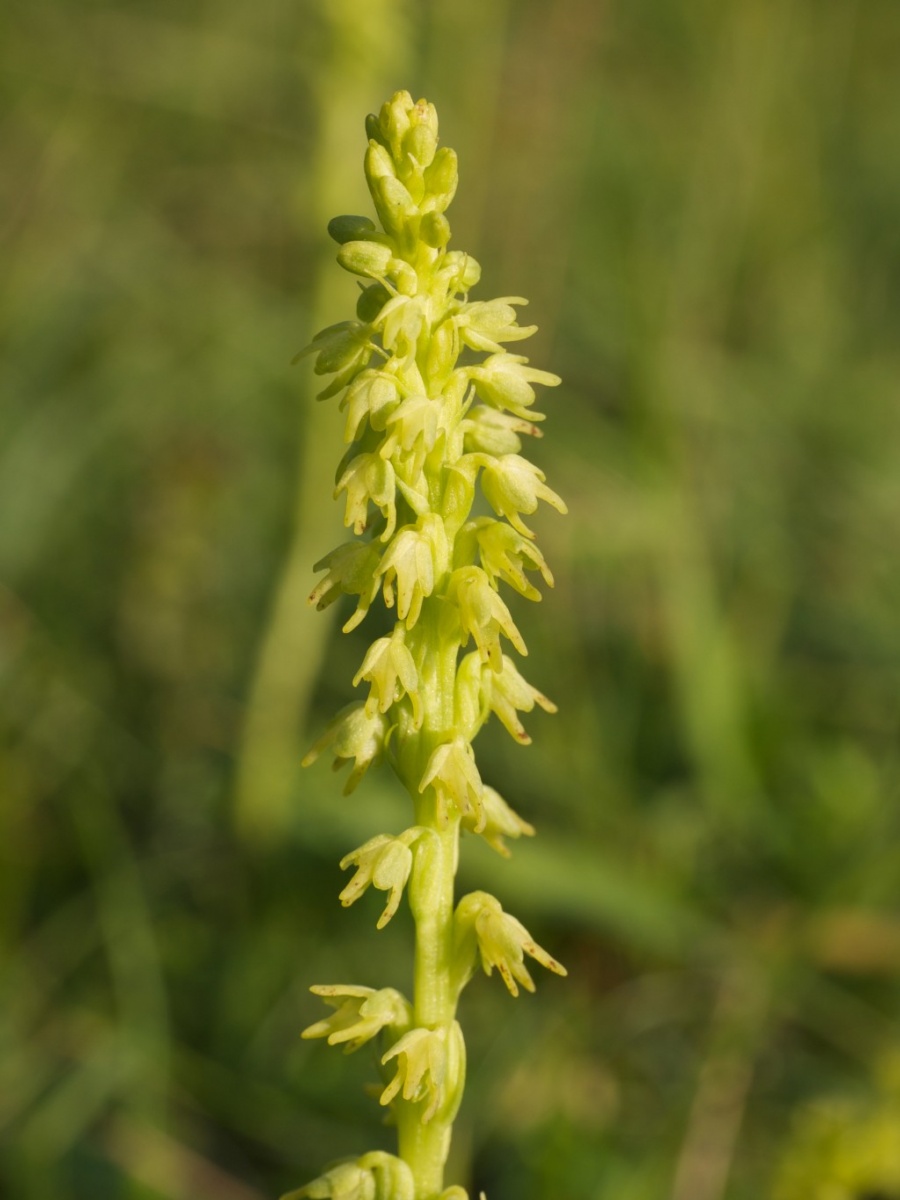
Musk Orchids flowering at three sites.

I was pleased to discover healthy populations of Musk Orchids flowering at three separate sites in recent weeks. July 5th at Barrow Wake where there were dozens of plants on short grass to both sides of the car park. July 8th, while looking for Frog Orchids at Swift’s Hill there was a reasonable Musk Orchid site with maybe 20 plants on the steep slope where we found just a solitary Frog Orchid that had finished flowering. In addition while walking on Leckhampton Hill there were also reasonable numbers of flowering Musk Orchids on the lower grassy slopes near higher parts of Daisy Bank lane.

Musk Orchid at Barrow Wake
Musk Orchid, Flowers, Barrow Wake
Musk Orchid, macro, Barrow Wake
Musk Orchids, Swift's Hill
Musk Orchids, Swift’s Hill
Musk Orchid Flowers, Swift's Hill
Musk Orchid Flowers, Swift’s Hill

Dark Green Fritillaries on Rodborough Common

Dark Green Fritillaries were on the wing on the south side of windy Rodborough Common yesterday. I photographed two and there seemed to be a third flying about. One obliging individual kept returning to feed on some thistles in a sheltered mini-quarry which he clearly reckoned was his territory since he kept chasing the Marbled Whites away.

20120718 IMG 5099 Dark Green Fritillary

20120718 IMG_5098 Dark Green Fritillary

Orchids at Caudle Green

Contributed by Richard Beal.

When we first moved here in 2000 there were only one or two orchids in our meadow. We have followed a strict mowing regime designed to restore the natural state. It is cut twice a year and all the cuttings are removed, to lower the nutrient levels. As a result the number of orchids has steadily increased. We get Common Spotted, Pyramidal and Common Twayblade, and once a Bee orchid.

This year there have been more than ever, with hundreds of Pyramidals including two white ones. This photo shows an area with lots of Pyramidals:

20120717 225 QFH Pyramidal orchids

Here are two Pyramidals, one white, one normal.

White Pyramidal Orchid

Coombe Hill Meadows 16/07/12

At the west end of Coombe Hill Meadows this evening two female Shelducks with nine ducklings, five Tufted Ducks, five Little Egrets, 27 Grey Herons, a Great Crested Grebe, a Sparrowhawk, an Oystercatcher, three Common Sandpipers, 50 Swifts, a Kingfisher, 20 Sand Martins and a Redstart. Dragonflies included an Emperor, a Brown Hawker, a Banded Demoiselle and numerous Common Darters.

Sparrowhawk in gardens at Woodmancote

A sparrowhawk was seen in the gardens at Woodmancote Cheltenham on Saturday afternoon. Blackbirds were squawking loudly and when it flew off it was carrying a blackbird. The neighbourhood was quiet for some time after.

Colour ringed Curlews, an update.

Contributed by John Sanders.

In the Septembers of 2010 and 2011 a total of 96 Curlews were trapped at the high tide roost at Wibdon Warth, Tidenham, and were fitted with unique combinations of colour rings.  Birdwatchers were asked to look out for these birds, so that their site faithfulness and longevity could be determined.  Sadly, enthusiasm seems to have waned, and I now find myself as the only person who has made recent records.

Curlews started to leave the estuary in early February, and all colour ringed birds had gone by the middle of April, so that only about thirty unringed individuals remained during May.  These clearly did not breed, and were assumed to be first-summer birds, as it is generally agreed that Curlews do not start nesting until their second-summers (third calendar years).  The return to ‘winter’ quarters started in the middle of June, and numbers rose rapidly at the end of the month and in the first week of July, so that soon over five hundred were coming into the roosts.  These included several juveniles, but most were adults in very obvious wing moult.  This suggests that the nesting birds start their moult before their young have fledged, and then quickly leave their breeding sites to return to the estuary.

It has been difficult trying to cover the three main roosts at Aylburton Warth, Guscar Rocks and Wibdon Warth in the prevailing wet and windy weather, but even so the results to date (12 July) have been very encouraging.  I have seen a total of 61 colour ringed birds since mid-June.  These have included individuals from presumed breeding sites in Oxfordshire and North Yorkshire, but, what is more surprising, is that two breeding birds from The Netherlands, two from Finland, and one from Germany have already returned to the estuary.  This means that the only known foreign bird not to have been seen so far is one more from The Netherlands.  It took me a long time to find the bird that frequented Coombe Hill and Ashleworth Ham during the late spring, but I eventually tracked it down to the roost at Wibdon Warth, just a few yards from where it had been ringed.

It is early days yet, but the results so far clearly show how site faithful the Curlews are, and how dependent they are on a relatively small feeding area. Even the foreign breeding birds are absent from the estuary for only a short time in the spring and early summer.  Any change to this environment, such as the construction of a barrage, is going to affect them adversely.  We must not take them for granted.

Three Water-dropworts, 5 July

Oenanthe silaifolia at Twyning
Oenanthe pimpinelloides at Brookthorpe
Oenanthe fistulosa at Twyning

I photographed and compared the three species of Water-dropwort that can still occasionally be found in meadows in the Severn Vale.

Narrow-leaved Water-dropwort (Oenanthe silaifolia) flowers in late May or early June in wet grasslands, and now the domed heads of the fruiting partial umbels clearly differentiate it from Corky-fruited Water-dropwort (Oenanthe pimpinelloides) which sometimes grow in drier parts of the same meadows. In the latter species the ripening fruit are held much more upright, so the partial umbels are almost flat-topped. Furthermore, it flowers in late June or early July. A third species, Tubular Water-dropwort (Oenanthe fistulosa) is just now coming into full flower. This also likes very damp conditions. It is a smaller, stockier species than the other two, often with only three rays to the umbel, which bears its fruit in globe-shaped bunches when they are ripe.

Ashleworth verge flora, 30 June 2012

Common Spotted Orchid

Common Spotted Orchids (Dactylorhiza fuchsii) putting on a beautiful show on a road verge in Ashleworth. This is within feet of the part of the verge that was unwittingly damaged in spring when it was used as a compound for water supply works to the village.

Skip to content