Letter to the Times?

Despite the fine weather in March, summer migrant birds seem to have been late in arriving in the Severn Vale: plenty of singing Chiffchaffs and Blackcaps since mid-March, but these were likely to have been birds that had wintered, using the resources provided by bird tables in hard weather, and bursting into song as soon as the weather improved.  But unusually no Swallows, very few Sand Martins (and these were all seen by others!), not a Willow Warbler anywhere.

So it was something of a surprise to hear, on the morning of Saturday 7 April, near The Leigh, the unmistakeable sound of a calling Cuckoo.  John Wiltshire and I looked at one another and couldn’t believe our ears, given that even the most optimistic ornithologists reckon that 14 April is an average first date for singing Cuckoos in the Vale.  Even more astonishing, I had hardly got over the surprise, when Mark Grieve rang me on my mobile phone to say that he was just back from a visit to Ashleworth, where he had heard…. a callling Cuckoo.  Mr Editor, may I venture to suggest that Cuckoos are remarkably early this year?

Easter Eggs in Standish

A Woodpigeon has been very obviously building in a nest in a dense 10ft cypress tree visible from the front window. Today, at lunchtime, a Magpie shot in half way up the tree at about the level of the pigeon nest, at which point a female Blackbird exited from the top. The Magpie flew off with something from near the top of the tree, was back within a minute and emerged with a Blackbird egg which it cached in a dip in the lawn at the foot of the tree concealing it with a dead beech leaf, then flew back into the tree and flew off with a pigeon egg, all within a couple of minutes. I had not known about the Blackbird nest. Did the Magpie know it was there, or was it just its good luck that its attack on the well-advertised pigeon nest flushed another species? We hunted for the cached egg and and unfortunately managed to stand on it.  However, we re-covered it, and at dusk I checked the cache site and only broken shell remained.

More on Curlews in Gloucestershire

The BTO project to colour-ring Curlews on the Severn Estuary below Lydney (66 ringed in September 2010, another 29 ringed in September 2011) has generated considerable interest (see previous posting about a colour-ringed bird seen at Coombe Hill).

Over the last week or so, there have been several new developments: John Sanders has continued his observations of high tide roosts on the estuary.  It’s very difficult to approach the birds close enough to read their colour-rings; they are very nervous and fly off if they notice the slightest movement; so John has developed a movable hide, which he places just below the lip of the warth (see picture below), and sits and waits for a long time until the birds are pushed into range by the tide.  On 28 March there were still as many as 500 Curlews between Aylburton and Wibdon Warth; clearly they have not all yet left for continental breeding grounds.

In addition to the many readings made at Aylburton Warth by John, Martin McGill has found one of the colour-ringed birds at high tide at Slimbridge.

One of the colour-ringed birds (Blue Red Red) was seen, as previously reported, at Coombe Hill from 20 to 26 March; it has appeared by day and also in the evening, when surprisingly large numbers of Curlews congregate round the scrape to roost, 36 on 26 March, 35 on 31 March; they come in at the very last minute when it is nearly dark, so the ring may have been overlooked at times.  Where do all these Coombe Hill Curlews come from, and what are they doing?  Are they migrants on their way to those continental breeding places?  Or are they local breeders?  Ian Ralphs saw Blue Red Red on 1 April at Ashleworth Ham, with a second bird, behaving like a pair preparing to breed.

Any new observations of colour-ringed Curlews, from anywhere in the county, would be very welcome.


A new birding spot near Gloucester?

Horsbere Brook Flood Storage Area is a recently created site, aimed at relieving flooding in Longlevens by th3 Horsebere Brook: worth a quick look (while your wife is in Sainsburys?); by the Gloucester Northern bypass, nearly opposite Premier Inn, convenient lay-by.  Depression full of shallow water, might well attract a passing migrant wader or two; couple of Pied Wagtails on the water’s edge tonight, some Lesser Blackbacks coming in to wash.

Ashleworth Ham today

Ashleworth Ham this morning, bright and sunny with a fair grass frost.  Water levels much lower than usual at this time of year, partly because of the drought, partly because the boards have been removed from the sluice slightly early, in the hope of attracting breeding waders.  Still 30 Wigeon grazing round the edges of the scrape, 5 Teal, pair of aggressive adult Mute Swans, chasing off two unfortunate immatures.  Four Lapwings doing aerial display, two bubbling Curlews Ashleworth Ham side, 1 Green Sandpiper.  One Chiffchaff and one Blackcap singing in Meerend Thicket, but no other summer visitors, still no Willow Warblers or hirundines.  Two Roe Deer grazing along the main ditch (they’ve been seen here quite frequently in the last couple of years).

Bluebells already

Bluebells in Standish hedge

Bluebells (Hyacinthoides non-scripta) are in bloom before the end of March. Seen yesterday in a hedgerow in Standish, and today in a wood at Highnam. I always used to think of them as a May flower!

Blackthorn Winter

Blackthorn blooms on leafless black twigs.

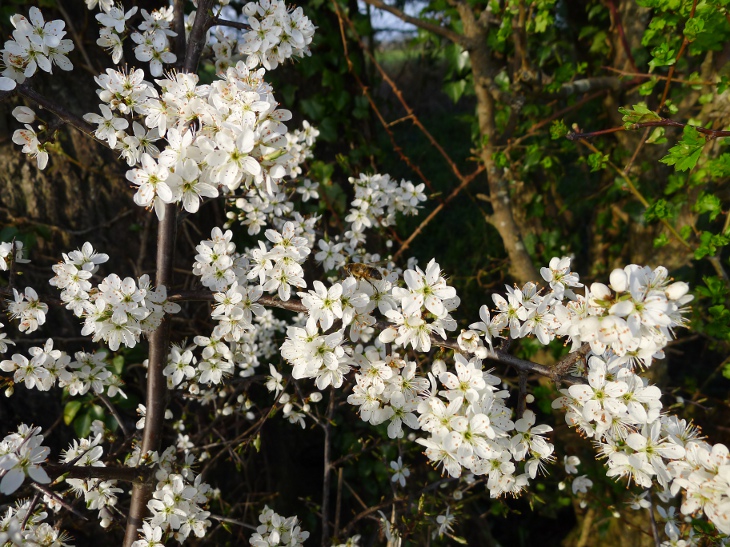
The Blackthorn (Prunus spinosa) is in full bloom. It is coating the Gloucestershire hedgerows like snow. The idea of Blackthorn Winter also incorporates the notion that, despite warm presages of summer to come, winter is not yet over and we can still expect frosts.

More on the colour-ringed Curlews from the Severn estuary

As reported in a previous issue of GNS NEWS, a number of Curlews were caught amd marked with a series of colour rings on the Severn Estuary below Lydney in September 2010 and September 2011.  One of these birds made a spectacular appearance at Coombe Hill on 20 March 2012 (and was present again today, 21 March).

The bird was colour-ringed with a blue ring on the left tibia (i.e. above the “knee”)  and two red rings on the right tibia.  See below the picture of this bird, taken at a high tide roost at Ayblurton Warth by John Sanders.  Resightings since ringing on 26 September 2010 are as follows:

22.03.11  Coombe Hill
23.03.11  Coombe Hill
28.03.11  Ashleworth Ham
01.04.11  Ashleworth Ham
12.08.11  Guscar Rocks
15.08.11  Guscar Rocks
17.08.11  Guscar Rocks
27.08.11  Guscar Rocks
29.08.11  Guscar Rocks
31.08.11  Guscar Rocks
30.09.11  Guscar Rocks
04.12.11  Oldbury Power Station
20.03.12  Coombe Hill

Thus the bird was ringed on 26 September 2010, seen four times in late March /early April 2011 at Coombe Hill / Ashleworth Ham, two wetlands close together, both Gloucestershire Wildlife Trust reserves in the Severn floodplain between Gloucester and Tewkesbury, where there are actually breeding Curlews in the hay meadows.  We wondered last year if the bird was a local breeder, as it seemed to be staying in the area for some time, but it wasn’t seen again after 1 April, so we supposed that it had stayed off-passage for a few days, feeding up at Coombe Hill, and had then moved on, to breeding grounds in northern Europe (some of the ringed birds go as far north as Finland).  It reappeared with all the others on the Severn estuary in August 2011 at the usual haunt where up to 1,000 Curlews regularly gather in late summer, autumn and winter, and was seen there by John Sanders and myself; it also popped across the river into South Gloucestershire, where it was seen by Pete Hazelwood at Oldbury.

Another of the ringed birds, seen by John Sanders at Aylburton on 16 February of this year, was resighted in the Netherlands on 24 February, and is still there now, behaving like a breeding bird.  Now, much later in the migration season, Blue Red Red has reappeared on 20 March, almost a year to the day from last year’s first observation, at Coombe Hill.  Les Brown and I were fantastically lucky to see it and read its ring, as the chances of seeing it are pretty slim.  It was one of a group of ten birds that arrived in mid-morning; they wanted nothing whatsoever to do with the local breeders, already on site, and fed as a group on the surrounding fields.  I assume from this behaviour that it was a migrant, stopping off on its way north, and presumably intending to go further north (where the snow will clear later) than all the birds that have already passed through; it will probably hang on for a few days, then move on.    So maybe those that don’t go so far north to breed are departing earlier?

Rachel Taylor of the British Trust for Ornithology will be the main speaker at the GNS Annual General Meeting on Friday 23 March; she will be speaking about the fascinating things that can be learnt by colour ringing waders.

P.S. Les Brown reports that the same colour-ringed bird was at Coombe Hill again on 22 March, making it three days in a row.  how much longer will it stay?


Red Admiral

Saw my first Red Admiral of the season here at St Briavels this morning.

Birds in the Severn Hams on 17 March

Water levels continuing to drop slowly in the meadows; not a lot of indication of summer visitors yet, apart from singing Chiffchaff and Blackcap – no sign of Sand Martins yet at the colonies in the banks of the Severn; but more song from resident birds.

Coombe Hill GWT reserve: Still 171 grazing  Wigeon, 9 Shelducks (several paired), 40 Teal, 21 Shoveler, 15 Gadwall, 2 Tufted Ducks, 2 Oystercatchers (apparently a pair), 16 Lapwings (lots of display, apparently preparing to breed), 4 Curlews, 1 Redshank, 2 Great Spotted Woodpeckers drumming, 3 Skylarks singing, 1 Treecreeper singing, at least eight Reed Buntings singing, 1 Yellowhammer singing.

Haw Bridge: one Blackcap singing.

Ashleworth Ham GWT reserve: 98 Wigeon, 38 Teal, 2 Gadwall, 3 Shoveler, 1 Peregrine, 1 Snipe, 1 Chiffchaff singing.

Lower Lode Brickpits; as many as 35 Cormorants, both adults and immatures, loafing on trees round the water, with a chorus of grunts and squawks – this seems to have become
the favourite resting area for Cormorants along our stretch of the Severn.  One Grey Heron, 1 Great Crested Grebe, 11 Coot, 10 Teal, three Tufted Ducks.  And one Nuthatch calling in parkland round nearby Forthampton Court – a species rarely found near the Severn banks – only on slightly higher ground with mature trees.

Skip to content