Adult robberflies (Order: Diptera, Family: Asilidae) are effective daytime hunters, relying on sight to target moving insect prey which they then seem able to immobilise by injecting posion through their mouthparts. Martin Matthews has prepared a basic introduction to the adults of the 16 species of robberflies (12 of them illustrated) that have been recorded in Gloucestershire at least once since 1950. The guide can be downloaded from the invertebrates section of our publications pages.
Thanks to Mike Boyes for his account of this unusual behaviour witnessed in his garden in Little Rissington…
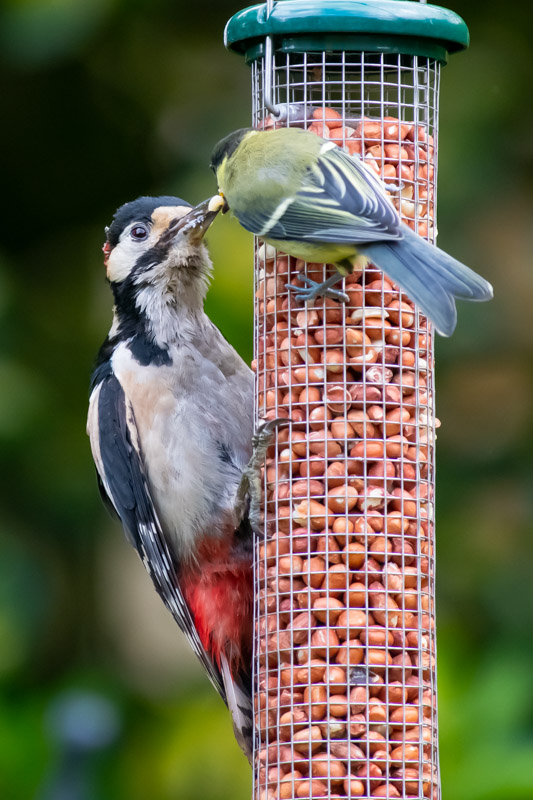
I noticed a male Great Spotted Woodpecker on our peanut bird feeder, so I grabbed my camera + telephoto lens to photograph it because I had only seen a female visiting for the past couple of weeks, and I wanted a picture of the male. What happened next surprised me
The GSW, after pecking repeatedly at the nuts for a minute or two at the base of the feeder, climbed to the top where a recently fledged Great Tit was waiting. The GSW then proceeded to try and feed pieces of peanut to the young Great Tit, while an adult Great Tit watched from another feeder close by. This process continued for perhaps a little less than a minute before being interrupted by the arrival of our postman, at which point both birds flew away.
Later during the day the adult male GSW returned to the feeder many times, as did an adult female GSW (possibly from a different pair as both birds always approach and fly away from the feeder in opposite directions). The unusual behaviour pattern I witnessed earlier in the day was not repeated.
Background info: we have a garden of just under half an acre, with plenty of small to medium trees for cover, and we have four hanging feeders – fat balls, peanuts, niger seeds and sunflower hearts, plus a tray feeder enclosed in a cage to keep out pigeons. We regularly see goldfinches, greenfinches, GSWs, robins, house sparrows, great tits, blue tits, starlings, blackbirds, chaffinches, a couple of nuthatches, dunnock, collared doves, pigeons, jackdaws, and less often a wren, coal tit, long-tailed tits, and thrushes. In winter, regularly visitors include redwings and fieldfares that feed on our cotoneaster berries, and the occasional bullfinch and blackcap. I have pictures of many of these garden birds too.
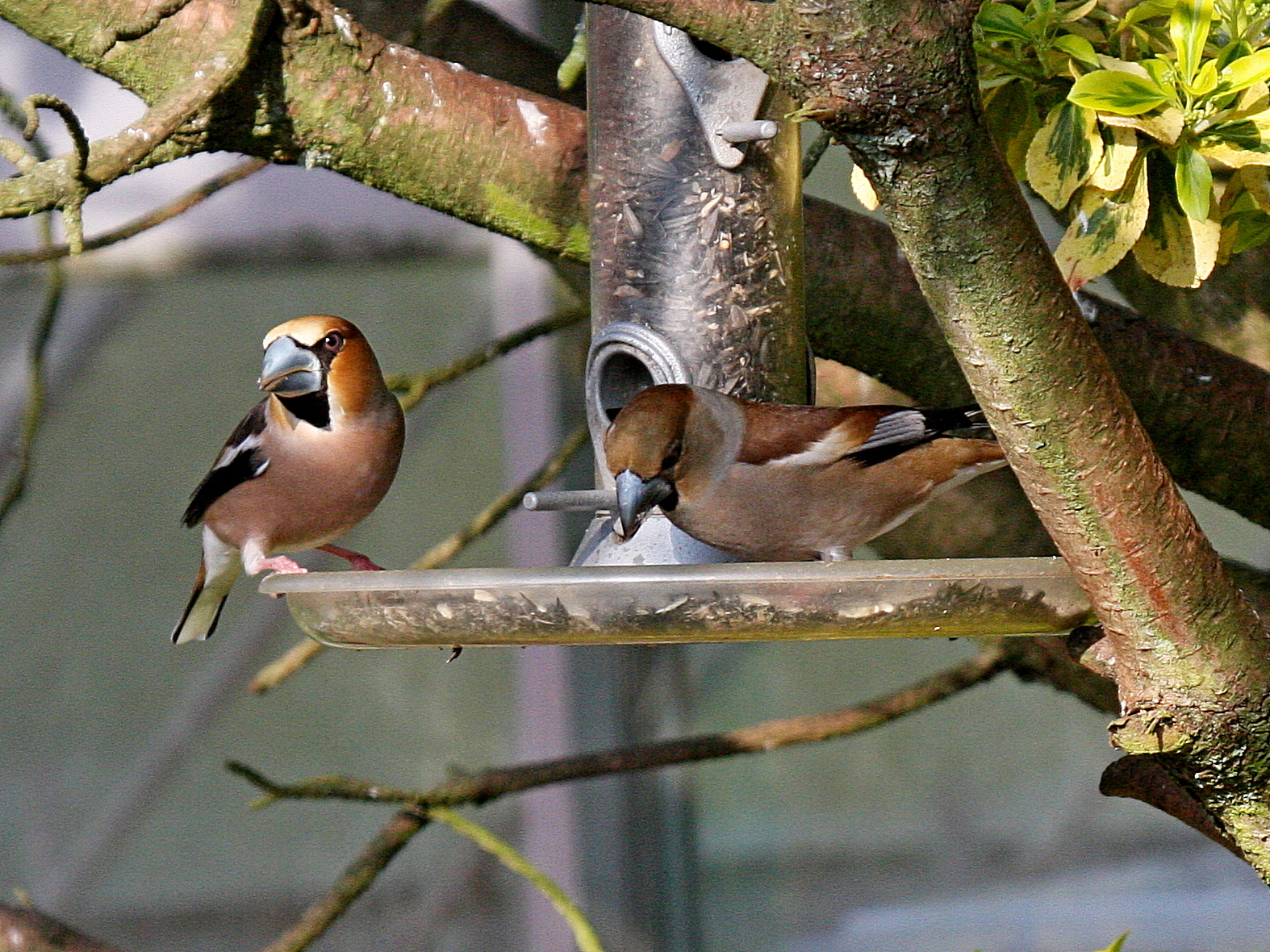
Many thanks to David Priddis for this submission about the activity he’s been observing in his garden in Woolaston. From Hawfinches to Hedgehogs, butterflies and bees, David describes his garden as a haven of sanity during COVID-19 isolation! Read David’s submission by downloading the pdf below…
Mervyn Greening has submitted this illustrated account of the goings on in his small Newent garden during the month of April 2020. Featuring observations on the weather, the activity that centres around his damson tree, the 15 species of bee he’s been able to identify, the butterflies, moths, birds, mammals and plants it’s an eye-opening account of the diversity that can be found in the small patches of ground that are our gardens. Download the full document below.
An interesting observation from the garden of Kate Kibble.
“Having spent some time observing the various solitary bees in my garden I realised that they were often accompanied by one or more unremarkable-looking flies. These closely followed the bees down to their nests and then were either seen to ‘stand watch’ by the entrance or to follow the bees down. I asked GNS recorder Tony Taylor to help with identification of some of the species I’d found and he informed me that the flies are sometimes known as satellite flies because of this behaviour. He considered they are most likely the species Leucophora obtusa and are kleptoparasitic on the mining bees, trying to lay their own egg on the food stored by the bee. Within my records for the afternoon were two other parasites of solitary bees – nothing in nature is ever as idyllic as it seems. The photo shows one of the flies waiting patiently outside an ashy mining bee burrow.”
Due to the country’s response to the Coronavirus pandemic, and our efforts to minimise the spread, GNS obviously cancelled all our scheduled events that were due to take place during the ‘lockdown’. We will continue to schedule events in accordance with government advice, and have therefore cancelled events up to and including 10th May. The government plans to announce the way forward as far as restrictions are concerned this coming Sunday, and we will of course comply with any rules or guidelines set out in that announcement. Therefore it’s quite likely that further cancellations will have to occur. If and when lockdown restrictions are relaxed, some leaders of field meetings may feel that they would still prefer that their respective meetings do not go ahead, so even at this point we will review each meeting individually. Please keep an eye on this website for up to date information.
UPDATE 14th May – In light of the recently revised guidelines from the government which still forbid meeting with more than one person from another household at a time, we have cancelled all meetings that were scheduled to take place during May.
UPDATE 29th May – We have cancelled all meetings that were scheduled to take place during June.
The first submission to the Garden Challenge comes from Geoff Stansfield, who has sent us a list of the flora and fauna he has found in his garden at Mill Place. The list covers mammals, reptiles, fish, birds, a range of invertebrates, trees, fungi, lichens and more.
All members are invited to take up the challenge of sharing their garden observations of wildlife.
What can be included? Just about any original observations made in your garden or from the windows of your residence.
What form might these observations take? • An account or accounts of a memorable wildlife sighting or sightings. • A report of a study made of wildlife in your garden. • A diary of what you have observed. • Annotated list of organisms encountered in your garden. • Original artwork illustrating an observation or study. • Anything you think worth sharing about wildlife from your garden
Some guidelines: • A maximum of one account per month to be submitted. Diary entries and lists should be submitted monthly • Pictures can be included. E.g. photographs or original artwork. • All submissions should have a clear title and name of author. • Your first submission should include a brief introduction about your garden.
How to take up the challenge: Each submission should be sent to our website manager for posting on our website. Some pieces may be used in the “News”. If you do not use the internet, you may still enter, and we will try to include some of your material in the “News”. Post your submission to M. Greening who will get it digitised for the website. Best to send a copy of your work if you can, but if you send original work and want it returned, please include an SAE.
Award: This is not a competition; it is an opportunity for us to share our thoughts about the wildlife we encounter in our gardens. We want to recognise the efforts made by entrants by awarding an annual prize to the entrant we feel has made the most inspirational contribution each year. The award is a vase, bequeathed to the society by the late Mornee Button, and will be given out each year at the AGM. The decision about the recipient of the award will be made by a committee nominated by the executive committee.
Contact details: For entries via e-mail please send to our website manager : mail@benlocke.co.uk For paper entries please send to: Mervyn Greening, 23, Lakeside, Newent, Glos. GL18 1SZ.
Back in December, Juliet Bailey led a general interest GNS field meeting on Edge Common and Haresfield Hill. Species lists for that meeting are in the process of being prepared, but here are the first two:
Just a quick note to say that more back issues of ‘The Gloucestershire Naturalist’ have been added to the publications section of the website and can be found here. Issues 1 through to 32 are all available to download as PDF documents. If you’re in need of further reading material whilst stuck at home, back issues of ‘GNS News’ are also available here.
This website uses cookies to improve your experience. We'll assume you're ok with this, but you can opt-out if you wish. Cookie settingsACCEPT
Privacy & Cookies Policy
Privacy Overview
This website uses cookies to improve your experience while you navigate through the website. Out of these cookies, the cookies that are categorized as necessary are stored on your browser as they are essential for the working of basic functionalities of the website. We also use third-party cookies that help us analyze and understand how you use this website. These cookies will be stored in your browser only with your consent. You also have the option to opt-out of these cookies. But opting out of some of these cookies may have an effect on your browsing experience.
Necessary cookies are absolutely essential for the website to function properly. This category only includes cookies that ensures basic functionalities and security features of the website. These cookies do not store any personal information.
Any cookies that may not be particularly necessary for the website to function and is used specifically to collect user personal data via analytics, ads, other embedded contents are termed as non-necessary cookies. It is mandatory to procure user consent prior to running these cookies on your website.