Sightings – June 2009

Saul and Arlingham (29 June contributed by Andy Jayne)

At Saul Warth today there were five Little Egrets, a Hobby, a Water Rail calling, a male Ruff, just one Black-tailed Godwit, ten Redshank and two Green Sandpipers. At Arlingham a Buzzard was seen carrying a Moorhen chick.

CWP West (6 June, contributed by Andy Jayne)

Around pits 79/84/85 today there were three drake Teal, two drake Shoveler, three drake Pochard, a pair of Red-crested Pochard, a Sparrowhawk, two Kestrels, a Hobby, a Little Ringed Plover, a Ringed Plover, a pair of Redshank, a pair of Common Terns and a Cetti’s Warbler.

Forest of Dean (4 June, contributed by Andy Jayne)

Four singing male Firecrests located in the Speech House Walk & Yewtreebrake area during the afternoon.

Woorgreens (1 June, contributed by Andy Jayne)

At Woorgreens this evening there were two sow Wild Boar with seven small young, crossing the main gravel track between there and Crabtree Hill. Only my 2nd ever sighting of these beasts.

Sightings – May 2009

Painted Lady influx (late May, contributed by Robert Homan and Gordon Avery)

The mass migration of Painted Ladies into the UK which started in the week ending 25th May has been evident in the county. There were 2 seen in a few minutes flying northwards across Pittville Park golf course on the 24th. There was one near Winstone on 25th and many in the Frocester Hill area on 26th. Today (28th) there were also 11 Silver Y moths, another immigrant species, near Dumbleton and Gordon noted 10 Painted Ladies by the River Severn at Sudmeadow. Butterfly Conservation is organising a big Painted Lady survey at the end of this week. See
http://www.butterfly-conservation.org/sightings_home/1095/migrant_watch.html.

Coombe Hill (26 May, contributed by Mike Smart and Les Brown)

A cold windy day, not very good for birdsong. The Spoonbill, first seen on 16 May, has been seen several times since, and was present again today, spending a lot of time in the Long Pool, where it has perhaps been overlooked; it’s a first summer bird, with lots of yellow on the bill and black on the wingtips; it won’t be breeding yet so it’s probably hanging around, growing up; maybe it wintered in SW England.

Also: 1 Little Egret; pair of Canada Geese with four smallish goslings; two pairs of Shelducks (one pair constantly on the scrapes, so the female isn’t sitting, and the male only has a very small knob on the bill); one male Gadwall; one Redstart singing; one Reed Warbler, two or three Sedge Warblers, one or two Lesser Whitethroats, at least six Whitethroats, all singing.

At the Wainlodes end, the Canada Geese have hatched four goslings and taken them onto the Severn. No sign of singing Cetti’s Warbler.

None of the nesting swans have hatched yet.

There is a nice stand of Ragged Robin at the back of the reserve in SO8727. Water Dropwort is all over the place, though I am not sure as to which species, in fields where there is no grazing.

Flaxley (24 May, contributed by Andy Jayne)

At Flaxley this afternoon a Goshawk, a Hobby, a Cuckoo, three Garden Warblers, two Siskins and two Hawfinches. At Flaxley Pool a female Mandarin with seven ducklings and a Turtle Dove nearby at Elton Lane.

Westbury (23 May, contributed by Andy Jayne)

At Westbury this morning a ‘reeling’ Grasshopper Warbler and a pair of Yellow Wagtails near the Strand.

Tuffley (14 May, contributed by Rob Purveur)

A Red Kite flying over in a NW direction at about 3.35pm.

Cheltenham (14 May, contributed by Robert Homan)

8 of the spectacularly marked froghopper Cercopis vulnerata along a 100m stretch of the Honeybourne Cyclepath this morning.

Sudmeadow (11 May, contributed by Gordon Avery)

A Garden Warbler was trapped and ringed today, the first here this season.

A Little Egret on the Lower Parting loosely accompanied by a very noisy Canada Goose and 7 Whimbrel flew north over Sudmeadow. The first record since one was seen flying over on the 13th June 1995.

Severn Hams (9 May, contributed by Mike Smart and Les Brown )

Coombe Hill on a cool rather windy day was not very good for birdsong, but we met two Roe Deer coming along the towpath at 6.45am: about 35 non-breeding Mute Swans on the scrapes; 13 Greylags; the pair of Canada Geese by the hide now has four tiny goslings left; another Canada Goose was at Cobney Meadows and still on eggs; at least 4 Shelducks; one Ringed Plover; 1 Whimbrel; 2 non-breeding Lapwings; a Lesser Spotted Woodpecker drumming along the south bank of the canal not far from the Wharf (it has been there for a week); rather few singing Redstarts in the wind, only two were heard.

At Wainlodes, the Cetti’s Warbler is still singing but has moved across to the west bank of the river.

Sudmeadow (5 May, contributed by Gordon Avery)

An unseasonal Grey Wagtail was on Sudmeadow and a Common Sandpiper was at the Lower Parting. Little else of note, mainly because of the strong winds.

Cheltenham (5 May, contributed by Robert Homan)

A Peregrine falcon was low over St Paul’s in the morning and later there was a single Swift over Swindon Lane battling against the wind.

Minsterworth Ham (5 May, contributed by Andy Jayne)

Recorded today were two Shelduck, a ‘bubbling’ Curlew, a Whinchat and two Lesser Whitethroats. Also three Brimstone butterflies.

Cheltenham (4 May, contributed by Robert Homan)

2 Swifts over St Paul’s this morning were the first of the spring.

Clarkes Pool Meadow near Blakeney (3 May, contributed by Peter Fitchett)

A good selection of colour forms of Green Winged Orchids seen this afternoon in the meadow as shown in the Peter’s pictures below.

Tewkesbury area (3 May, contributed by Mike Smart)

Along the Avon: at Upham Meadows, numbers of Curlew (apparently only six) and Redshank (only a single) were lower than usual – the result of the summer floods which caused the death of many worms which are the normal foodstuff of these species. About eight Sedge Warblers singing, mainly along the river also a few along the ditches. A Mute Swan and a Canada Goose, both on eggs; two broods of Mallard ducklings. No Corn Buntings.

Along the Severn: at Mythe Brook another female Mute Swan incubating while her mate chased off the neighbouring pair of Canada Geese; a male Tufted Duck on the Brickpits. A Curlew and (at last!) 2 Lapwings on the wet green field below Shuthonger Common. Remarkably few singing warblers. One Yellow Wagtail in the last field before the county boundary, probably overshot from the new Ripple Gravel Pits south of the M50 in Worcestershire, where there were at least ten apparently breeding in cereal fields round the pits; also a Nightingale singing plus 6 Lapwings, 2 Redshank, 2 Little Ringed Plovers and 4 Curlews.

Sudmeadow (1 May, contributed by Gordon Avery)

A pair of Tufted Duck have at long last arrived on the tip pools, hopefully to breed. The first sighting of the species this year.

GNS Field Meeting, Splatt Bridge (17 May, contributed by Ingrid Twissell)

The main focus of this walk was to see a Hairy Dragonfly and hear and/or see a cuckoo. Five GNS members, including a junior, met at 11am after a torrential rainstorm and a short sunny spell. It was cloudy when we set off over Splatt Bridge, Frampton, and travelled southwards along the towpath of the Sharpness – Gloucester Canal. It was too windy for flying insects, but we did see a drinker moth caterpillar, a dark bush-cricket nymph, and heard the lovely sound of birdsong in the bushes – blackcap, sedge warbler, chiffchaff and lesser whitethroat. We passed through the gate to cross the two fields towards Green Lane, and here we had a botany lesson from Juliet who explained the characteristics and differences between three species of buttercup. By the gate into Green Lane, a small copper butterfly and another drinker moth caterpillar were seen. Once in Green Lane we started to look carefully for any signs of the Hairy Dragonfly, but unfortunately all we saw were damselflies – Large Red, Blue-tailed, Common Blue and Azure – sheltering in the vegetation, as well as an alien Harlequin ladybird, a 14-spot joined ladybird, a Cardinal beetle, and Orange Tip and Green-veined white butterflies. As we entered a short way into the WWT 100 Acres, another drinker moth caterpillar was spotted, which Amy is holding in the picture below. We also saw a 19-spot (water) ladybird, a green-coloured leaf beetle, black and red frog-hoppers, and a poisonous plant – Hemlock Water Dropwort. Whilst here the rain that had threatened for most of the walk began to fall and we beat a hasty retreat back to the cars. The highlights of the meeting were a quick glimpse of a grass snake as it disappeared into the vegetation, and walking back along the canal we did hear a cuckoo. It was just a shame that the conditions were not right for us to see a Hairy Dragonfly.

Sightings – April 2009

Butterflies (Late April, contributed by Juliet Bailey)

Maisemore, 29 April 2009

With recent good weather there seem to be a few butterflies about now. All the lanes, lined with Jack-by-the-hedge (Alliaria petiolata), have at least one Orange Tip every 50 yards, and I finally saw Small Tortoiseshells, though thier numbers seem very low to me. Other butterflies seen today were, Green-veined White, Speckled Wood, Peacock and this Holly Blue.

Hartpury, 26 April 2009

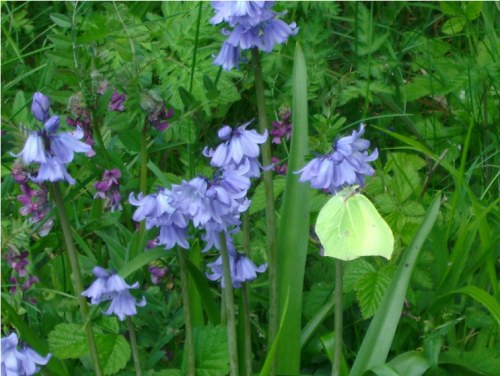
When I saw this Brimstone on bluebell, I thought how lovely it looked, until close-up I noticed the splaying bell and spreading perianth segments of the hybrid of the Spanish Bluebell and the native flower. This was on an open country lane, several hundred yards from the nearest habitation and surrounded by genuine native Bluebells that the butterfly didn’t seem to find nearly as attractive. When my proximity scared it off this flower, it circled round only to resettle on the same clump.

Witcombe Reservoir (30 April, contributed by Gordon Avery and Laurie Pierce)

Among the more typical species for this site were 2 Common Sandpipers and at least 2 Swifts.

Sudmeadow (29 April, contributed by Gordon Avery)

During the first CES session for the season, a most unusual find was a first year male Nightingale in the net. This is the first Spring record here. Also a Shelduck on the Lower Parting.

Wainlode (29 April, contributed by Mike Smart)

The Cetti’s Warbler still singing at the same place; at least fifteen Swifts and three or four singing Redstarts.

Ashleworth (28 April, contributed by Mike Smart)

Two Lesser Spotted Woodpeckers drumming and calling in different tetrads. At least one, perhaps two Grasshopper Warblers reeling. Really good numbers of summer songbirds now seem to have arrived: about ten Redstart singing males and a similar number of Sedge Warblers. Still 2 Wigeon and 2 Shelducks on the pool. The number of Lapwings though is desperately poor with practically none anywhere along the upper Severn Vale this spring.

Walmore (27 April, contributed by Andy Jayne)

A Whinchat at Walmore Common this evening.

Coombe Hill and Wainlodes (25 April, contributed by Mike Smart and Les Brown)

Coombe Hill this morning: a bit windy and therefore none too good for birdsong; the better meadows looking gorgeous with carpets of cuckoo-flower and sedge. 4 Bar-tailed Godwits (first identified yesterday evening by Lawrence Skipp), one male and three females, almost unheard of inland in spring though this would be a classic date for the estuary; 1 Black-tailed Godwit, two Oystercatchers (one with metal ring on left leg), 3 Little Ringed Plovers dropped in, then flew off at 08.25am confirming that LRPs here are generally if not always migrants, 2 Redshanks with a little display, up to 7 Shelducks, at least 6 Sedge Warblers along canal, two or three Lesser Whitethroats, at least three or four Redstarts singing.

River Severn at Wainlodes: 1 Cetti’s Warbler, singing not very frequently from riverside willows; 1 Yellow Wagtail over to north.

Walmore Common (24 April, contributed by Mike Smart)

Seen today: 2 Little Ringed Plovers, only three Lapwing, at least 2 Reed Warblers, 2 Sedge Warblers and 2 Lesser Whitethroats singing. Also four Linnets. The vegetation is looking lovely on the Common with lots of Orange-Tip butterflies.

Leigh Meadows (23 April, contributed by Mike Smart)

Seen yesterday evening: this area has some of the best unspoilt hay meadows in the Severn Vale and they are just beginning to look really full of flowers – carpets of Cuckoo Flowers and sedges growing nicely. The birds were a bit quiet: only one Curlew and 2 Lapwings, 2 singing Lesser Whitethroats, one Redstart with alarm call.

Coombe Hill (22/23 April, contributed by Mike Smart)

On the evening of 22 April: 4 Shelducks, 15 Greylags, 1 hybrid Greylag x Barhead, 2 Oystercatchers, 2 Black-tailed Godwits, 8 Curlew came to roost, 1 Whimbrel, no Lapwings or Redshank, 1 Sparrowhawk, 1 Cuckoo.

On the morning of 23 April: mMost of the above, plus: 2 Little Ringed Plovers, 2 singing Lesser Whitethroats, at least three singing Redstarts and birds of the day were 2 Linnets.

Northleach (21 April, contributed by Gordon and Margaret Avery)

A Red Kite was seen being harassed by a Carrion Crow over the A40.

Little Rissington (21 April, contributed by Gordon and Margaret Avery)

A female Wheatear was on Little Rissington airfield.

Cheltenham (19/21 April, contributed by Robert Homan)

A Lesser Whitethroat was singing in Swindon Lane on the morning of the 19th and late afternoon on the 21st there was the first Holly Blue of the year.

Sudmeadow (19 April, contributed by Gordon Avery)

Seen this afternoon at Sudmeadow were: a Green Sandpiper and a Cuckoo, while there were 2 Wheatears on the GLS slope.

Standish (11 April, contributed by Juliet Bailey)

An astonishing cloud formation, straight as a die, the sky divided blue to the west, flat grey cloud to the east, running from horizon to horizon. We checked it up on the Met Office website and the satellite image showed it extending in pretty much a straight line from the Bay of Biscay, through southern England, up the Welsh Marches, out across the North Sea roughly on the Scottish borders and continuing up past the Shetlands. It was visible as a curious line on the southern horizon when we got up at around 7am, and this photo was taken at around 10am after it had passed overhead.

Forest of Dean (11 April, contributed by Andy Jayne)

In the Woorgreens/Kensley area today, highlights were nine Goosander, two Goshawks and a Sparrowhawk high overhead, a male Redstart, a male Pied Flycatcher, four Ravens, about 20 Lesser Redpolls and two Hawfinch. Also two Tree Pipits nearby at Yewtreebrake.

Sudmeadow (11 April, contributed by Gordon Avery)

Seen this afternoon were:

3 Teal on the Plantation Pool
1m Peregrine over Sudmeadow
1 Green Sandpiper at Sudmeadow
1 Red-legged Partridge on the GLS slope
1m Wheatear on the GLS slope
2 Willow Warblers at Sudmeadow marsh (at last)!

Ashleworth and Coombe Hill (11 April, contributed by Mike Smart, Les Brown and John Wiltshire)

Coombe Hill: the water level continues to drop. Ducks and waders were very few in number. 2 pairs of Shelduck, one at the Long Pool and one at Cobney Meadows; 15 Teal on the Long Pool, a single Wigeon. 25 Mute Swans had roosted and went to graze on the neighbouring farmer’s field. Absolutely no sign of breeding Lapwing or Redshank, either around scrapes or on Cobney Meadows, Curlews few in number. 2 Whimbrel flew in mid-morning. Summer visitors on the other hand increasing hand over foot: at least 15 Willow Warblers, 10 Chiffchaffs, 2 Sedge Warblers, 1 Whitethroat, at least six Redstarts (the latter mainly at western end of canal), all singing their hearts out.

Ashleworth : a Cuckoo seen and heard.

Walmore (9 April, contributed by Mike Smart)

It was very quiet during a walk around today at midday. There were 6 Mute Swans (all grazing immatures, I couldn’t find any nests), 5 Shelducks (two pairs prospecting), 5 Teal, a flock of 5 Curlew which must have been passing migrants, no Lapwings and no Redshanks which is disappointing. 20+ Swallows, 2 House Martins. The local farmer said their first Swallow this year was on what for them was the early date of 28 March.

Saul Warth (9 April, contributed by Andy Jayne)

Seen today: a drake Red-breasted Merganser. Also a pair of Pintail, a Little Egret, two Water Rails, two Oystercatchers, 16 Black-tailed Godwits and a Spotted Redshank.

Guscar Rocks & Aylburton Warth (8 April, contributed by Andy Jayne)

At Guscar Rocks & Aylburton Warth today sightings included two Canada Geese, c. 26 Shelduck, 11 Teal, an adult male Peregrine, two pairs of Oystercatcher, a Ringed Plover, c.50 Lapwing (including numerous pairs on territory), a Snipe, one Bar-tailed Godwit, 190 Curlew, 23 Redshank, single Green and Common Sandpipers, a male Yellow Wagtail, seven White Wagtails, two female Wheatears and two Ravens. Also two Brown Hares.

Poor’s Allotment, Tidenham Chase (8 April, contributed by Andy Jayne)

At Poor’s Allotment, Tidenham Chase today a pair of very active Lesser Spotted Woodpeckers and also two Lesser Redpolls.

Coombe Hill (7 April, contributed by Mike Smart)

An evening session at Coombe Hill: everything is drying out with the lack of rain over the last six weeks, but birds were a bit thin. A single Little Ringed Plover, sitting on the edge of the scrape, no doubt a migrant. Only nine Curlews came to roost (against 28 a week ago), largely in pairs, all very noisy, bubbling, males chasing larger females. No Lapwings, Redshank or Snipe, though it was a bit windy. 27 Mute Swans (nearly all immatures) still stuffing themselves with the neighbouring farmer’s grass and coming in to roost very late. Two pairs of Shelducks, one per scrape, looking well established. About 25 Sand Martins over the Long Pool; a note in the logbook said there had been considerable passage in the morning, with some Yellow and White Wagtails.

Sudmeadow (6 April, contributed by Gordon Avery)

A walk around this afternoon produced the following:

2 Red-legged Partridges
1 Green Sandpiper
1 female Wheatear
Pair of Linnets (the first returning birds of the year)

Ashleworth (5 April, contributed by Mike Smart and Mervyn Greening)

The year’s first ringing session this morning (sharp frost and thick mist over the Severn), produced 22 birds, a fair figure for the time of year. Among the birds of interest were:

a one year old male Redstart (quite heavy and still carrying a good deal of fat, so probably a bird on the way through); also at least one bird singing.
a Willow Warbler (also heavy with a good fat score, so also probably a bird moving through); at least one other singing
a female Blackcap
six Reed Buntings (every single one a retrap from previous summers, so we are clearly monitoring them effectively); many more singing.

Otherwise quiet: two Curlews bubbling, one non-displaying Lapwing.

Coombe Hill and Ashleworth (4 April, contributed by Mike Smart and Les Brown)

Coombe Hill: still very quiet around the scrapes. Three Shelducks, 20 Teal, two Shoveler, 1 Sparrowhawk. 1 Little Ringed Plover (an adult present early in the morning but moved off calling at about 07.30am, so likely to have been a migrant); still no Lapwings displaying round the scrapes, one pair of Curlew bubbling, eight Fieldfares went over high to the north east, at least three Willow Warblers singing. At Wainlodes end, four displaying lapwings, one Redshank, one Green Sandpiper, 2 Ravens, one Willow Warbler singing.

At Ashleworth, the water levels on the reserve have dropped sharply since the boards were removed from the sluice: still 55 Wigeon, 58 Shoveler, 38 Teal, 6 Pintail, one Treecreeper singing.

Coombe Hill (1 April, contributed by Mike Smart)

An evening visit revealed 1 Little Egret, at least 7 Shelducks, 25 Mute Swans which came in to roost at nightfall after laying bare the neighbouring farmer’s prime grass all day. Most interesting were, as always on spring evenings, the waders: 2 Little Ringed Plovers, really looking like passing migrants (non-vocal and retiring), 3 Redshanks (a pair and a gooseberry perhaps, agitated but no real display), but no Lapwings; most interesting were the Curlews with additional birds coming in all the time, chasing one another, making display calls and generally very excited. The final total at nightfall was not less than 28. I am sure this is a communal roost for all the neighbouring breeders. Snipe started to fly round at dusk but there was no drumming. A Blackcap and five Chiffchaffs were singing but as yet no Willow Warblers.

Sightings – March 2009

Sudmeadow (31 March, contributed by Gordon Avery)

Very quiet here really although 2 male Blackcaps were in song today plus at least 3 Chiffchaffs. Also new were 2 male Reed Buntings and a Snipe remains in the marsh.

Coombe Hill and Ashleworth (31 March, contributed by Mike Smart and Les Brown)

All still very quiet, birdwise.

Coombe Hill: a flock of immature 24 Mute Swans was newly arrived on a neighbouring farmer’s field south of the canal (the field preferred by the Whoopers). 18 Canada Geese, one pair nest building within site of the hide. Again, a single Little Ringed Plover dropped in just for a short while; this seems to be the pattern here with migrants showing very briefly. Only one Lapwing and two Redshanks. 4 Shelducks, 30 Teal, 13 Shoveler. Three Pied Wagtails which were clearly migrants. A Blackcap and six Chiffchaffs singing.

Ashleworth: most boards have been removed from the sluice, to reduce water levels as per management plan. Four Pintail, 10 Tufted Duck with duck numbers overall dwindling rapidly. One singing Blackcap.

Standish (29 March, contributed by Juliet Bailey)

Two Swallows flew over this morning – the first of the spring here.

Coombe Hill and Ashleworth (28 March, contributed by Mike Smart and Les Brown)

Coombe Hill: the fields are drying out at last after the dry weather of last two weeks and the cold winds. There is still plenty of water in the scrapes (but few birds!). At least three pairs of prospecting Shelducks, 2 Little Ringed Plovers (flew in separately during the morning, suggested they were passing migrants); at last three Lapwings displaying (not round the scrapes but at the west end of the reserve); at least four pairs of Mute Swan holding territories between the Wharf and Wainlodes. Only 12 Teal and 9 Shoveler on the Long Pool, also 4 Snipe. 10 Chiffchaffs singing and a Peregrine on the grass again, though not the same one as last week; this time a very obvious brown immature.

Ashleworth: a steady northward trickle of Sand Martins with two House Martins and a couple of Swallows. One Curlew, no Lapwings, 15 Tufted Ducks. Ducks decreasing rapidly: maybe 30 Wigeon and 20 Teal.

GLS “Sheep Downs” (28 March, contributed by Gordon Avery)

A walk in the area today revealed little! However, there was a minimum of 35 Ravens on the sheep downs, taking care of the carcases, etc.. On Minsterworth Ham there were 10 Shelduck, accompanied by the Australian type hybrid male.

Castle Meads (27 March, contributed by Gordon Avery)

5 Little Egrets were present yesterday (26th, per John Sanders) and I saw them again this morning – perhaps there are lots of frogs there or were!

Coombe Hill and Ashleworth (24 March, contributed by Mike Smart and Les Brown)

Rather quiet again today. The most interesting thing was a Peregrine, adult or near adult, on the ground outside the Grundon Hide at Coombe Hill, consuming what appeared to be a Mallard, with two Carrion Crows in close attendance only a yard away, eating scraps and two Brown Hares 20 yards away, taking absolutely no notice.

Otherwise, at Coombe Hill: 1 Little Egret, two pairs of Shelducks, 30 Teal, 10 Shoveler, 8 Snipe, 2 Curlews, absolutely no Lapwings, 7 singing Chiffchaffs.

At Cobney Meadows: another pair of Shelducks, 2 Curlews, 2 singing Chiffchaffs.

At Ashleworth: 60 Wigeon, 30 Teal, 10 Gadwall, 20 Shoveler, 10 Tufted Ducks, 25 Coot, 45 Snipe, 2 Jack Snipe.

Witcombe Reservoir (24 March, contributed by Gordon Avery)

A pretty mundane wildfowl count this morning enlivened by a ‘sinensis’ Cormorant – an Adult in breeding plumage with classic head and neck markings plus a good square gular patch.

Ketford (22 March, contributed by Juliet Bailey)

Eight members of GNS executive committee met at Ketford Bank this morning, a nature reserve known for its wild daffodils, which were at peak bloom. (See Juliet’s photo below). The Bank’s steepness may have saved it from agricultural intensification in the past, but the down side is that it requires manual attention to control the bracken and bramble.

This site has long had connections with Gloucestershire Naturalists’ Society. Sonia Holland, then county botanist, bought it some 20 years ago and gave it to the Farming and Wildlife Advisory Group. John Hughes, one-time chairman of GNS and FWAG adviser also loved the site. We could not fail to be impressed by the swathe of daffodils, voted Gloucestershire’s county flower. We would encourage the reserve’s continued management and would like to see its future assured.

There is no access onto the reserve, but a public footpath lined with wild daffodils, the Poets Path, runs along the top of the Bank, giving excellent views.

Other species showing well this morning were white violets, yellow star-of-Bethlehem, moschatel, a comma butterfly and two beeflies. A chiffchaff was singing, and there was an occasional chur from fieldfare.

Newnham (21 March, contributed by Andy Jayne)

News passed on from David Eaton of the Glos RSPB Group concerns a Swallow flying upriver at Newnham today.

Severn Hams (21 March, contributed by Mike Smart and Les Brown)

It was rather quiet at Coombe Hill this morning: 2 Little Egrets, 40 Teal, 12 Shoveler, no Lapwings which is really worrying, 1 Curlew, 6 Snipe; 4 Black-tailed Godwits resting in Long Pool which then flew off high and were clearly passing migrants; 5-6 singing Chiffchaffs, two Pied Wagtails.

At Ashleworth, it looks as though the 4 Whoopers have departed – they haven’t been seen since Tuesday and their normal departure dates are 16-19 March. 80 Wigeon, 20 Shoveler, only 2 Pintail, 15 Tufted Ducks, 3 Snipe, 1 singing Chiffchaff.

Cheltenham (18 March, contributed by Robert Homan)

A Peregrine Falcon circling high above the town centre at lunchtime today, its presence betrayed by gull alarm calls. Later a Comma butterfly along the Honeybourne Cyclepath near St Paul’s.

Coombe Hill and Ashleworth (17 March, contributed by Mike Smart and Les Brown)

The floods are pretty much gone at both sites and the ground is very slowing drying out after the constant flooding since last September. Today was a fine windless spring day. Duck numbers are decreasing fast. There has been little sign of breeding waders as yet. The Sand Martins reported last the weekend had moved on.

At Coombe Hill: 5 Shelduck, 54 Teal, 3 Little Egrets, 1 Little Ringed Plover, 2 Lapwings (didn’t look very interested in nesting), 3 Little Egrets.

Cobney Meadows (The Wainlode end of the canal): 2 bubbling Curlews, no Lapwings, 1 Green Sandpiper heard.

Ashleworth: four Whooper Swans roosting on the water; they flew out to graze on the field by Stank Lane at 06.25am, but hurry, they will be going to Iceland any day now. 167 Wigeon, only 30 Teal, 61 Shoveler, only two Pintail, 22 Tufted Duck, 1 Pochard, no Lapwings, 1 Curlew, 64 Snipe, 7 Jack Snipe, Little Grebe whinnying; at least five Chiffchaffs but not much song yet. Lots of Reed Buntings, which are very active, chasing one another and singing.

Sudmeadow (16 March, contributed by Gordon Avery)

A good day today in this area.

This morning at Sudmeadow were 4 Teal, 9 Snipe, Barn Owl and at least 2 Chiffchaffs. Later at the Landfill Site was a new species for the area in the guise of a Red Kite floating over towards Minsterworth Ham at 1.55pm. A great find!!

Cheltenham (16 March, contributed by Robert Homan)

A Chiffchaff was singing by the Honeybourne Cyclepath near Wyman’s Brook this morning.

Forest of Dean (15 March, contributed by Peter Fitchett)

A wide variety of easily seen birds was on offer this morning, including make and female Mandarins at Mallards Pike and Nuthatch, Chaffinch, Greenfinch, Great Tit, Blue Tit, Brambling and this male Siskin on the feeders at New Fancy View. In addition the Great Grey Shrike at Boys Grave was showing well. See Peter’s pictures below.

Cheltenham (15 March, contributed by Robert Homan)

A male Brimstone butterfly was a brief garden visitor this morning.

Newent area (15 March, contributed by Peter Fitchett)

The wild daffodils in Gwen and Vera’s Fields were at their best today in the spring sunshine – see Peter’s pictures below.

Ashleworth (12 March, contributed by Juliet Bailey)

White violets were blooming abundantly today on a woodland edge, and inside the wood the earliest wood anemones were in flower.

Castle Meads, Gloucester (12 March, contributed by Juliet Bailey)

While driving past Castle Meads today I noticed a single Little Egret on the pools to the east of the causeway. Presumably the same bird was also present on Thursday 5th March.

Standish area (12 March, contributed by Juliet Bailey)

Spring is starting to gather pace with flowering celandine now widespread, and a few early buttercups. I saw my first flowering cow parsley over the weekend, though only in May will it come to dominate the road verges and hedgerows.

Coombe Hill (11 March, contributed by Mike Smart)

Evening look at Coombe Hill today from the Grundon Hide:

1 Little Egret, 4 Shelduck, 13 Curlews roosting round edge of scrapes – were they migrants, stopping off to roost, or local breeding birds gathering to roost? Also a big pack of perhaps 200 roosting crows, Carrion Crows and Jackdaws, gathering on the grass before going to roost in the withies, unnerving the Curlews by their social interactions. No Lapwings , where have they gone? Perhaps intimidated by the crows. Just a little calling by Snipe, after 7.45pm. Also a fox slinking through the Phallaris.

At midday, a flock of 62 migrant alba wagtails, at least two of them White and a Water Pipit had been recorded in the hide log-book.

Tewkesbury and Hasfield Ham (10 March, contributed by Andy Jayne)

At Tewkesbury today there was a 1st-winter Mediterranean Gull on the Severn Ham with a metal ring on the left leg and a large orange-red ring on the right leg. Unfortunately I couldn’t read it due to the long grass, but it has been suggested that it is from Eastern Europe. Also four Snipe and four Curlew there.

At Hasfield Ham two adult Peregrines (a pair), a Jack Snipe, 45 Snipe, three Curlew and a female Stonechat.

Severn Vale Wetlands (10 March, contributed by Mike Smart and Les Brown)

Walmore: the two Bewick’s cygnets (Stinking and Bishop, offspring of Gorgonzola) which had stayed on at Walmore last week on their own, were last seen on Saturday afternoon. Interesting, because 12 of the remaining 13 Bewick’s at Slimbridge departed on Friday night. There was no sign of them on the Common by day yesterday; they definitely didn’t roost on the Common pool last night (not present at 0545 this morning with only 11 Mutes present) and weren’t at Slimbridge either. So they have set out on their own.

Coombe Hill: 1 Little Egret, 3 Shelducks, 150 Teal, 12 Shoveler; some sign of wader passage: 1 Little Ringed Plover, 3 Dunlin; also some resident waders looking territorial – about 5 each of Lapwing and Curlew, lots of bubbling from the latter; and 2 Green Sandpipers at the Wainlodes end.

Leigh Meadows: still four Whoopers grazing.

Ashleworth: 34 Gadwall, 60 Coot and lovely flock of migrant wagtails, 55 Pied and a single male White.

Sudmeadow (9 March, contributed by Gordon Avery)

Seen the afternoon were: 19 Teal, 5 Snipe and 2 Woodcock.

Hempsted Meadows NR (6 March, contributed by Gordon Avery)

A look around Hempsted Meadows NR this morning produced 2 Snipe plus a pair of Reed Buntings, the first this year, and the first Skylark here in song. On Minsterworth Ham there were 2 pairs Shelduck, 1 pair of Canada Geese and a drake Shoveler.

Sudmeadow (6 March, contributed by Gordon Avery)

A Green Sandpiper, 1 Snipe and 4 Teal on Sudmeadow plus a pair of Shelduck on the waste ground pools by Presswelds factory, Hempsted.

Walmore Bewick’s (5 March, contributed by Mike Smart)

There is a note below about the practice departure migration flight taken by 20 or 30 Bewick’s on 21 February. Those birds went up the Severn in the morning passing over Walmore , Sudmeadow and Coombe Hill but then returned to Slimbridge. Since then, as you can see from Julia’s blog on the WWT website, they have in fact departed, usually at night, and numbers at Slimbridge are down to 13 with two cygnets.

However, Walmore Bewick’s have been doing their own thing: there was a family of one parent (Gorgonzola) with two cygnets, which had been visiting Walmore since January, and often roosting on the Common Pool, even when other Bewick’s Swans returned from Walmore to Slimbridge in the evening. Gorgonzola + 2 had joined the practice departure on the morning of 21 February, but I saw them return to the Common together later in the morning, and carry on feeding. However, on the night of 21/22 February, a night when about 40 Bewick’s departed from Slimbridge, Mum (Gorgonzola) disappeared, most unusually leaving her two cygnets behind. These are birds born on the Russian tundra in summer 2008, which flew to Gloucestershire in autumn 2008 with Mum (Dad has never been definitely identified), but have never made the return trip to the breeding grounds.

Since 22 February, they have been observed in daylight every day at Walmore, generally keeping aloof from the local Mute; some evenings they fly back to Slimbridge, some evenings they roost on the Common. What is going to happen to them? Are they going to link up with the last 13, and depart to the tundra? Or, if they don’t link up, how are they going to find their way? Are we going to have summering Bewick’s in Glos? Watch this space!

Severn Hams (5 March, contributed by Mike Smart)

At Walmore: the two unaccompanied minor Bewick’s (offspring of the departed Gorgonzola) are still present, and probably roosted there last night without going back to Slimbridge; also 2 Shelduck, 35 Teal, 14 Lapwings (one displaying a bit), 10 Snipe, at least 5 Reed Buntings singing.

At Ashleworth, the water level on the reserve is still high, although little or no floodwater remains on the surrounding meadows. Only about 400 ducks left: 180 Teal, 120 Wigeon, 25 Gadwall, 40 Shoveler, 15 Pintail, 10 Tufted, 55 Coots (as usual an increase in spring before the waters drop); 3 Curlews (one giving the bubbling display song), 82 Snipe, 1+ Jack Snipe, 5 Reed Buntings singing. No sign of singing Chiffchaffs or of the Hen Harrier reported recently in the area.

At Leigh Meadows, four Whooper Swans, still grazing placidly.

Sudmeadow (5 March, contributed by Gordon Avery)

An immature male Peregrine was over the tip the afternoon heading towards the Lynton Farm.

Sightings – February 2009

Cheltenham (24 February, contributed by Robert Homan)

Croaking from the garden pond last night suggested that the frogs were active and indeed this morning there were 5 clumps of spawn and a number of presumably female frogs present.

Coombe Hill (24 February, contributed by Mike Smart and Les Brown)

The floods have receded, leaving the meadows muddy, dank and desolate, more like a mudflat than a hay meadow. Some signs of early wader passage: 17 Curlews, which had obviously roosted, flew off to the northwest soon after first light; a flock of 44 Lapwing, still in winter plumage and flocking, whereas birds are already displaying at Walmore; a single Dunlin with the Lapwing; a lone Golden Plover flew over, calling; 30 Snipe on the southern meadows. Duck numbers were low: 5 Shelduck lekking, 170 Teal, 5 Shoveler.

A mink departed with alacrity as I entered the Long Pool Hide; from the smell, it has taken up residence there. Three brown hares were seen.

Witcombe (24 February, contributed by Gordon Avery)

22 Siskins were in alders at the reservoirs this morning.

Walmore and the Bewick’s Swans (23 February, contributed by Mike Smart)

More interesting sightings today. Two cygnets (presumably Gorgonzola’s offspring) were on their own, without their mother, at Walmore yesterday (22nd). They were there again this afternoon at least from 4.20pm onwards when I arrived, and I assumed that they would roost on the pool on the Common again. But no, at 5.55pm they took off and flew in the direction of Slimbridge. So they should have connected with the main flock of Bewick’s at Slimbridge again, and will presumably depart with them.

Interestingly, the usual group of Bewick’s (including TUV, BCH and 607) that flies over to Walmore for the day and returns to Slimbridge in the evening was not seen at Walmore either yesterday or today. Which suggests that they are probably among those that left on Sunday night.

Walmore and area (22 February, contributed by Andy Jayne)

Seen at Walmore Common were two juvenile Bewick’s Swans, five Shelduck, 100 Teal, 60 Snipe and a record count of six Jack Snipe.

At Broadoak, Newnham a first-winter Iceland Gull was seen late afternoon.


Sudmeadow (21 February, contributed by Gordon Avery)

10 Lapwing moved north over the Lower Parting at 08.08am.
Adult Male Peregrine on the pylon at Lower Parting at 08.30am, then seen twice more during the morning, once on the pylon at the Power Station at Port Ham and once on the pylon over on the ‘Manor’ Linton Farm.
A male Chaffinch singing at Sudmeadow, the first I’ve heard this year.

See below for additional observations concerning Bewick’s Swans in the area.

Severn Vale (21 February, contributed by Mike Smart, Les Brown and Gordon Avery)

At Walmore at first light this morning in bright clear conditions, there were three Bewick’s Swans, Gorgonzola and her two cygnets, who for at least a week have stayed to roost on the Common Pool at Walmore, rather then returning to roost at Slimbridge, like most other Bewick’s. They flew the 200 metres to their usual grazing field at 06h58. Then at 07h08 (a very early time for birds to arrive at Walmore from Slimbridge for the day’s grazing), a flock of 20 Bewick’s appeared over the Common, circled twice and, without landing, flew off upriver to the north; Gorgonzola and her family thereupon took off and joined them. At 07h20, there was one Bewick’s left on the pool at Walmore, which took off and landed on one of the fields, but sat looking agitated with its neck vertical; another singleton arrived from the north at 07.45am.

At 07.24am, at Sudmeadow, just south of Gloucester, Gordon Avery noted a flock of 22 Bewick’s Swans (including at least four immatures) flying NE along the Severn. Then at 07.35am, 13, probably some of the same birds, flew south over Sudmeadow again.

At 07.45am, Les Brown, who was in the hide at Coombe Hill, heard Bewick’s overhead and saw a flock of 18 which circled, did not land, then flew west towards the Severn. At 07.53am, Richard Cook who was driving along the Gloucester by-pass at Over saw “about 20” swans (not definitely Bewick’s, but it seems very probable) flying south back downriver. Meanwhile at Walmore, two more adults came in from the north at 08.10am, and the two already present began a furious threat display against them; at 08.20am, all four took off and headed over the Chaxhill ridge in the direction of Slimbridge. At 08.32am, seven swans flew into Walmore from the north and landed, four of them unringed adults, the other three, an adult and two cygnets which must have been Gorgonzola and family. These seven remained and no more arrived (i.e. not the usual morning influx from Slimbridge) before 10.30am when I left. The seven were still present at 14.15pm when I took another quick look.

It looks very much as though this was a “practice departure”: the flock of 20 left Slimbridge in the early morning (as they often do on departing NE migration), overflew Walmore, called up Gorgonzola & kids, then all flew north towards Coombe Hill, losing heart as they went, and various birds peeled off, returning southwards, until the whole flock returned south. It will be interesting to see how many are recorded at the roost at Slimbridge this evening. But in these perfect conditions for return migration, they surely won’t be around much longer.

There is a great deal of information on Bewick’s Swans and their comings and goings at Slimbridge here.

Sudmeadow (19 February, contributed by Gordon Avery)

A superb female/imm female Merlin seen this afternoon flying over the tip towards Minsterworth Ham.

Severn Hams (17 February, contributed by Mike Smart and Les Brown)

Water levels remain high at Coombe Hill and the hides are inaccessible, but birds can be seen from the canal towpath. Highlights today were the first Curlew of the spring, a flock of nine, with three Dunlin. At Ashleworth, the water also high and not many ducks were visible; there were 19 Snipe and 3 Jack Snipe near Stank Lane. At Leigh Meadows the four Whooper Swans still present.

At Walmore, five Bewick’s roosted and were joined by 19 more from Slimbridge. A coordinated count yesterday afternoon gave 166 at Slimbridge and 14 at Walmore, which is very close to the winter’s maximum of 183, so departures haven’t begun yet. 20+ Ravens flew out from Walmore at first light in the direction of the land fill site at Gloucester.

Cheltenham (16 February, contributed by Robert Homan)

A male Blackcap was singing in Swindon lane today and a Peacock butterfly was a brief garden visitor in the late morning sunshine. Yesterday in Cheltenham town centre a male Blackbird was in full song at 6.00pm.

Walmore (15/16 February, contributed by Mike Samrt)

Following the big tides last week (the largest of the year with tides of over 10 metres for four days running), Walmore was lightly flooded.

With the floodwater dropping gradually on the 15th, at first light there were 29 Bewick’s Swans (three cygnets) which had roosted on the water there. They included three ringed birds (607, TUV and BCH) which have been recorded regularly at Walmore since the beginning of the year. (The three ringed birds were back at Slimbridge in the evening, so did not roost again). Also at least 400 Teal, 8 Snipe, 7 Canada Geese.

On the evening of the 16th, with the water level lower, there were only 14 Bewick’s (with three cygnets), none of them ringed, which stayed until 6.00pm when it was practically dark. Some appeared to fly to Slimbridge but some stayed to roost. Also at least 48 Ravens coming to roost in oak trees, flying in from the direction of Gloucester between 5.15 pm and 6.00pm, presumably from the land fill site.

Arlingham Warth (15 February, contributed by Andy Jayne)

A male Goshawk was seen today being mobbed by Crows and gulls. Also a Jack Snipe and four Snipe were flushed from a stubble field.

Sudmeadow (14 February, contributed by Gordon Avery)

A Chiffchaff was by the marsh this morning, hawking for insects.

Walmore (14 February, contributed by Mike Smart)

The floodwater at Walmore is decreasing and not iced over now. At first light 29 Bewick’s were present, including three cygnets. They had obviously roosted, which accounts for a slight decrease at Slimbridge in the last few days. Also present were 375+ Teal, 13 Pintail, 1 Shelduck, 1 Raven.

Severn Hams (14 February, contributed by Les Brown)

At Coombe Hill the floodwater has risen again, making the hides inaccessible, though the central reserve can be viewed from the canal towpath. The water is higher at Ashleworth too, but the hides were still accessible along the road.

Minsterworth Ham area (11 February, contributed by Andy Jayne)

At Minsterworth Ham today 17 Shelduck, a Green Sandpiper and 100 Meadow Pipits and nearby at Calcott’s Green a Hawfinch in an orchard and a redhead Goosander on the Severn.

Frampton and Longney (10 February, contributed by Andy Jayne)

At Frampton Pools today there were three female Scaup among 208 Tufted Duck and ten Pochard on the Sailing Lake.

At Longney there was a pale second-winter Glaucous Gull on the sands for well over an hour mid-afternoon. Also a first-winter Herring Gull with white primaries and 100 Skylarks on a nearby field.

Cheltenham (10 February, contributed by Robert Homan)

A pair of Ravens was seen in flight low over Swindon Lane this afternoon. Their presence in the area in now a more or less daily occurence.

Sudmeadow (9 February, contributed by Gordon Avery)

A female garden Blackcap was seen this morning.

Sudmeadow (8 February, contributed by Gordon Avery)

Seen in the area this morning were: 8 Cormorants
5 Canada Geese
14 Teal
2 Wigeon
300 Wood Pigeons in the area probably due to shooting on the other side of the river
28 Siskins feeding in riverside alders, less than annual here.

Standish (5 February, contributed by Juliet Bailey)

I had been feeling a bit deprived; there have been all these reports of heavy snow, but it seemed to have missed this part of the Vale until this morning, when there was about 4 cm lying. I went for a short walk round the local farmland (see my picture below), looking for animal prints. Rabbit prints were abundant, a few fox tracks, but only birds apart from that. What particularly surprised me was the lack of deer prints. Roe are very common round here and I see them more often than not when on this walk. I wonder if they had retreated to the woods. In the garden the birds showed beautifully, lit from below as well as above. A Fieldfare was guarding the lawn where I have put out stored windfall apples, and it chases off all other Fieldfares, Blackbirds and Song Thrush. Perched on the shed roof, it started pecking the moss cushions. This looked like displacement activity rather than feeding. I had previously noticed a chunk of apparently healthy moss on the ground and wondered why it had broken off. This could be the answer.

Aust (4 February, contributed by Juliet Bailey)

Seen in Aust churchyard today, a little patch of celandines in full bloom.

Sudmeadow (4 February, contributed by Gordon Avery)

An adult male Peregrine heading SE over this morning at 08.05 and a male Stonechat in the area.

Severn Hams (3 February, contributed by Mike Smart)

The Severn continues to drop, but there is still extensive water, much of it iced over, on the riverside meadows. At Coombe Hill, the hides are still inaccessible and likely to remain so for a couple of days yet, but the area of open water can be seen from the canal towpath. At Ashleworth, hide easily accessible, and most birds sitting round the edges of the water on the main reserve field. Biggest combined total of ducks so far this winter, 2,500 or so; unusually in relation to previous winters, Teal are much the most numerous, with a lot less Wigeon, normally the commonest species; the cold snap clearly hasn’t scared them off yet.

At Coombe Hill today, a total of over 800 ducks (not immediately obvious because a lot are sitting round the edges, hiding and loafing in the vegetation): 200 Wigeon, 500+ Teal, 10 Gadwall, 60 Mallard 150 Pintail, 40 Shoveler, 65 Coot 43 Lapwings.

At Ashleworth, at least 1,500 ducks maybe nearly 2,000: 2 Little Grebes, 800 Teal, 400 Wigeon, 100 Pintail, 70 Mallard, 40 Shoveler, 30 Gadwall, 10 Tufted Duck; in fields along Stank Lane, 20 Snipe, 1 Jack Snipe.

I couldn’t find the Whoopers today, but the are probably tucked away somewhere.

Severn Hams (2 February, World Wetlands Day, contributed by Mike Smart)

The Severn is still dropping, despite the snow and water is pouring off meadows at Coombe Hill and Ashleworth.

The 4 Whooper Swans are back on Leigh Meadows. Also seen today were: 190 Canada Geese in flight over Coombe Hill; a Grey Wagtail perching on flotsam below Haw Bridge; a Raven at Wainlodes and a flock of 40 Stock Doves near Ashleworth Ham, the biggest for some time.

GNS Field Trip to Garden Cliff, Westbury-on-Severn (21 Feb 2009, contributed by Andrew Bluett)

The GNS field trip to Garden Cliff at Westbury-on-Severn took place on a gloriously warm and sunny day which had all the signs of a promising Spring about it. The meeting point at Westbury Village Hall proved to be a good location where cars could be left and the assembled company of 14 members led by Membership Secretary Andrew Bluett walked down Strand Lane to The Strand at the end of the public road on the river bank close to the western end of Garden Cliff.

After clambering down over the river wall onto the “beach” the members were led along the foreshore below the cliff to the eastern end, then up and over the river bank and back via the public footpath along the top of the cliff back to Strand Lane.

Garden Cliff is one manifestation of the mudstone beds that are evident throughout the Severn Valley and exposed at Wainlodes in the north, Garden Cliff, Newnham, Bullo and Box Wood (Awre) in the west, Hock Cliff in the east and Aust Cliffs (adjacent to the Severn Bridge) in the south. Sometimes referred to as Keuper Marls, the mudstone (which is so friable and soft as to barely warrant the title “rock”) was formed in the upper Triassic some 200+ million years ago and marks the boundary with the later Jurassic period. With its stripes of green-grey and red strata, Garden Cliff stands out as a visible landmark in the alluvial plain. Within the strata the stone is visibly globular and breaks down into characteristic near spherical and curved, sharp edged fragments and even in the light winds during the visit, was constantly being wind eroded with small falls of rock occurring most of the time. The beds were formed in arid, semi-desert conditions before being overlaid by brackish and marine water borne sediments of the early Jurassic.

At the eastern end of the cliff the strata dips down so that the overlying beds of shale, sandstone and limestone are visible and within reach. The foreshore at this point is littered with slabs of fossilised beach fragments, the ripples clearly visible and diagnostically marine formed as evidenced by their profile. (The varied strata in the cliff are clearly shown in this picture taken by Ingrid Twissel.)

Within these beds there are fossils of sea shells and marine creatures including fish whose teeth, scales and bones can be found along with Ichthyosaur and Pleisiosaur bones, coprolites (fossilized excrement), Shark’s teeth, and the remains of choristoderes, these being marine, lizard-like creatures which grew to 1m in length. It is also possible to find deposits of Pyrites (Fool’s Gold) with particles from dust size to crystals several millimetres across and in both gold and a copper-red colour, several members collected samples of both.

More detail on Garden Cliff and the other sites in this geological group is available here.

On arrival at the site it was immediately clear that the river level was at its lowest ebb, there were large expanses of sand exposed and covered with hundreds of Gulls of several species, mainly Lesser Black Backed interspersed with Greater Black Backed, Herring, Common and Black Headed Gulls and Crows. Within minutes of walking along the beach Colin Twissel had located the first of seven Smooth Newts (see Colin’s picture below) whilst turning over driftwood in search of insects. Much speculative discussion took place as to why these creatures were present in what appears to be an alien environment for them. One specimen could be seen to be accidental, but seven suggests something different. Is this in fact a habitat where they occur naturally? Or are the Newts casualties from washout of watercourses after the flooding and snow melt that have made landfall on the foreshore and taken temporary refuge? The question remains to be answered.

On the cliff face there was evidence of roosting Peregrine and Kestrel in the splashes of “whitewash” littered under several perching points, unfortunately neither bird was present, and 3 Mallards floated offshore.

At the eastern end of the cliff the party spent some time searching for fossils and for Pyrites with some success and with helpful comments on geological and paleontological matters from Dr Mike McEllin, before scaling the river bank and beginning the trek back along the cliff top footpath towards the start point.

In the fields stretching back from the cliff edge flowering Speedwell was located, two Rabbits and Two Hares were seen, there were Buzzards and a flock of up to 30 Reed Buntings frequenting the thorn thicket on the cliff edge and flying out from the bushes to alight and feed in the grass. Dead Elms were scattered along the cliff top, none more than 10 inches in diameter and all victims of Dutch Elm Disease. The first butterfly of the year, a small Tortoiseshell, flew by and a Raven called from somewhere across the river.

Other species noted during the walk were freshwater shrimps (Gammarus) under stones and driftwood, a singing Blackcap at The Strand, a Green Woodpecker and Little Owl calling near Moys Hill Farm and a Cormorant over the river. Footprints of a mammal were found on the foreshore, a round pad with five smaller round toe prints which were possibly Otter and there were a few Snowdrops in full flower on the walk back to the Village Hall.

Altogether a very enjoyable and successful walk with a few surprises and with both river and weather conditions being near perfect it was enjoyed by all present.

Field Trip Sound Files

Recordings made on the field trip to the Garden Cliffare available here:

20090221 GNS Garden Cliff 1 (1.7MB)

20090221 GNS Garden Cliff 2 (1.5MB)

The recordings are from Vernon Harwood’s radio show “The Spirit of Gloucestershire” made available by courtesy of Brian Bailey and BBC Radio Gloucestershire – copyright remains with BBC Radio Gloucestershire.

Sightings – January 2009

Coombe Hill (31 January, contributed by Mike Smart and Les Brown)

The level of the Severn continues to drop gradually, but the water is much slower to drop on the riverside meadows.

At Coombe Hill, flooding is still extensive and there has been no drop in the water level. The hides are still inaccessible, but the floodwater can be viewed from the towpath. Not as many ducks as on 27 January: 60+ Wigeon, 100+ Teal, 27 Pintail; two Song Thrushes singing already (a difficult bird to find for BTO Atlas roving records).

At Ashleworth, duck numbers were also lower: 120+ Wigeon, 380+ Teal, 20 Pintail, four Little Grebes and a Peregrine on the pylons.

There was no sign of the Whooper Swans anywhere.

Coombe Hill (28 January, contributed by Mike Smart and Les Brown)

Severn level is a bit lower today, allowing the Chelt to discharge; but it is still too high for water to flow off the meadows at Coombe Hill, so the Long Pool and Grundon hides are still inaccessible.

The four Whoopers were back near Wainlodes, on slightly higher grass emerging from the flood, accompanied by four Greylags.

Plenty of Teal on the floodwater at Coombe Hill, but no sign of Garganey or Goosander.

Severn Hams (27 January, contributed by Mike Smart and Les Brown)

The Severn is dropping, but slowly and water is still high on the meadows at Coombe Hill and Ashleworth.

At Coombe Hill, the hides are still cannot be reached, but access is still possible along the towpath. There was a magic atmosphere at first light: light ice on the water, with the sun just catching the brown stems of the dead canary grass and turning them to gold, behind the willow stems showing wine red; already some pussy willows showing white. There was perfect visibility with a very faint east wind. The air was full of the sounds of ducks, mainly Teal, which were carrying out vigorous courtship display, the males (much more numerous) throwing back their heads at the small numbers of females they surrounded. A group of Mallard “decoyed” a fox: that is they all swam towards it as it sat on a spit of land, swimming very close and peering intimidatingly at it from only two or three metres, until it turned away and slunk off. Altogether about 900 ducks present, one of the highest counts this year: 590 Teal, 130 Wigeon, 30 Pintail, 15 Tufted and a Pochard. On the way back we stopped to have a closer look and to our astonishment found a male Garganey, not yet in full plumage but obvious among the Teal ; this is a species that should be in Senegal right now; it must have stayed to winter with its close relative the Teal; as if that wasn’t enough, a redhead Goosander swam past.

At Ashleworth, the Ham Road is just open and the hides accessible and conditions similar to Coombe Hill with lots of ducks on the water – a total of about 1200 ducks with the majority (about 550) Teal, but 400 Wigeon and 180 Pintail.

There was still no sign of the Whoopers; where have they gone?

Slimbridge (28 January, contributed by WWT)

A juvenile Glaucous Gull was seen around the reserve on a number of occasions today.

Sudmeadow (27 January, contributed by Gordon Avery)

A single Green Sandpiper, a Peregrine and 3 very vocal Little Egrets, that headed towards Port Ham, were all seen just before 9.00 am.

Walmore and Rodley (26 January, contributed by Mike Smart)

At Walmore today, nine Bewick’s Swans were seen at midday: two of the nine were ringed and were white TUV and BCH, which have been regular visitors from Slimbridge to Walmore over the years and have been seen at Walmore several times this January; there were two cygnets (probably the one parent family that has been regular in January) among the nine, but the other seven were not ringed. By 3.00pm two more Bewick’s had joined them. There were also 12 Mutes, keeping quite separate from the Bewick’s. One Stonechat was seen.

At Wilmer Common, Rodley, there was still some floodwater, but not a lot of birds, just one Grey Heron and four Shelducks. Bird highlights were more in the passerine line: a Goldcrest in the hedges a Grey Wagtail on a wet spot and a flock of 100 Fieldfares.

Ashleworth and Walmore (24 January, contributed by Mike Smart and Les Brown)

The Severn is still pretty high (9.98 metres at Haw Bridge) but has not broken its banks. However, this means that local streams, swelled by the recent heavy rain, cannot flow out into the Severn, so are flooding the meadows. The Red Lion and Ham Roads are still both open. Shallow water was icebound this morning.

At Ashleworth there was no sign of the Whoopers at first light, and they were not grazing on the heavily flooded Leigh Meadows later. Still plenty of ducks on the floodwater at Ashleworth, though they are very widespread and difficult to count:

perhaps 200 Wigeon
perhaps 400 Teal (very active courtship display)
10 Gadwall
180+ Pintail (also active courting)
40+ Shoveler
3 Tufted Duck

A Peregrine was on the pylons and there were one or two Snipe on the icy fields. At least ten Reed Buntings were also seen.

At Walmore, where there is very little flooding: 11 Bewick’s on grassland, including at least two ringed birds BCH and one of its offspring 607 (both seen there in the last week). Rodley was largely iced over with eight Shelducks and a dozen Meadow Pipits.

Slimbridge (23 January, contributed by WWT)

A pre-roost flock of 15,000 Starlings has been performing some spectacular dusk displays over the last few days.

Sudmeadow (22 January, contributed by Gordon Avery)

Continuing Tuesday’s theme of unusual species locally was a drake Pintail at the lower Parting this afternoon – the first seen by me in this area for 5 years.

Sudmeadow (20 January, contributed by Gordon Avery)

A new species for the area in 2009 this morning was a Little Egret, which flew over towards Castle Meads. Also 2 Green Sandpipers on Sudmeadow.

Severn Hams (20 January, contributed by Mike Smart and Les Brown)

The Severn is high again (though not overtopping its banks), and causing tributaries to back-flood. As a result, the hides at Coombe Hill are inaccessible again, though the towpath along the canal is still accessible. From the canal bank today: 13 Mute Swans, 5 Greylags, 1 Shelduck, 120 Wigeon, 30+ Teal (many more calling from behind the willows in the Long Pool), 2 Gadwall, 39 Pintail, 149 Lapwings, 1 Snipe.

At Ashleworth, the meadows are flooded but the road and hides still accessible: 250 Wigeon, very good numbers of Teal – at least 600, 40 Mallard, 30 Pintail, 30 Shoveler, 2 Tufted, at least 60 Snipe (which seem in winter to like fields of lightly flooded Glyceria), 3 Jack Snipe.

No sign of the Whoopers on the Leigh Meadows or anywhere else, but they are probably out there somewhere.

Severn Hams (17 January, contributed by Mike Smart and Les Brown)

At Coombe Hill this morning: 130 Teal, 60 Mallard,13 Wigeon, 7 Shoveler, 190 Lapwings.

At Leigh Meadows: 4 Whooper Swans (three adults and one cygnet) grazing behind the Red Lion; 1 Peregrine.

At Ashleworth (water just above the normal winter level); birds returning slowly after cold snap of last week, though Snipe present in force: the Whoopers had been recorded coming in to roost late last night, but were not seen at first light this morning; 75 Canada Geese, 12 Greylags, 130 Wigeon, 300 Teal, 23 Gadwall, 45 Mallard, 87 Pintail (in active courtship display on the water, with lots of drakes surrounding and chasing lone ducks amid excited calling), 50 Shoveler, 6 Tufted Ducks, 3 Lapwings, 88 Snipe, 1 Great Spotted Woodpecker drumming.

At Walmore: 16 Bewick’s Swans, all on “improved” agricultural grass: 14 adults and two cygnets; the cygnets again with a single parent, no doubt the same group previously seen there: three of the adults ringed: 607 yellow ring, reading upwards on the left leg(“Wylfa” seen earlier in the week); TUV white ring, reading upwards on left leg; and (not read with absolute certainty, but it’s TUV’s mate) BCH white ring, reading upwards on right leg. 607, TUV and BCH have all been regular visitors to Walmore from Slimbridge in previous years.

Cheltenham (17 January, contributed by Peter Fitchett)

A flock of 17 Waxwings on a house roof in The Grove, off Hales Road this morning at 10.30. Pictures below taken by Peter.

Sudmeadow area (17 January, contributed by Gordon Avery)

A Green sandpiper seen today by the river.

Port Ham and Castlemeads (16 January, contributed by Andy Jayne)

Birds seen in this afternoon were very predictable. The highlights were 150+ Teal, 16 Shoveler, 22 Snipe, one Green Sandpiper, a Grey Wagtail, three Stonechats and three Reed Buntings.

Witcombe Reservoir (15 January, contributed by Gordon Avery)

Not much about this morning as the 3 tanks had been almost completey frozen over during the cold snap. Of interest though was an extremely handsome male Gooseander, the bird of the day!!

Sudmeadow area (14 January, contributed by Gordon Avery)

At least 1 Redpoll this morning (less than annual here) and 4 Goosanders (including 3 males) flew downriver at 11.20ams after the bore had gone up, this is another species hard to come by here.

Sudmeadow area (11 January, contributed by Gordon Avery)

3 Stonechats, Hempsted Meadows Nature Reserve.
5 Snipe on the Sheep Downs (old tip).

On the Severn between the NR and Minsterworth Ham were:
12 Mute Swans ( the Lower Parting gang!)
60 Wigeon
40 Teal
35 Shoveler

Also 3 Canada Geese on Minsterworth Ham.

Cheltenham (11 January, contributed by Robert Homan)

What a difference a day makes – yesterday there were some 300 Fieldfares feeding on apples in Swindon Lane. Today, with much milder temperatures, the flock was much smaller with only 50 birds present.

Standish (11 January, contributed by Juliet Bailey)

The cold snap seems to have come to an end and the ice on the pond, that was thick enough to slide on yesterday, is finally melting. Chasing up a report of Waxwings I had a good morning birdwatching. Among the more unusual sights was a white-headed Fieldfare and some Siskins. Manure has been spread on some of the nearby arable fields, which are now laden with gulls (Herring, Lesser Black-backed, Common and Black-headed), Rooks, Carrion Crows, Jackdaws, Starlings and Lapwings. Smelly it might be, but a fantastic spectacle. Snowdrops and aconites are starting to bloom.

Sudmeadow area (10 January, contributed by Gordon Avery)

A mega find this afternoon was a Short-eared Owl by the Severn Way. This the first live record of SEO in the area since there were 2 on Sudmeadow on October 13 1989. I did find a dead bird attached to barbed wire in May 1990.

14 Mute Swans are now in the general area of the Lower Parting and 24 Teal were also noted.

Tewkesbury area (10 January, contributed by Robert Homan)

Still the flock of 100 Golden Plover in the fields on the west side of the A38 opposite the Odessa Inn and 20 Lapwing an autumn sown cereal field north of Staverton village.

Severn Hams (10 January, contributed by Mike Smart and Les Brown)

It was very quiet at Coombe Hill today, the ground was very hard and the scrapes and ditches almost completely frozen over. There were practically no ducks on the scrapes and Long Pool, but 200 Teal at the Wainlodes end on the flight pool, with about five Wigeon. There were about ten Snipe, all on the open water at the edges of icy ditches. One Sparrowhawk. Very few Fieldfares and Redwings in the hedges. One Treecreeper.

There was another Sparrowhawk at Bishop’s Norton which put up a flock of 300 Fieldfares from an orchard in which there were also two Blackcaps.

At Ashleworth about 40 teal and 10 Wigeon.

There was no trace of the Whooper Swans at Coombe Hill or at Ashleworth.

Most of the Teal and Wigeon have abandoned the Severn Hams in the icy conditions. Mallard, on the other hand, seem to survive in the area by sitting on the Severn.

Sudmeadow (8 January, contributed by Gordon Avery)

On the river below the Parting there was a dramatic change in the Teal numbers with only 18 being found. The Gadwall had increased to 5 with another male appearing. 13 Shoveler and at least 1 Wigeon had also turned up. A male Peregine was seen flying SW over Sudmeadow at 1.10pm and the Stonechats continue to survive by the Parting.

Ashleworth (7 January, contributed by Mike Smart and Les Brown)

Main reserve at Ashleworth still almost completely iced over today, and even less ducks in view: 100 Mallard, 3 Wigeon, 10 Teal 2 Pintail and 1 Shoveler. No sign of roosting Whoopers at first light and they weren’t on the field by Stank Lane where they usually graze either.

Passerines in the hedges were very few and far between, most seem either to have left or to be keeping their heads down in the cold weather. However, one set-aside field had about 20 Greenfinches, 25 Reed Buntings, a dozen Yellowhammers and a few Bullfinches.

We looked along the Severn at many spots from Lower lode to Wainlodes in search of Goosander or Smew, which sometimes appear in cold snaps like the present, but we had no luck.

Ashleworth (6 January, contributed by Mike Smart)

Extremely quiet today, as almost all the water is frozen over, except for a small and contracting pool near the main ditch, around which the few remaining ducks are sitting. No sign of Whoopers on the field where they have been grazing for the last week; have they taken a holiday at Slimbridge? Only 5 Canadas, 100 Mallard, 30 Teal, 10 Wigeon left at midday; one Grey Heron, couple of Buzzards, a Sparrowhawk and some Redwings feeding on short grass in the absence of berries.

Sudmeadow (6 January, contributed by Gordon Avery)

The Teal numbers on the River below the Lower Parting have increased dramatically for here. I counted 140 this morning, also a surprise find was a pair of Gadwall which is a very rare species here, a young Coot and a first winter Great Crested Grebe. The pair of Stonechats are still by the Parting and a female Blackcap continues to visit the garden.

Cheltenham (6 January, contributed by Robert Homan)

Until a flurry of records in late June 2008 (see the June News Archive page), the Hornet Moth Sesia apiformis had not been seen in Gloucestershire since 1946. The adult moth is a tricky insect to find, but the pupal exit holes are a noticeable feature around the bases of the trunks of large poplar trees. The pictures below were taken in Pittville Park today and similar holes have been seen in the area between Tewkesbury and Ashleworth. The holes have a diameter of 8-9mm.. These records suggest that the moth is more widespread than previously thought.

Nearby in Swindon Lane, a flock of 200 Fieldfares and 1 or 2 Redwings were feeding on wind-fall apples and there was a male garden Blackcap.

Sudmeadow (4 January, contributed by Gordon Avery)

A single Snipe and a Kingfisher seen this morning.

Sudmeadow (3 January, contributed by Gordon Avery)

9 Mute Swans (2 First Winter) now at the Lower Parting and an increase in the Teal numbers with 65 being present along the river bank. A pair of Stonechats still at the Parting and 1 male seen on Port Ham. Also 2 Snipe Sudmeadow marsh.

Severn Hams (3 January, contributed by Les Brown and Mike Smart )

Certainly the coldest day of the winter so far, with temperature down to about -5 C. At first light the whole water surface was iced over, except for one of the small pools near the main ditch, where geese, ducks and swans had been roosting and had kept a small area free of ice. The four Whoopers had roosted on this pool, and flew out to feed on the usual grassy field along Stank Lane at 08.57am, once the geese had left, leaving them room to take off. About 23 Greylags, about 320 Canadas and one Barnacle Goose took off between 08.30am and 08.50am, heading north (is this the flock that feeds at Bredon’s Hardwick?). About 50 Shovelers, 8 Pintails, 4 Gadwalls, 60 Mallard and only about 70 Teal and 40 Wigeon left.

Interestingly, there were two Bewick’s in the middle of the ice at first light, which had obviously roosted, quite separate from the pool. One was an adult the other appeared to be a yearling; it looked as though they had been looking for Slimbridge, got lost and landed, but didn’t associate at all with the other waterbirds. At about 08.10am, not having been served breakfast, they got up and flew off to the south in the direction of Slimbridge; will be interesting to see whether they were noted as new arrivals at Slimbridge today.

Otherwise, two Peregrines on the pylons, a couple of Ravens, only about 10 Snipe in the whole area; 45 Lapwings flew south in an obvious weather movement, together with a single Golden Plover. Also a dozen Reed Buntings and a similar number of Yellowhammers.

Tewkesbury (3 January, contributed by Robert Homan)

A flock of c.100 Golden Plover in the fields on the west side of the A38 opposite the Odessa Inn.

Ablington (2 January, contributed by Ian Ralphs)

An Otter spraint was found by the River Coln today.

Sudmeadow (1 January, contributed by Gordon Avery)

8 Mute Swan, 6 adultss and 2 first winter birds at the Lower Parting. (High number for here, presumed iced out from various local sites)? 65 Wigeon flew downriver at the Lower Parting at midday. 44 Teal on the river below the Parting. 2 Grey Wagtails at Sudmeadow and a pair Stonechats on the Severn Way below the Parting.

Walmore Common (1 January, contributed by Andy Jayne)

Seen in the morning – three Bewick’s Swans, 50 Teal, one Peregrine, one Water Rail, one Snipe, one Woodcock, two Stonechats and a Cetti’s Warbler. Nearby at Broadway Farm, another Woodcock and a Lesser Redpoll.

GNS Field Meeting, Haresfield Hill (18 January 2009, contributed by Juliet Bailey)

Eleven members met for a field meeting of general interest on Haresfield Hill. We walked out across the plateau, admiring the Cotswold landscapes, the sweep of the Severn, including the bridges some 25 miles away, the Forest of Dean on the far shore, and Wales beyond. Descending the scarp, we examined the cliff faces of old quarries and discussed their geology, looked at lichens, saw roe deer, fox and evidence of rabbits. There is an unusual station for the introduced umbellifer Alexanders tight under the cliff. Normally this has a coastal distribution, (though it is also abundant on the roadside near Deerhurst and no doubt other places in the county). A dozen species of birds were recorded, with Bullfinch probably the most notable. Walking back towards the top we came across an area of cowpats where grazing has been reinstated (though stock removed for winter). Here, the coarse Tor-grass (Brachypodium pinnatum) was evident in and among young thorn bushes where it had been protected, with a tight sward elsewhere. We had a very interesting group discussion, on the merits and problems of controlled burning of common land, and whether you would restart it after it had fallen into abeyance for 40 years. The picture below was taken by Brian Bailey.


Sightings – December 2008

Severn Hams (30 December, contributed by Mike Smart and Les Brown)

Everything very quiet, passerines especially so, with cold weather and partly iced water surfaces.

At Coombe Hill, where the hides are now easily accessible, two Shelducks, 3 Wigeon, 120 Teal, 60 Mallard, 10 Pintail, six Shoveler, one Merlin, maybe 20 Snipe all very scattered.

At Ashleworth, the four Whoopers (three adults and one cygnet) feeding on the same field along Stank Lane; maybe 80 Canadas, 160 Wigeon, 140 Teal, 30 Pintail, 70 Shoveler, six Tufted Ducks and two Peregrines on pylons.

Sudmeadow area (29 December, contributed by Gordon Avery)

Seen in the morning over Sudmeadow were 19 Teal flying NE and a Peregrine with a kill. There was one Chiffchaff in riverside willows below Llantony Weir.

Sudmeadow area (28 December, contributed by Gordon Avery)

Seen in riverside willows adjacent to Sudmeadow this morning was a ‘flock’ of 4 Chiffchaffs and 2 Goldcrests by Llantony Weir.

Ashleworth Ham (27 December, contributed by Les Brown)

The solitary adult Whooper Swan at Ashleworth has been joined by a family of two adults and a cygnet, seen in a field along Stank Lane.

Tewksbury area (26 December, contributed by Robert Homan)

A Chiffchaff in Lower Lode Lane and 16 Cormorants in the “usual” tree at Lower Lode. In the autumn sown cereal fields at the junction of the lane to Deerhurst and the B4213 were 120 Lapwings and 4 Golden Plover. In the churchyard at Deerhurst, a small “Glastonbury Thorn” tree (Crataegus monogyna ‘Biflora’) is just coming into flower.

Severn Hams (23 December, contributed by Mike Smart and Les Brown)

At Coombe Hill(MS), the floodwaters are dropping only slowly and the Grundon Hide was still not accessible today, though it will probably become accessible in the next day or two. As usual, the falling flood attracted a good number of ducks, visible from the canal bank: 800+ Wigeon (the biggest number this winter so far), at least 500 Teal, 80+ Pintail, 10 Shelduck, 280 Lapwing and a single Golden Plover.

The lone Whooper has moved to Ashleworth (LB), feeding on a field north of Stank Lane. A couple of Peregrines and a Water Pipit also present.

Hempsted Meadows Nature Reserve (SO 809166) (23 December, contributed by Gordon Avery)

2 pairs of Stonechats and 15 Teal were found here midday.

Walmore Common (22 December, contributed by Mike Smart)

The floods have dropped very rapidly and the fields, though wet underfoot are green again.

No Bewick’s Swans this morning. 11 Mute Swans, 2 Shelduck, 275 Teal, 12 Snipe, 2 Jack Snipe, 2 Stonechats.

Sudmeadow (20 December, contributed by Gordon Avery)

On Sudmeadow Marsh this morning were 11 Teal and 1 Woodcock and at Sudmeadow: 1 Chiffchaff and 25 Goldfinches.

Severn Hams (20 December, contributed by Les Brown and Mike Smart)

The Severn has gone down considerably in the last two or three days, but water only moves slowly off the meadows. The hides at Coombe Hill are still inaccessible, but good views across the floodwater looking towards the Long Pool can be obtained from the towpath. One Whooper still feeding with the family of Mutes on good grass on higher ground south of the canal. Fair numbers of ducks: 620 Wigeon, 100+ Teal (many more calling from the Long Pool), 70 Pintail, 30 Shoveler, 7 Gadwall, 3 Tufted Ducks. Red lion road now open.

At Ashleworth, the hide is still easily accessible from the Ham Road (which never flooded), but there is still deep water on the meadows. 330 Canada Geese, 2 Tufted Ducks, small numbers of Wigeon, Pintail, Gadwall, all rather scattered. On an old setaside by Stank Lane conditions were perfect for Snipe: 60 Common Snipe, 4 Jack Snipe, also about 15 Meadow Pipits, 4 Skylarks and 6 Yellowhammers (the latter not often found here).

Rodley and Longney Sands (19 December, contributed by Andy Jayne)

Seen briefly this afternoon were a first-winter Glaucous Gull and an immature (second-winter ?) Iceland Gull amongst the thousands of other large gulls present. Also a Sparrowhawk, about 1000 Golden Plover, 1000 Lapwing, 25 Snipe, 151 Curlew, a Kingfisher and a pair of Stonechats.

Cannop Ponds and Oakenhill Wood (19 December, contributed by Andy Jayne)

At Cannop Ponds this morning there were 104 Mandarin, seven Tufted Ducks, eight Goosander (six adult male) and eight Little Grebes. At Oakenhill Wood there were eight Crossbills.

Meysey Hampton (18 December, contributed by Gordon Kirk and Mike Smart)

Seen today at Meysey Hampton, straddling the Glos/Wiltshire border, a Little Egret on a tiny pond where a family of Mute Swans appeared to have nested this year. Bullfinches and Yellowhammers present as well.

Severn Hams (16 December, contributed by Mike smart and Les Brown)

The Severn itself is now dropping, but water is backing up in the meadows. The Ham Road is still open and the Ashleworth hide is still easily accessible. The water is quite deep at Ashleworth and fair numbers of ducks about (though some appeared to have moved to Longdon Marsh in Worcs., where there were 600 ducks, including 61 Pintail): 1 Little Grebe, 100 Wigeon, 150 Teal, 50 Mallard, 4 Gadwall, 40 Shoveler and 21 Pintail.

At Walmore, the water is also rising: no Bewick’s at 11.00 this morning, but there were 11 Mute Swans, 30 Canada Geese, 120 Wigeon, 300 Teal, 20 Shoveler, 20 Pintail and 50 Mallard.

Walmore and Minsterworth (15 December, contributed by Andy Jayne)

At Walmore Common there were six Bewick’s Swans, ten Canada Geese, four Shelduck, 180 Teal, 160 Mallard, 24 Pintail, 26 Shoveler and a Yellow-legged Gull.

At Minsterworth Ham there were 100 Wigeon, 210 Teal and singles of Pintail, Dunlin, Green Sandpiper and Kingfisher.

Sudmeadow (15 December, contributed by Gordon Avery)

On Sudmeadow marsh there were 10 Teal, 1 Water Rail, 6 Snipe and 1 Green Sandpiper. Flying north were c120 Wigeon and a nominate race adult male Chiffchaff was trapped during a ringing session.

Severn Hams (14/15 December, contributed by Les Brown and Mike Smart)

The Coombe Hill hides were inaccessible on 14th with viewing from the canal bank only; a Whooper Swan was still present (Les Brown).

On the 15th the Severn had risen a bit more, and was beginning to overtop its banks between Haw Bridge and the Red Lion, so that road will very soon be closed. The Chelt was also overtopping its banks which means levels will rise at Coombe Hill. The Ham road from Tirley to Ashleworth was still open and the Ashleworth hide easily accessible; it may get more difficult if the river rises any more. In the morning at Ashleworth there were at least 14 Gadwall, 40 Pintail in courtship display, about 50 Shovelers and a male Peregrine sitting on a pylon. There were no Canadas roosting; does anyone know where they feed by day? (Mike Smart).

Coombe Hill and Ashleworth (9 December, contributed by Mike Smart and Les Brown)

A slight frost this morning, with light icing on much open water; at Ashleworth the edges of the water were thinly iced over (not cleared by midday) but the middle remained clear, probably because of the numbers of Canada Geese there. At present, the majority of the ducks and geese seem to prefer Ashleworth to Coombe Hill.

At Coombe Hill, a lone Whooper had roosted, and flew out to feed on rich grass on the southern meadows at 07.30am. It seems likely that this was the bird seen briefly at Slimbridge on Sunday; it definitely seems to have lost its mate.

At Ashleworth, 320 Canada Geese, one Barnacle Goose and 25 Greylags had roosted and most had flown out to the north by 08.15am; where do they go? No swans. 120+ Wigeon, 160+ Teal, 31+ Pintail, 47+ Shoveler and 70 Mallard. The only ducks feeding were Shoveler (upending); lots of display from the Pintail, the rest asleep. Two Coot. About 20 Snipe, dotted over three or four partly iced rough fields, 1 Jack Snipe. Surprisingly large numbers of Reed Buntings, maybe 25 in hedges and rough vegetation; quit a lot of Greenfinches too in the hedges. 1 Peregrine on the wires.

Severn Hams (6 December, contributed by Mike Smart and Les Brown)

Coombe Hill: a distinct decrease in duck numbers following the ice earlier in the week: No Wigeon, only 120 Teal, 1 Pintail, 20 Shoveler. Still only a single Whooper Swan which had roosted but flew at first light flew with Mutes to graze on the good grass south of the canal. 60 Lapwings, 5 Snipe, 5 Bullfinches, 4 Reed Buntings; a Great tit already singing .

Walmore Common: the November floods have gone but the grass is still very wet underfoot. No Bewick’s Swans (it seems that none at all have been recorded yet this winter), 8 Mute Swans, 60 Teal and 2 Stonechats.

Coombe Hill (4 December, contributed by Mike Smart)

Coombe Hill and Ashleworth were both iced over at the beginning of the week, but the ice had all disappeared today.

Rather few birds at Coombe Hill, maybe they had all moved to the estuary because of the ice. Since Sunday, only one Whooper has been in the area, and it was there again today, grazing with Mutes in the fields south of the canal, then flying onto the scrapes at nightfall. Has the other one flown somewhere else because of the ice? This seems unlikely, as pairs almost always stick together and the two looked like a pair; a worrying thought is that it may have hit the overhead power-lines like so many other birds, especially swans in the area. One piece of good news is that Central Networks say they are going to fit bird diverters when they next overhaul the lines; they only do this once every thirty years, so it’s a once in thirty years opportunity!
Castle Meads, Gloucester (4 December, contributed by Mike Smart)

A Short-eared Owl flew over the by-pass into Castle Meads at 10.25pm.

Skip to content