Thanks to Mike Boyes for his account of this unusual behaviour witnessed in his garden in Little Rissington…
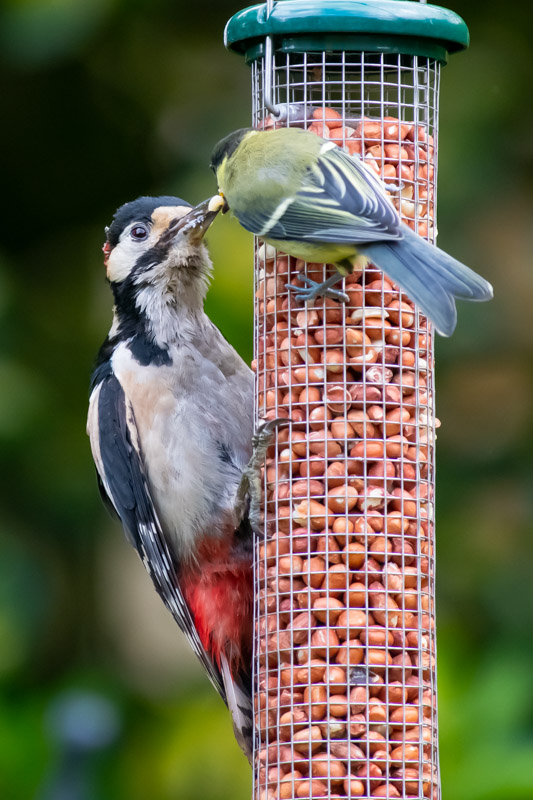
I noticed a male Great Spotted Woodpecker on our peanut bird feeder, so I grabbed my camera + telephoto lens to photograph it because I had only seen a female visiting for the past couple of weeks, and I wanted a picture of the male. What happened next surprised me
The GSW, after pecking repeatedly at the nuts for a minute or two at the base of the feeder, climbed to the top where a recently fledged Great Tit was waiting. The GSW then proceeded to try and feed pieces of peanut to the young Great Tit, while an adult Great Tit watched from another feeder close by. This process continued for perhaps a little less than a minute before being interrupted by the arrival of our postman, at which point both birds flew away.
Later during the day the adult male GSW returned to the feeder many times, as did an adult female GSW (possibly from a different pair as both birds always approach and fly away from the feeder in opposite directions). The unusual behaviour pattern I witnessed earlier in the day was not repeated.
Background info: we have a garden of just under half an acre, with plenty of small to medium trees for cover, and we have four hanging feeders – fat balls, peanuts, niger seeds and sunflower hearts, plus a tray feeder enclosed in a cage to keep out pigeons. We regularly see goldfinches, greenfinches, GSWs, robins, house sparrows, great tits, blue tits, starlings, blackbirds, chaffinches, a couple of nuthatches, dunnock, collared doves, pigeons, jackdaws, and less often a wren, coal tit, long-tailed tits, and thrushes. In winter, regularly visitors include redwings and fieldfares that feed on our cotoneaster berries, and the occasional bullfinch and blackcap. I have pictures of many of these garden birds too.
This page from the BTO offers a few suggestions as to what might be happening here.