Buckholt Woods / Painswick Stream – 8th July 2024

by Alan Waterman

This meeting was led by John Field ably assisted by his son Henry.  The group met up at the small car park for Buckholt Woods and John went through the preliminaries, not only health and safety for ourselves but also the Crayfish. We had all been advised that our footwear (wellies) had to be scrupulously clean and disinfectant spray was on hand to make doubly sure.  John apologised for the initial ambiguity over the date for this meeting (although that was not necessary) but explained that the Crayfish are fully protected from any interference until July 1st as they are breeding, and the females are carrying eggs and young and that if they are captured, they will release the eggs or young which is obviously not beneficial. Also, that Crayfish do not refer to the calendar so depending on the local conditions the safe date to catch and observe them is of necessity variable.

John works for GWT and is involved with their efforts to conserve  the White-clawed crayfish, this involves providing refugia for the Crayfish  and natural flood management structures that have been  installed in the Painswick Stream at Cranham Scout Centre and Buckholt Woods.

The work is quite complex and involves various operations, initially we were shown stream management which has become more untidy and more natural over the years, mostly trees that are close to the stream are felled ( usually Ash with dieback) and allowed to fall across the steam and other branches etc are introduced to provide a natural barrier. Also, the Crayfish are detritivores so they will feed on rotting bark and other dead plant material that collects in these natural dams. In addition to helping the Crayfish the water retention helps reduce the risk of flooding lower down in places like Stroud.

As most of us are aware that the White-clawed Crayfish is our native crayfish but in recent years the Signal Crayfish has been introduced and has widely replaced the native species. Signal Crayfish are bigger, more resistant to pollution and disease and they are more able to spread from place to place. Even if there were no disease or pollution John said that the Signal Crayfish would gradually out compete and replace the White-clawed Crayfish.

The main disease of crayfish is a fungus called  Aphanomyces astaci , both species are vulnerable to it, but the Signal Crayfish has a slightly thicker exoskeleton so is more resistant. Transport of signal crayfish, and  infected native European freshwater crayfish between waters is the main cause of contamination, though the disease can also be spread via items that have been in contact with contaminated water, such as a fishing tackle and  footwear. The spores are sensitive to high or low temperatures. ( pour boiling water over you wellingtons). They also suffer from another disease called Porcelain disease, where the under sides of their abdomen appears white.  Its tough being a White-clawed Crayfish.

Another aspect of the GWT’s  work is to capture and relocate adults to areas where the crayfish were once found but have recently disappeared from. John explained that they aim to move 200 individuals at a time but they each have to be checked so that 50% are male and 50% are female also that they are the right size, so no small young ones and no large old ones and then they are checked to see that they are not showing any signs of disease. Also that they are the right species and no Signal Crayfish slip through.

Apart from managing the flow of the streams they also provide little microhabitats for the crayfish, these are called refugia, it may be a bundle of coppiced twigs ( faggots) laid into the water or a good layer of stones and rocks for them to hide in and to search for food.  Prior to our visit John deployed artificial refuge traps, these resemble overgrown pan pipes and the crayfish use them to hide in. This was where John’s son came in, he had waders on and his task was to retrieve the trap and tip out any crayfish into a white inspection tray. The first trap had two crayfish, both males and the second one had just one, we did not inspect other traps leaving the occupiers in peace. The unfortunates that were caught were duly photographed and John used them to explain to us how to tell the White-clawed from the Signal which is largely to do with sharp little forward facing spines on their carapace that you can feel with your finger as you run it over them. The signal Crayfish lacks these and is quite smooth.

Johns main message was that prevention is key to reducing the spread of crayfish plague. Everybody who enjoys the countryside can play their part in helping to stop the spread of crayfish plague and therefore help to save our native White-clawed Crayfish. Crayfish plague is water-borne and is spread very easily on contaminated kit – wellies, canoes, fishing tackle, etc. It’s really important that people check that their wellies, and other kit, are clean and dry before moving between watercourses so as to prevent the spread of Crayfish Plague. On a practical level this means washing, ideally disinfecting, your boots and other kit at the end of your walk or paddle and allowing them to fully dry before being used on your next wet adventure – that pair of half-forgotten damp wellies or waders in the back of the shed could be harbouring the fungal spores that cause Crayfish Plague. Preventing the spread of non-native crayfish is also vitally important – crayfish must not be removed from, or moved between, watercourses. The trapping of non-native Signal Crayfish for human consumption requires a permit from the Environment Agency, but the activity is discouraged unless part of an authorised eradication scheme. Please note that the native White-clawed Crayfish is a Protected Species and can only be handled by licensed persons.

John imparted a huge amount of knowledge to us during our meeting and answered vast numbers of questions indicating how interested his audience was. Many thanks and keep up the good work.

Ampney Downs, 25th June 2024

By Alan Waterman

A limestone downland area in the east of the county, just north of Cirencester and part of the Barnsley Warren valley system. This meeting was led by Anna Field who is a GNS member and the Glorious Cotswold Grasslands Programme Officer at the Cotswolds National Landscape.
We met at 5.00pm at a location on the narrow road known as Welsh Way which extends east to west (towards Wales?) on a very warm evening, there were about 10 members. We were blessed by the presence of Clare and Mark Kitchen so along with Anna we had several experts on hand to identify the wealth of wild flowers on view.

Calcicoles; plants that like alkaline soils like limestone or chalk. The opposite is Calcifuges which live in acidic conditions, I think of them as refuges from calcium and then there are many species which are not so fussy and live in neutral soils but will tolerate a pH a bit above or below 7. There are many more Calcicoles than Calcifuges so on downlands you can expect a large number of species, and this was exactly what we got.
Obvious early in our walk were the bright pink Pyramidal Orchids which were at their best, we also saw some Fragrant Orchids which were going over a bit and one Bee Orchid and one Common Spotted Orchid.
Once we got onto the steep south-facing slope where the grassland was unimproved, managed by autumn/winter cattle grazing, the numbers of species vastly increased, were you to randomly place a 1m quadrat anywhere in this region I would guess you would encounter upwards of 25 species.
From memory we saw Woolly Thistle, Common Rock Rose, Dropwort, Autumn Gentian ( not yet in flower) Squinancywort, Fairy Flax, Bird’s-foot Trefoil, Betony, Agrimony, Salad Burnet, Red Clover, White , Clover, Eyebright, Common Milkwort, Yellow- Wort, Field Scabious, Small Scabious, Meadow Cranesbill, Yellow Rattle, Ladies Bedstraw, Hoary Plantain, Wild Thyme, Selfheal, Mouse-eared Hawkweed, Oxeye Daisy, Heath Speedwell, Glaucous Sedge, Wild Basil, Bittersweet, Stemless Thistle, and many more. Dyers Greenweed was much in evidence and this a species I had not seen that much in the past, it was used as the name suggests to produce a dye but not green as you might expect form the name but yellow, the colour of the flowers.
Mark Kitchen commented that it was surprising that as we walked back along an old hedge largely composed of Hawthorn and some lovely Dog Roses showing a nice range of colours from almost pure white to a good strong pink that we did not see any Old Mans Beard or Honeysuckle, shrubs normally found in alkaline regions.
This was largely a wild flower walk but we did see a few birds notably a group of 18 Lapwings which evidently nest on the top of the downs also Sky larks were seen and heard, also corn bunting, skylark, yellowhammer, whitethroat, redstart, buzzard, red kite, various commoner species.

Several of the plants had Ladybirds but mostly they were the Harlequin species, there were a few butterflies about but not many largely Meadow Browns and the odd Small Heath.
Many thanks to Anna and her very knowledgeable 8-year old daughter who did her best to spot as many different species as possible. I shot off quickly at the end to catch the England Football match, they got a 0-0 draw, but it was not as memorable as the visit to Ampney Downs.

Tewkesbury Nature Reserve,  17th June 2024

by Alan Waterman

This was our second meeting lead by Giles Alder, he has two hats one is Cleeve Common and this time he was wearing his Tewkesbury Nature Reserve hat. It was a gorgeous June day, blue sky with a few white clouds, just to add interest, nothing threatening, given the poor weather this Spring and summer it was almost the first summers day. A nice sized group of about 12 turned up and whilst we were going through the preliminaries ( don’t fall into the river etc) we heard a Cuckoo from the car park and saw a greenfinch in a hedgerow tree.

There are some Willow growing close to the car park and these were covered with silken webs from Ermine moths.   One of the participants on the walk was Robert Homan the County Moth recorder and he explained that they were Willow Ermine Moths and later we identified Orchard Ermine moths. Great to have him on hand to talk us through the life styles of leaf miners and the complex predator prey relationships involved. Robert supplied this list of some of the more interesting species that we encountered.


Gymnosporangium fuscum  European Pear Rust gall

Aculus tetanothrix Mite gall

Euura proxima Sawfly gall

Heterarthrus wuestneii  Sawfly leaf mine

Agriopis marginaria  Macro moth caterpillar

Epermenia chaerophyllella  Micro moth lavae

Mompha epilobiella  Micro moth larvae

Stigmella aceris Micro moth leaf mine

Yponomeuta padella (Orchard Ermine) Micro moth larval webs

Yponomeuta rorrella (Willow Ermine) Micro moth larval webs

Agromyza viciae Leaf mining fly leaf mine

Chromatomyia ramosa  Leaf mining fly leaf mine

Phytomyza ranunculi Leaf mining fly leaf mine

Pentatoma rufipes Shieldbug nymph

We meandered round the site, roughly following the small river Swilgate and taking care to not fall in though at one point there was a nice dragonfly resting on the reeds but just a little way out so it was tempting to lean out a little to get a good photo. This turned out to be an immature female called a Scarce Chaser. Aptly named as it is the rarest of the Chasers and Giles later confirmed that there had only been one previous record of it at the site back in 2020. ( photo supplied by John Woodbridge) There were various other damsel flies about including the very beautiful and delicate Banded Demoiselle. Not quite so eye-catching was a snail also on the reeds by the river, this was later identified as Succinea putris and is a first record for the site, not perhaps for its rarity but because it had previously been overlooked. This species is also an intermediate host for a fluke which also parasitises birds like Robins and Wagtails.

On the bird front we saw a reasonable range, this list supplied by GNS member Mike Daw.

Cuckoo, Blackcap, Skylark, Herring Gull, Wood Pigeon, Magpie, GS Woodpecker, Greenfinch, Chiffchaff, Mallard, Reed Bunting, Starling, Buzzard, Sedge Warbler, Goldfinch, Heron, Wren, Swift, House Martin, Blackbird, Reed Warbler, Dunnock.

We also came across a member of the public kitted out with telephoto lens, binoculars and a phone app who said he had heard but not seen a Bluethroat  ( identified from the phone app???) We did not see or hear one.

The second part of the walk crossed some nice wet meadow type of habitat and our attention turned mainly to the wild flowers and there was a good range to be seen including some difficult to identify umbellifers.  Several members had some knowledge but no that we had absolute experts but subsequent investigations by Giles and Alan Waterman suggest.

This is a list from my memory and with thanks to Des Marshall who took the trouble to note down some of the species we came across.

Common Meadow Rue Pepper-Saxifrage Thalictrum flavum Silaum silaus
Great Burnet Sanguisorba officinalis
Narrow-leaved water dropwort Oenanthe silaifolia
False fox sedge Carex otrubae
Purple loosestrife Lythrum salicaria
Hard rush Juncus introflexus
Smooth tare Vicia tetrasperma
Hairy St.John’s wort Hypericum hirsutum
Glaucous sedge Carex flacca
Grass vetchling Lathyrus nissolia

Greater Knapweed                                                                  Centaurea scabiosa

Finally a big thanks to Giles who has now taken us on two very interesting walks. It was apparent that the majority of folks present had not visited the Tewkesbury reserve before and if you have also not been there before then it is well worth a visit.

Hawkweeds in Gloucestershire

There are many flowers that look like Dandelions to the non-specialist. This key by Tim Rich will help you sort them out. He provided it as an introduction to a workshop on the genus Hieracium (Hawkweeds) given in Painswick on 9 June 2024 where his Key to Hawkweeds in Gloucestershire (available as number 43 in The Gloucestershire Naturalist series) was presented.

Ermine Moths

Several of us have noted unusual defoliation, especially of willow trees, in the Severn Vale recently. The trees look as though they have almost entirely lost their leaves, as if winter is approaching. We have never noticed such extreme loss of leaves in previous years, so it seems to be an exceptional phenomenon this year. We first noticed this at the Gloucestershire Wildlife Trust’s Ashleworth Ham reserve, where Richard Humphreys has taken a series of photographs. It is clear that the outbreak is caused by the Willow Ermine Moth, which leaves webs containing caterpillars on the trees.


Rob Homan, the East Gloucestershire Moth Recorder for Vice-County 33 (East Gloucestershire) comments: “It really is an extraordinary phenomenon”. He confirms that the occurrence seems to be much heavier than usual, and notes that the same phenomenon has been noted on spindle trees.  He has provided a map showing the distribution of adult Willow Ermine moths in Gloucestershire (green dots) and the distribution of larval webs (red dots). All records up to 2023 are included. The contrast in the two patterns is marked. Note the rogue web in Cheltenham, seen last year, but not seen at that location this month.

Map produced by Robert Homan (Contains OS data © Crown copyright and database right 2024.)

He adds: “I have been in contact with the Worcs moth recorder – plenty of webs as is normal along the Severn and Teme valleys, but no records for 2024 for defoliation. Nothing of note has been added to iRecord for the species.”

Further searches have recorded intensive occurrences of moth webs in a variety of sites across the county, in particular at Coombe Hill, along the Leadon, and on the Avon north of Tewkesbury, mainly on willows but also on spindle trees (as far south as Frampton).    

This is a preliminary note to make GNS members aware of the numbers of Ermine Moths this year, and to appeal for further information. We may be able to present a more complete account of this year’s observations later in the year.


Meanwhile, the following note from May 2014 on Butterfly Conservation’s website may provide some useful background:

“At this time of year we often receive reports of ghostly silken webbing covering sections of hedgerows and, on occasions, individual trees. Although it can look rather sinister, don’t be alarmed. The most likely culprit is a harmless caterpillar.

“Webs have already been seen in parts of Dorset in the last week or so. These striking and obvious webs hide hundreds and sometimes tens of thousands of caterpillars of a group of moths called the Small Ermine moths. There are eight species in this group, although only the Orchard Ermine Yponomeuta padella, Spindle Ermine Y. cagnagella and Bird-cherry Ermine Y. evonymella tend to produce such extensive webbing, the former mainly on blackthorn and hawthorn, the others on spindle and bird-cherry respectively. The Bird-cherry Ermine tends to have a more northern distribution compared to the other two and occasionally whole trees can be covered by their webs, the leaves stripped bare giving the tree an eerie appearance. Sometimes these webs are so extensive that they can cover nearby objects such as benches, bicycles and gravestones.

“Why do these species spin these webs and live together in such large numbers? It’s a successful evolutionary strategy, providing protection from predators through safety in numbers. However, numbers are hard to hide and hence the production of the silken webbing.


“These webs and caterpillars are harmless and usually last from May to June. The webs slowly disappear over the summer and typically the hedgerow shrubs/trees recover. The adult moths fly later in summer and all look superficially similar, being white or greyish with many small black dots, hence the ermine name.

“Ermine moth webs should not be confused with other web-forming larvae, which can be found around the same time, although these nests tend not to be so extensive and the caterpillars of most are hairy. Nests could belong to the nationally scarce Small Eggar Eriogaster lanestris, whose webs can reach the size of a small football; the declining Lackey Malacosoma neustria, with their striking stripy caterpillars; the Brown-tail Euproctis chrysorrhoea, which is expanding its range; and the introduced Oak Processionary Thaumetopoea processionea. The caterpillars of the latter two have urticating hairs, i.e. these can cause rashes, and because of this we advise that all hairy caterpillars and webs should be avoided and not handled.”

Mark Parsons
Head of Moth Conservation

Stephen French adds…

“Yes, I’ve witnessed the evidence around Ashleworth and Tirley, where I often walk. Both Spindle and Willow Ermine are having a “good” year – if that’s the right term!

It’s certainly the most noticeable outbreak of Willow I have ever seen. Even some of the tree trunks are totally clad in the webs.

There is normally no lasting damage to the trees – we will have to wait and see whether the sheer scale of things this year changes that. As to why they are so numerous, I have no idea (Climate? Lack of predators?).

As Robert says, the adult moths will be on the wing soon, so we can monitor how the trees recover (although we may have to wait until next year now).

I’m doing some targeted moth recording/trapping at the nearby Hasfield Estate. It will be interesting to see if numbers of the adult moths reflect the dramatic increase in the larval stage.”

Special editions of The Gloucestershire Naturalist

Two new special editions of The Gloucestershire Naturalist will soon be available, TGN 42 on the Landscape and Landforms of the Cotswolds and TGN 43, a Key to the Hawkweeds are likely to be of limited interest, so to avoid wastage, will only be available to those members requesting copies. Full details and order forms are on the flyer which can be downloaded and printed using the link below. Please note, non-members and digital only members will be required to pay £9.00 per copy (P&P included).

Coombe Hill – 21st May

On 21 May (this year coinciding with Biodiversity Week) ten GNS members attended what has now become an annual evening field meeting in early summer at the Gloucestershire Wildlife Trust reserve at Coombe Hill. The aim was to look at breeding waterbirds and to note any other birds that might come to roost on the scrapes in the evening. After a very wet winter and spring, with almost permanent flooding from late October until mid-April, many of the meadows were still very damp, often with a mat of dying vegetation preventing normal spring flower growth – reminiscent of the historic July 2007 floods.

The evening timing meant that there was only limited birdsong along the towpath, though Sedge and Reed Warblers, Blackcap and Lesser Whitethroats, Chiffchaff and Reed Bunting were all heard; rather surprisingly, there was no Cuckoo song, though this species has been heard by day on the reserve. While walking along the towpath, we met a group of very young boy and girl scouts in full uniform who said they had enjoyed their visit and seen lots of swans.

From the hide overlooking the scrapes we too saw up to 30 Swans, mostly immature non-breeding birds that have concentrated here for the summer: a swan nest below the boardwalk appeared to have been abandoned. At least five broods of Mallard ducklings (some of them nearly full-grown, so the eggs must have been laid early on when the floods were still high, perhaps in nests in the boles of willows and other trees), and broods of very young Coot were seen. Because of the very wet conditions, wader nests were late: a single Oystercatcher was incubating in a determined way; probably two pairs of Avocets (though hard to be sure, as they often settle on the islands on what look like nests, when in fact they are just resting); a single pair of Little Ringed Plovers; Lapwings were mainly nesting on a barley field; Redshanks were present and noisy with breeding calls but may not yet have settled down to lay eggs; just before dusk, four adult Curlews flew in, two pairs, one of them carrying rings that showed it to be one of the birds raised in an incubator from eggs (“head-started”) at Slimbridge in 2019 and now nesting nearby; their arrival was not a good sign, since if they had had an active nest, they should have been incubating the eggs; indeed it was later confirmed by the WWT team studying Curlews in the Severn and Avon Vales that the nest had failed today.

Also present were an immature Great White Egret, and several Grey Herons, some of them immatures, just flying, from a nearby heronry.

No sign of migrant waders like Greenshank, which may well be passing through on their way to Arctic breeding grounds as this time of year, but – as agreed by the members who took part – a magical experience at this time of year producing a feeling of calm serenity.

There was also a good display of Tiger Sawgill fungus (Lentinus tigrinus), an uncommon find in Britain, growing here on the waterlogged rotting branches of willow.

Cleeve Hill field meeting report

by Alan Waterman

Weather is always an important factor and, in the lead up to this meeting it had not been good. We met in the Golf Club Carpark and even there the views are quite spectacular but also give you a good indication of the weather to come. It was quite cloudy and was cold and very windy. Thus, I put on two
extra layers, one to keep warm and one to keep dry.

Giles Alder was the leader he is the warden working for Cleeve Common Trust providing conservation advice, and working with volunteers on conservation and wildlife monitoring projects. He welcomed the small group who had braved the conditions and after negotiating the Car park ticket machine we eventually set off. We had already spotted two Swallows and a Kestrel from the car park.

The first 10 minutes was up and exposed, but Giles had said it would lead us to a more sheltered area, he was right and thank goodness as it was quite bitter to start with. Giles pointed out the rare Purple Milk Vetch which likes the short cropped grass, in April it was not in flower, a bit latter we did see numerous Early Purple Orchids and they were in flower. There were good views of Sky Larks and Meadow Pipits in this area. We also had a look for Adders which could have been out as there was some sunshine and in the sheltered areas where we had headed for it was possible.

Largely it was a bird watching meeting and it had been timed to give us a chance at Ring Ouzels, Giles of course knew the best areas. He said someone had posted a shot with 5 birds all together on FB recently, It was pointed out that with Photoshop anything can be arranged now a days. We saw a good range of
birds, and many were in full song. Lots of Willow Warblers and some Chiffchaffs, also Blackcap, Red Kites and a Buzzard, a particularly nice Goldfinch with a beak full of white sheep’s wool. And then a little distant but not too far off was what we were all hoping for the Ring Ouzel. This was a female so only just a slight lightening of the plumage on the breast not the more obvious white as shown by the male. This one had a peculiar white spot on one side of its head. Those of us with cameras did snap away but the distance was a bit too far, although Giles said it was not as distant as they often are. We followed a route round, and the sun came out more and more and the two layers I had on by that stage seemed a bit excessive. The day warming up had the advantage of bringing out some Adders and we saw three also three slowworms. Along the final stretch we also saw Stone chats.

Many thanks to Giles, an excellent guide and he is also leading another meeting for us on Monday 17th June at Tewkesbury Nature Reserve.

Pasqueflower

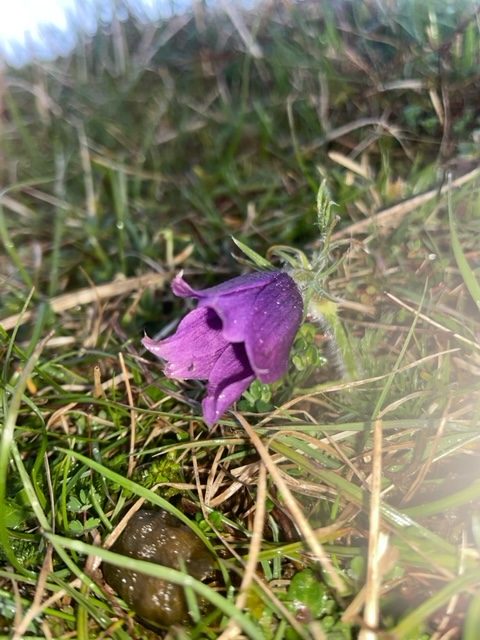
Pasqueflower (Pulsatilla vulgaris), a rare member of the buttercup family, is just coming into bloom. It still can be seen on a few sunny grasslands on thin soils in the Cotswolds, attracting visitors from far away, this time Chris Heath while he was back on holiday from his job in Zambia. Pasqueflower means Easter Flower but with Easter so early they took some finding, even on this well-known site on the steep banks of Barnsley Warren. In early summer the purple petals are replaced by attractive feathery seed heads.

Woorgreen and Crabtree Hill Sunday 24th March.

Good weather and a nice sized group, we were lucky to have some experts on hand so that a good range of species
could be identified. With one exception(reptiles) we managed to spot representatives of all the major groups.
On the botanical side we were able to distinguish between Evernia and Ramalina, both are similar lichens and we
even found the two species on the same twig making comparison more easy. Another pair of similar looking
lichens were Parmelia sulcata and Flavoparmelia caperata, the former being bluer green and the later more apple
green. Fungi were not surprisingly few and far between but a large though ageing specimen of the yellow Witch’s
Butter fungus Tremella mesenterica was found close to the top of Crabtree Hill. Also, a slime mould was found,
pink and globular it was not positively identified at the time but was most likely Lycogala epidendum sometimes
known as Wolfs Milk. The conifers were well represented and perhaps the most notable were the Larches (our
deciduous evergreen!) these were just coming into leaf. Then it was a matter of deciding which species of Larch,
European or Japanese or even the hybrid, examples of both were found. Towards the end of the meeting, we
found some Horsetails just poking their heads skywards and in terms of flowering plant there was a reasonable mix
but very few were in flower. Close to the carpark there was quite a lot of Wood-sorrel which is Oxalis, and further
round we saw Sheep’s Sorrel which is Rumex. The Wood-sorrel was in flower but perhaps more impressive than its
white nodding flower heads were the bright green, acid green leaves, the Sheep’s Sorrel was not in flower, another
month or so before its dotty red flowers appear.

In the animal kingdom we managed a few invertebrates including a deceased dung beetle, a mix of bees feeding
on a willow species that was in flower and one Peacock Butterfly that was enjoying the sun.

There were a lot of tadpoles in a stream the flows along the lower section of Crabtree hill, it was agreed that they
seemed to be a quite an advanced stage for the time of year, not quite getting their back legs but not far off, just
as well because the water course they were living in is not permanent and is normally dry in the summer. Whether
they were destined to become frogs or toads, the group had mixed views on that.

No reptiles though the weather was warm enough to bring out a lizard or adder, but none were spotted.

Birds were not in great evidence but with about 18 keen pairs of eyes on the lookout we did manage a reasonable
list but nothing that exciting. Mike Daw keeps a mental note of what is seen and supplied me with this list:
Great Tit, Long-tailed, Tit, Blue Tit, Coal Tit, Nuthatch, Robin, Wren, Siskin, Chaffinch, Chiffchaff,
Treecreeper, Goldcrest, Blackbird, Mandarin Duck, Mallard, Canada Goose, Raven, Goshawk, Buzzard.

Before the meeting commenced at 10.30am there were a couple of Carion Crows around the car park and on the
way round some members with good hearing picked out a Blackcap singing along with Woodpigeon and Mistle
Thrush.

We did see about 4/5 young Fallow deer running across the path and they successfully jumped the fence that
surrounds the site, no signs of cattle or ponies on this visit. Plenty of evidence though of Wild Boar both their
digging and their droppings.

Thanks to all who attended and the expert knowledge that was shared with the group.

Skip to content