Coombe Hill and Ashleworth today

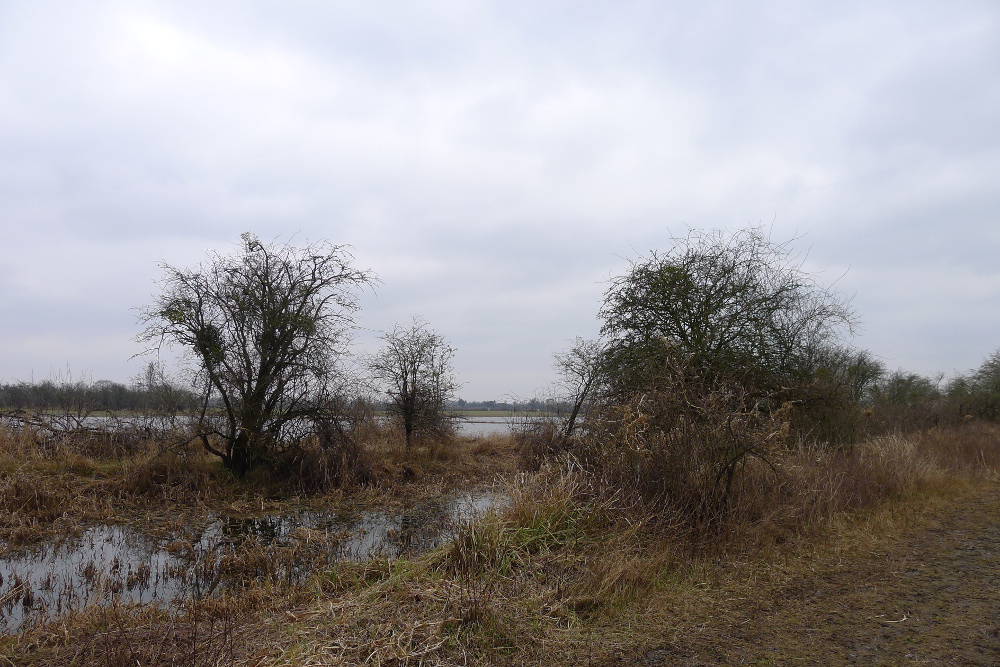
A sharp frost this morning  left ice on the edges of the waters; despite the bright sunlight, the wind remained cold, and there were still no singing Chiffchaffs or other migrant songbirds.  Water levels on the scrapes and pools in the meadows continue to drop slowly.

At Coombe Hill: 16 Shelducks (four pairs and eight unattached males, teh latter lekking actively), 8 Wigeon, 130 Teal (decrease in the last few days), 60 Mallard, 4 Tufted Ducks, 5 Little Egrets, 1 Little Grebe (whinnying); 5 Little Ringed Plovers, 12 Lapwings (a little aerial display), 5 Curlews (with bubbling display call), 18 Snipe, 1 Great Spotted Woodpecker drumming, 1 or 2 Skylarks singing, 1 Tree Creeper singing, 2 Pied (not White) Wagtails.

At Ashleworth, there were rather more ducks: 54 Wigeon, 350 Teal, 54 Mallard, 7 Pintail, 9 Shoveler, 5 Tufted Ducks: a Mute Swan on a nest with one egg in the middle of a field; only 1 Lapwing. 2 Curlews, 15 Snipe, 1 Goldcrest singing. 20 Fieldfares, 3 Redwings.
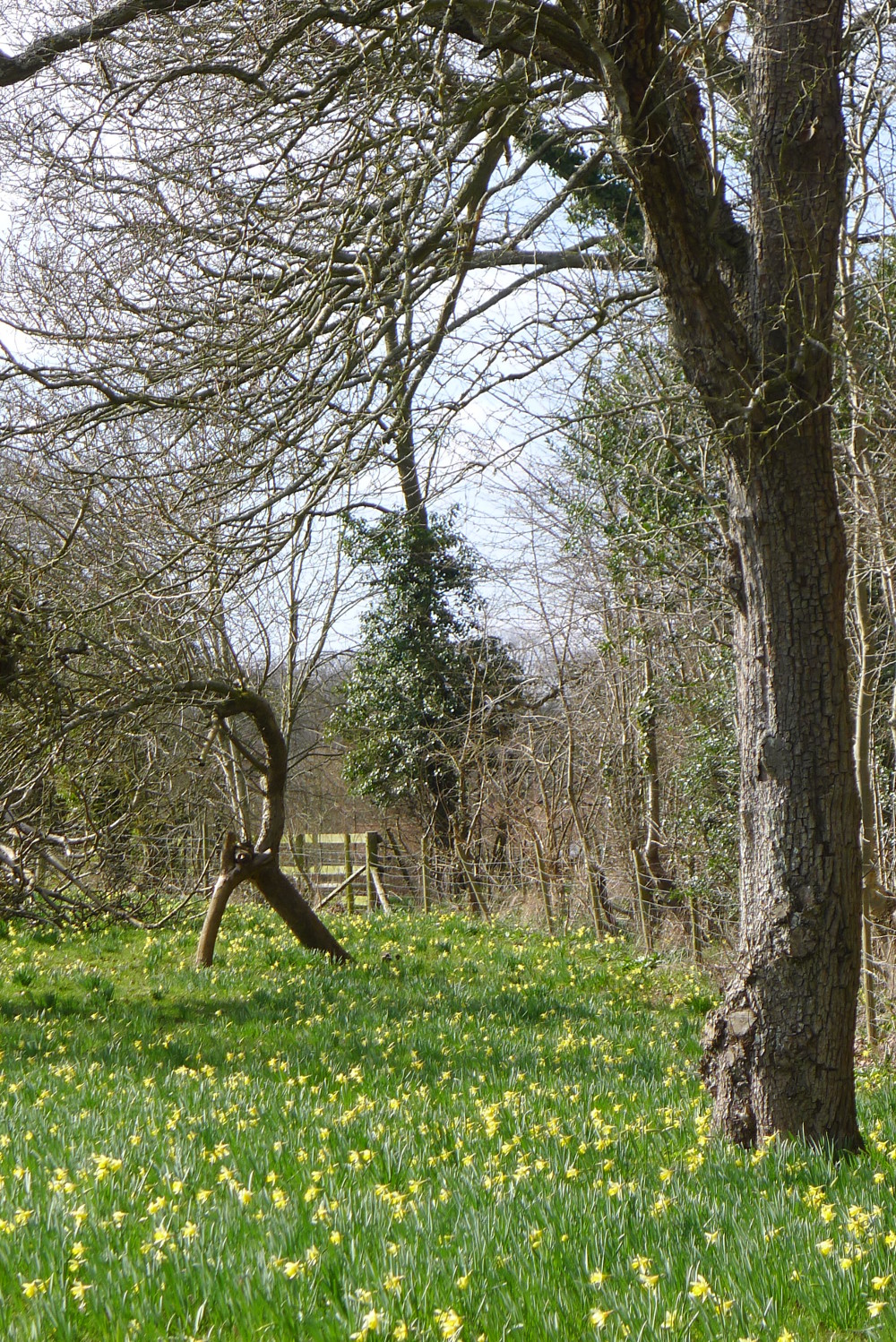
Daffodils!

The wild daffodil season is several weeks late, but getting going now.  Good places to see them include the Wildlife Trust reserve Gwen and Vera’s Fields SO696276, pictured here, and the adjoining Greenaway’s Wood. It is a joy driving round this part of Gloucestershire right now, as the Wild Daffodils (Narcissus pseudonarcissus subsp pseudonarcissus) are often abundant on the verges.  So cheer up, spring really must be just around the corner.

gwenandveras

Bluethroat sighting

A male Bluethroat (Luscinia svecica) was trapped at a private site in the county earlier in the week. The bird showed features of the subspecies “cyanecula”. Perusing of my, albeit not large, collection of Gloucestershire Birds Reports (2003 onwards), I have not been able to find a recent record of the species in the county. A number of Bluethroats have been reported from various points on the south coast of the UK in the last few days suggesting that this particular bird is part of a small influx of the species.

20130404 Bluethroat

Posted on behalf of David Anderson.

Morning and evening at Coombe Hill

Not surpisingly, if you go to the Coombe Hill GWT reserve at different times of day, you see different things.  Water levels have dropped a little since the weekend; the Long Pool hide is now accessible, and some migrant waders are beginning to show.

First, Les Brown’s observations from this morning:

4 Mute Swans.  2 Canada Geese.  11 Shelducks.  c90 Teal.  c40 Mallard.  2 Pintails.  10 Tufted Ducks.  1 Grey Heron.  2 Little Egrets.  12 Coots.  61 Lapwings in a flock with 3 Golden Plovers and  c20 Lapwings in meadows to south of canal,some displaying. 7 Curlews.  2 Snipe.  2 Dunlins.  1 Redshank. 1 Little Ringed Plover.   2 G.S.Woodpeckers.  3 Reed Buntings.

When I looked this evening, staying until after sunset, my main interest being Curlews, I saw waders were mainly on the damp bits of the Southern Meadows – now 3 Little Ringed Plovers (a migrant species which winters mainly south of the Sahara), a Ruff (another miogrant wader) and one Dunlin, but no sign of Golden Plover or Redshank.  The biggest difference was in Curlew numbers; by 19h50 (sunset at 19h35) 35 individuals had come in to roost, some of them apparently in pairs; were these local breeders, or passing migrants?  If local breeders, wherever did they all come from?  Also at least 265 Teal.  And a flock of 60 Fieldfares (migrants which breed in Scandinavia) on the ground.  And a Little Grebe whinnying.  And 4 Little Egrets.

Sadly, no Snipe, drumming or otherwise.

Still no Chiffchaffs singing; these summer visitors would normally have been in full throat since mid-March

Polecat Confirmation

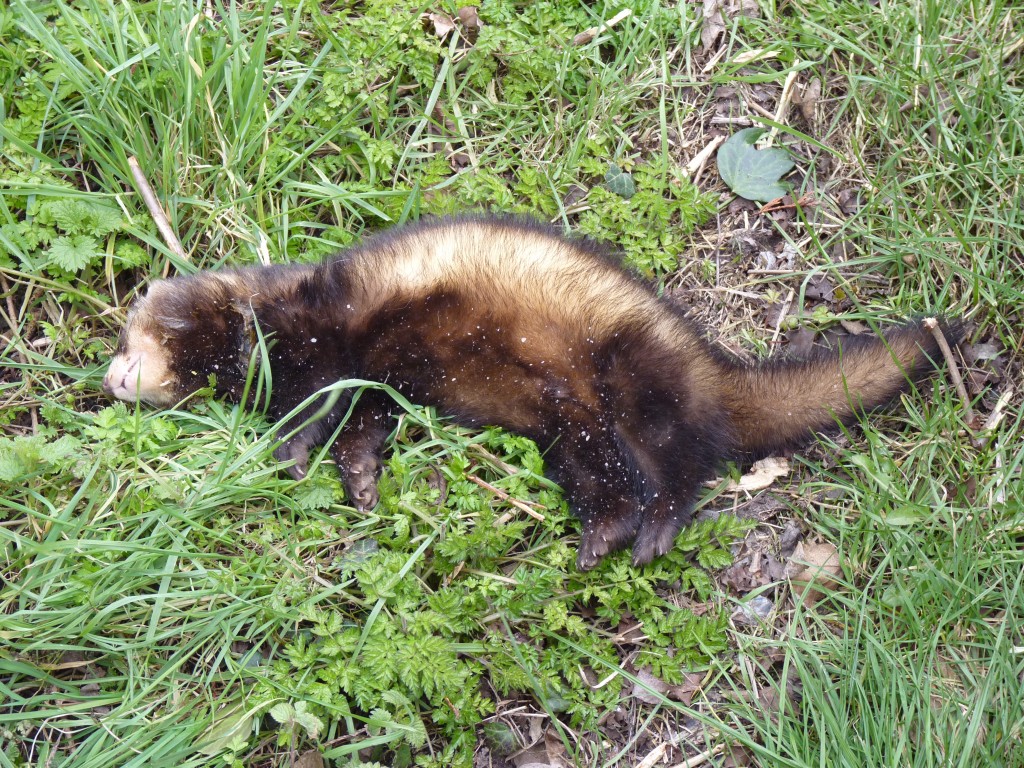
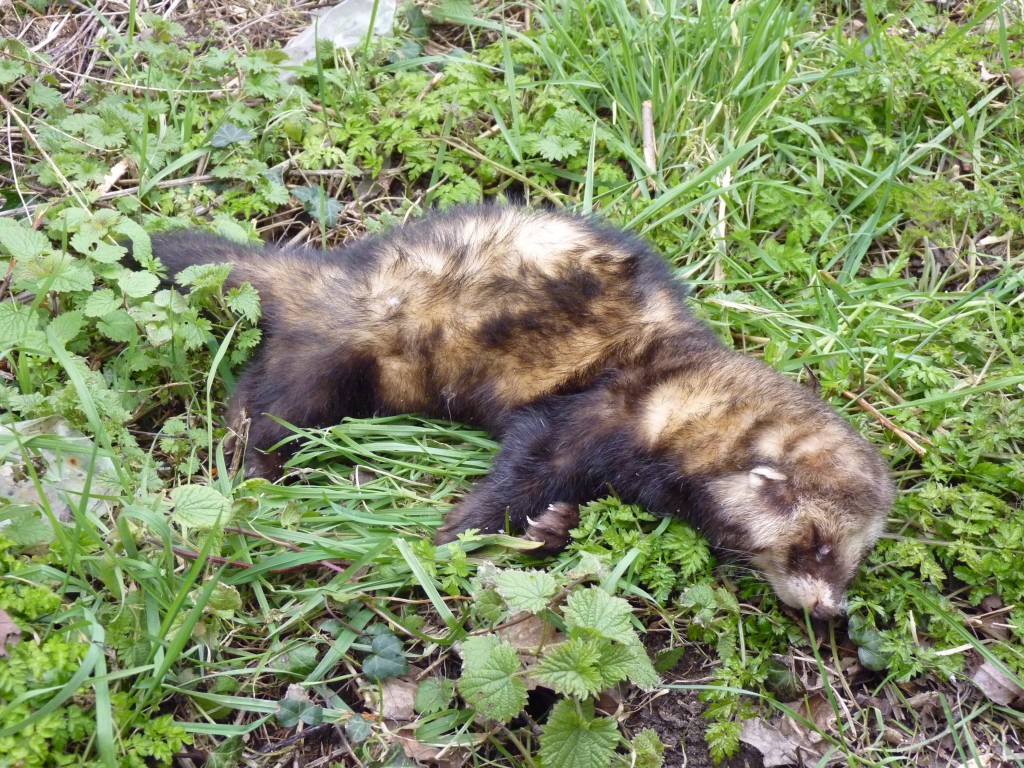
Regarding the probable Polecat – see photos etc below, posted by Andy Jayne on February 24th, the same animal was seen by Andrew Bluett and again photographed. A report with the photographs was sent to John Field, mammal recorder at GWT, his response follows:

“Thank you very much for the record, particularly the photographs. Your photos clearly show that your specimen was a true polecat and not a polecat-ferret hybrid. You are probably already aware that true polecats can/do interbreed with escaped domestic ferrets and as a result it can be hard to distinguish a polecat from a hybrid animal.

However, there are five pelage signs to look out for to be able to determine a true polecat from specimens with ‘ferrety’ characteristics:

Nose – In true Polecats the brown fur on the nose extends all the way down to the nose, this is very obviously the case with yours.

Face – True Polecats have pale cheek patches contrasting with the dark facial mask. Yours had the classic Polecat mask.

Throat – True polecats don’t have extensive throat patches or a white mink-like bib on the chin. No throat patch on yours, although it does have a pale (but not white) chin

Guard Hairs – True polecats don’t have white guard hairs. No white guard hairs visible with yours – there are a couple of white hairs visible however they’re just from scar tissue and not “guard hairs”

Paws – All four paws of a true polecat will have dark (almost black) fur. Polecat-ferrets often have a bit of white on one or more paws. Four dark paws clearly visible on your specimen

No ferrety characteristics at all, so I’m happy for yours to be recorded as a true polecat”

References: The Distribution & Status of the Polecat… http://jncc.defra.gov.uk/page-2795 – OR just put Polecat into your search engine…

All dark paws
All dark paws
Polecat Mask
Polecat Mask
Polecat - full view
Polecat – full view

Severn Hams today

Flooding on the meadows is still extensive, and has hardly decreased at all in the last few days.  Cold easterly weather (still snow remaining on the Cotswolds and Malverns), little sign of migrant birds – still no Chiffchaffs singing.

Coombe Hill, where much of the floodwater was iced over early on: 10 Shelducks (lekking on the ice), still good numbers of Teal  (505 counted, but no Garganey found despite careful search), 2 Gadwall, 30 Mallard, 7 Tufted Ducks, 1 Great Crested Grebe (new arrival), 1 Grey Heron, 19 Coot, 60 Lapwings (mainly in flocks, though with some display), 1 Little Ringed Plover (an obvious migrant, flew in from south, calling), 2 Snipe, 6 Curlews (appeared to be three pairs), 1 Great Spotted Woodpecker (drumming), 1 Treecreeper (singing), 2 Yellowhammers (new arrivals), 4 Reed Buntings (singing).

Cobney Meadows, water considerably lower: 2 Shelducks, 230 Teal (no Garganey either), 1 Little Egret, 2 Oystercatchers (pair), 2 Curlews (pair)

Ashleworth Ham, where water levels had hardly declined at all: 78 Wigeon (only ones seen all day; most seem to have departed), 270 Teal, 45 Mallard, 13 Pintail, 21 Shoveler, 2 Tufted Ducks, 1 Great Crested Grebe (also a new arrival).

Severn Hams on Tuesday 26 March

The level of the Severn has dropped a little over the last couple of days, but it is still relatively high, so that it is difficult for tributaries to discharge their waters into the main river.  Little outflow from the River Chelt at Wainlodes, none from the Deerhurst Parish Drain, which drains Coombe Hill and Cobney Meadows.  So water on the meadows is everywhere higher, rather a disappointment when it appeared at last to be dropping.

The bitter east wind made conditions unpleasant; no sign of summer visitors such as Chiffchaff or Sand Martin.

Coombe Hill: water levels have risen since Sunday, and the level is above the top of the stage boards in the north and south scrapes (so above 1.00).  Rather few birds present; presumably most of the remaining ducks were sheltering from the wind, unseen, in the Long Pool.   No sign of the male Garganey found on Sunday.  Only 10+ Teal (undoubtedly an underestimate), 2 Gadwall, 1 Shoveler, 10 Coot, 100 Lapwings (all that remain of the flocks of many hundreds in the area over the last few weeks); 2 + Curlew – what appeared to be a resident pair on the southern meadows, bubbling actively; 1 or 2 Skylarks singing, 3 or 4 Reed Buntings singing.

Cobney Meadows: flooding has risen again and is quite extensive: 30 Mallard, 50 Teal, no sign of Lapwings.

Ashleworth Ham: Water also very high, Hasfield Ham side inaccessible: 60 Wigeon, 205 Teal, 4 Gadwall, 9 Pintail, 9 Shoveler, good numbers of Snipe on some flooded (60 Snipe and  2 Jack Snipe), 60 Fieldfares (the last few migrants), no Lapwings.

Field Meeting at Coombe Hill Canal, 24 March 2013

Poisonously cold for Palm Sunday with a biting northeast wind, a speckle of snow flakes in the air and snow on the Cotswolds. And we had been hoping for summer migrants!

Two members accompanied Mike Smart, the leader, along the muddy towpath from which there were good views across the flooded meadows, which looked pretty desolate.  small20130324_113551_1070874

Little bird song – the odd Dunnock, Wren, Greenfinch. Only four Lapwings, one or two Curlew with a little bubbling, one Little Egret, one Grey Heron, one Cormorant in flight, a Sparrowhawk hunting along the towpath, and a Tree Creeper in the withy bed

However, some shots from the Apperley side (presumably for clay pigeons) put up the ducks from the Long Pool, and it transpired that there were still good numbers of Teal, about 370, with 7 Wigeon, 6 Shoveler, and the odd few paired Mallard.  A more careful look revealed a male Garganey skulking in the withy bed, and keeping rather separate from the Teal, so we did have one migrant.

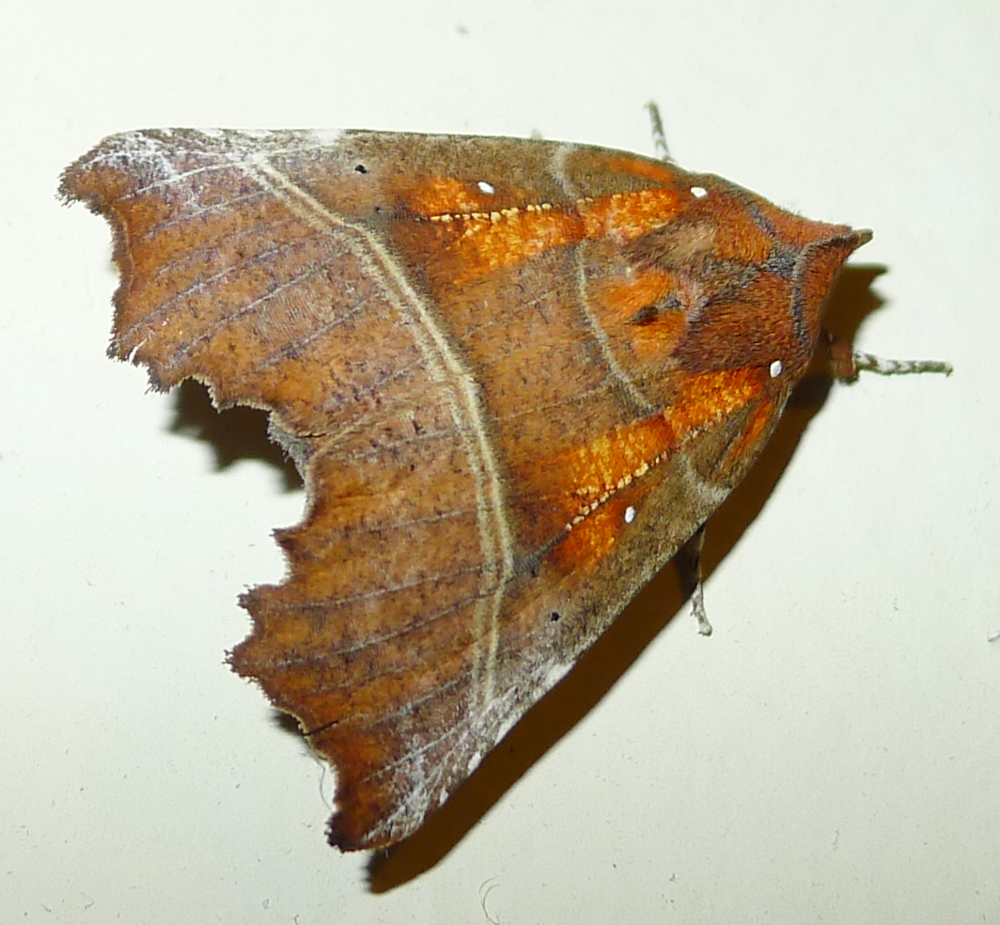
Herald Moth, Standish, 6 March 2013

A Herald Moth (Scoliopteryx libatrix) was on the wall in my hall.  herald

I sent the photo for confirmation to Robert Homan, the County Moth Recorder for V-c33, East Gloucestershire, who kindly supplied some supplementary information.

The Herald overwinters as an adult, and Robert suggest it may have been drawn out of hibernation by the recent brief outbreak of spring. I asked if it was called the Herald because it heralds the spring.  He dashed such notions, saying that in “The Scientific Names of the British Lepidoptera – their history and meaning” A Maitland Emmet suggests that the “herald” might be derived from Linnaeus’ original name of libatrix – “the moths’ vestiture may have suggested to him a stately robe, suitable for ceremonial duty.

Robert has provided this distribution map of the Herald in East Gloucestershire which shows a close parallel with the main river systems and thus its larval food plants – willows and poplars – both of which occur in my garden.herald_in_vc33


Polecat ?

I don’t know if the identification can be confirmed by these pictures, but this recent road casualty by the A38 at Coombe Hill today appears to be a Polecat Mustela putorius. Comments please!


20130224 P1030511 Polecat

20130224 P1030514 Polecat

20130224 P1030517 Polecat

Skip to content