Red Kite at Woolaston Common

Red Kites are becoming a more familiar sight with every passing season in the Cotswolds as the Oxfordshire/Berkshire population increases and spreads out. Kites to the west of the Severn though are still relatively infrequent by comparison but they do show up now and then as this photograph of one of two Kites seen circling with a Buzzard over the Woolaston Common area shows.  Photo by David Priddis, 20th April 2013

Red Kite IMG_3082_cr

Cleeve Common sightings and a Cuckoo

Cleeve Common: Between 1pm and 2pm

2 Ring Ouzel
4 Singing Willow Warbler

Bill Smyllie Butterfly Conservation Reserve.

2.30pm a Cuckoo. Digiscope record shots below.

20130419 Cuckoo 1

20130419 Cuckoo 2

Posted on behalf of Ken Cservenka.

Exotic migrant???

Yesterday I posted comments regarding the increasing bird activity and incoming migrants, today, this little gem arrived in my garden.

I don’t really think it’s an exotic migrant, just an unfortunate escapee…

Eastern Rosella (Platycercus eximius) IMG_1865a

Eastern Rosella – Platycercus eximius

Bird Activity intensifies…

As will be seen from Mike Smart’s account of the Black Tailed Godwits heading north through Coombe Hill, it is evident that bird activity is increasing now that the chill resulting from the over-southerly position of the Jet-Stream has eased. In the past 10 days or so Swallows amd a few Martins have begun to appear, the Ring Ouzels made their annual Spring appearance at Cleeve Hill, a few other migrants have been seen, particularly over the hilltops to the east of the Severn.

The Blackcap and Dunnock that have been feeding in my garden all winter have now been issuing bursts of welcome song for a couple of weeks,the Blackbirds who have also been daily visitors to my feeding station have chicks in the brambles behind my garden fence.

I heard my first Chiff Chaff singing at Horsbere Brook on 7th April, eight days later on the 15th, I heard the first Willow Warbler singing in almost exactly the same spot.

It reminds me of a childhood rhyme… The Spring is sprung, the grass is riz, I wonder where the birdies iz?

Cuckoos shortly I hope..!

Black-tailed Godwits at Coombe Hill this month

Black-tailed Godwit is a regular spring passage migrant at Coombe Hill, but the numbers this year are a good deal higher than usual.  Comparable records in recent years are 25 from 6 to 8 April 2005, 14 on 7 April 2006, 25-45 in the second half of March 2007; in other years since 2001 numbers recorded in the last ten days of March or the first ten days of April have been in single figures.  The Icelandic breeding popuation of Black-tailed Godwit winters in western Europe (particularly in UK and Ireland) and passes through western England in March/April en route to its Icelandic breeding grounds.

On Sunday 7 April at 18h00, five birds were seen, all but one very red (males in summer plumage); five were seen during the morning of Monday 8 April, and on the morning of Tuesday 9 April; none were seen on the evening of Wednesday 10 April, and the five are presumed to have left – though they could have been part of the larger flocks seen later in the week.  The five were present at the end of the long period of cold easterly weather, with strong winds, which only began to give way to milder weather with south-westerly Atlantic fronts on 10 April.

The milder weather saw the arrival of much higher numbers, no doubt previously held back by the adverse conditions; other migrant waders showed the same tendency.   On Friday 12 April, 51 godwits flew in at about midday.  On the morning of Saturday 13 April 66 were counted between 06h30 and 08h30, when they flew off to the west; they included a colour-ringed bird, originally ringed in Iceland (details of life history awaited).  This flock was not found later that morning, but a flock of 110 (including the colour-ringed bird) were present from about 10h00 until 13h00 on Sunday 14 April; that evening from 18h00 until dusk, only three birds were left.  This group was seen to fly off to the west several times, but returned; perhaps they went to another wet spot at Cobney Meadows; the presence of the colour-ringed bird suggests that the same birds were involved each time.  There was movement of this species elsewhere in the county (38 at Walmore, about a hundred in flight over Frampton on 13 April).

On the next morning, Monday 15 April, 95 were once again present at 10h30; they flew off at about 11h00; the colour-ringed bird was not seen in this flock (though some were in deep water, and it could have been overlooked); so this may have been some of those previously recorded, or possibly new arrivals.    On Tuesday 16 April, none were found at Coombe Hill, but five were flushed from the flight pond at Cobney Meadows.

Coombe Hill this morning

Water levels not declining following recent rain (north scrape 0.68, south scrape 0.72); no outflow from the Parish Drain to the Chelt.

At Coombe Hill this morning, clear indications of more migrants passing through, despite the rather windy conditions.

Still a few ducks: 30 Teal, 2 Wigeon, a female Mallard on the canal with eleven newly-hatched ducklings (first of the year), 2 Shoveler , 10 Tufted Ducks; plus 2 Little Egrets.

Among potentially breeding waders: 2 Oystercatchers, 20 Lapwings, 2 Redshank, 4 Curlews.

Among passage waders, the large numbers of Black-tailed Godwits still present yesterday (95 seen in the morning) appeared to have moved on; just five left on Cobney Meadows; the colour-ringed bird seen on Saturday 13 and Sunday 14 was definitely ringed in Iceland; full life history not yet received.  Two Little Ringed Plovers, 1 Greenshank, 2 Common Sandpipers, 1 Dunlin, 2 Snipe, 1 Jack Snipe.

Among passerine migrants: 3 singing Chiffchaffs, 2 singing Willow Warblers, 2 singing Sedge Warblers, 3 Wheatears, 1 Yellow Wagtail, 2 White Wagtails, 30 Swallows, 1 House Martin, 40 Sand Martins.  No sign of singing Redstarts yet at the west end of the canal.

It’s clearly worth regular visits to Coombe Hill and other wetlands in the Severn Hams at present.

More from the Severn Hams

A dismal, cold Novemberish day, with a biting easterly wind early on.

Water depth at Coombe Hill continuing to decrease; much of the grassland looking grey and desolate because the hay was not harvested last year, and the dead grass now forms a mat of dry vegetation through which new shoots are not yet showing.  Good variety of waders, but difficult to interpret because an immature Peregrine made them jumpy: 3 Oystercatchers (quite noisy, perhaps preparing to breed), 46 Lapwings (maybe 11 pairs displaying, plus a flock of 24 non-breeders), 4 Little Ringed Plovers (behaving quietly  like passing migrants, though the Peregrine made them agitated), 3 Redshanks (trilling actively as though intending to breed), only two or three Curlews with very little bubbling, quite different from the numbers found on recent evenings, 5 Black-tailed Godwits (undoubtedly the same birds as those seen on Sunday evening – three bright males, one dull male and a pale female – presumably off passage in the cold conditions), 30 Snipe, 1 Jack Snipe.  Otherwise  3 Shelducks, 60 Teal, 8 Shoveler,  4 Little Egrets, 1 Little Grebe.  Some passage of pipits with about 80 Meadow Pipits.  Three brave Chiffchaffs. a Treecreeper and a Reed Bunting all singing.

Water levels on Cobney Meadows low, few birds about, but one Canada Goose sitting; no sign of Curlews.

At Ashleworth a Chiffchaff singing from Meerend Thicket, 160 Teal, 6 Wigeon.

Sunday evening at Coombe Hill

Another look at Coombe Hill, this time in the evening, staying until it was practically dark at 8.30 p.m.  – mainly with the object of seeing how many Curlews came into roost; some interesting differences from yesterday morning’s observations there.

In the end 35 Curlews came to roost on the island in the scrape (the same number as on 2 April), many coming in very late, when it was almost dark; a surprisingly large number, given that in daylight it is rare to see more than half a dozen together there; they were not very excitable, sitting quietly with little interaction between individuals.  The question has been whether these roosting Curlews are local residents, breeding somewhere nearby, and gathering to roost communally; or do the large numbers represent a concentration of migrants, just passing through en route to breeding places much further north (they breed as far north as Finland, as shown by recoveries of ringed Curlews in Gloucestershire).  Since the same number were seen on 2 and 7 April, this could suggest that they were more likely to have been local residents; but are there 17 pairs nesting in the immediate area of Coombe Hill?  From how far do they come to join the roost?

No Little Ringed Plovers were present (as against five yesterday morning, presumably migrants which had moved on northwards); on the other hand 5 Black-tailed Godwits, were present, four brightly coloured males and one female, no doubt en route to Iceland, as they were very skittish and jumpy (unlike the Curlews) , but did stay to roost.  One Oystercatcher came in to roost.  Six Little Egrets, which flew off just before it was completely dark, apparently roosting elsewhere.  A single Chiffchaff, which didn’t deign to sing (though one at Boddington did).  About 30 Fieldfares and  20 Redwings. late winter visitors which had not yet departed for Scandinavia.

Horsbere Brook Flood Containment Area

Gloucestershire’s birding sites are generally well known, and with the information network with Mike King’s Gloster Birder web-site at the heart of it, not much gets missed. Consequently, there isn’t much room for “new” sites. However, the Horsbere Brook Flood Containment area, completed some time ago, is not yet well known and not figuring much in the birding reports thus far, but has the potential to become one of the most interesting “new” sites of recent years.

The area is in effect a reservoir, designed to collect and hold surface water and in the process “buffer” water outflow, thus preventing flooding by the Horsbere Brook. It is located in the area to the East of the A417 between the Sainsbury’s/C&G Roundabout and the A40 western end of the Golden Valley by-pass, south of the railway line; Access is quite easy with a “works access” turn off and a large lay-by on the southbound side of the dual carriageway, or from the car park between the Premier Inn and Ten Pin Bowling via the footbridge over the dual carriageway from the northbound side. Once on the edge of the site it is possible to walk around the whole basin with uninterrupted views across the area.

The basin contains water of varying depths, deeper at the northern end, shallower overall at the southern end and rather like “flash” pools, scrubby dry patches, sand bars and channels but of course is subject to seasonal and perhaps very quick changes in water levels and therefore it’s potential as a wildlife site will vary according to the prevailing conditions. The Horsebere brook runs along the western edge of the area before turning westwards under the dual carriageway and disappearing underground into the Elmbridge area on its way to the Severn beyond Longford.

I visited the site on the afternoon of April 7th 2013 with water at pretty low levels under a bright but hazily overcast sky and after a while walking around the perimeter, watching and listening began to discover a lengthening list of birds. The most obvious were the Gulls, Common, Black Headed, Lesser Black Backed and Herring, a couple of pairs of Crows, similarly a couple of pairs of Magpie, a dozen pairs of Mallard, three Herons, more than a dozen Pied wagtail, three Meadow Pipit and the highlight – four Little Ringed Plover. In the shrub and tree growth alongside the brook a Chiff Chaff searched for food whilst another sang from sowhere just down the road.

Whilst the changing water levels might be something of a problem to wildlife, I suspect invertebrates will flourish here including a range of Dragonflies and Damsels and the area has the potential, provided there is sufficient water through the summer period and at other times of year, to become a very interesting bird migration drop-in site. The resident corvids and visiting gulls are likely to be problematic for any waders and some water birds attempting to breed, but passerines could be more succesful.

Andrew Bluett

P1000688a

P1000681a

Hosebere Brook

P1000683a

Flood storage area from North

P1000687a

Flood storage area from South

Bird photos here – Horsebere Flood Cont Pictures

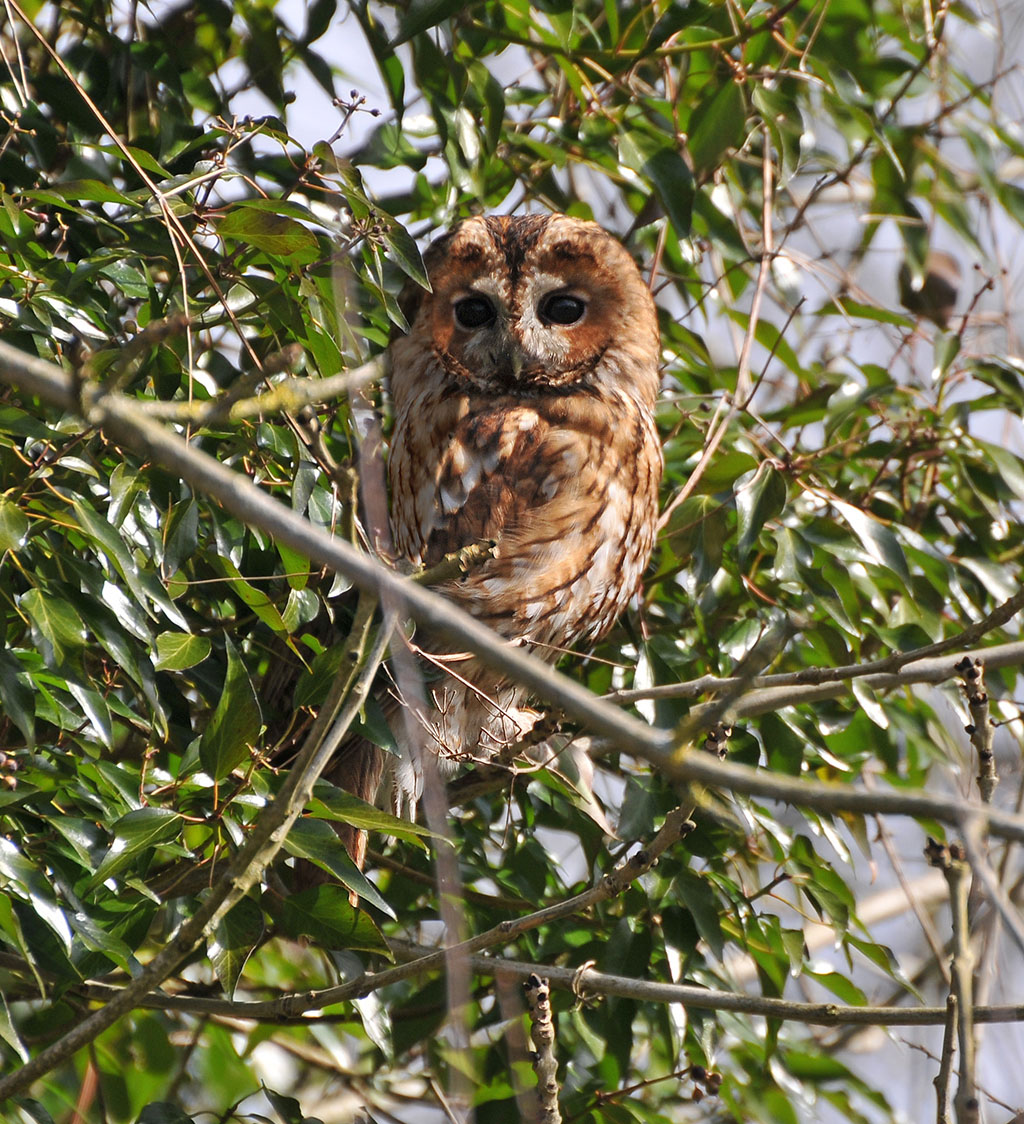
Tawny Owl

Despite living by woodland edge and hearing Tawny Owls day and night all year long, it is very hard to see them. Usually I get only a glimpse as one flies away. But the other day we saw one in full sunshine, in plain sight, and it stayed there long enough to get this photo. I think it was warming up after another very cold night.

Tawny Owl
Tawny Owl

Posted for Richard Beal.

Skip to content