Port Ham/Castle Meads (West) area, Gloucester

A steady walk around the above area this morning produced the following birds.

At Castle Meads(West)
3 Wigeon
2 Teal
1f Stonechat
12 Lesser Redpolls feeding in Silver Birch trees.

Port Ham
2 Snipe
1 Stock Dove ‘singing’
7 Meadow Pipits
M&F Stonechat
60 Fieldfares
75 Redwings
1 Jay

‘The Manor’ Linton Farm
110 Lapwing

Gordon Avery

Autumn arrives in the Severn Hams

After a (normal!) dry summer in the meadows along the Severn above Gloucester, most of the pools at the Gloucestershire Wildlife Trust’s two reserves at Coombe Hill and Ashleworth Ham had dried out; in September and early October the only extensive area of open water was on the Long Pool at Coombe Hill, which was attracting small numbers of Teal and a few Snipe, but not the numbers of ducks commonly found when the fields are flooded.

All this changed last weekend, when the level of the River Severn rose sharply, reaching 10.02 metres at Haw Bridge, a level not seen since last February.  When the Severn is this high, its smaller tributaries (e.g. the Chelt, and the Deerhust and Leigh Parish drains) cannot flow out into the Severn and so flood back, filling the ditches and covering some of the meadows with a shallow film of water, very attractive to ducks and geese.  Last Saturday the fields were dry, but by Tuesday some were lightly flooded.  How the water birds get the message so quickly, nobody knows; but by Tuesday, Wigeon numbers were up from 70 to 640 and Greylag and Canada Geese numbers were over 400; this tendency has continued today.  Although the Severn level is now dropping again (until the next rainy period at least), it has not subsided enough for the tributaries to discharge, so floods are slightly more extensive on the meadows(though aboslutely normal for the time of the year, and not posing any danger).  Numbers of Wigeon have now exceeded a thousand and there are more than 600 geese at Coombe Hill, presenting a fine spectacle from the rebuilt hide.  In addition, there are small numbers of other duck species, notably Teal and Mallard, with the odd Pintial and Shoveler, though no very large numbers of the latter yet.  Wigeon are autumn arrivals from northern Europe; had they come up from the Severn estuary? Or were they newly arrived birds which happened to find suitable habitat conditions? The Wigeon flock includes one easily recognisable individual, a part-albino (or leucistic) female; perhaps by checking on the presence of this bird, we shall be able to understand the movements of the flock better.

Comma caterpillars, Standish, 18 August 2013

Pulling up nettles in my veg garden I came across several Comma (Polygonia c-album) caterpillars, which I moved to another  nettle patch in a different part of the garden, where this one at least started eating young leaf immediately. They are said to look like bird droppings, thus are unmistakeable.

Comma caterpillar on nettle

Pretty spikey bird droppings.


Common lizards (Lacerta vivipara/Zootoca vivipara), nr Parkend in Forest of Dean.

At around 11am last Sunday (11 August) I saw a group of 5 to 8 common lizards sun bathing on a fence rail where the Forest of Dean cycle trail crosses the B4234 to the north of Parkend (OS map ref: SO6107 0888).  I was cycling with friends at the time and first thought that the lizards were simply darker stains on the fence!   The lizards were all small (approx. 50mm seemed to be the maximum length) so I guess that they may have been youngsters.  They were very dark in colour, with little discernable dorsal colouration although a darker stripe could be made out along the spine (they were certainly far darker to other common lizards I’ve seen).  The undersides appeared lighter and more orangey in colour towards the head (although we couldn’t see the underside as the lizards were hugging the (warm) wooden rail).  The lizards were perfectly happy being watched and were present on our northwards outwards cycle (when we counted 5 animals) and the southbound return (when we counted 8).  The weather was good and the sun was coming through the morning cloud cover, so the lizards were presumably warming up for the day as they were reluctant to move and we could get quite close.  The surrounding vegatation was primarily bracken and grasses on the edge of broad-leaf woodland.  They made for fascinating watching and I only wished I had my camera or phone on me (memo to self: take next time!) as they would have made excellent subjects.

Weedy arable fields

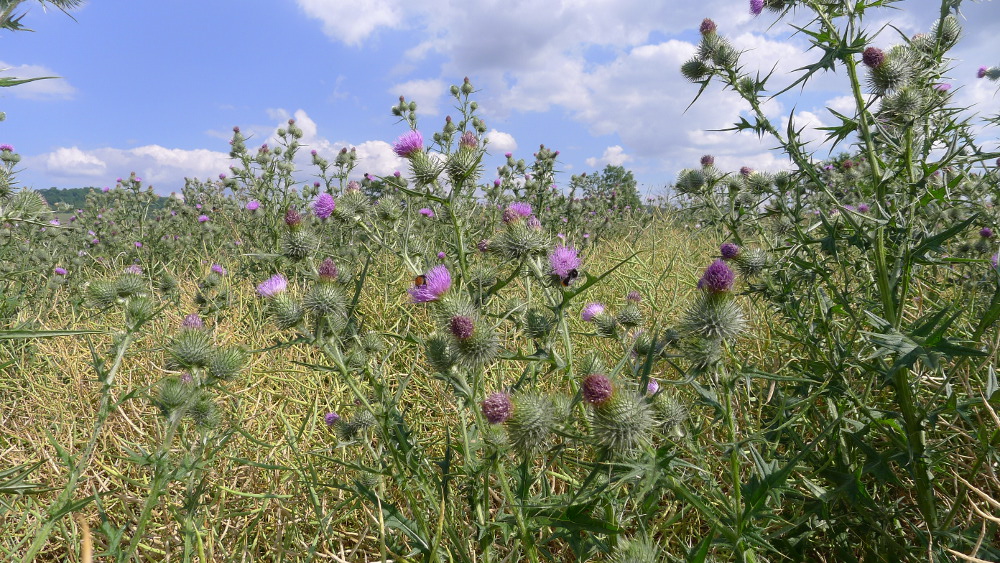
Many autumn-sown crops were growing so poorly and patchily after the wet winter and cold spring that they were ploughed up and replanted.  On a Standish farm, only one of several oil-seed rape fields was considered worth keeping.  Even so, it has produced flush after flush of weeds.  I’m sorry for the farmer, but it has been fabulous for wildlife – full of finches feeding on the weed seeds and abundant  insects for swallows and swifts.  Currently it is over-topped by 6ft high spear thistle (Cirsium vulgare), and so is alive with butterflies and bees.

Spear Thistle in Oil-seed Rape

Mud puddling butterflies, Standish, 18 July 2013

A group of 7 or more butterflies – Small White (Pieris rapae) and Green-veined (Pieris napi), I think – were mud-puddling on the edge of my garden pond.  According to Wikipedia, they do it to obtain nutrients such as salts and amino acids. They did not spread out along the available bank to do this, but congregated in a little group, with much wing shivering whenever a new butterfly flew over or came to join them.

White butterflies mud puddling

I did not observe other butterflies present in the area (Comma and Small Tortoiseshell) engaged in this activity.

Garden tiger moth (Arctia caja) in Gloucester

A single Garden tiger moth (Arctia caja) was spotted today (09/07/13) at 15:15hrs on the Gloucestershire Archives site (OS Map ref: SO835189).

Butterfly was resting on a window on the N side of the Archives building in shade in the gap between the Archives building and the Frith Centre.  When it did fly, it appeared to be having trouble fighting the prevailing wind (which channels through the gap).  It eventually flew downwind into the garden area at the Archives.

Marsh Stitchwort at Highnam

I just thought you might be interested in a report of Marsh Stitchwort (Stellaria palustris) growing at Highnam, specifically in a field adjacent to Lassington Wood.  The reason I decided to report it is that I identified the plant via the Botanical Society of the British Isles’ website (http://www.botanicalkeys.co.uk/flora/content/species.asp?1109) which noted the plant as ‘scarce’.

The precise location was OS map ref: SO 8026 2056. There are a cluster of plants covering about 10 square metres, not in huge abundance but enough for me to notice them.  The habitat is a meadow one, on the western crest of a ridge above the Leadon, the other flora being a mix of buttercups, sorrel and various common grasses.  It hardly seems the ideal location of a wetland plant, but it is only 200m or so away and above the Leadon’s floodplain.

I am in the process of joining the GNS.

Posted on behalf of John Putley.

Ley Park, Blaisdon

A Broad-bodied Chaser at Ley Park today. Birdlife included a Hobby soaring high overhead, at least two Ravens, Great Spotted Woodpeckers feeding young,a singing Tree Pipit, two Spotted Flycatchers, a Garden Warbler and two Siskins.

P1030621

Skip to content