
There were two male Hairy Dragonflies at Walmore Common on Saturday 17th May.
Sightings
Are these flying ants?
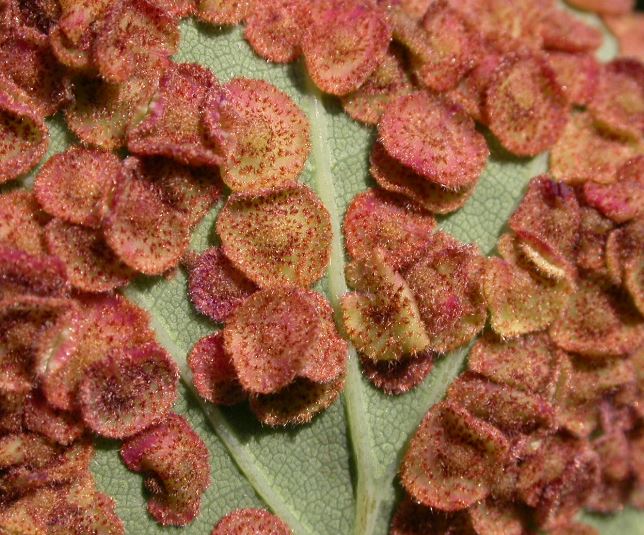
This question was put to me this weekend as hundreds, if not thousands, of little black winged insects (approx. 3mm long) settled on the white walls of our house and are doing so again today. These are the parthenogenetic, or agamic, generation of a gall wasp (Neuroterus quercusbaccarum) that lives on oak trees (Quercus). The warm weather has encouraged them to hatch and swarm. This generation will lay its eggs on oak catkins, producing little round galls that each house a single larva. Later in the year this larva will turn into the sexual generation (male and female) of the wasp which lays its eggs on oak leaves and produces spangle galls. These galls fall off in the autumn and shelter the agamic generation through the winter prior to hatching the following spring. These gall wasps do not bite or sting.

- The gall wasp Neuroterus quercusbaccarum
Baby Rabbits
Signs of spring. Baby Rabbits on my lawn in Standish. There is a burrow in the shrubbery, and a hole, that we keep trying to block but always gets re-excavated, that comes out in the lawn itself. We’ve seen up to 5 kittens simultaneously over the last week, which is the usual number here, so probably represents the entire litter. Anne McBride’s book Rabbits and Hares (Whittet Books 1988) says 5 is the average number in a litter.The photo was taken with my DMC-LX5 camera through a telescope, which I join together using a ring of plastic from a cut-off calking tube. Not high-quality digi-scoping, but it works for me.

Wood Hopper discovered in Gloucestershire
Arcitalitrus dorrieni (Amphipoda: Talitridae) has been found in a compost heap in Cirencester. While digging post holes to replace a storm-damaged fence in Cirencester last week, I had to move some old compost out of the way. As I did so, a small being hopped around over the surface. First thoughts were that it was a large springtail but second thoughts were it was too large and too shiny, and it behaved like the sandhoppers you find on beaches. Investigation proved it to be a shrimp about 8mm long, very dark brown in colour and glossy. After the initial hopping around it played dead before trying to crawl back into the substrate. With one exception, all shrimps in this country are found in water courses and lakes. The exception is A. dorrieni, a species described as new to science in 1924 from the Scilly Isles. After some years it was found on the Cornish mainland where it has spread slowly through South Devon and part of Dorset. Outlier populations were subsequently discovered in Bristol and Kew. More recently it has been found in South Wales and Inverewe gardens in Northwest Scotland and a very few other sites.
It is now known to originate from Australia and was most likely imported with plants from that region. This particular compost heap has not been disturbed for several years (being a student house) and, from the numbers seen, the population appears to be well established. In the Southwest and Inverewe the species is found in woodland leaf litter.
English names for this species are Wood Hopper, Land Hopper and Lawn Shrimp. Not being a freshwater species it has been adopted by the British Myriapod and Isopod Group as an “honorary woodlouse” and distribution records end up with them. As county recorder for the Group I would be interested in any records or specimens that people think might be this species.

Birds and flooding in the Severn Hams
In winter, the Severn floodplain, especially the area between Gloucester and Tewkesbury, regularly welcomes many thousands of wintering waterbirds. After the dry summer, there was a light local flood in late October and early November, then a much deeper one beginning just before Christmas. The November flood attracted large numbers of Wigeon and Teal (much higher numbers of Wigeon than were present on the estuary in the Frampton/Slimbridge area at the time); when the flooding receded in late November, many of these birds moved to the estuary. They came back to Coombe Hill as waters began to rise again in mid-December. So the link between the estuary and floodplain sites inland was clearly demonstrated. (For a full account of birds in the area between October and December, see “Birds in the Severn and Avon Vales October to December 2013” under Published reports on this website).
However, as has been widely reflected in the media, the flooding has got much more serious since Christmas, and there were Severe Flood Warnings (the highest category, indicating danger to human life and property) on either side of New Year. The top of a spring tide cycle in early January pushed water up the estuary and into the flood plain, coinciding with a flush of water coming down the Severn, following heavy rain at the top of the Severn catchment in north Wales and in the northwest Midlands; this flush was exacerbated by inflow from the Avon, not to mention other local streams like the Leadon, Chelt and Swilgate, which could not flow out into the Severn and so back-flooded riverside meadows. As a result, there is very deep flooding between Gloucester and Tewkesbury, with main roads closed by flooding – the A417 from Gloucester to Ledbury round Maisemore, the B4213 at Haw Bridge. The Gloucestershire Wildlife Trust had only just inaugurated its new hide and boardwalk at the Coombe Hill Meadows reserve, replacing the one washed away by the previous winter’s floods; the hide is now totally inaccessible and will remain so for many weeks – it is to be hoped that it will survive intact!
The effect on waterbirds has been striking: wild birds don’t like deep flooding any more than humans do. So the thousands of surface-feeding ducks which were in the Coombe Hill and Ashleworth area only ten days ago, grazing and feeding round the edges, have disappeared (as far as one can tell in the flooded conditions!). Some of them may well have moved downriver to the estuary, but a fair proportion have sought out shallow flooded areas upriver, just into south Worcestershire. On 4 January there were about 3,000 surface feeding ducks on Longdon Marsh, including about 1,400 each of Wigeon and Teal, with nearly 150 Pintail and about 35 Shoveler. But where have the thousand odd Greylag and Canada Geese gone, the ones that were previously shared between the Coombe and Ashleworth Ham reserves? Perhaps to Ripple Lake, the former gravel extraction area along the Severn opposite the outflow to the Severn from Longdon Marsh – there are many hundred geese there.
Plenty to look out for in the New Year then!
Witcombe Reservoir WeBS count
Hi Members
Here is the list of birds seen at the reservoir midday.
| Species | Number |
|---|---|
| Grey Lag Goose | 30 |
| Canada Goose | 4 (plus 4 hybrid young) |
| Teal | 41 (a good count for this site) |
| Mallard | 71 |
| Pochard | 9 |
| Teal | 47 |
| Cormorant | 10 |
| Little Grebe | 4 |
| Great Crested Grebe | 7 |
| Moorhen | 12 |
| Coot | 74 |
| Black-headed Gull | 27 |
| Common Gull | 5 |
| Herring Gull | 5 |
Best wishes
Gordon & Margaret Avery
Port Ham area, Gloucester 09/12/2013
A midday walk produced: 2 male Peregrines flying towards Gloucester Tip over Castle Meads west at 1113hrs. A female Sparrowhawk was seen by Port Ham Pool, a Little Grebe was on the pool.
On Port Ham itself was 3 Snipe and the pair of Stonechats were found to be still present as was the lone female down on the Oxlease/Castle Meads area. 25 Goldfinches were by the Llantony Lock House on the walk back.
2 Buzzards were also in the general area.
Gordon
Horsbere Brook Flood Area & Witcombe Reservoir 08/12/2013
In the flood area a good number of gulls were present. A male Peregrine flew over towards Brockworth at 1130hrs. Wildfowl present were: 2 Mute Swans, 4 Wigeon and 17 Mallard also a juvenile Grey Heron was seen as well.
Witcombe Reservoir: I was surprised to find a Little Egret here, amongst the wildfowl was 28 Teal and 9 Pochard. 3 Little Grebes were seen as well.
Odessa, Tewkesbury
This afternoon at 1445hrs we counted 500 Lapwing, 96 Golden Plover and a single Buzzard in the field opposite the Odessa Inn where Hoo Lane and the A38 converge.
Gordon and Margaret
Sudmeadow area, Gloucester 26/11/2013
A mornings walk around the northern edge of Gloucester Landfill Site produced 1 Buzzard, 2 Kestrels, m&f Stonechat and a minimum of 1200 Starlings sitting on the overhead power cables waiting to feed on the refuse tip, a rare sight now with all the disturbance from the falconers regular rocket launches to scare the gulls. 40 Goldfinches were also seen feeding on teasel.