Sightings – September 2010

Coombe Hill area (28 September 2010, contributed by Mike Smart and Les Brown)

Coombe Hill was quiet today with the water level low (no water in scrapes, but still some in the Long Pool). The extension to the board walk has been completed completed and looking good; it should now be possible to reach the Grundon Hide in low to moderate flooding. 72 Teal, 3 Shoveler, 4 Snipe, 1 Green Sandpiper, unusually large flock of 150 Goldfinches, some passage of Meadow Pipits, maybe 50 over to southwest.

River Chelt near Prior’s Norton: 1 Kingfisher.

Barrow Ponds: 6 perching Cormorants.

Wibdon Warth (26 September 2010, contributed by Mike Smart)

On Sunday 26 September at Wibdon Warth (on the Severn Estuary between Lydney and Chepstow) an experienced team of BTO ringers, led by Steve Dodd and Dave Coker, caught and ringed 67 Curlews out of about 300 present on a high tide roost; another larger roost of 500 birds remained entirely undisturbed. The catch was carried out on the Severn Estuary SSSI/SPA, with the permission of the landowner, and with authorisation from Natural England.

The purpose was partly to provide additional data for assessing the effect of possible tidal barrages on the Severn, and partly to contribute to a larger BTO project of monitoring turnover of waders at sites they regularly use. This was almost certainly the first Curlew cannon-net catch in Gloucestershire, and produced interesting new information about Curlews in the county; nearly all the Curlews were adults which had almost finished their moult, with only a single first year bird; there were three ringed birds (an excellent proportion for such a catch), one with a British ring, one with a Dutch ring and one with a Finnish ring. This suggests that the 800 odd Curlew regularly found in this area from late summer through autumn and winter may be adults from the Low Countries and Fenno-Scandia (as reported in the BTO Migration Atlas), rather than birds from the Gloucestershire breeding population; the finding of few young and lots of adults ties in with findings from Curlew catches in North Wales.

All the birds were marked with a combination of colour rings, and it is very much hoped that local bird watchers will note any observations of colour-ringed Curlews very carefully and report them to BTO. Please report them to Niall Burton of BTO at niall.burton@bto.org or on 01842-750050, giving details of the colour and position of all colour and metal rings.

Walmore (25 September 2010, contributed by Andy Jayne)

At Walmore Common today sightings included a Sparrowhawk, a Snipe, a Green Sandpiper, a Kingfisher, a Sand Martin, a Whinchat, a Wheatear and four Siskins overhead.

Coombe Hill and Walmore (21 September 2010, contributed by Mike Smart)

At Coombe Hill, everythingis still very dry with little or no water in the scrapes, although there is still some water in the Long Pool. 2 Herons, 4 Teal, 1 Green Sandpiper, 10+ Chiffchaffs calling from the bushes, one or two bursts of song. The scrub has now been cleared along the north bank of the canal as far as the footbridge, and the hedges cut back further down, making it more open and making access easier. The extension to the broadwalk is under construction; this will allow access to the Grundon hide in light flooding.

At Walmore there was one Green Sandpiper (unusual here) 2 Snipe, 2 Stonechats, 1 Whinchat, about 100 Swallows and at least 20 Meadow Pipits.

SUD/GLS (15 September 2010, contributed by Gordon Avery)

Fairly quiet, although a single juvenile Dabchick and a Green Sandpiper around the pools today.

Aylburton Warth, Guscar Rocks and Wibdon Warth (12 September 2010, contributed by Mike Smart)

The high tide of 9.2 metres today did not flood the riverside warths. 560 Curlews, 2 Bar-tailed Godwits, 1 Redshank, 1 Common Sandpiper, 2 Lapwings, 1 Little Egret, 200+ Swallows and 40+ House Martin going downriver in little parties, one Yellow Wagtail, 3 Wheatears, Meadow Pipits much more in evidence than of late, maybe 30 individuals.

Hasfield Ham (12 September 2010, contributed by Andy Jayne)

In the afternoon there were three Hobbies, a Stonechat and five Spotted Flycatchers.

Aylburton Warth (11 September 2010, contributed by Andy Jayne)

Seen at the warth this morning were: a Merlin (presumed same as 29th Aug), a Peregrine, one Little Stint, one Curlew Sandpiper, two Dunlin, 98 Curlew, one Common Sandpiper, two Sand Martins, one Yellow Wagtail, six Wheatears plus a flock of 13 Knot and c.20 Bar-tailed Godwits flying upriver.

Aylburton Warth, Guscar Rocks and Wibdon Warth (10 September 2010, contributed by Mike Smart)

I went to Guscar /Aylburton again yesterday on what was (as noted in the latest GNS NEWS) one of the highest tides of the year (9.8 meters at Sharpness). A most impressive sight as the river surges upstream with huge energy on such occasions and floods areas that normally remain dry; the whole of Aylburton Warth was under water, as was much of the warth between Pillhouse and Wibdon. Newspaper reports last weekend suggested that funding for the largest version of the proposed Severn barrage was unlikely to be forthcoming in the current financial situation.

The main bird interest was the large concentration of Curlews, many of them in full wing moult with about 850 individuals moving their roost site from Aylburton via Guscar to Pillhouse and Wibdon as the tide rose. With them were three Knot and four Bar-tailed Godwits, two Common Sandpipers and (on Aylburton Warth) a Green Sandpiper. Four Yellow Wagtails went high downstream, at last a few passage Meadow Pipits, not many, perhaps half a dozen; one Wheatear and two Whinchats at Guscar; the hedges full of the calls of young Chiffchaffs, at least one singing. Ravens everywhere, with at least ten.

Aston Down (2 September 2010, contributed by Gordon Avery)

There were 2 Wheatears at midday at the airfield.

Sightings – August 2010

Selsey Common (30 August 2010, contributed by Peter Fitchett)

Among the late summer species seen today were: Autumn Lady’s Tresses, three Adonis Blues as well as some Common Blues and Meadow Browns. There were plenty of Carline Thistles and Harebells in bloom. See Peter’s pictures below.

Gloucester (26 August 2010, contributed by Andy Jayne)

Two Peregrines on Gloucester Cathedral today.

Coombe Hill (26 August 2010, contributed by Mike Smart, Dave Pearce and Graham Smith)

There is a little more water in the Long Pool and a small puddle on the scrapes. The main beneficiaries of rainfall seem to be the crows with a mixed flock of 500 Jackdaws and Rooks on the grass, looking for insects brought to the surface by the rain. Otherwise, 120 Mallard and 5 Teal, plus a single Green Sandpiper on the Long Pool. Two Wheatears and a Whinchat from the Grundon Hide. Lots of Chiffchaffs (20+ maybe) calling from vegetation with one burst of song. At least 50 Swallows plus an odd House Martin hawking for Swallows low over the grass.

Upham Meadow, Twyning (25 August 2010, contributed by Mike Smart)

4 juvenile Yellow Wagtails and 100+ Swallow hawking low over grass.

Ayleburton (23 August 2010, contributed by Andy Jayne)

Aylburton Warth this evening produced one Little Egret, three Ringed Plovers, one Snipe, 11 Curlews, three Common Sandpipers, ten Turnstones, an Oystercatcher, three Yellow Wagtails, five Whinchats, six Wheatears and 50 Ravens moving west to roost.

Meadow Brown Butterflies (17 August 2010, contributed by Juliet Bailey)

After what seems to have been a crash in the population at home, I have at last seen some Meadow Brown butterflies at Selsley Common, Crabtree Hill and Standish.

Witcombe (17 August 2010, contributed by Gordon Avery)

There was a male Firecrest by the cottage today. It was with a tit and warbler flock feeding around the garden. There was some brief song as well when it was perched in one of the leylandii trees.

Cotswold Commons (17 August 2010, contributed by Juliet Bailey)

Autumn Ladies Tresses Orchid is now coming into flower.

Guscar Rocks and Aylburton Warth (16 August 2010, contributed by Mike Smart)

It was rather quiet at high tide today. There were 4 Oystercatchers, 2 Common Sandpipers, 700 Curlew; also 4 Yellow Wagtails, 1 immature Wheatear and 5 Meadow Pipits.

Aylburton Warth and Walmore (15 August 2010, contributed by Andy Jayne)

Today’s sightings at Aylburton included a juvenile Little Ringed Plover, four Ringed Plover, three Dunlin, a Greenshank (heard only), a Common Sandpiper, a Tree Pipit, three Yellow Wagtails, two Wheatears and 20 Ravens.

At Walmore there were two Snipe, two Redstarts, a Whinchat and a Nuthatch (only my second ever Nuthatch here).

Coombe Hill (10 August 2010, contributed by Mike Smart and Les Brown)

All the hayfields have been cut and are being grazed by cattle, which should improve hay meadow vegetation and create good conditions for breeding waders next year. The whole reserve is very dry and the scrapes in front of the Grundon Hide have been dry for a month now. Most of the ditches have dried out. The only open water is in Long Pool with good viewing from the Long Pool hide. The 2 Mute Swans on the canal have lost their lone remaining cygnet. 19 Greylags flew out and 20 Canadas flew in. Also, 2 Teal but 1 Green Sandpiper was the only wader present. A steady visible migration of Swallows to thesouthwest, probably 100 in all. Three or four Willow Warblers singing, at least one Chiffchaff singing and lots of juvenile Chiffchaffs calling.

Beachley Point (9 August 2010, contributed by Ivan Proctor)

Seven species of ladybird were seen today at Beachley Point. Three 18-spot Ladybirds were beaten from pines and one Cream-spot from oak along the road leading to the electricity pylon. The verge here produced one each of Seven-spot and 14-spot. Sweeping in the grassland between the Point and the Wye Bridge produced six more 7-spots, two 22-spots and single 16-spot and 24-spot. The grassland here usually produces many more 24-spot ladybirds than this. Birds were few and quiet but Linnets and Oystercatchers were both heard and there were about a hundred Black-headed Gulls out on the estuary. A Brown Rat ran across the access road.

Wigpool Common (5 August 2010, contributed by Juliet Bailey)

Despite the dry summer, there is still wet mud at the Wig Pool, attracting a Green Sandpiper.

Sightings – July 2010

Sudmeadow (30 July 2010, contributed by Gordon Avery)

A Hobby over Sudmeadow today at 7.12am.

Purton (30 July 2010, contributed by Andy Jayne)

At Purton this evening: three adult Mediterranean Gulls (one with green ring on left leg), six Little Egrets and a Common Sandpiper.

Witcombe (28 July 2010, contributed by Gordon Avery)

A Hobby over the reservoir at about 10.35am and 71 Tufted Duck were also present – a highish count here.

Forest of Dean (16 July 2010, contributed by Ivan Proctor)

Over the past few days, July 10th-16th, I have seen kidney spot ladybird larvae at Dark Hill and in the Cannop Valley. They have always been on the trunks of medium sized ash trees where they feed on ash scale insects and are easy to spot. They are about 3 mm long, black and, under magnification, spined. On two occasions adult ladybirds have been near by on the same tree. Ivan’s pictures show both an adult and one of the larvae.

Coombe Hill and Ashleworth (10 July 2010, contributed by Mike Smart and Les Brown)

The scrapes in front of the Grundon Hide dried out completely in the last week (for the first time since summer 2003), but there is still water in the Long Pool and good views can be obtained from the Long Pool hide. Today there were 5 Teal, 2 Little Egrets, 2 adult Oystercatchers with one chick which can just fly on rounded wings, 1 Little Ringed Plover, 6 Green Sandpipers, and about ten adult Lapwings, with half a dozen young of different sizes that had obviously walked over from the scrapes. A little song still from 1 Reed Warbler, 2 each Sedge Warbler, Blackcap and Whitethroat, also a Tree Creeper. A male Sparrowhawk sitting in the middle of the dry scrape.

Forest of Dean (3 July 2010, contributed by Andy Jayne)

A Turtle Dove ‘purring’ at Loquiers near Harrow Hill today.

Sightings – June 2010

Coombe Hill and Ashleworth (29 June 2010, contributed by Mike Smart and Les Brown)

At Coombe Hill, the water level is dropping fast despite last night’s rain. The scrapes in front of the Grundon Hide are almost dry (three large fish just surviving), and the Long Pool level is also dropping. The Mute Swan by the Wharf has at last hatched its first cygnet, and another pair with two cygnets is eating duckweed (must be very nutritious) on the Parish Drain. 3 Teal, no Shelducks, 9 Little Egrets, 9 Grey Herons (two adults and seven birds of the year); the Oystercatchers still have one chick which they have taken to the Long Pool; at least four perhaps five broods of young Lapwings, only one curlew seen. Among early migrant waders one Little Ringed Plover, four Redshanks, five Green Sandpipers; at least one juvenile Black-headed Gull, which must have flown in from a breeding place elsewhere. At least four singing Reed Warblers, but most Sedge Warblers have given up singing; surprisingly , still two bursts of Lesser Whitethroat song.

At Ashleworth, hay cutting has started on the SSSI but not on the reserve: all very quiet, but one pair of Lapwings with young just off the reserve.

Walmore and Forest of Dean (19 and 20 June 2010, contributed by Andy Jayne)

On the 19th, at Walmore Common a Jack Snipe flushed twice;also, a pair of Curlew, a pair of Red-legged Partridges and a Kingfisher. At Flaxley Woods a singing male Firecrest and a Muntjac Deer.

On the 20th in the FoD there were two Hobbies at Clanna and a Curlew nearby at St.Briavels.

Jack Snipe is extremely rare in Britain in summer, even Shetland has only two or three records. When I first flushed it I thought it must be a half-grown juvenile Common Snipe. That in itself would be an exceptional record these days. The possiblity of Jack Snipe never even crossed my mind. Later, however, as I walked back I flushed the bird again and gained rather better views. It was clearly a Jack Snipe and if it was anytime between September and April I wouldn’t have given it a second thought. Walmore has been a very reliable spot for Jack Snipe for many winters with up to seven birds present in recent years. My last sighting this spring was a single on 27th March. I looked for it again today, but no luck.

Severn Hams (17 June 2010, contributed by Mike Smart)

River Severn near Lower Lode: 1 Oystercatcher, 20 Sand Martins around a colony in the river bank.

Lower Lode Brickpits: 20 Cormorants in dead trees, seven Herons, a pair of Mute Swans with three cygnets and a male Yellow Wagtail sitting on an oak.

Coombe Hill (17 June 2010, contributed by Mike Smart, John Wiltshire and Tim Cash)

Breeding waders: 2 adult Oystercatchers and two chicks; at least three broods of Lapwings with chicks (one of which has hatched since Thursday; at least three pairs of Curlew behaving as though they had young.

Waders on return migration: a flock of 25 Lapwings, at least 7 noisy adult Redshank, 3 Green Sandpipers, one additional Oystercatcher.

In addition, there were 2 Teal, 4 Little Egrets and still plenty of singing warblers (Sedge, Reed, Whitethroat, Blackcap, but no singing Redstarts). The Mute Swan by the wharf still as three eggs.

Sudmeadow (17 June 2010, contributed by Gordon Avery)

A Little Egret flew over this morning at 07.57. It then seemed to head off towards the SW.

Stratton (16 June 2010, contributed by Ken Cservenka)

A young Little Owl was calling from a tree at Stratton House Hotel near Cirencester with an adult calling nearby at 1.10am..

Coombe Hill (15 June 2010, contributed by Mike Smart and John Wiltshire)

The scrapes and Long Pool: two pairs of Shelduck, one pair of Gadwall, six individual Teal, one Tufted Duck, 3 Little Egrets; 1 Quail singing; two adult Oystercatchers with two tiny chicks (the first successful breeding record here), at least three late pairs of breeding Lapwings (one still sitting, two with tiny chicks), probably two pairs of Curlews; about four Redshanks considered to be non-breeders arrived from outside; at least two Redstarts singing or giving alarm notes. Still plenty of singing Sedge Warblers, Whitethroat, Lesser Whitethroat, Blackcap, Chiffchaff and Willow Warblers.

In nearby arable fields: still one anxious adult Lapwing, in the area where small chicks were seen two weeks ago; one pair of Yellow Wagtails.

Cheltenham (12 June 2010, contributed by Robert Homan)

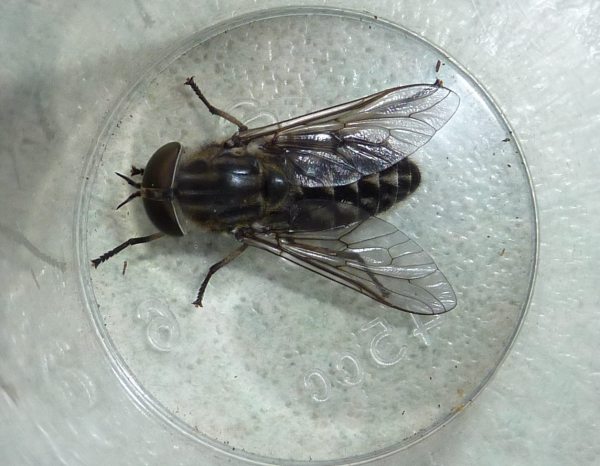
A weekend of large insects at home with an impressive 17mm long tabinid fly (Tabanus autumnalis) falling out of a pile of washing just brought in from the garden and a 20mm+ long-horn beetle (Stenocorus meridianus) seen in the garden. Pictures of the fly and beetle below.

Cleeve Hill (11 June 2010, contributed by Robert Homan)

The picture below shows one of thousands of Garden Chafers (Phyllopertha horticola) swarming over Cleeve Hill today. They attracted the attention of a few gulls and a dragonfly attempted to pick the beetles off gorse bushes.

Coombe Hill (8 June 2010, contributed by Mike Smart and Les Brown)

Midsummer at Coombe Hill: luxuriant vegetation in the rain, wild roses in all the hedges, all the northbound migrants gone through, none moving south yet, but they’ll be coming soon; still plenty of birdsong.

The Mute Swan by the wharf which laid late is still incubating; 31 Canada Geese including three goslings, now almost full grown; 10 Greylags flew in; a single male Shelduck (is there a female on eggs somewhere?); 80 Mallard (two females with ducklings); 1 Little Egret; 2 Oystercatchers still incubating (changeover seen); at least two Lapwings incubating eggs in the rain (they started late too; first chicks seen on 2 June); 2 adult Curlews behaving as though they had young; a single Redshank, non breeder; at least one Redstart singing; at least four Reed Warblers singing; at least six Sedge Warblers singing; five Whitethroats singing; at least five Reed Buntings singing.

Coombe Hill (6 June 2010, contributed by David Scott-Langley)

Life is returning to the canal and the meadows after the floods of 2007 and 2008 and in the canal this has been helped by the work on the south bank in 2009. A walk along the canal at the beginning of June produced sightings of six Tench grubbing about in the weed, including one lurking under some floating debris only 3 metres away from a 60cm (2ft) long Pike. The tench were probably on the large side for the pike and it was more likely to be lying in wait for ducklings or moorhen chicks. There were also Sticklebacks, both old and young, basking in sunny spots. Invertebrates of the surface film were in evidence, those above being Pond Skaters (Gerris) and Whirligig beetles (Gyrinus) while beneath them were several species of Water Boatmen and Backswimmers along with some small Dytiscid beetles. Paired Enallagma damselflies were busy depositing eggs on waterweeds near the surface. Along the margins on the south bank, invertebrates are returning following the clearing of scrub. The carabid beetle Elaphrus riparius was prowling the edges looking for prey with its large round eyes while the much smaller Bembidion and Stenus species were also on the lookout for insects such as springtails. From the bund to the footbridge the water gives the impression of being not such good quality, i.e. cloudy. However, hanging over the rails on the footbridge and looking straight down into the water, this cloudiness turns out to be many millions of Daphnia water fleas, rendering the canal bottom barely visible. The canal paths were also patrolled by Orange-tip, Green-veined White and Brimstone butterflies, as well as the occasional territorial Speckled Wood.

Out on the meadows the buttercups and hawkweeds add a vigorous splash of yellow to the green background, with Cuckoo flowers just going over and Ragged Robin and Red Clover just beginning to open. Green-veined White and Common Blue butterflies were visiting these flowers in the sunshine. The vegetation is now long enough to hide the occasional Hare. In some fields the dock plants are growing well but will soon be found by the Dock Leaf Beetle (Gastrophysa viridula) whose larvae will convert most of them to brown lace before too long. Already the females with overly-distended bodies are laying bunches of yellow eggs on the undersides of the leaves. After the recent spell of hot weather the newer ditches are low on water and being choked up with vegetation but the water edges are still being patrolled by Bembidion and Stenus beetles and the prolific predatory waterside bug Salda littoralis. Patches of Crowfoot flowers brighten up these ditches here and there. In the older ditches and drains Great Pond Snails (Limnaea stagnalis) and Ramshorn snails can be seen moving around on the underside of the surface film accompanied by water beetles such as the 18mm Colymbetes fuscus and smaller relatives. Where the Duckweed has built up into a thick raft it might be possible to see species such as the Screech Beetle (Hygrobia hermanni) which, when alarmed, makes a quite audible sound – less of a screech and more like the sound of running your fingernail rapidly along a comb. In these ditches were also to be seen young Sticklebacks in some numbers.

In one of the fields is a muddy dip that is normally wet into early summer but this year has dried out with deep cracks and blocks of soil. These cracks are hiding places for Bembidion, Salda and a number of small Staphylinid beetles, including the brightly-coloured red and black Paederus littoralis. Under the blocks of soil were several Horse Leeches (Haemopis sanguisorba) trying to find the last vestiges of moisture to see them through the summer dry spell. One group that particularly suffered in the floods was the Wolf Spiders that do not spin webs, do not balloon when young, and live in the ground layer of vegetation. This year a few can be seen running through the grass as they recolonise the area from outside, some carrying their eggsacs as they go. There is no mention of birds here as they are well covered by other observers!

Sightings – May 2010

Forest of Dean (31 May 2010, contributed by Mike King)

This pair of Dor Beetles (Geotrupes sp.) was seen today at at Burnt Oak near New Fancy View.


Minsterworth Ham (27 May 2010, contributed by Andy Jayne)

There were two Black-tailed Godwits at the Ham this evening.

Cleeve Hill (26 May 2010, contributed by Robert Homan)

Never believe a weather forecast that you want to be right is the moral of this story! A sheet and light mothing session on the hill should have been over by the time the rain came through, but it arrived just after we were set up and the evening became something of an extreme mothing event:

However, weather not liked by humans proved to be fine with the lepidoptera and the highlights of the evening were 3 Light Feathered Rustics:

This species has an interesting national distribution pattern which is almost a map of limestone and chalk in southern England. See http://www.mothscount.org/maps/94/moth_distribution_maps.html?filter=L&species=NHMSYS0000501177

Coombe Hill and Ashleworth (25 May 2010, contributed by Mike Smart and Les Brown)

At Coombe Hill things remains quiet. It looks as though the fine weather in April and May has allowed migrant birds, especially waders, to move straight through without forcing them to make stopovers. Today, the pair of Oystercatchers was still present, the female apparently incubating on the island in the northern scrape. About 12 Lapwings were present, after a total absence in the early part of the breeding season; some seemed to be incubating while others showed only a very weak attachment to their nests. A single very nervous Redshank which behaved as though it had failed elsewhere and was moving through. Two or three Shelducks defending territories, as though they had females on eggs hidden away somewhere. A single Little Egret, a single Sparrowhawk, one male Teal in the Long Pool; the pair of Mute Swans has nested again (very late) at the usual nesting site by the Wharf, after trying and failing further down the canal. One Redstart singing behind the Long Pool, at least five singing Whitethroats, at least three Sedge Warblers and two Reed Warblers singing in the withies. There are extensive stands of Ragged Robin in the usual field and evidence everywhere that the Dock Leaf Beetles (Gastrophysa viridula) are continuing to prey on docks.

Ashleworth was quiet too. At least three Redstarts singing along Stank Lane. It appears that there is only one pair of breeding Curlew in the area. The same species of beetle were busy there among the docks too.

Guscar Rocks (23 May 2010, contributed by Andy Jayne)

A Grey Seal moved slowly upriver on the incoming tide at 4pm. Also present were ten Ringed Plovers and a male Yellow Wagtail.

Standish (5 May 2010, contributed by Juliet Bailey)

The first St Mark’s Fly was around today. This is a species that is supposed to appear on 25 April (St Mark’s Day), so we are running about 10 days late. Also, the Swifts are about, I saw my first over Ebley yesterday, and over my garden today. A Hobby has also returned to the area.

Severn Vale (5 May 2010, contributed by Mike Smart)

Along the Severn between Lower Lode and Chaceley Stock and in the fields inland of the river were: a pair of Egyptian Geese that were displaying on the river bank; at least 1 and perhaps 2 Lesser Spotted Woodpeckers drumming and singing; 1 Raven; 1 Kingfisher; 3 Lapwings, with at least two chicks; 1 Common Sandpiper; 1 Redstart singing at the Chaceley GWT reserve. At Maisemore Court, at least one pair of Canada Geese with small goslings.

Sightings – April 2010

Swillbrook Lakes (28 April 2010, contributed by Ken Cservenka)

In the evening: 1 Swift, several singing Cetti’s Warblers, 3 singing Nightingales, a Cuckoo heard. Also Garden Warbler, Blackcap, Sedge and Reed Warblers.

Stratton (28 April 2010, contributed by Ken Cservenka)

A singing Blackcap, and throughout April at least 2 pairs of Yellowhammers.

Miserden Park (27 April 2010, contributed by Ken Cservenka)

I heard a Cuckoo today at Bullbanks in Miserden Park. Also a Raven overhead being harassed by a Carrion Crow. The crow then turned its attention onto a pair of Buzzards.

Ashleworth (27 April 2010, contributed by Mike Smart)

When the morning mist lifted, it was clear from the birdsong, that most of the summer songbirds were present in force: a male Lesser Spotted Woodpecker seen drumming and calling from the same oak tree as this time last year; no less than three different Grasshopper Warblers singing; at least six or seven Redstarts singing; about five Sedge Warblers, three or four Whitethroats and a Lesser Whitethroat singing.

Severn Vale (25 April 2010, contributed by Mike Smart)

Severn Ham, Tewkesbury: 1 Shelduck on the Severn, 2 pairs of Curlew bubbling on the Ham, 1 Common Sandpiper by the weir and an unusually high total of four singing Corn buntings round the Ham.

Lower Lode brickpits: 1 Mute Swan’s nest, 2 pairs of Shelducks on arable nearby, 2 pairs of Tufted Ducks, 1 Great Crested Grebe, 2 pairs of displaying Lapwings on arable and 1 Cuckoo.

Near Chaceley: a Redstart singing at a new site.

Coombe Hill during evening GWT walk: the Brent Goose was not seen, 2 displaying Oystercatchers, 5 Lapwings, 6 Curlew, 1 Whimbrel, 3 Snipe and 1 Cuckoo.

Twyning and Lower Lode (22 April 2010, contributed by Mike Smart)

At the Great Hay Meadow, Twyning, this morning: about eight pairs of Curlew on the Hay Meadow and two or three more pairs on surrounding grassland; interestingly, they were nearly all walking round and feeding in pairs, with little vocal display. This suggests to me that they haven’t laid yet (the more so as the grass is still pretty short, with clumps of longer sedge and lots of Ladies’ Smock). Only one Redshank. No sign of any Corn Buntings. Two Hobbies flying over Bredon, but they were marginally in Worcs. Lots of paired Canada Geese, which appear to have lost their eggs/nests. About five Sedge Warblers singing along the Avon.

Four Roe Deer, appeared to be the same individuals (two male as and two females in the same place) as last week. Lots of Rabbits (a rarely recorded mammal) round Sandacre Farm and on the base of the motorway bridge.

At Lower Lode, at least 30 Sand Martins around the colony which is in the river bank, a Little Owl; one Lesser Whitethroat and one Whitethroat singing; there seem to be more Lessers than Common so far this year.

Ashleworth (21 April 2010, contributed by Mike Smart)

At Ashleworth this evening: the male Garganey, for once sitting right in front of hide, but no sign of the female; about 34 Teal, overwhelmingly in pairs; a pair of Shelduck; 6 Wigeon; a single male Shoveler; only two Curlews, probably a pair, came in to roost.

Tewkesbury (20 April 2010, contributed by Mike Smart)

At Severn Ham in the morning were: 1 Cuckoo, 1 reeling Grasshopper Warbler, 1 Sedge Warbler. Later along the River Swilgate by Priors Park, in the masses of Blackthorn now in full bloom, were: 1 Nightingale, 1 Lesser Whitethroat, 1 Grasshopper Warbler singing.

Coombe Hill (19 April 2010, contributed by Mike Smart)

Seen during an evening look at Coombe Hill, mainly to see waders, both local birds roosting and passing migrants: about eight Curlews coming to roost with a Whimbrel, two Oystercatchers, two Little Ringed Plovers, the latter being more vocal than usual. One sitting Canada Goose plus about 20 non breeders, the Brent Goose yet again. Four pairs of Shelduck. One male Wheatear. A Lesser Whitethroat singing briefly. There was a complete absence of Lapwing and Redshank.

Port Ham, Gloucester (18 April 2010, contributed by Gordon Avery)

A male Cuckoo was present this afternoon.

North Meadow, Cricklade (18 April 2010, contributed by Juliet Bailey)

As the picture below shows, the fritillaries are looking good now but are not quite at their peak yet.

Hemmingsdale Road, Gloucester (17 April 2010, contributed by Gordon Avery)

A Holly Blue today was the first this year, plus a first for the garden came in the form of a Larch Ladybird (Aphidecta obtiterata).

Coombe Hill (17 April 2010, contributed by Tom Cash, Mike Smart and Les Brown)

A cold morning with a light frost, although it brightened up with lots of sunlight later. There was not a lot of birdsong first thing.

8 Mute Swans had roosted and went to feed on a fresh grass ley on the Southern Meadows; one pair on the canal seen mating. 15 Canada Geese, the Brent Goose was still there. Three pairs of Shelduck. 56 Teal. 1 Sparrowhawk. Following recent records at Slimbridge, one Avocet was present at first light, maybe a bird en route to Upton Warren near Droitwich, where they have bred for some years. Two Oystercatchers displaying actively, as though they were going to breed. A single Lapwing by the scrapes, only one by the arable to the south; it doesn’t look as though they are going to breed there in any numbers, if at all. 1 Little Ringed Plover, very subdued and probably a passage bird. Maybe 4 Curlew. 1 Redshank, 1 Green Sandpiper. 1 Redstart singing and another calling. 2 Whitethroats and 1 Lesser Whitethroat singing. Numerous Blackcaps, Willow Warblers and Chiffchaffs.

One Peacock butterfly, two Small Tortoiseshells. One Brown Hare behind the Long Pool.

Ashleworth Ham (15 April 2010, contributed by Mike Smart and Les Brown)

In the evening there were still 40 Wigeon, 40 Teal, 10 Shoveler; 4 Green Sandpipers together, clearly migrants; a late flock of 20 Fieldfares; only one Redstart was found.

Great Hay Meadow, Twyning (15 April 2010, contributed by Mike Smart)

1 immature Peregine was sitting on a stone in the middle of the meadow; more Canada Geese nesting on the Avon bank – at least three nests seen (in pretty obvious places, two of them predated); 2 Oystercatchers flew downriver, 12 Curlews, 1 Swallow, no sign of Corn Buntings or Yellow Wagtails. Four Roe Deer, two males with horns (one pointed, the other still velvety) and two females.

Severn Vale (13 April 2010, contributed by Mike Smart and Les Brown)

Rather a cold north-easterly wind inhibiting birdsong early on, so that many arriving bird migrants may have kept very quiet; brightening later, but still not as warm as the last few days. Water levels dropping gradually everywhere, though ditches and scrapes are still fairly full. Verges full of cuckoo flowers and lesser celandine, but few cuckoo flowers in meadows as yet. One or two Small Tortoiseshells out.

Coombe Hill: Very quiet – 30 Canada Geese, mostly non-breeders, but one on eggs and another suspected; the Brent Goose still keeping them company; 3 pairs of Shelduck; 44 Teal; 3 Oystercatchers; 2 Curlews; 1 Green Sandpiper; no Lapwings; 5 Sand Martins hawking insects over the Long Pool; four singing willow Warblers.

Leigh Meadows: a pair of Lapwings perhaps breeding, two Curlews, a very short snatch of song from one Redstart.

Haw Bridge: 12 Sand Martins around colony in the river bank; one Common Sandpiper on beach.

Staunton: it looks as though the Lapwings have given up on their breeding attempt.

Ashleworth: a male Garganey, 26 Wigeon, 53 Teal, 13 shoveler, 17 coot, one on a nest; no sign of any Redstarts

Standish (14 April 2010, contributed by Juliet Bailey)

Many of the spring crucifers are now in bloom. I am particularly fond of the hardy little annuals, about 2 inches high, that make a living among the crushed stone of my drive. The top below picture shows mostly Whitlowgrass (Erophila verna), with its oval seed pods developing, but in the centre is a stem of Hairy Bittercress (Cardamine hirsuta) with long seed pods. With them on the drive can be found Danish Scurvygrass, shown in the second picture below (Cochlearia danica) which is the plant that is coating the verges of all dual carriageways currently, looking a bit like a thin skim of snow.


Puesdown, A 40 (11 April 2010, contributed by Peter Fitchett)

A Red Kite circling over the A40 by the Puesdown public house today.

Spring Flowers (11 April 2010, contributed by Peter Fitchett)

Pictures below by Peter show a Pasque Flower on the reserve, near Cirencester and the start of the Fritillary show at Cricklade North Meadow, just over the county boundary in Wiltshire. Peter suggests that the meadow will be at its best in a week or so.

Coombe Hill and Ashleworth (10 April 2010, contributed by Mike Smart and Les Brown)

Coombe Hill this morning: Mute Swans building nest, Brent still there, 7 Shelducks, 45 Teal, 4 Grey Herons in breeding plumage, 1 Little Grebe, 3 Oystercatchers displaying (present for at least four days), 2 Whitethroats singing, at least seven Willow Warblers singing, 2 Blackcaps singing.

Later at Ashleworth,: Mute Swan incubating, 10 Wigeon, 40 Teal, 4 Grey Herons, 6 Buzzards soaring, 2 Curlews, at least 3 Redstarts (two males singing rather poorly; the first ones had been noted on 8 April), about five Willow Warblers, 2 Blackcaps and ten Chiffchaffs all in song.

Cleeve Hill (8 April 2010, contributed by Robert Homan)

7 Wheatears near the trig point this morning.

Severn Vale (3 April 2010, contributed by Mike Smart and Les Brown)

At Coombe Hill: Brent Goose still there, 7 Shelducks, 15 Shoveler, 1 passing Peregrine, 2 Little Ringed Plovers (a male and a female, very placid, looked like passing migrants), 2 Lapwings, 6 Curlews, 4 Snipe, 10 Chiffchaffs singing, 2 Willow Warblers, 6 Sand Martins and a Swallow. LB and MS

Wilmer Common, Rodley: 2 Shelducks, 3 Chiffchaffs. (MS)

Walmore Common: 2 Teal, 4 Lapwings, 4 Snipe, 3 Chiffchaffs. (MS)

Sightings – March 2010

Witcombe Reservoirs (31 March 2010, contributed by Gordon Avery)

Seen around the reservoirs this morning were c.40 Swallows, 20 Sand Martins and 3 House Martins, all presumably knocked down by the cold weather.

Cleeve Hill (30 March 2010, contributed by Robert Homan)

No spring migrants, although there was a flock of 50 Fieldfares at Postlip which flew off high to the east.

Coombe Hill and Ashleworth (30 March 2010, contributed by Mike Smart and Les Brown)

The Severn level is slightly higher following recent rain, which means that the ditch levels in the meadows are a little bit higher, but with no additional flooding.

At Coombe Hill at first light there were 11 Curlews, most of which must have been passing migrants that had roosted, since they were harried by one of the residents. About eight of them flew off to the north pretty early on. It looks as though there are two pairs holding territory. Ten Shelducks including two (maybe three) established pairs, the rest lekking noisily. One Brent Goose, one Little Ringed Plover, one Green Sandpiper and a pair of Garganey on the Long Pool, which must have paired up on the wintering grounds. Group of 30 Swallows and Sand Martins, clearly migrants, arrived mid-morning.

At Ashleworth, there were still 90 Wigeon, 70 Teal and 10 Shoveler; the Great White Egret has moved on to pastures new near Slimbridge. All three full boards were removed from the sluice, which will allow the water to flow out in spring, as provided in the management plan, thus creating optimum conditions for breeding waders and hay meadow vegetation.

Chesterton, Cirencester (28 March 2010, contributed by David Scott-Langley)

A pair of Small Tortoiseshells and a Peacock butterfly flew through the garden this afternoon. Also a cuckoo bee was seen following a Buff-tailed Bumblebee all round the garden for some time, never more than 30cm behind the latter’s erratic flight path. Yesterday a Chiffchaff passed through the trees in the neighbour’s garden but was not heard today.

Stratton (28 March 2010, contributed by Ken Cservenka)

At about 4.00pm today a Red Kite was circling overhead. In my garden here, I have had between 6 and 12 Yellowhammers throughout March visiting the ground beneath my feeders and the bushes nearby. A cock Pheasant has also been a regular visitor.

Severn Vale (27 March 2010, contributed by Mike Smart and Les Brown)

Coombe Hill was again rather quiet: the Brent Goose was still there together with 15 Shelducks (the two established pairs, plus six males lekking with two females and two immatures); only two Lapwings, both males but with no display, probably off duty males from the arable nearby; three Little Egrets; a very hesitant Willow Warbler trying to sing; Chiffchaffs all over the place with at least four singing; one Green Sandpiper. A fox was sat out in the open, marking his territory and trying to get among the flock of 10 non-breeding Canadas but they were far too smart for him.

At Ashleworth the Great White Egret was still present.

At Staunton, the Golden Plover had of course moved on.

Someone had left a telescope tripod in the road hide at Ashleworth and the owner should contact 01452.830608

Staunton (27 March 2010, contributed by Mike Smart)

A surprising observation, but all the more pleasurable for that. I went to check on a field where Lapwing appear to be nesting at Staunton, near Ashleworth and sure enough, three Lapwings were displaying actively. All of a sudden there were liquid calls overhead and a party of Golden Plover, clearly migrants, circled the field, eventually landing. There were 27 of them, several in summer plumage, others moulting into summer. The Lapwings didn’t think much of the intrusion and tried to chase them off, but they crouched down close to the soil, only standing up when the Lapwings got bored of harassing them. Why did they pick this field? Because there were Lapwings present? Or do they have traditional stopping fields on the way north? They often seem to appear on the same field each spring.

Lechlade (24 March 2010, contributed by David Scott-Langley)

A single Swallow was circling the church spire this morning. Also nests of the following were noted in a garden near the church: Collared Dove (almost fledged young), Woodpigeon (eggs), Blackbird (eggs).

Gloucester (23 March 2010, contributed by Mike Smart)

In Cheltenham Road, a Blackcap was singing well at first light.

Coombe Hill and Ashleworth (23 March 2010, contributed by Mike Smart and Les Brown)

Coombe Hill was still quite although there were some signs of migration. There were no roosting waders, but when the early morning mist rose, one Little Ringed Plover came through, calling loudly and flew north without landing, followed soon after by two others, not calling but also going straight on to the north. Shortly afterwards, one Swallow and seven Sand Martins, all going straight on to the north. All seen between 07.30 and 08.15am, so it is worth getting there early, but probably worth sitting in the hide all day to see what happens!

Otherwise 2 Mute Swans and two or three pairs of Canada Geese, all looking territorial; two pairs of Shelduck plus three hangers-on, the Brent Goose still (is it a wild bird or feral?) and the Bar-headed Goose is back; also 4 Wigeon, 15 Shoveler, 20 Teal, 3 Little Egrets, no Lapwings on the reserve, but seven displaying on arable just outside; two Curlew displaying; Saturday’s three Redshanks seemed to have moved on. Still 2 Green Sandpipers on the Long Pool. Three Chiffchaffs singing.

The Great White Egret was still at Ashleworth. It seems to have been feeding on toads, with a shivering movement of the legs like a Little Egret.

Walmore (22 March 2010, contributed by Mike Smart)

All was pretty quiet in wet and windy conditions: about four pairs of displaying Lapwings, 12 Snipe (no sign of drumming), no Redshanks, 15 Teal, 20 Meadow Pipits. A solitary Chiffchaff gave a brief burst of song.

Chapman’s Cross, Sapperton (21 March 2010, contributed by David Scott-Langley)

A flock of approx. 200 Golden Plovers flying around a field near the crossroads at about 5.00pm.

Overley Wood, Cirencester (21 March 2010, contributed by David Scott-Langley)

2 Brimstone butterflies were seen flying through the wood during a field meeting. Wood ants were very active in the sunshine and there were clusters of hibernating Orange Ladybirds on Hazel and Oak branches.

Overley Wood, Daglingworth Field Meeting (21 March 2010, contributed by David Scott-Langley)

The day before this meeting it had rained solidly and the prospects were not good but fifteen members met on the roadside by Overley Wood above Daglingworth in full sunshine. This brought out some Brimstone and Peacock butterflies and a Comma looking for early spring flowers. Three species of ladybird were seen including the Orange Ladybird, usually in clusters on oak and hazel twigs. This species was quite rare but in recent years it has expanded its range.

Overhead, a Buzzard was being harassed by a Raven, while other birds were heard as they flew above the trees such as three Skylarks and some Siskins. In the trees were Marsh, Coal, Long-tailed, Blue and Great Tits accompanied by an occasional Treecreeper and Nuthatch. In all we recorded twenty-eight bird species. Mammals were in evidence – earthworks by Moles on the woodland floor; Fallow Deer droppings everywhere; a Hare was put up and ran off deeper into the woods; and part of an old badger skeleton, including the skull, was found in the thorn scrub which lead to a demonstration of the permanently-hinged lower jaw. Grey Squirrels had been eating hazel nuts on some old cut tree stumps and in two cases they had also eaten the large ground beetle Carabus problematicus, leaving the wing cases and thorax. This beetle is approximately 30mm long, dull black in general colour with an iridescent purple edge to the thorax and wing cases.

Close study was made of a rare springtail which looks like an orange 2mm long Michelin Man with long hairs (Monobella grassei) and its much commoner cousin that looks like a grey version of the same thing (Neanura muscorum). The long life (11 years) of the Pill Millipede (Glomeris marginatus) was mentioned. The Wood Ants were out in the sunshine warming up in preparation for rebuilding their nests after the winter ravages, and renewing their trails across the woodland floor in search of food to keep these huge communities alive. Some were even sitting on sun-warmed scrap black plastic soaking up the heat. The White-lipped and Brown-lipped snails were both found and there was a discussion about the differing ground colours and number of bands within each species and how this related to where they lived in different habitats.

Spring flowers such as Primrose and Ground Ivy were beginning to open in the warm weather and Wild Arum, Bluebells and Dog’s Mercury were just starting to push their leaves through the leaf litter. Some Scarlet Elf Cup fungi were seen growing among the mosses on the ground beneath the thorn scrub and several other species were seen during the walk. Thirty-one lichen species were recorded from the various tree species. We also had an introduction to reading a woodland and being able to determine its history – in this case it appeared to be lapsed coppice with standards with some mature conifer planting.

I would like to thank Mark Leebrecht, who manages this part of Earl Bathurst’s woodland, for permission to allow the group to meet in Overley Wood, and to all those who have contributed records which will be forwarded to Mark.

North Cerney (20 March 2010, contributed by Robert Homan)

Two Little Egrets were once again by the River Churn – one north and one south of the village.

Coombe Hill and Ashleworth (20 March 2010, contributed by Mike Smart and Les Brown)

It was quiet at Coombe Hill today, although there were signs of the breeding season starting. The Brent Goose was still there, a pair of Canadas mating on the scrapes, four Greylags including one with a white ring inscribed FT6, 2 pairs of Shelducks, 2 Wigeon, 20 Teal, 2 immature Cormorants fishing, 2 Little Egrets, 1 Sparrowhawk, no Lapwings, 2 Curlews bubbling, 3 Redshanks in full summer plumage, 2 Green Sandpipers. Skylarks and Reed Buntings singing lustily.

At Ashleworth the Great White Egret still showing well.

Coombe Hill (19 March 2010, contributed by Robert Homan)

Seen or heard from the canal bank: male Reed Bunting, Great Spotted Woodpecker, a single Fieldfare and a Peacock butterfly. Seen from the Grundon Hide in the morning: 2 Little Egrets, a Mute Swan, 4 Teal, the Brent Goose, a Brown Hare and a Sand Martin which by through at 11.00am.

Ashleworth Ham (19 March 2010, contributed by Mike Smart)

The Great White Egret, which has been present for a couple of days, is a much travelled bird – ringed as nestling at Besné (Loire Atlantique, France) on 6 May 2009, metal ring CA 69229.
It has been seen on 25 September 2009 at Brockholes Wetland LWT, Lancashire
from 8 – 13 November 2009 and from 13 – 28 December 2009 at Crossens Outer Marsh, Lancashire
on 29 December 2009 and 8 January 2010 at Churchtown Moss, Lancashire
on 1 January and 20 January 2010 at Marshside RSPB, Lancashire
from 22 – 23 January 2010 at Castleton Court, Fortran Road, St Mellons, Cardiff
and at Ashleworth Ham from 17 – 19 March.

New Fancy View (14 March 2010, contributed by Andy Jayne)

Several Adders were seen in the area basking in the warm sunshine. One of them is shown below in Andy’s photo.

Cheltenham (14 March 2010, contributed by Robert Homan)

A Red Admiral was seen briefly flying in Swindon Lane today.

Cheltenham (13 March 2010, contributed by Robert Homan)

The first Frog spawn of the year was in my garden pond this morning. By comparison, in 2009 the first was noted on 24 February.

Port Ham and Castlemeads (11 March 2010, contributed by Andy Jayne)

In the Port Ham/Castlemeads area today there were at least 85 Teal, three Shoveler, a Little Grebe, a male Sparrowhawk, a Water Rail, five Snipe, three Green Sandpipers, two Cetti’s Warblers, 40+ Goldfinch and ten Lesser Redpolls.

Frampton Court (9 March 2010, contributed by Andy Jayne)

The female Ring-necked Duck was sen again on the Court Pool this afternoon.

Sudmeadow area (6 March 2010, contributed by Gordon Avery)

12 Teal on the marsh and either another or the same Woodcock from was flushed from inside the osier bed at 10.55am.

Sudmeadow area (5 March 2010, contributed by Gordon Avery)

There were c.7000 Starlings at the Landfill Site, 1 Chiffchaff at Lower Parting, 1 Woodcock and 4 Common Snipe in Sudmeadow marsh and 10 Meadow Pipits at Sudmeadow.

Ashleworth (3 March 2010, contributed by Mike Smart and Les Brown )

All rather quiet, as though the bulk of the winter birds has left and the passage migrants and summer visitors have yet to arrive. There has been a slight rise in the water level as a result of the big bores of the last few days.

The three adult Whooper Swans had roosted on floodwater at Hasfield Ham and at 7.20am flew off across the river in the direction of the Leigh Meadows. They were later found there, not in the meadow immediately visible from the hill above the Red Lion, but in one of the fields half way between Wainlodes and the A38. Also seen at Ashleworth were: 4 Shelduck, 100 Wigeon, 200 Teal, 20 Pintail, 10 Shoveler, 8 Tufted Ducks, 30 Lapwings looked like migrants. Only one Snipe was seen despite a careful search. One Curlew was heard in bubbling territorial song with another on Leigh Meadows.

Standish (2 March 2010, contributed by Juliet Bailey)

Another sunny day and an even better sign of spring. The first Small Tortoiseshell of the year for me, on Snowdrops on my lawn.

Sudmeadow (1 March 2010, contributed by Gordon Avery)

A Red Kite flew SE over Llantony Weir at 3.00pm today.

Cheltenham (1 March 2010, contributed by Robert Homan)

This tephritid or picture winged fly (Tephritis formosa) was disturbed from a privet hedge in my garden today, where it was presumably over-wintering. The adult fly shown here is approximately 7mm in length. The larvae cause galls in the flowers of Sonchus species.

Standish (1 March 2010, contributed by Juliet Bailey)

Signs of Spring today included this Crocus in my lawn being visited by honey bee and a fly species.

Forest of Dean (1 March 2010, contributed by Ken Cservenka)

At New Fancy View this morning there were 2 Goshawks displaying overhead, also 4 Fallow Deer in the adjoing clear fell area. In the trees below Parkend Church at 12.30pm there was a Hawfinch. Another Hawfinch was seen from New Fancy View in the afternoon with an Adder basking at the side of the path just below the summit of the viewpoint. Also 2 Raven overhead. Nuthatchs appear to have survived the winter unscathed as I saw them at every location I stopped at.

Stratton near Cirencester (1 March 2010, contributed by Ken Cservenka)

There was an early morning count of 6 Yellowhammer today.

Sightings – February 2010

Stratton near Cirencester (27 February 2010, contributed by Ken Cservenka)

On my Nyger seed feeder today were a male Siskin and up to 6 Goldfinch. On my Sunflower heart and seed feeders, 8 Greenfinches. On the ground under the feeders and on them, around 30 Chaffinch. On the ground under the feeders and on the overgrown Hawthorn at the end of my garden, 14 Yellowhammers and a female Reed Bunting. I also have regular visits from a cock Pheasant. The Jackdaws have learnt how to hang on to the thin perches of my seed feeders and the wire cage of my fat ball feeder and while flapping their wings they are managing to feed. During the worst of the snow, a Rook also learnt this method of feeding. The Wood Pigeons are now fearless and I have around 12 feeding regularly under the seed feeders.

Coombe Hill (26 February 2010, contributed by Robert Homan)

Early afternoon there were 2 Snipe by the canal near the start of the board walk and from the Grundon Hide there were 2 Mute Swans, the Brent Goose again, 8 Shelduck, 2 Grey Herons, a Little Egret and just 4 Lapwing. A Curlew was heard calling from the area.

In the Mistletoe at the Wharf end there were 2 mines of the BAP species micro-moth, Celypha woodiana. Compared to previous years these showed only modest development, perhaps reflecting the cold weather.

Cirencester (24 February 2010, contributed by David Scott-Langley)

Spring must have arrived early! The Rooks have been collecting sticks for some time now and then there was the House Sparrow in Woodmancote ten days ago. Now the male Robin, which has been in my garden through the winter as I rebuild it, has teamed up with a female who is now taking nesting material into some ivy on my next-door neighbour’s fence. As I will be churning the soil around for the next few weeks, they could be on to a good thing. However, if they are successful, they will miss the BTO atlas breeding season surveys and have to do it all over again!

Stratton near Cirencester (22 February 2010, contributed by Ken Cservenka)

Garden sightings today included 14 Yellowhammers and a male Brambling.

Coates (20 February 2010, contributed by David Scott-Langley)

A friend of mine, John Brook, happened to look out of his kitchen window yesterday and saw this Sparrowhawk (see picture below) arrive on his garden fence and spread its feathers to warm itself in the afternoon sun.

Fossebridge (19 February 2010, contributed by David Scott-Langley)

Three Hares crouching in a cereal field near Stowell Park eating the young green shoots as the snow was melting.

Deerhurst (16 February 2010, contributed by Robert Homan)

2 male Chaffinches singing at the church this morning and 12 Buzzards over the arable fields next to the lane to the B4213.

Coombe Hill (15 February 2010, contributed by Robert Homan)

Compared to last week the Grundon Hide was much quieter early afternoon today. The Brent Goose was present but otherwise just 3 Mute Swans, 1 Grey Heron and 29 Lapwings which were joined by another small flock of 20 with all of them departing to the west some minutes later. 2 Mistle Thrushes in the willows with large clumps of mistletoe next to the canal.

Woodmancote, nr Cirencester (13 February 2010, contributed by David Scott-Langley)

A female House Sparrow was seen collecting nest material (dead grass) and flying off with it.

North Cerney (13 February 2010, contributed by David Scott-Langley)

A Little Egret was on the River Churn again today – is it now a permanent resident?

Netheridge (12 February 2010, contributed by Gordon Avery)

A Little Egret was in the field just north of the Owl Centre at Netheridge late morning today.

Another Gloucester Starling Roost (12 February 2010, contributed by Mike Smart)

A lonely vigil outside a carwash provided news of another north Gloucester Starling roost, at The Triangle, Longlevens; the car owners had the grace to say that the birds were wonderful to watch in their evening display, but did cause a large bill at the car wash.

Walmore (12 February 2010, contributed by Mike Smart)

At Walmore Common today the water level was low and it was very quiet from 12.00 to 1.15pm. There were no Bewick’s, just 23 Snipe and a few Teal.

Ashleworth Ham (11 February 2010, contributed by Andy Jayne)

The three adult Whooper Swans were present again this afternoon. Nearby on Hasfield Ham there was a Knot, a Dunlin and eight Ruff amongst about 400 Lapwing. The Knot has earlier been at Coombe Hill (see below).

Coombe Hill (11 February 2010, contributed by Robert Homan)

With sub-zero temperatures overnight, there was a great reduction in the number of waders present with a maximum of 130 Lapwing in the morning, none of which stayed long on the partly frozen ground. They were however joined by a single Knot. The duck flock was confined to the deeper water to the north of the Grundon Hide. There were also 14 Shelduck from the Grundon Hide, 10 Coot on the Long Pool, a Snipe by the North Meadow bridge and a solitary Curlew.

Gloucester Starling Roosts (10 February 2010, contributed by Mike Smart)

There are currently two roosts in north Gloucester, both in little clumps of firs: one with maybe 5,000 birds is in a line of conifers in Great Western Road just behind the station; local residents told me it’s been there for two weeks. Another roost with some 2,000 birds is in Old Cheltenham Road Longlevens in some thick conifers in a garden. Aerial displays over both sites, with Sparrowhawks in attendance but so far unsuccessful, take place every evening from 4.45 to 5.15pm

Coombe Hill (10 February 2010, contributed by Mike Smart)

The water level continues to drop and the hides are easily accessible. The wildlife spectacle continues however, with really good numbers of ducks just in front of the Grundon Hide. There was no sign of the Whoopers or Bewick’s early on, but the Brent Goose was still present. Also 4 Shelducks, 1500+ Wigeon, 500+ Teal, 30 Gadwall, 20 Pintail, 10 Shoveler, 10 Tufted Ducks, 500 Lapwings, 8 Ruff. There was a Green Woodpecker near the canal which is unusual for this area! 2 Whitefronts and a Dunlin also seen by another observer.

Coombe Hill (9 February 2010, contributed by Les Brown and Robert Homan)

The water level at Coombe Hill and at Ashleworth is dropping fast now and the Grundon Hide at Coombe hill easily accessible with wellingtons; bird numbers are holding up well, although the birds are concentrated onto smaller areas of floodwater.

In the morning (LB) there were: 3 Whooper Swans, 15 Bewick’s (which took off and went towards Ashleworth at 09.15am), 1 Dark-bellied Brent Goose, 2800 Wigeon, 420 + Teal, 185 Pintail (the highest count this winter), 570 Lapwing, 2 Dunlin, 1 Curlew, 8 Ruff, and 2 Peregrines. Early afternoon (RH) much as above although 10 Bewick’s Swans had returned only to fly west again mid-afternoon, 30 or so Mute Swans, 100+ Greylag Geese, 3 Shelduck, 4 Gadwall and 2 Curlew. There was a great deal of disturbance in the afternoon with distant gun shots, several low flying helicopters and, more naturally, a passing Peregrine. One advantage of this was that it was much easier to see the waders in flight than against the extensive areas of mud, water and grass. The pictures below show a variety of afternoon views of Coombe Hill, including part of the 3000+ flock of ducks (click on the image for a larger view), the tide line from the flood water showing a mass of short grass stems (where from?) and the view from the Wharf end showing the recently shorn south bank of the canal.

Ashelworth (9 February 2010, contributed by Mike Smart)

10 Bewick’s which flew in from Coombe Hill at 09.20am, 375 Canadas, 300 Wigeon (with more not counted on Hasfield Ham), 370 Teal, 28 Pintail, 44 Shoveler and 150 Lapwings.

Severn Hams (7 February 2010, contributed by Mike Smart and Dursley BWPS)

At Coombe Hill at 09.00am at the eastern end of the canal, a group of 38 Whitefronts, flying over high to the south, circled and appeared to be going to land on the floodwater but didn’t. This is the biggest flock here for a very long time. On the floodwater 3 Whoopers, 8 Bewick’s (flew in from the direction of Cobney Meadows and landed on the floodwater), 1 adult Brent Goose, 2 Whitefronts, 2000 Wigeon, 800 Lapwings, 1 Golden Plover, 1 Curlew (heard – the first of the season), 1 Peregrine.

At Ashleworth the water is a bit lower and there were 200+ Canada Geese, 5 Tufted Duck and 1 Pochard.

Coombe Hill (6 February 2010, contributed by Mike Smart, Les Brown and Mike King)

Seen today were: 3 Whooper Swans, 2 Whitefronts, 1 Bar-headed Goose, 2000 Wigeon, 600 + Lapwing, 1 Dunlin. Plus at Cobney Meadows at the west end of canal, an increase in the number of Bewick’s Swans which are now up to 19 with 16 adults, including one family of two adults plus three cygnets.

North Cerney (6 February 2010, contributed by Robert Homan)

3 Little Egrets were by the River Churn, late morning.

Coombe Hill (5 February 2010, contributed by Mike Smart and Hugh Tollemache)

Coombe Hill was at its winter best today, with signs of an early wader passage. The floodwater is still extensive and the hides are still inaccessible but there were brilliant views from the canal towpath: 3 Whooper Swans, 1 Dark-bellied Brent, at least 2000 Wigeon, 1 Peregrine, 1 Water Rail calling, at least 1000 Lapwings with other associated waders, 5 Golden Plover, 2 Dunlin, 1 Ruff, 2 Black-tailed Godwits.

North Cerney (5 February 2010, contributed by David Scott-Langley)

A Little Egret was on the River Churn in the morning.

Coates (4 February 2010, contributed by David Scott-Langley)

A specimen of the bright, metallic blue ground beetle Leistus spinibarbis was found wandering around under a manhole cover before moving off into the surrounding grass.

Witcombe Woods (4 February 2010, contributed by Gordon Avery)

A male Brambling seen in the woods today.

Severn Hams (3 and 4 February 2010, contributed by Mike Smart and Les Brown)

The Severn has dropped sharply in the last few days and the flood water is flowing off the meadows.

At Coombe Hill on 3rd, the hides were still inaccessible, but good views could be obtained from the canal bank: 3 Whooper Swans, 1 White-fronted Goose, 1800 Wigeon and the remarkable figure of 1200 Teal (LB). At the Wainlodes end, most of the flooding has gone, but the remaining water held 15 Bewick’s Swans, a higher figure than that recorded lately: a family of two adults and three cygnets, plus five adults (these ten have been around for some days); but also another pair and a group of three, hence 15 in all. Also on the 3rd a Nuthatch at Apperley (MS).

On 4th, a Merlin hunting in vegetation round the edge of Severn Ham, Tewkesbury (MS).

Cheltenham (3 February 2010, contributed by Robert Homan)

A male Brambling feeding with a handful of Chaffinches in Swindon Lane today.

Llantony Weir (2 February 2010, contributed by Gordon Avery)

A Little Egret flew south over the weir at about 2.30pm today.

Walmore (2 February 2010, contributed by Mike Smart)

The floods have almost entirely receded with no surface water left. Consequently, there has been a decrease in birds and today there were no Bewick’s. On a more positive note there were 2 Mute Swans, 1 Shelduck, 150+ Teal in the ditches, 20 Mallard, 1 Grey Heron, 1 Peregrine perched in a line of poplars and about 15 Snipe.


Sightings – January 2010

Severn Hams and Guscar (22 January 2010, contributed by Mike Smart)

Walmore at first light: as expected, the 15 adult/yearling Bewick’s; they appeared to be made up of a group of four (probably Widemouth and family) and another of 11, including a very grey yearling. They were there at 7.15am, and the same number was still present at 12.00, when I passed again: no new arrivals, probably because of the drizzle and misty weather which inhibited movement from Slimbridge.

At Guscar Rocks in the gloom, 1 Shelduck, 200 Wigeon, 30 Teal, 300 Dunlin, 50 Lapwings, 15 Redshank, 60 Curlews and 5 Snipe.

Ashleworth and Coombe Hill are both inaccessible. The Severn, though dropping is still high and the access roads are flooded.

Walmore (21 January 2010, contributed by Mike Smart)

Floodwater was a little higher today. During the afternoon there were 27 Bewick’s Swans present at 2.00pm, 25 adults and two yearlings; most were on the water and some way off, so it was difficult to read rings. Most were not ringed but there appeared to be one yellow ring and two white rings, keeping fairly close together; they might well have been the family group of Wylfa, Widemouth and Winny. After much head-bobbing and nervous calling, three flew off at 3.35pm and headed towards Slimbridge; then at 3.40 another nine flew off in the same direction. At 4.00 the remaining 15 also took off, but only went as far as the next field where they landed. Then, surprisingly five new birds (three adults and two cygnets) flew in at 4.20; could these have been the family that have been at Coombe Hill since the beginning of the year; they did not stay long however and left (presumably for Slimbridge) at 5.07 when it was nearly dark. The remaining 15 appeared to be staying to roost at Walmore. Otherwise there were 220 Wigeon, 2 Shelduck, 20 Mallard, 2 Gadwall, 5 Shoveler, at least 75 Teal. 15 Canada Geese already there with 33 more flying in from the south at 3.45.

Walmore (20 January 2010, contributed by Mike Smart)

The water level is a good deal higher. At dusk there were no Bewick’s present, but at least 1310 Wigeon on the water

Coombe Hill and Walmore (19 January 2010, contributed by Mike Smart and Les Brown)

The Severn has risen even more sharply and the Coombe hill car park is under water again.

At Walmore, where flooding was also more extensive, at first light several hundred Wigeon had roosted and flew back towards the estuary in the fog. Still at least 200 Wigeon, 400 Teal and 5 Shoveler left on the water. No Bewick’s roosting

Severn Hams (17 January 2010, contributed by Mike Smart)

The Severn is continuing to rise and so local streams cannot discharge and are therefore backing up at Coombe Hill and Ashleworth. The Severn is indeed close to breaking its banks below Haw Bridge, which will cause further flooding at Coombe Hill. The Chelt is already breaking its banks and flooding the Leigh Meadows and Coombe Hill.

WeBS counts and once-in-five year Whooper and Bewick survey took place today.

At Coombe Hill which is still pretty iced up: only three Whoopers (no sign of the other five); 6 Bewick’s (a pair and another pair with two cygnets), 369 Canada Geese, 29 Greylags, 1360 Wigeon, 17 Gadwall, 840 Teal, 180 Mallard, 32 Pintail, 21 Shoveler, 1 Tufted Duck, 2 Red-crested Pochard.

Cobney/Leigh Meadows (open fresh water): 450 Wigeon, 20 Gadwall, 120 Teal, 70 Mallard, 40 Pintail and an impressive male Goldeneye that flew off towards the Severn.

Ashleworth, pretty icy: 1 Shelduck, 530 Mallard, 295 Teal, 95 Mallard, 55 Pintail, 12 Shoveler, 2 Pochard, 1 Great Crested Grebe.

Severn Hams (16 January 2010, contributed by Mike Smart and Les Brown)

The Severn has risen sharply (by two metres at Haw Bridge) since Tuesday, no doubt as a result of the thaw. This has slowed run-off from the meadows and will probably cause light flooding in the next few days.

At Coombe Hill, the snow has gone from the fields, but any surface water is still largely frozen, so there are still extensive ice sheets, making access to the hides difficult. But the birds love it! At first light this morning there were 5 Bewick’s Swans (two adults and three cygnets, all unringed, presumably the family seen in the last few days of 2009) and EIGHT Whoopers, all adults (the highest count for several years), all unringed, presumably the three seen since mid –December plus the five found at Lydney Grounds last week by Andy Jayne. Five in fact flew off towards Tewkesbury and Worcs at about 10.15am. In addition at least 660 Teal and 1200 Wigeon on the ice, very noisy and active, plus 1 Shelduck, 8 Gadwall, only 10 Shoveler and 5 Pintail.

At Ashleworth, about 300 ducks including 45 Shoveler and a Merlin.

At Walmore, no flooding yet, 13 Bewick’s Swans, including the three ringed birds TUV, BCH and 607 that are regulars.

Cirencester (13 January 2010, contributed by David Scott-Langley)

I was cutting and splitting some logs today, in between the snow showers, when I spotted these (see David’s pictures below) tunnels in the rotten centres. These plum logs have been in my garden for three years and had begun to deteriorate and last summer they must have reached the right condition for a Leafcutter Bee to excavate tunnels. I had noticed the “cut-outs” in various plants in the garden such as Roses and Enchanter’s Nightshade but not seen where they were being transported to. As you can see in the picture, the leaf fragments have been rolled up and pulled into the tunnel where they were then filled with pollen. The Bee then laid an egg in each cell, sealing it up before constructing the next. These cells are now filled with hibernating bee larvae, ready to pupate in the spring and hatch later this year.

Top picture – leafcutter bee cells in plum logs. Bottom picture – leafcutter bee damage.

Lydney New Grounds to Guscar Rocks (12 January 2010, contributed by Andy Jayne)

Minimum counts included five adult Whooper Swans (see Andy’spicture below), 900 Wigeon, 130 Teal, a Little Egret, three Sparrowhawks, six Buzzards, two Kestrels, a Merlin, two Peregrines, eight Snipe, 50 Skylarks, 15 Ravens, ten Bramblings, ten Siskins, 250 Linnets and 15 Reed Buntings. In addition, a drake Goosander flew upriver at Guscar Rocks.

Severn Hams (12 January 2010, contributed by Mike Smart)

Coombe Hill is still covered by ice and snow and there is open water only in one or two ditches. There has been a big decrease in birds since last Saturday: still 15 Mute Swans on one open ditch, no Whoopers (thought they might have flown out before I arrived); 10 Teal, 10 Gadwall, 40 Mallard, 5 Shoveler, 2 Snipe.

At Ashleworth: 40 Teal, 160 Mallard, 10 Shoveler; flock of 10 Reed Buntings and 200 Linnets, the biggest flock of this species for a very long time, on stubble grazed by sheep.

Sudmeadow (11 January 2010, contributed by Gordon Avery)

The only significant find today was a Woodcock in the area of of osier.

Woodmancote (10 January 2010, contributed by Peter Fitchett)

A Fieldfare (see Peter’s picture below) has been visiting our garden in Woodmancote for several days now during this cold period, eating the fruit on our crab apple tree. We have also had a flock of 14 goldfinches on a tall conifer.

Severn Hams (9 January 2010, contributed by Mike Smart)

The Severn has now dropped to quite a low level, allowing water to drain off Coombe Hill meadows via the Parish Drain. This still leaves sheets of ice over the meadows, but it is impossible to tell what is underneath them, so the hides are still not accessible.

All the meadows were frozen over at 9.00 this morning and there were no areas of open water in the ice. Just the Parish Drain had flowing water in it. One side ditch held 15 Mute and 3 Whoopers which had obviously roosted there. The three adult Whoopers took off at 9.35am and flew northwards towards Tewkesbury; no idea where they went to graze. Is there any grass which is not snowbound in the Tewkesbury area? Or maybe they have returned to Worcestershire? On this same ditch there were perhaps 20 ducks, mainly Mallard but with a couple of Teal, Wigeon and Gadwall.

However, a flock of about 1000 ducks, almost exclusively Teal, with half a dozen Shoveler and a few Gadwall, rose from the Long Pool and flew round continuously. Between 10.00 and 11.00am several skeins of Wigeon, at least 500 individuals, came over from the south, flying very high and going straight over; could they have been Wigeon which were on the floodwater last week, had gone to the estuary and were now flying up to take a look round? Also two or three Snipe on the ditches. About 45 Greylags flew in from the south and landed on the ice, where there had been holes last year.

At Ashleworth, one small pool in the ice held the two resident broken-winged Canada Geese and 80 Mallard.

Walmore at 1.30pm looked entirely ice- and snow-bound from the road; no sign of any birds at all, certainly no Bewick’s.

Ashleworth (8 January 2010, contributed by Mike Smart)

Ashleworth is completely frozen over with no ducks, swans or geese on the ice at 1.30pm today.

Along the Severn bank from Haw Bridge to Chaceley Stock: remarkably few passerines in the hedges and not much on the river either, just a couple of pairs of Mute Swans, 7 Canada Geese, maybe 150 Mallard, a lone female Wigeon looking poorly, a Grey Heron and a couple of Cormorants flying over. The highlights were a Coot and three Tufted Duck. I guess that all the surface feeding ducks have returned to the estuary.

Sudmeadow (8 January 2010, contributed by Gordon Avery)

Today there was a Water Rail in Sudmeadow Marsh and up to 70 Teal on the river bank just below the Parting, but little else.

Chesterton, near Cirencester (7 January 2010, contributed by David Scott-Langley)

Many small flocks of Fieldfares and Redwings flying through gardens in Chesterton and settling in bushes looking for food during this very cold spell. We still have up to 6 inches of snow on the ground and this has forced the Dunnocks in our garden to start feeding directly from the nut-feeders instead of hanging around underneath waiting for the crumbs. The daily female Great-spotted Woodpecker is such a messy feeder on the nuts that she has a regular following of Blackbirds picking up the bits.

Haresfield (7 January 2010, contributed by Juliet Bailey)

There is about 5 inches of powder snow lying in the fields here. Today I watched a flock of 30 Skylarks feeding on the leaves of oil-seed rape which occasionally poke through the blanket. The photo below shows the nibble marks.

Hempstead (5 January 2010, contributed by Gordon Avery)

An adult male Peregrine flew over, heading NE, at 10.14am.

Coombe Hill (5 January 2010, contributed by Mike Smart)

The Severn level is now lower still and water is flowing fast out of the meadows into the river. Milder this morning before the snow, so ice was melting and cracking.

Still a good number of ducks round a hole in the ice, but fewer than over the weekend, perhaps 2000 in all; mostly Wigeon, with a big decrease in Teal, only 150 left; 50 Pintail, 30 Gadwall, 10 Shoveler. About 65 Greylags, 50 Canada Geese, 35 Mute Swans, 3 adult Whoopers, no Bewick’s. 2 Water Rails squealing. 1 Little Grebe on the canal.

Standish (4 January 2010, contributed by Juliet Bailey)

Many of the larger local fields have flocks of birds, particularly around the old airfield. The highest Lapwing count today was about 500 seen flying and there were 110 Golden Plover on one of the fields near Blooms garden centre.

Coombe Hill (4 January 2010, contributed by Mike Smart and Les Brown)

Coombe Hill has been brilliant in the last couple of days. Despite heavy icing, the mass of birds present has maintained areas of open water and there is a fantastic wildlife spectacle, all the more stunning as the light is brilliant, especially in the mornings when the sun catches all the colour in the winter willows. The hides are still inaccessible because the ice is extensive and dangerous, but excelent views can be had from the towpath.

The last few days of the 2009 saw a welcome return of Bewick’s Swans to the Severn Hams (there were no records of birds coming up from Slimbridge in winter 2008/09). A flock of 25 Bewick’s was seen flying from Ashleworth to Coombe Hill on 28 December, and there were seven at Ashleworth (a family of two adults with three cygnets, plus two adults) on 31 December.

On Saturday 2 January at Coombe Hill, there were two Bewick’s on the pool of open water in the ice at Coombe Hill (perhaps the two that had been at Ashleworth on 31 December?); they were rather unusual for Bewick’s and MS thought they were Whoopers at first because of the long sloping head shape; one was a big yellow-neb, the other had a lot of yellow on the bill and was a near penny-face with an inverted Y shaped black mark on the bill; I guess they were a pair. In the morning, there were no Whoopers present, but on Saturday afternoon Colin Butters saw the two Bewick’s accompanied by three Whoopers at Coombe Hill. Andy Jayne found them all on the afternoon of 3 January.

LB and MS had another look on the early morning of Sunday 3 January, when the three Whoopers and the two Bewick’s were present. Clearly the same two Bewick’s, which had roosted; the three Whoopers were all adults, with two behaving like a pair and a third loner. Two Whoopers had been reported briefly at Leigh Meadows in late November and the Worcs. birding website reported two at Grimley on 9 December. I imagine that the pair at Coombe Hill were the same birds. Similarly, a singleton was reported at Slimbridge on 2 November, then on the Herefordshire border in late November, at Coombe Hill from 15-19 December, then at Pirton Pool, just into Worcestershire, on 20 December. I strongly suspect that these are the same pair and singleton, wandering round the area in November (when water levels were low), which have now found their normal wintering ground (and will hopefully stay until mid-March, thus getting themselves included in the international once in five years Whooper Swan survey in January). The two Bewick’s came out of the water and were definitely not ringed.

In addition to the return of the swans there was a welcome return of White-fronted Geese which used to come up regularly from the estuary at Slimbridge to the Severn floodplain, but have only been seen very rarely in recent years as numbers have decreased on the estuary. There were two adults present on 2 January (definitely European Whitefronts from Russia, with pink bills, not the yellow-billed Greenlanders), fast asleep and looking very tired; perhaps they had come in from the east and hit Coombe Hill first instead of Slimbridge. Then, in addition, on 3 January, a flock of six (also European birds, five adults and an immature) flew in from the south (coming from the estuary?) and landed on the water.

In addition there were at least 500 Canada Geese, 135 Greylags, and a feral Bar-headed Goose on 2 January; all present again on 3 January with a Barnacle Goose. The Greylags are roosting somewhere to the south (Barrow Ponds?) and fly in a little after sunrise.

There was an absolute mass of ducks as well: for once the Teal were not hidden in the willows, and could be well seen and counted, though very closely packed, on the edge of the ice; LB and MS estimated 1490 on 2 January, Andy Jayne’s figure for 3 January was 1200. The other duck present in large numbers was, as might be expected, Wigeon; we estimated 2800 on 2 January, Andy thought 2000 on 3 January. It was striking how few Shoveler were present, they must find it hard to feed in icy conditions. Pintail numbers were not large: we thought about 50, Andy had 74. A few Mallard, Gadwall and Shelduck present too. Few waders: a flock of 150 Lapwings flew over, but could not find enough solid ground on which to land. One squealing Water Rail.

It will be interested to see whether these numbers of ducks (considerably higher than those recorded in the last few winters) will stay if the icy weather continues; it may well be that they will be forced back to the estuary in search of food.

Chalford (3 January 2010, contributed by Juliet Bailey)

A sweet violet in full bloom in a Chalford garden, not looking remotely pinched by the frost.

Sightings – December 2009

Severn Hams (31 December 2009, contributed by Mike Smart and Les Brown)

The Severn has risen sharply in the last couple of days, preventing both the Chelt and Leadon from discharging into the Severn and leading them to back flood. The water has also risen at Ashleworth/Hasfield, but Walmore has not yet flooded.

Ashleworth this morning: 7 Bewick’s Swans were on floodwater on the Hasfield side, A family part of five (two adults and three cygnets) flew in, no doubt from Slimbridge, at 10.15am; couldn’t get close enough to see bill patterns or whether they were ringed. This is actually the first record of Bewick’s on day trips to Ashleworth since February 2008, as there were none at all last winter. Also two Shelducks and a squealing Water Rail.

At Walmore: no Bewick’s, no floodwater; 70 Teal, 3 Shelducks, one Water Rail actually seen.

Port Ham and Castlemeads (26 December 2009, contributed by Andy Jayne)

At Port Ham/Castlemeads today were 20 Teal, a Little Egret (flew SW), a Sparrowhawk, two Kestrels, a Water Rail, nine Snipe, a pair of Stonechats, a Cetti’s Warbler, two Chiffchaffs and five Lesser Redpolls.

Deerhurst (25 December 2009, contributed by Mike Smart)

As a follow-up to the observations and pictures of up to 30 Buzzards feeding on earthworms in a field near Berkeley on the Gloster Birder website for 1 October, today near Deerhurst there were at least 41 Buzzards on the ground, no doubt looking for earthworms in a newly sprouting field. Also about 40 Lapwings and 20 Black-headed Gulls with them.

Coombe Hill and Ashleworth (22 December 2009, contributed by Mike Smart and Les Brown)

The number of waterbirds has decreased sharply as the remaining floodwater ices over.

Coombe Hill is almost completely iced up. There is an ice sheet between the canal bank and Grundon Hide which is still not safely accessible. There was a small group of birds round a small hole in the ice: 20 Mute Swans, 15 Canada Geese, 10 Teal, 5 Wigeon, 10 Mallard. 2 Water Rails squealing. A flock of 7 Golden Plovers flew south. No sign of the Whooper Swan; one was reported at Pirton Pool in Worcs. yesterday and it seems likely this was the bird that was at Coombe Hill last week.

At Ashleworth, there was a much larger area of open water in the ice and more waterbirds: 12 Mute Swans, 51 Canada Geese, 500 Wigeon, 290 Teal, 40 Pintail, 101 Shoveler, 117 Mallard, 2 Gadwall. 15 Snipe on surrounding fields and a male Sparrowhawk hunting along hedges.

Walmore (21 December 2009, contributed by Mike Smart)

The water level has dropped right down and most of the grassland and shallow water is frozen, but some ditches still had open water. Sharp decrease in birds, most had no doubt withdrawn to the estuary.

No Mute Swans, only 4 Mallard and 50 Teal, three Snipe and a rather bedraggled female Stonechat. Eight swans flew over at 12.30pm going northeast, almost certainly Bewick’s; they circled but didn’t land and I couldn’t see where they went.

Severn Hams (19 December 2009, contributed by David Anderson, Les Brown and Mike Smart)

The Severn continues to drop. As usual, the Severn Hams are best on a dropping flood. Leigh/Cobney Meadows is almost free of floodwater, Coombe Hill is still flooded and the hides still inaccessible, but should soon become accessible without waders. At Ashleworth, water levels have dropped considerably and the hides are easily accessible. Extensive ice cover at both Coombe Hill and Ashleworth meant that the diving ducks had departed, but surface-feeding ducks sat round open pools in the ice, offering opportunities for good counts.

At Coombe Hill: 1 Whooper, 34 Mute Swans; 750 Canada, 163 Greylag, 1 each Pinkfoot, Barnacle and Bar-headed Geese; 1450 Wigeon, 600 Teal, 140 Pintail, 45 Shoveler, 2 Golden Plover, 276 Lapwings, 5 Snipe, 2 Ruff.

At Ashleworth: 11 Mute Swans, 176 Canada Geese, 1060 Wigeon, 700 Teal, 130 Pintail, 120 Shoveler, 220 Lapwings, 4 Snipe.

At Cobney/Leigh Meadows: 5 Mute Swans, 1 Cormorant, 2 Peregrines, 30 Snipe, 2 Green Sandpipers.

Coombe Hill (18 December 2009, contributed by Andy Jayne)

At Coombe Hill Meadows this afternoon were: an adult Whooper Swan, the Pink-footed Goose, 12 Shelduck and well over 3000 other duck, mainly Wigeon and Teal, but also 200 Pintail and smaller numbers of Gadwall, Mallard and Shoveler. Also two Ruff, a Kingfisher and male Blackcap. See Andy’s pictures below.

Coombe Hill (16 December 2009, contributed by Mike Smart)

The floodwater continues to drop, but the hides are still inaccessible. However, excellent views of the spectacle are available from the towpath.

At the western (Wainlodes) end, the big flock of Lapwings (800 today) that has been moving back and forth between Ashleworth and Coombe Hill around the edges of the floodwater for the last few days was joined by two Redshanks and three Ruff, plus lots of gulls and crows.

From the eastern end (Wharf) still about 3000 duck (around 2600 Wigeon and 100 Pintail), nearly 1000 geese (including the immature Pinkfoot and an adult Bar-headed Goose), 125 Lapwings plus a Dunlin and a Little Stint. One adult Whooper Swan on the floodwater, definitely unringed. Still 60 Pochard and 45 Tufted, but couldn’t find the Goldeneye today. Water Rail very vocal again.

Severn Hams (15 December 2009, contributed by Mike Smart and Les Brown)

The hides at Coombe Hill are still not accessible because of floodwater, but good views can be obtained from the canal towpath.

Conditions today were perfect as the dropping flood is now very shallow, allowing birds to feed comfortably, presumably on seeds and material deposited by floods. Good numbers of ducks especially Wigeon, which presumably have moved in from the estuary and lots of Canada and Greylag Geese which have moved back after dispersal during high flooding. Go and have a look before the floods drop further and the birds return to the estuary.

So the best spectacle of the winter so far and, at last, a single adult Whooper Swan (perhaps the one seen earlier in the season at Slimbridge then in Herefordshire); 9 Mutes (including 3AY with mate and their three cygnets – they nested on the canal this summer); about 570 Canada, 1 Barnacle and 190 Greylag Geese, 6 Shelducks, 2500 Wigeon, 200+ Teal (probably lots more but they hide and are difficult to count), 30 Gadwall, 94 Pintail, 40 Shoveler; even some diving ducks – 47 Tufted, 58 Pochard and a Goldeneye to boot. Two Peregrines flying round. 58 Coot (! – a huge number for the time of the year) at least one Water Rail doing it’s little pig squeal. 30 Lapwings. At least one, maybe two, Chiffchaffs plus Bullfinches and lots of Long–tailed Tits along the towpath.

Numbers at Ashleworth much smaller with a total of about 300 surface feeding ducks and another 270 Canada Geese; two Treecreepers feeding in the hedge opposite the hide.

Lydney and Aylburton (15 December 2009, contributed by Andy Jayne)

Two Chiffchaffs at Lydney Harbour today. Another Chiffchaff and a Barn Owl (flushed from thick ivy) along the Stockwell Brook at Aylburton.

CWP(E) (12 December 2009, contributed by Ian Ralphs)

The light was so good today that it was possible to identify the food items of the 2 Great Northern Divers on pit 125 as mainly American Signal Crayfish.

North Cerney (12 December 2009, contributed by Robert Homan)

Now 3 Little Egrets feeding by the River Churn north of the village, up from just 1 on 29 November.

Cheltenham (11 December 2009, contributed by David Scott-Langley)

A female Blackcap spent about 10 minutes pecking away at Mahonia japonica flowers in a garden at Christchurch, Cheltenham, presumably going for small insects visiting for nectar.

Aldsworth (10 December 2009, contributed by David Scott-Langley)

A Red Admiral butterfly was seen flying in the afternoon sunshine among trees at Aldsworth today.

Cranham (8 December 2009, contributed by Juliet Bailey)

There was a queen Buff-tailed Bumblebee flying around outside the Black Horse in Cranham village today, perhaps responding to the fairly mild conditions?

Severn Hams (6 December 2009, contributed by Mike Smart)

The overnight rain has caused water levels on the meadows at both Ashleworth and Walmore to rise again, as it can’t get out to the river.

At Walmore this morning, the five Bewick’s seen yesterday were already present at 08.30am; it is not clear whether they had roosted or flown in from Slimbridge. As yesterday there was a group of three yellownebs, all adults, associating with one another as though they were a family group; two were ringed: one was TUV (“Widemouth”), black letters on a white ring on the left leg, the other BCH, black letters on a white ring reading up on the right leg. This pair have been regular visitors to Walmore for several years, often accompanied by their offspring from previous years; the third unringed bird was presumably one of their offspring from a previous year, though it looked to be an adult rather than a yearling. The three yellownebs at first kept away from the two others, both black nebs, behaving as though they were pairedy. But then all five joined forces at the edge of the water. One of the blacknebs was ringed, again a white ring with black letters on the left leg, reading up. I could only definitely read the top letter which was Z; it may have been TPZ or TSZ.

Minsterworth Ham (6 December 2009, contributed by Andy Jayne)

Seen today were: a juvenile Dark-bellied Brent Goose, six Shelducks, a Wigeon, 34 Teal, a Shoveler, a Sparrowhawk, 300 Lapwing and four Green Sandpipers.

Severn Hams (5 December 2009, contributed by Mike Smart and Les Brown)

The Severn continues to drop (down half a metre overnight to 8.95m at Haw Bridge today), but is still too high for any water to be discharged from the meadows. At Ashleworth, the two outfalls from the meadows to the river had absolutely no outflow and at the Severn Bore at Minsterworth there was no sign of any water flowing out either from the ditches that drain Walmore Common.

At Walmore today: 5 Bewick’s Swans, all adults, feeding in shallow water by putting their heads under the water and pulling up vegetation, presumably grass; strange they do this when they don’t seem to like the wet grass when the floods drop. The five appeared to be a pair, both with black nebs, one with a white ring on the left leg; and a group of three yellow nebs, one ringed white left, one white right, one unringed. It was impossible to read the rings as they were far off in deepish water. I would suggest that they had flown in from Slimbridge this morning, as they weren’t seen at Walmore yesterday, so are unlikely to have roosted even though conditions are suitable. In addition to the Bewick’s, duck numbers were pretty much as yesterday: 6 Shelducks, 44 Pintail, 170 Wigeon, 300 Teal, 100 Mallard, 20 Gadwall, 50+ Shoveler. About 100 Lapwings, at least 3 Ravens.

Les Brown took another look at Longdon Marsh (just in Worcs.) and found only 25 Mallard remaining, the other ducks having disappeared, probably back to Coombe Hill, where an estimated 750 could be seen on the water from afar and Ashleworth where there were also about 750. There is a massive flock of 1050 Lapwings at Ashleworth, round the edge of the flood, such numbers have become unusual in recent years, as they all seem to rush off to Slimbridge.

Severn Hams (4 December 2009, contributed by Mike Smart)

The Severn is beginning to drop (the level is down to 9.45m at Haw Bridge) but is not yet low enough for water to discharge from the flooded meadows, where the water levels are still increasing slightly. So the Coombe Hill hides remain inaccessible, though the hides at Ashleworth are still perfectly accessible from the Ham Road.

With such high water levels in Gloucestershire, it seems that many of the Ashleworth/Coombe Hill ducks have moved to Longdon Marsh, just in Worcestershire, where Les Brown fond about 1,000 surface feeding ducks on Wednesday.

At The Mythe, Tewkesbury today, a Treecreeper singing already! Over the Severn Ham at Tewkesbury a Peregrine, making directly for the abbey.

At Walmore around 11.45 am, the flooding was still extensive and there were about 700 ducks present: 6 Shelducks, 100 Wigeon, 300 Teal, 100 Mallard, 25 Gadwall, 150 Shoveler, 50 Pintail, also 200 Lapwings and 30 Canada Geese and a single adult Bewick’s Swan; it was sleeping on the earth banks left when the ditches were cleaned out, not feeding, looking pretty tired, soperhaps it had recently arrived.

Walmore Common (2 December 2009, contributed by Andy Jayne)

Five adult Bewick’s Swans today. Other wildfowl included minimum counts of 40 Canada Goose, five Shelduck, 120 Wigeon, 29 Gadwall, 250 Teal, 200 Mallard, 35 Pintail and 70 Shoveler.

Gloucester (2 December 2009, contributed by Andy Jayne)

A Barn Owl was between Elmbridge and Barnwod over the ‘waste’ ground just NE of the Wall’s factory in the early hours (just after midnight).

Sedbury (1 December 2009, contributed by Gordon Avery)

The Pomarine Skua was still present this morning and looked very bedraggled, although it is still doing the occasional fly round. Also seen were 13 Redshank and 2 Rock Pipits.

Skip to content