I don’t know if the identification can be confirmed by these pictures, but this recent road casualty by the A38 at Coombe Hill today appears to be a Polecat Mustela putorius. Comments please!
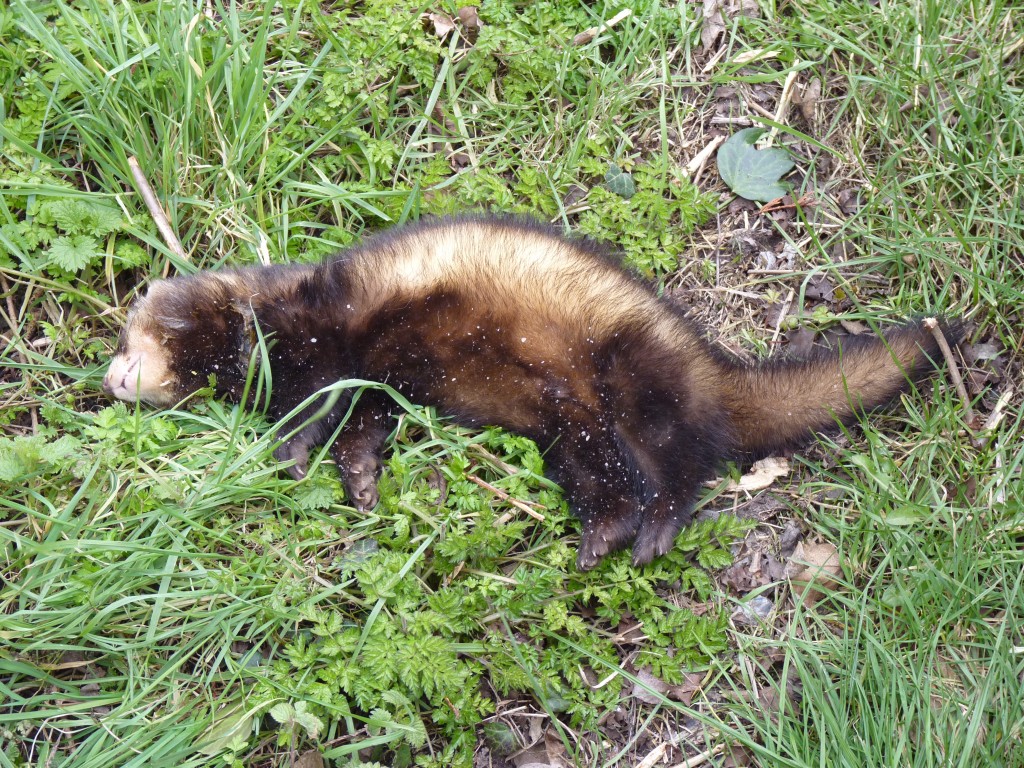
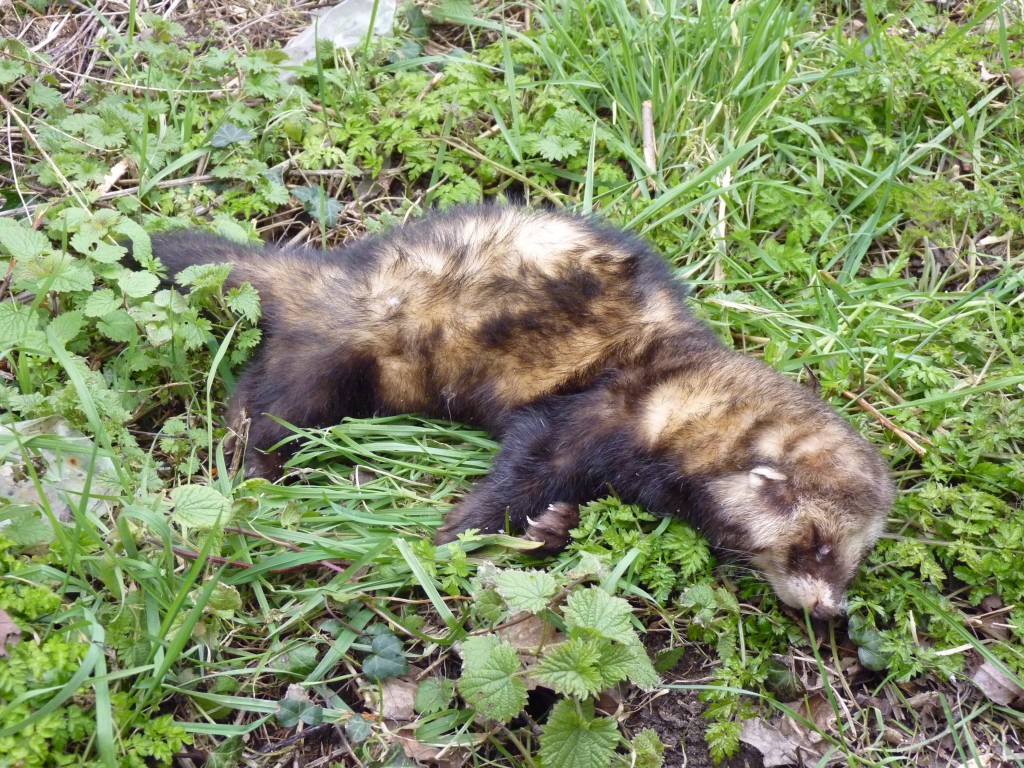


I don’t know if the identification can be confirmed by these pictures, but this recent road casualty by the A38 at Coombe Hill today appears to be a Polecat Mustela putorius. Comments please!
The GNS Field Meeting, at Upham Meadow on the Avon near Twyning, planned on Sunday 24 February is to go ahead (unlike the January meeting at Lower Lode, which had to be cancelled because of flooding). The flooding along the Avon has subsided, so that the meadow is accessible, though still very wet underfoot,
so wellingtons or waterproof footwear are essential.
To get there from Twyning (beyond Tewkesbury, in the extreme north of the county), take the left turning on the green just past the school towards Strensham, then turn down the second right turn, along the road to the Cotswold Grange Country Park at SO 908371. The leader will be waiting by the turning to the Park from 9.45 a.m. Park by the chicken sheds just past Sandacre Farm. A couple of hours walk around the meadows and along the Avon over the river from Bredon.
This is one of the largest meadows in England, of great botanical, ornithological interest, and a fascinating survival of old farming techniques. The visit is at an unusual time, right at the beginning of the spring, to give guidance for later visits at prime bird and flower time.
Dear Members
This issue of GNS NEWS gives a good deal of prominence to the Forest of Dean, one of the richest and most interesting parts of our county in terms of biological diversity and nature conservation. We have articles on recording, and articles on conservation issues. Furthermore GNS is involved (with many other bodies) in an exciting application to the Heritage Lottery Fund which, is approved, should generate considerable funding (several million pounds) for conservation of the natural and cultural heritage of the area, and for developing training and demonstration in this field in the area.
I am writing just after the meeting of the Planning Committee of the Forest of Dean District Council on 13 February, which approved plans for the Cinderford Northern Quarter: these plans involve construction of homes and provision of jobs in the Cinderford area, but the work will pose grave threats to the wildlife of the area (notably to newts, moths, bats and dormice); the high conservation values are well known and documented, but do not appear to have been given adequate consideration in the planning process. The Gloucestershire Wildlife Trust has been closely involved with putting forward the case for wildlife, and details about the issue are available on their website; as they note, it is still open to the public (and to you as GNS members) to write to the minister concerned (Secretary of State Eric Pickles), asking him to “call in” the plans for further review. Even if the plans are put into execution, it is by no means clear how the necessary “mitigation” or wildlife compensation measures can be carried out in time: the plans speak of work beginning next autumn, but before work can begin, alternative bat roosts have to be built and adopted by the bats – a process which would normally take years, even if the bats adopt the new roost sties. Future issues of GNS NEWS (and the GNS website) will of course bring you details of developments.
May I also draw your attention to the forthcoming GNS Annual General Meeting, to be held this year on Cirencester, where we have a very active GNS branch, which has not hosted the AGM for at least ten years. So, a welcome return. There will also be a Special General Meeting (as agreed at the 2012 AGM, and mentioned in the Minutes distributed with the summer 2012 issue of GNS NEWS); your Executive Committee has reluctantly come to the conclusion that an increase in subscriptions has become necessary: GNS subscription levels have not changed for about twenty years, and it is simply not realistic, nor good financial practice, to allow financial reserves, which have been built up over the years through generous bequests from former members, to dwindle away. I hope that members will support the Committee on this issue: as I have said many times, GNS provides wonderful value: the meetings, the opportunity to contribute to recording of wildlife in the county, the quarterly newsletter (GNS NEWS), the annual “Gloucestershire Naturalist” and Bird Report; so an increase in subscriptions after twenty years is, in the Committee’s opinion, fully justified.
Finally, some sad news: Mrs Mary Palfrey, who had been one of the most active botanists in the county, and had recently stepped down from the Executive Committee, died on 10 February. A full obituary will appear in the next GNS NEWS. We shall greatly miss her expertise, and even more her friendly presence at meetings, and devotion to conservation in the county. Perhaps I may also draw your attention to another recent death at the age of 89 of Professor Geoffrey Matthews, for long years the head of research at the Wildfowl and Wetlands Trust, and a major figure in international wetland conservation.
Looking forward to seeing you at the AGM at Watermoor Hall, Cirencester on Friday 22 March,
Yours sincerely
Mike Smart
Hon Chairman
The Gloucestershire Naturalists’ Society has been following closely the issue of the planning application for building of new houses and a spine road through the Cinderford Northern Quarter, which will affect the Cinderford Linear Park and nearby wildlife sites. There have been regular articles in GNS NEWS, and many GNS members and recorders have submitted records of wildlife to illustrate the values of the site. The initial planning application was approved last week, and a press release was issued on 13 February by the Gloucestershire Wildlife Trust; the text of the press release is given below. GNS members may wish to write to the Secretary State to support the request that the application be “called in” (i.e. reviewed).
Mike Smart
Hon Chairman
MEDIA RELEASE
RARE AND PROTECTED WILDLIFE AT SERIOUS RISK IF WORK ON NORTHERN QUARTER STARTS THIS AUTUMN – WILDLIFE TRUST
There won’t be time to preserve and protect rare and precious wildlife before work starts on the massive redevelopment of Cinderford’s Northern Quarter, warns the Gloucestershire Wildlife Trust.
The Northern Quarter plans have now been approved by Forest of Dean District Council, just two months after the site was declared a Key Wildlife Site by ecological experts.
The developers say they want to start work this autumn, but Dr Colin Studholme from the Wildlife Trust warns there simply won’t be time to carry out the statutory work the developers must do before the building starts, in order to preserve the site’s rare and protected species of newt, moths, bat, dormice and other wildlife.
“The Government’s own ecologists recognised the extreme importance of the site in terms of rare species – but the measures they recommend to protect and preserve them would take up to five years to complete, and that has to happen before building starts.
“The Northern Quarter’s new spine road will involve demolishing buildings which are home to protected rare bats. Before the buildings can be demolished, replacement bat roosts have to be built; the bats have to move in and they have to start breeding. The developers appear not to be aware of their statutory duty otherwise they would not be talking about starting work this autumn,” added Dr Studholme.
“We remain deeply opposed to the development and will be writing to the Secretary of State Eric Pickles to request that his department “calls-in” the application. We would urge anyone else who opposes this scheme to do the same.”
Dr Studholme said the Trust was not opposed to some development of the site, understanding the need for jobs and housing in Cinderford, but recent claims y some councillors that wildlife would adapt or go back from where it came from, were “ill-informed and not helpful.”
“For this scheme to have been sustainable for wildlife, the applicant should have had full knowledge of the wildlife they were dealing when this whole planning process started 15 years ago. They are now trying to shoehorn wildlife into a scheme which was long-conceived but only latterly considered the environmental issues.”
The development will have significant negative impacts on local wildlife, he said. A panel of experts from local authorities, Natural England and top ecologists unanimously agreed last November that the Northern Quarter site was significant enough to be a Key Wildlife Site.
Title | ‘Silent Spring Revisited’ – A talk by nature writer Conor Mark Jameson |
Organiser | John Moore Museum |
Date | Saturday 2nd March 2013 |
Time | 7.30pm to 8.30pm |
Venue | The Old Baptist Chapel, Church Street, Tewkesbury, Gloucestershire |
Details | Rachel Carson is said to have sparked the modern day environmental movement with the publication of Silent Spring in 1962. She made vivid the gloomy prospect of life without birdsong. But have her warnings been heeded?Fifty years on, Conor Mark Jameson reflects on the growth of environmentalism since Silent Spring in his own book, ‘Silent Spring Revisited’. In his talk, Conor will explore the wildlife conservation situation since 1962, drawing upon his experiences and observations from two decades of working in the field, as well as attempting to answer the important question: are we silencing the spring? Conor Jameson works for the RSPB and has contributed to numerous wildlife magazines including the RSPB magazine and BBC Wildlife. In 2010 he won the BBC Wildlife Nature Writer of the Year award with his article, Phantom about an encounter with a goshawk in Berlin. For tickets contact the John Moore Museum, Church Street, Tewkesbury: Adults £8.00, Concessions £5.00 Telephone: 01684 297174 E-mail: curator@johnmooremuseum.org: |
Very sad that a lovely lady has gone (see Mike Smart’s post yesterday). Always cheerful, hard working, telling you straight how things are, demon driver, good naturalist. Here she it at Ketford Bank in March 2009 when the GNS executive committee visited the site.

Several GNS members attended the funeral of Mrs Mary Palfrey, as St Edward’s Church, Stow on the Wold today. She had been fighting illness courageously for some time, and remained in touch with GNS members until near the end.
Mary was an enthusiastic and expert botanist (entirely self-taught, as mentioned in the eulogy); she was a keen gardener and horticulturalist, and regularly attended the Chelsea Flower Show. In botanical terms she specialised in the flora of Cotswold limestone grasslands, where she made many plant surveys, often in conjunction with the Farming and Widlife Advisory Group, which made her a lifteime achievement award for her contribution to knowledge of the flora of these habitats. Fortunately her surveys have been kept and will form a long-standing record of the condition of these sites in her time, of great relevance for future monitoring and management of these sites, so typical of Cotswold Gloucestershire
She was for many years a member of the GNS Executive Committee, retiring only recently, and her active contribution to the running of the Society was much valued by other Committee Members.
We shall all greatly miss her, her wise counsels and her friendly expertise.
Mike Smart
Hon Chairman, GNS
Hi, Mike Smart has requested any personal memories of Mary Palfrey for the website so here is a first from me.
I first got to know Mary when I volunteered to help her “stuff” the GNS Journal (as it was then known) and the Bird Report. This involved me in a round trip from Cheltenham to Quedgeley to collect several boxes of magazines and transporting them to Maugesbury where Mary would have the envelopes all ready to receive the magazines. In the early days we had to lick both the envelopes and the stamps but we soon moved to self-seal envelopes and then to the non-lick stamps with which we have all become so accustomed. Over a cup of tea and cake we would talk about matters of general natural history – in my case mostly birds – and I soon came to realise the breadth of Mary’s knowledge especially, but not exclusively, in the field of botany. Mary had an excellent relationship with her local Post Office and on most occasions the postman would collect several heavy bags from her house which meant that we did not have to carry them.
When Mary moved into Stow itself this arrangement continued, but on several occasions we did load the boxes back into my car and transport them up the road where by this time the Post Mistress was actually putting the stamps on for us – another job we didn’t have to do.
The Bird Report was a particular problem as we had to get special heavy duty envelopes to take the weight of each book and weigh the bags or boxes as the post man had a limit to what he was allowed to carry – not that we were able to manage more anyway.
This arrangement which ensured that members received their publications in a timely fashion continued for over 10 years – I forget how many – with Mary and I getting together about 6 times per year to recreate our little production line.
On the day I rang to make arrangements for the latest meeting I found it difficult to take in that Mary was telling me that she could no longer carry on as she had been diagnosed with Cancer. After that new arrangements had to be made but I am glad to say that the publications are still being produced and still being mailed to all GNS members.
I saw Mary several times during her illness and she was always her welcoming and friendly self. Still interested in wildlife and particularly botany.
I miss the times I spent working with Mary and the chats we used to have and I know that there are many other people with their own memories.
Margaret Woodward
The latest round of deep flooding in the riverside meadows between Gloucester and Tewkesbury is beginning to drop, but many of the usual bird-watching areas are still inaccessible, and the birds are very widespread, seeking shallow edges difficult to apprach, rather than the deep water still to be found in many places.
At Coombe Hill it is now possible to walk along the towpath (which is very muddy indeed), but only as far as the first gate into the GWT reserve; the lower lying area of towpath between this gate and the entrance to the boardwalk is still under water, which will probably clear in the next few days: 8 Mute Swans, maybe 100 Canada Geese, one Shelduck, Wigeon and Teal very widely spread, but at least 500 each, maybe 50 Pintail, 10 Shoveler, 1 Shelduck. Bird of the day a Curlew, the first of the year in the meadows, suggesting that those wintering on the estuary have begun to move back towards nesting grounds, whether locally or further afield on the continent.
Cobney/Leigh Meadows: the road past the Red Lion at Wainlodes is just passable by car (for the first time today); still extensive flooding, though water is flowing out fast down the Parish Drain and the Chelt to the Severn. At least 500 ducks on the floodwater, probably more, mainly Wigeon, three Shelducks.
Ashleworth Ham: not accessible at all, because the Ham Road between Ashleworth and Tirley is still partly under water.
Meadows near Chaceley north of Haw Bridge: at least 1,500 ducks on shallowly flooded meadows, visible from the river bank, in a place where they are not normally seen at all. At least 100 Fieldfares and a couple of hundred Black-headed Gulls feeding on fields recently emerged from the floodwater.
Alerted by a post on the Gloucestershire Wildlife Trust website, I went to look at another Gloucester Starling roost today. GWT says there is a roost “in the Bristol/Stroud Road area”. I found quite large numbers circling in the Tuffley Avenue area from about 16h45. There seem to be (at least) two roosts- one smaller one of perhaps 1,000 birds near Tuffley Crescent, which after much quiet circling, finally landed and started chirping in a small group of three or four tallish thickly vegetated conifers (cypresses, I think) in a back garden. They once again attracted the attention of a passing Sparrowhawk, which again failed to catch any Starlings, before diving into the conifers. A local resident said they hadn’t been roosting there long. There appeared to be another, larger roost somewhere towards Linden Road, which I’ll find another day.
Are these roosts present all through the winter? Or do they gather only in late winter, just before the birds depart on migration to breeding grounds in eastern and northern Europe?
As in previous years, there is a fair-sized Starling roost in central Gloucester, in Great Western Road, just behind the station. This evening, flocks were in the air from just before 16h45, going silently round and round, never straying more than a few hundred yards from above the site of the roost. More and more birds joined them – there were perhaps five thousand (?) at the end. A passing Peregrine took no notice, but twice a Sparrowhawk showed interest, without attempting to catch one. The roost is in a line of conifers, seven trees, maybe twenty metres high, in about fifteen yards, They all dived into the conifers at about 17h20 (very close to lighting up time), and started to chatter on landing, whereas they had been very quiet before.
Why this flying round before they roost, which must use up a lot of energy in midwinter?
Passers-by seemed to enjoy the sight, though nobody had parked their cars along the roadside beneath the trees.