Severn Hams today

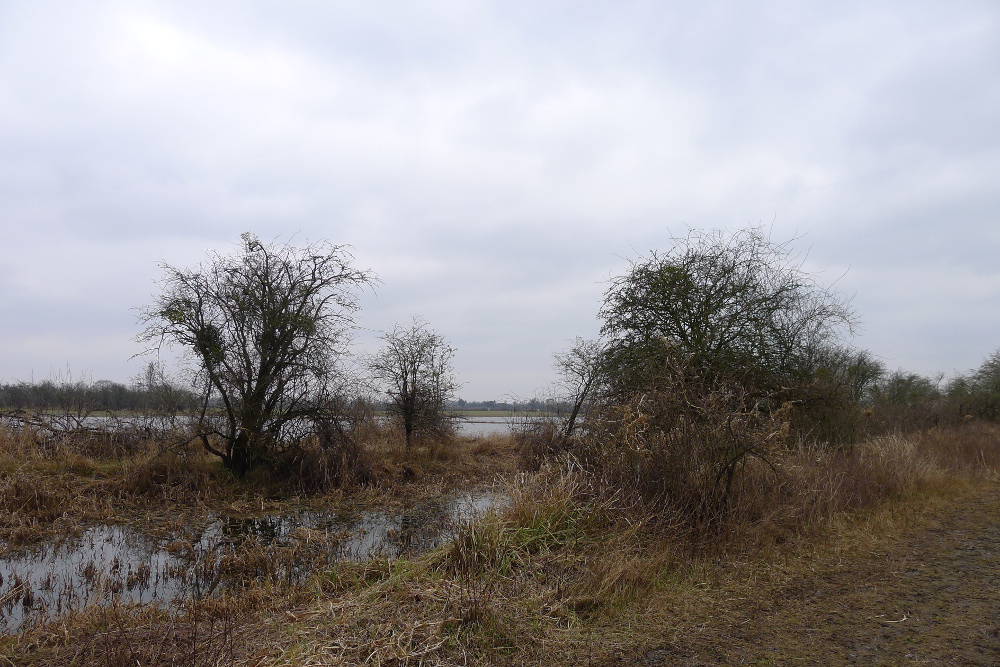
Flooding on the meadows is still extensive, and has hardly decreased at all in the last few days.  Cold easterly weather (still snow remaining on the Cotswolds and Malverns), little sign of migrant birds – still no Chiffchaffs singing.

Coombe Hill, where much of the floodwater was iced over early on: 10 Shelducks (lekking on the ice), still good numbers of Teal  (505 counted, but no Garganey found despite careful search), 2 Gadwall, 30 Mallard, 7 Tufted Ducks, 1 Great Crested Grebe (new arrival), 1 Grey Heron, 19 Coot, 60 Lapwings (mainly in flocks, though with some display), 1 Little Ringed Plover (an obvious migrant, flew in from south, calling), 2 Snipe, 6 Curlews (appeared to be three pairs), 1 Great Spotted Woodpecker (drumming), 1 Treecreeper (singing), 2 Yellowhammers (new arrivals), 4 Reed Buntings (singing).

Cobney Meadows, water considerably lower: 2 Shelducks, 230 Teal (no Garganey either), 1 Little Egret, 2 Oystercatchers (pair), 2 Curlews (pair)

Ashleworth Ham, where water levels had hardly declined at all: 78 Wigeon (only ones seen all day; most seem to have departed), 270 Teal, 45 Mallard, 13 Pintail, 21 Shoveler, 2 Tufted Ducks, 1 Great Crested Grebe (also a new arrival).

2012 – disaster year for butterflies

At the Annual General Meeting of the Gloucestershire Naturalists’ Society, a team from Butterfly Conservation reported on monitoring of Lepidoptera at the newly-purchased reserve at Rough Bank (see separate report on the AGM below).    The link below gives details of a press release on butterfly recording in 2012 by Butterfly Conservation, the Centre for Ecology and Hydrology and UK Butterfly Monitoring Scheme:

http://butterfly-conservation.org/48-3680/2012-a-disaster-year-for-uk-butterflies.html


The full text of the press release is as follows:


2012: A Disaster Year For UK Butterflies

Washout 2012 was the worst year for UK butterflies on record with 52 out of the 56 species monitored suffering declines, a scientific study today revealed.

Some of our rarest species such as the fritillaries bore the brunt of the second wettest year on record and now face the real threat of extinction in some parts of the UK.

Last year’s relentless rain and cold created disastrous conditions for summer-species in particular as they struggled to find food, shelter and mating opportunities; butterfly abundance plummeted to a record low as a result and 13 species suffered their worst year on record.

The critically endangered High Brown Fritillary fell by 46%, the vulnerable Marsh Fritillary was down 71% and the endangered Heath Fritillary saw its population plummet by 50% in comparison to 2011.

Many of our most threatened butterflies were already in a state of long-term decline prior to the 2012 deluge. There are now real fears that these already struggling species could become extinct in some parts of the UK as a result of last year’s wet weather.

Hairstreaks did particularly badly last year – the Black Hairstreak, one of the UK’s rarest species, saw its population fall by 98%. The Green Hairstreak was down 68%, the White-letter Hairstreak fell by 72% and the Brown Hairstreak, slipped by 34%.

Many common species struggled. The Common Blue plummeted by 60%, the Brown Argus collapsed by 73% and the Large Skipper fell by 55%.

The widespread ‘Whites’  including Green-Veined White and the two ‘Cabbage Whites’, Large White and Small White saw their populations tumble by more than 50%. The Orange-tip fell by 34%.

The alarming slide of garden favourite the Small Tortoiseshell continued with its population slipping 37% from 2011 figures.

Data was gathered by the UK Butterfly Monitoring Scheme (UKBMS) jointly led by Butterfly Conservation and the Centre for Ecology & Hydrology (CEH).

Only four species saw their populations increase. The grass-feeding Meadow Brown was up 21% and the Scotch Argus, which thrives in damp conditions, rose by 55%.

Dr Tom Brereton, Head of Monitoring at Butterfly Conservation, said: “2012 was a catastrophic year for almost all of our butterflies, halting progress made through our conservation efforts in recent years.  Butterflies have proved before that given favourable conditions and the availability of suitable habitat they can recover, but with numbers in almost three-quarters of UK species at a historically low ebb any tangible recovery will be more difficult than ever.”

UKBMS has run since 1976 and involves thousands of volunteers collecting data every week throughout the summer from more than 1,000 sites across the UK.

CEH butterfly ecologist Dr Marc Botham said: “Despite the horrific weather in 2012 over 1,500 dedicated volunteers still managed to collect data from over a thousand sites across the UK. Their amazing efforts enable us to assess the impacts of wet summers on butterfly diversity.”

The UKBMS is operated by the Centre for Ecology & Hydrology and Butterfly Conservation and funded by a multi-agency consortium including the Countryside Council for Wales, Defra, the Joint Nature Conservation Committee, Forestry Commission, Natural England, the Natural Environment Research Council and Scottish Natural Heritage. The UKBMS is indebted to all volunteers who contribute data to the scheme.

Butterfly Conservation is the largest charity of its type in the world. Our aim is the conservation of butterflies, moths and their habitats. We run conservation programmes for more than 100 threatened species and manage over 30 nature reserves. www.butterfly-conservation.org

The Centre for Ecology & Hydrology (CEH) is the UK’s Centre of excellence for integrated research in the land and freshwater ecosystems and their interaction with the atmosphere. CEH is part of the Natural Environment Research council, employs more than 450 people at four major sites in England, Scotland and Wales, hosts over 150Phd students and has an overall budget of about £35m. CEH tackles complex environmental challenges to deliver practicable solutions so that future generations can benefit from a rich and healthy environment. www.ceh.ac.uk You can follow the latest developments in CEH research via http://www.ceh.ac.uk/rss.xml


Severn Hams on Tuesday 26 March

The level of the Severn has dropped a little over the last couple of days, but it is still relatively high, so that it is difficult for tributaries to discharge their waters into the main river.  Little outflow from the River Chelt at Wainlodes, none from the Deerhurst Parish Drain, which drains Coombe Hill and Cobney Meadows.  So water on the meadows is everywhere higher, rather a disappointment when it appeared at last to be dropping.

The bitter east wind made conditions unpleasant; no sign of summer visitors such as Chiffchaff or Sand Martin.

Coombe Hill: water levels have risen since Sunday, and the level is above the top of the stage boards in the north and south scrapes (so above 1.00).  Rather few birds present; presumably most of the remaining ducks were sheltering from the wind, unseen, in the Long Pool.   No sign of the male Garganey found on Sunday.  Only 10+ Teal (undoubtedly an underestimate), 2 Gadwall, 1 Shoveler, 10 Coot, 100 Lapwings (all that remain of the flocks of many hundreds in the area over the last few weeks); 2 + Curlew – what appeared to be a resident pair on the southern meadows, bubbling actively; 1 or 2 Skylarks singing, 3 or 4 Reed Buntings singing.

Cobney Meadows: flooding has risen again and is quite extensive: 30 Mallard, 50 Teal, no sign of Lapwings.

Ashleworth Ham: Water also very high, Hasfield Ham side inaccessible: 60 Wigeon, 205 Teal, 4 Gadwall, 9 Pintail, 9 Shoveler, good numbers of Snipe on some flooded (60 Snipe and  2 Jack Snipe), 60 Fieldfares (the last few migrants), no Lapwings.

March GNS News out

The March 2013 issue of GNS News is now available, with articles including a consideration of the ecological consequences of the proposed Cinderford Northern Quarter developmentcovermarch13, the Red-Data fungus Stephanospora caroticolor, discovery of the harvestman Opilio canestrinii in Gloucestershire, a study of Hobbies, and (cover story) Willow Tits in the Forest of Dean.

GNS Annual General Meeting; and latest on Rough Bank

The 2013 GNS Annual General Meeting was hosted by the GNS Cirencester branch on Friday 22 March, with the Society’s President, Anna Jones, in the chair, and about 30 members present.  The Society’s Chairman, Mike Smart, presented an overview of the year’s activities; he recalled the Society’s role through which voluntary naturalists record natural history, emphasizing the special character of the previous year with its very wet weather that had severely affected flora and fauna; he noted the personnel changes at Gloucestershire Wildlife Trust, and indicated that contacts were under way to strengthen links between the two bodies.  He pointed out however that the Society had had limited success in its efforts to recruit and train young naturalists.  In conclusion he recalled the importance of the Society’s Recorders, who were among the best experts in their field in the county, who provided enormous support to the Gloucestershire Centre for Environmental Records, and were highly regarded by professionals and voluntary naturalists alike.

The Hon Treasurer, Andy Oliver, then reported that the Society was in a very favourable financial position, with considerable reserves which enabled it to make grants to a number of individual naturalists and to local and national bodies; among the latter were Butterfly Conservation as a contribution to the purchase of Rough Bank, support for the production of a Red Data Book on bryophytes in the county, support for the publication of the new “Birds of Gloucestershire” to be launched in November 2013, and a series of recording workshops on Cleeve Common.  The Treasurer however noted that such grants represented a considerable drain on the Society’s capital reserves, which did not cover annual running costs (notably publication of GNS NEWS, The Gloucestershire Naturalist, and the county Bird Report.  Given that the subscription of £8 per annum had not been raised for something like twenty years, the Executive Committee was proposing an increase of the annual subscription to £15 per household per annum, to ensure that the Society’s finances remained on a sustainable basis in the long term.  This proposal, already announced at last year’s AGM, was then put to the membership in a Special General Meeting, as provided in the Society’s Rules and Regulations, and was unanimously approved.

The Chairman of the Society’s Scientific and Publications Committee, David Scott-Langley, reported on the Committee’s activities in the previous year, paying tribute to Colin Twissell, the Recorder for Amphibians and Reptiles, and to Roger Gaunt, the Moths Recorder, both of whom were standing down after very many years in post.  He noted that the quarterly GNS NEWS, edited by Kate Kibble, had continued to maintain its high level of quality, while the 2012 edition of The Gloucestershire Naturalist had been larger than ever and contained reports on many taxa.  As Chairman of the Cirencester branch, he noted that a successful programme of indoor meetings had continued and that the branch would celebrate its fiftieth anniversary in 2014.

The Membership Secretary, Andrew Bluett, noted that the Society’s membership had held steady at around 560 members, and appealed to members, when they renewed their subscription, to sign Gift Aid forms.

After a tribute to Mrs Margaret Woodward, who was standing down from the Executive Committee after many years of active participation, the present Committee was re-appointed.  In her concluding remarks, the President expressed appreciation of the Society’s contribution to knowledge and conservation in the county, particularly in a context when governmental funding for such activities, notably as regards land-use planning, were diminishing.

In the second part of the meeting, a trio of speakers from the county branch of Butterfly Conservation gave a presentation on the newly-acquired reserve at Rough Bank.  This limestone grassland site on the Cotswold Scarp, at the head of the Slad Valley above Painswick, was known to be of special interest for moths and butterflies, notably Duke of Burgundy and (in the past) Large Blue butterflies.  Regular and planned monitoring of moths had been carried out by Guy Meredith in the previous year and had increased the number of moths recorded from 38 to over 260, including a number of national rarities.  Meanwhile Chris Wiltshire had carried out weekly monitoring sessions and, despite the miserable weather for butterflies, had recorded a wide variety of butterfly species.  GNS members greatly appreciated these presentations, which illustrated the value of regular and constant monitoring in the Society’s tradition.  Sue Smith noted that, whilst the reserve was open to the public, visiting by car was being discouraged until road access safety improvements had been made.  It was reassuring to hear that, with this acquisition, the major sites of importance for Lepidoptera on the Cotswold scarp are now under conservation management.

Field Meeting at Coombe Hill Canal, 24 March 2013

Poisonously cold for Palm Sunday with a biting northeast wind, a speckle of snow flakes in the air and snow on the Cotswolds. And we had been hoping for summer migrants!

Two members accompanied Mike Smart, the leader, along the muddy towpath from which there were good views across the flooded meadows, which looked pretty desolate.  small20130324_113551_1070874

Little bird song – the odd Dunnock, Wren, Greenfinch. Only four Lapwings, one or two Curlew with a little bubbling, one Little Egret, one Grey Heron, one Cormorant in flight, a Sparrowhawk hunting along the towpath, and a Tree Creeper in the withy bed

However, some shots from the Apperley side (presumably for clay pigeons) put up the ducks from the Long Pool, and it transpired that there were still good numbers of Teal, about 370, with 7 Wigeon, 6 Shoveler, and the odd few paired Mallard.  A more careful look revealed a male Garganey skulking in the withy bed, and keeping rather separate from the Teal, so we did have one migrant.

Coombe Hill field meeting on 24 March to go ahead

The field meeting at the Gloucestershire Wildlife Trust reserve at Coombe Hill Meadows on Sunday 24 March will go ahead.  Meet at the car park by The Wharf at 10.00 a.m.  Following recent rain, water levels are rising in the River Severn, so water levels on the meadows are likely to be rising too.  Wellingtons or waterproof shoes are therefore absolutley essential.  Times of rising water level are often of special interest, not only for wildlife, but from a hydrological point of view: which ditches fill first, which fields flood first, how does the water affect wilfdlife – both flora and fauna.

See you there

Mike Smart

Herald Moth, Standish, 6 March 2013

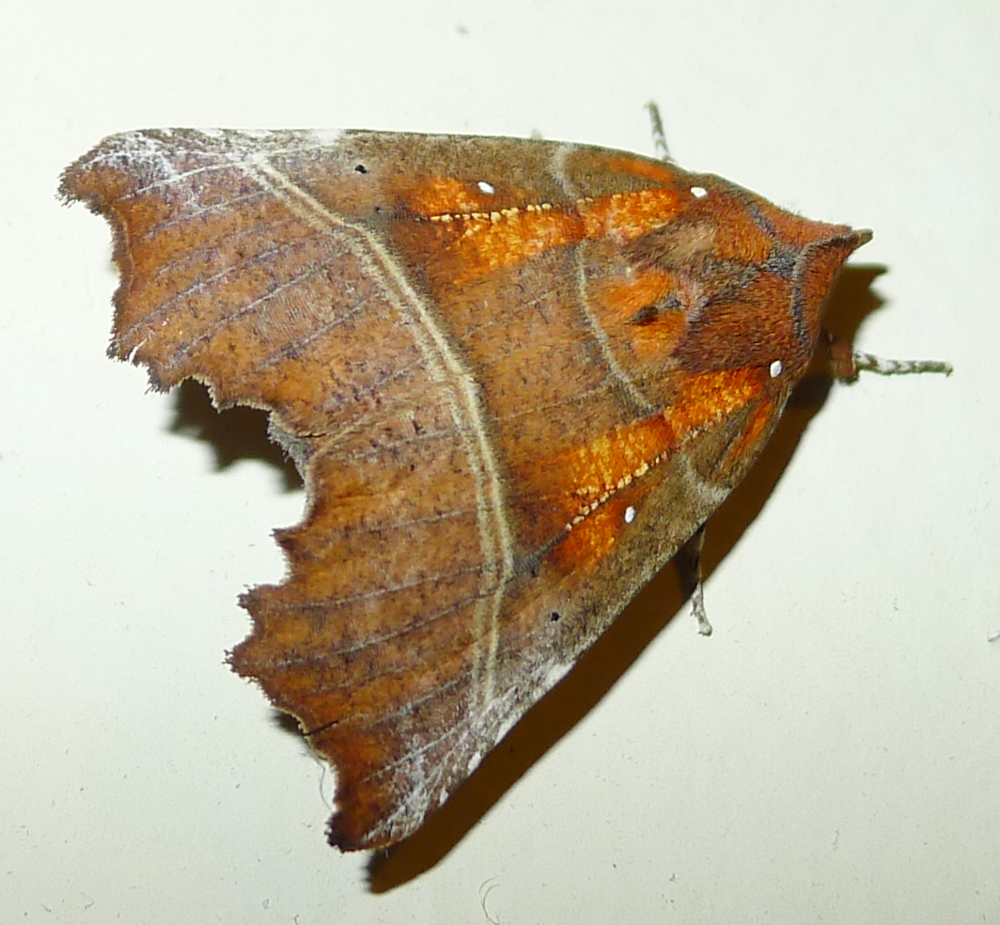
A Herald Moth (Scoliopteryx libatrix) was on the wall in my hall.  herald

I sent the photo for confirmation to Robert Homan, the County Moth Recorder for V-c33, East Gloucestershire, who kindly supplied some supplementary information.

The Herald overwinters as an adult, and Robert suggest it may have been drawn out of hibernation by the recent brief outbreak of spring. I asked if it was called the Herald because it heralds the spring.  He dashed such notions, saying that in “The Scientific Names of the British Lepidoptera – their history and meaning” A Maitland Emmet suggests that the “herald” might be derived from Linnaeus’ original name of libatrix – “the moths’ vestiture may have suggested to him a stately robe, suitable for ceremonial duty.

Robert has provided this distribution map of the Herald in East Gloucestershire which shows a close parallel with the main river systems and thus its larval food plants – willows and poplars – both of which occur in my garden.herald_in_vc33


John Moore Museum: ‘The Kemerton Conservation Trust’ – A Talk by Chairman Adrian Darby OBE

Friday 15th March  2013
7.30pm to 8.30pm
The Old Baptist Chapel, Church Street, Tewkesbury, Gloucestershire
The museum is very pleased to welcome Adrian Darby OBE, Chairman and founder of the Kemerton Conservation Trust (KCT), to the museum in March 2013.  KCT is a registered charity which aims to conserve wildlife and places of beauty in Gloucestershire, Herefordshire, Worcestershire and adjoining counties for the public benefit.Much of the Trust’s activity takes place in the area surrounding Bredon Hill in south Worcestershire, where there is a concentration of traditionally-managed farmland and woodland habitats which are exceptionally rich in fauna and flora.

The Trust has four main purposes:

  • Managing important sites for the benefit of wildlife
  • Developing innovative conservation practices
  • Continuing a twenty-five year programme of scientific surveying, monitoring and analysis
  • Educating the public, land managers, and other organisations about conservation priorities and practices

In his talk, Adrian Darby will be giving people a fascinating insight into the work of this important conservation charity, whose work is particularly important in these times of pressure on our countryside and its wildlife.

Tickets available in advance from the John Moore Museum, Church Street, Tewkesbury:
Telephone: 01684 297174
E-mail: curator@johnmooremuseum.org:

Adult: £5.00
Concessions: £4.00

Skip to content