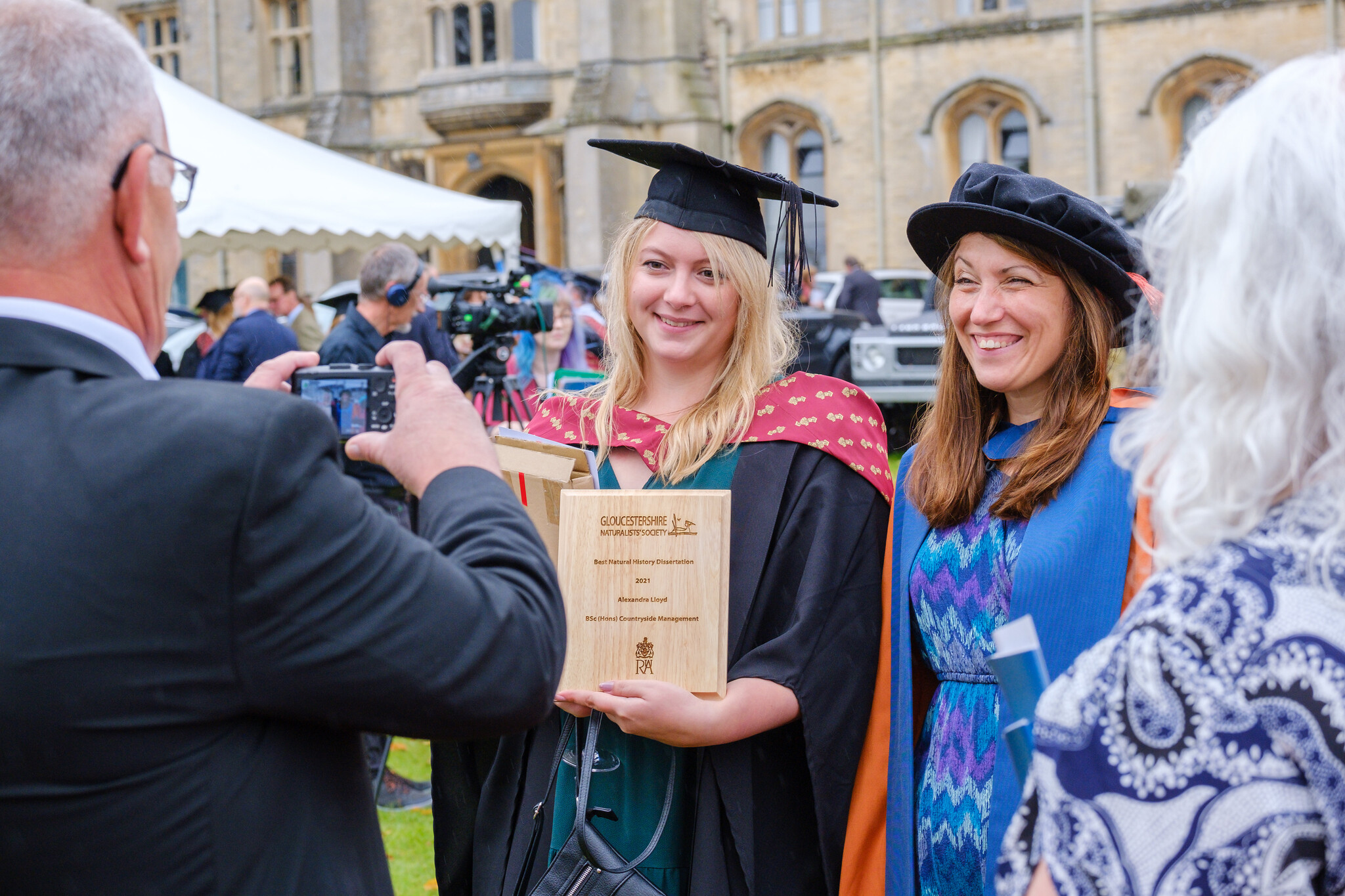
Natural History Dissertation Award 2021

Alexandra (Lexi) with her prize and dissertation supervisor Dr Felicity Crotty

The Royal Agricultural University presented GNS’s sustainable bamboo plaque for the best natural history dissertation at their short graduation ceremony to Alexandra Lloyd studying the BSc (Hons) top-up in Wildlife and Countryside Management for her highest scoring dissertation under the criteria on ‘Tramline orientation effects on aboveground invertebrate dispersal’.

Globally, invertebrates have been found to have declined in abundance and diversity, in part due to the intensification of agriculture. However, with agricultural land covering 70% of the UK and forming a habitat for invertebrates within the soil, crops and hedgerows, farmers and scientists need to work together to discover the best ways to reduce this decline. The relationship between terrestrial invertebrates and agricultural management practices has been widely investigated, however this study aims to assess an area that is often overlooked; whether invertebrate dispersal from field edge is impacted by the orientation of tramlines in relation to the field boundary.

Overall, 646 invertebrates were collected via pitfall traps placed along 100m tramlines from the field boundary, an established hedgerow, to field centre, set over a twenty-four-hour period. These transects were orientated either parallel to the tramline or perpendicular to the tramline. Individuals were identified to the taxonomic family level. Soil compaction data was also collected, using a penetrometer, along the transects.  An analysis of variance was used to analyse abundance of total fauna; Collembola; and predatory species (consisting of combined Coleoptera and Araneae data). In each of the three groups abundance was significantly higher in the perpendicular orientation than the parallel; total fauna (p<0.001), Collembola (p=0.001), predators (p=0.018). No significant difference was found over distance from hedge to field centre for any of the groups studied, nor was there a difference in diversity of samples collected across the transects. There was no significant difference in field compaction between orientation of measurements from the tramlines, however the distance from the hedgerow into the centre of the field did show significant differences (p=0.036), with greater compaction near the hedgerow.

Overall, the results of this study show that tramline orientations in relation to field boundary do influence some above ground invertebrates ability to disperse from the field edge to the field centre. This should be taken into consideration when surveying above-ground invertebrates within agricultural fields. Compaction had little direct impact on the above ground terrestrial invertebrates movements here, however it could affect flora species on which invertebrates rely for habitat and food source which encourages dispersal. Further research is needed to confirm these findings across season and at a range of different field sites.

Field Meeting Ashleworth 9-1-2022

A small group of about eight GNS members gathered for the first field meeting of the new year at Ashleworth Ham on Sunday 9 January 2022, in bright fine conditions, after a light early frost. The Gloucestershire Wildlife Trust reserve of Ashleworth Ham comprises the lowest area of flood meadows on the west bank of the Severn and surrounding fields and hedges, and has always flooded when the Severn is high, attracting good numbers of wintering waterbirds. for which Ashleworth and Hasfield Hams are designated as a Site of Special Scientific Interest. (Its old name “The Duckeries” reflects its former status as the hunting ground of the Hasfield Estate). The Severn at Haw Bridge reached a peak of over 10 metres on 27 December, not high enough for the river to overtop its flood-bank, but high enough to prevent local tributaries from discharging into the Severn, so that they back up and flood Ashleworth Ham. (‘Ham’ is a word of Anglo-Saxon origin, meaning a riverside hay meadow that may flood in winter). On the day of the GNS field meeting, water levels on the reserve were fairly high, perhaps a little too high for surface-feeding ducks to feed comfortably, but not enough to spill over onto the road, which happens when the Severn breaks its banks.

The main aim of the meeting was to look for waterbirds, but these were eclipsed, right at the beginning of the session, by the sight of three otters in the floodwater. Otter spraints and footprints are often found in the Severn Vale nowadays, but it is rare to have such good views of these extremely sleek and elegant creatures; they swam and played for several minutes in full view, so that their graceful shape, almost recalling a porpoise could be well seen. These were probably the same three individuals seen and photographed here in December by John Fletcher.

The usual ducks were present, but numbers were difficult to gauge, as many were hidden in the thicker vegetation under the ancient willows: roughly 200 Wigeon, 300 Teal, 4 Gadwall, 100 Mallard, at least 5 Pintail, 10 Shoveler; the Teal and Wigeon calling loudly. In the old days Bewick’s Swans and White-fronted Geese regularly came up from Slimbridge to Ashleworth and other flood meadows (the “Severn Hams”) at time of flood, but with the decrease of both species on the estuary, sightings have been rare in the Hams in recent years. Instead, the wintering goose population is now made up mainly of feral Greylag and Canada Geese, occurring in some numbers (at times over a thousand) and making an impressive spectacle with the sound of their calls and wingbeats, as they move between the water and grazing areas. At Ashleworth the greatest numbers of geese are found at dawn and dusk when they come in to roost, but one sizeable group of just over 100 Greylags was grazing on a grass ley (not very popular with the farmer!). Closer examination showed that one Greylag had a fair extent of white feathering on its crown and forehead, which might have made a casual observer mistake it for a Whitefront, but it wasn’t, just a Greylag a heavy orange bill and white on the head. However there was also a genuine Whitefront in the flock, much smaller than the Greylags and with a clearly demarcated white patch on its forehead, rather than a white smear all over the front of the crown; it had little or no barring on the breast and may have been the one that has been seen of late at the GWT reserve at Coombe Hill, only a few miles away as the goose flies. The Greylag flock also held an unusual hybrid, a cross between a Grey and a Swan Goose, a huge beast with a massive bill and a dark streak along its crown and nape betraying its Swan Goose ancestry. These hybrids stand out and are useful markers, making it possible to follow the movements of goose flocks: this one had been seen in previous winters, and was noted at Ripple Lake, just up the Severn between Tewkesbury and Upton, in October last; at that time there was little or no floodwater, so the birds stayed mainly at Ripple; now, with more water at Ashleworth, they have moved downstream.

Other waterbirds present included a small flock of perhaps 50 Lapwings (at the height of the flood in late December there had been 1,500 at nearby Longdon Marsh), and about 15 Snipe, most of them resting by day in the long damp vegetation, and waiting for dark when they fly out from their daytime roosts to feed with their extremely long bills in soft ground around the reserve. Some passerines also appeared in the hedges and willow pollards: Robins and Dunnocks, singing and defending territories already; a male Stonechat in the long dead Reed Canary Grass (probably with his mate nearby, since they remain in pairs in winter, though we could not find her), and a flock of a hundred wintering Redwings and Fieldfares, looking for invertebrates in the long grass, then flying up into the hedges as we approached. And surveying all from a discreet distance were two raptors, a Peregrine on the electric pylon and a Buzzard on a fence post.

The final observation was of two hares, now happily a relatively frequent sighting in this characteristic Gloucestershire Severn landscape of flooded hay meadows bordered by hedges of hawthorn with the occasional oak and many ancient, twisted crack willows (the Latin name is curiously Salix fragilis – they look anything but fragile with their boles appearing for all the world like Mediterranean olive trees).

Mike Smart

Skip to content