Nightjar Meetings in the Forest of Dean

A total of 22 members and guests joined Andrew Bluett over three evening visits to the Forest of Dean on 18th and 24th June and 9th July 2015. Each meeting began at 9.00 pm with Nightjar activity commencing soon after 9.30. The site visited held two pairs of birds which gave good sightings of flying birds approaching to within 10 metres of the group several times and long bouts of “churring” song.

The warm still evenings did encourage the local Mosquitos to be troublesome but not seriously so, and at the first and last meetings groups of Wild Boar of various ages and sizes were seen near the car park. Song Thrush song punctuated the waiting before Nightjars became active and the clicking of a Stonechat was heard on all three occasions, Woodcock were notable by their absence for most of the time with only a very few roding passes; a young Tawny Owl was heard calling from the denser part of the forest at all meetings.

The Nightjar flights were visible easily when traversing the backlit sky but less so when low down and skimming across the vegetation; one male bird sang regularly from a particular Silver Birch Tree and could be picked up in a torch beam, most especially when the eye caught the light and reflected it back.

At two of the meetings members with Bat detectors were able to locate and identify various species for the group.

Walking back to the car park was rather uneventful at the first two meetings but on the third meeting, a number of variously sized Toads were discovered along the forest track, most of them small and no more than 18 mm long. A rather suspicious rustling in the undergrowth was a little un-nerving until the light of torches brought to bear revealed two Fallow Deer rather than the expected Wild Boar.

My thanks to all those who took part and for those who were not able to attend the meetings, you should get another chance next year..!

Photographs of male Nightjar courtesy of Ken Cservenka – note the white patches in the wings and tail identifying males and a short video by Andrew Bluett at the link below.

IMG_9929A IMG_9917A

Nightjar 2015 Video Clip

Birds of Prey Day for the Summer Holidays – Sat 8 August

Event at John Moore Museum

A Live Animal Event
20150808 John Moore Museum

OrganiserJohn Moore Museum
DateSaturday 8th August 2015
Time10am to 1pm & 2pm to 5pm
VenueJohn Moore Museum, 41 Church Street, Tewkesbury, GL20 5SN
DetailsCome along to the museum to meet JRCS Falconry who, amongst others, will be bringing along a Barn Owl, a Tawny Owl, a Harris Hawk, a Buzzard, a Peregrine Falcon and an Eagle Owl. Learn all about these fascinating creatures from a falconer, who will be in the museum to answer all your questions about birds of prey and the ancient art of falconry. Enjoy seeing these magnificent birds in our beautiful cottage garden.

Admission
Adult: £3.00, Seniors & Students £2.50, Children £2.00, Family £8.00

ContactContact: Simon Lawton (Curator) – very happy to give interviews
E-Mail: curator@johnmooremuseum.org
Telephone: 01684 297174

Red Kite Sighting

On Friday 3rd July @ 7 p.m. Red Kite was spotted circling  over bungalow in Winchcombe Gloucestershire  before heading off in 160 degree  SSE direction.  No mistaking the shape witnessed via binoculars.


Cath Symons

BIOBLITZ 700 at The Park & Poor’s Allotment: 25th – 26th July 2015

The Gloucestershire Wildlife Trust is holding a 30 hour recording session at its newest reserves – The Park and Poor’s Allotment, Tidenham, Forest of Dean – over the weekend on 25th and 26th July.  The aim of the event is to find out as much as possible about the reserves ahead of producing management plans for the sites.  Our aim is to record at least 700 species across the weekend.  We would like as many people as possible to come along to help with the recording effort so that we can reach our target by 4.00 pm on Sunday afternoon.  If you are available and would like to join in all the details are in the attached programme and also on our website. You will see that we have a whole series of guided walks for the public during the weekend to get them involved in and enthused about recording.  You can either join in with these or wander at your leisure across the sites to see what you can find.  We will have the Old School Rooms in Rosemary Lane as the Recording Hub for the weekend where sightings will be collated and specimens displayed.  Drop in any time to see how we are doing.

Here are all the details: Bioblitz Programme 25-26 July 2015 v2 (Word document)

Damselflies hatching in kitchen sink pond

In my back garden in Warden Hill, Cheltenham I have used an old white Belfast style sink to create a water feature.  This has been in-situ for around 5 years, so I’d say is ‘mature’.  Initially I filled it with rain water, placed in some local rocks (to allow larger animals to escape if they fell in) and then ‘kick-started’ it with some water from a local pond (which included some pond weed and a few snails).  For the last couple of years I’ve noticed the moults of damsel flies and this year just happened to be outside recently when I noticed the latest nymphs climbing up the reeds and changing to adults.  They are not brilliant photographs (I’d left my good camera at work and these are from my iPhone), but are not too bad.  I think they are Large Red Damselfies (Pyrrhosoma nymphula).  It just goes to show that nature will find a way!

Hatched damselfly 2 Large Red Damselfly Pyrrhosoma nymphula Nymphs climbing sink reeds edit

Victoria Park Bioblitz and Wildlife Day, Windmill Hill, Bristol. July 3 and 4.

Dear Glos Nats

I am organising a bioblitz and wondered if any of your members may be interested in coming along?

Some of my friends at Bristol Naturalists Society and Somerset Rare Plants are coming, but I thought you might be interested too as we are in West Glos vice county.

Thanks and best wishes
Alex Morss

Victoria Park Bioblitz and Wildlife Day, Windmill Hill, Bristol

Fri July 3 & Sat July 4, 2015

Please bring your curiosity, or your specialist knowledge, and your friends to this natural history fun event – all ages and abilities welcome. As part of the Bristol Festival of Nature, our free, public Bioblitz involves two days of activities aimed at finding, identifying and discovering more about Victoria Park’s wildlife.

* 9.15am – 3pm Friday July 3: This period is exclusively for primary school children – but BNS helpers are welcome to come along to assist with species identification.

* 9.15pm, Friday July3: Public bat walk led by David Brown.

* 9pm, Friday July 3: Public moth trapping evening led by Neale Jordan-Mellersh.

* 10am – 4pm Saturday July 4: public bioblitz, mixing science and discovery with a wildlife-themed day of walks, talks, identifying things, arts, crafts, family fun, story telling, games and more.

This year, the mowers have been turned off, across half the park, and efforts made to welcome back wildlife – so it’s a good opportunity to find what’s here. Victoria Park is on an important urban wildlife corridor through the heart of our city. As well as its wonderful trees and curious moving springs, the park was chosen as a study site by Bristol University researchers, who recently made some promising finds here as part of their UK-wide Urban Pollinators research experiment.

For detailed activity times, please visit: www.bnhc.org.uk/festival-of-nature

To help, please contact the organiser Ms Alex Morss: morzojunk@yahoo.co.uk

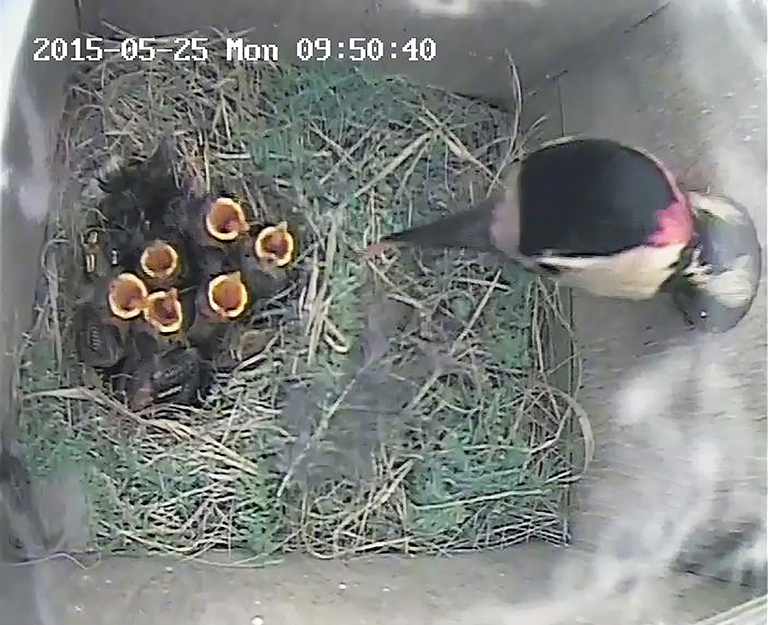
Woodpecker raiding Blue tit nestbox

This is a still from the recording of our nestbox camera this morning. We saw a woodpecker flying to it and poking his head in. When we played back the video, there he was. Luckily the chicks were just out of reach of his beak.

He tried a second time, and interestingly this time the chicks kept low in the nest with their beaks closed.

The mother was back within seconds of him leaving.

20150525 Nestbox with Woodpecker

Nuthatches in nestbox

IMG_3038_adj_cr We have over a dozen nest boxes in our 1.5 acre garden at Woolaston. For the fourth year, Stock Doves are nesting in a kestrel-design box fixed to a shed wall where squirrels find access more difficult.

This year, for the first time, we have nuthatches in one box. There seem to be two chicks nearly ready to fledge (24th May 2015)

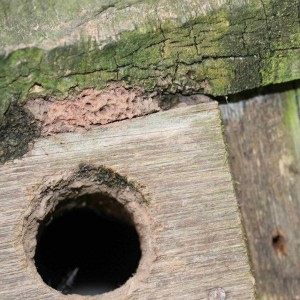
It is a larger box than my standard tit boxes. Internal dimensions are approx. IMG_3026_cr30cm high at front x 15cm deep x 10 cm wide. After woodpecker damage I nailed on a new ply entrance, still enlarged by the woodpecker. The nuthatches have added mud above the entrance to seal it  and have also adjusted the entrance size and shape  to  make it downward sloping inside and a little smaller.

Bark nest material
The nest is made from large pieces of thin bark from our paper-bark maple. They must  have struggled to pull them through the entrance hole.

David Priddis

Nightjar Field Meetings planned for 2015

Nightjar Artwork

Following the success of last year’s Nightjar evenings I plan to do more this year, proposed dates are Thursday 18th June, Wednesday 24th June and Thursday 9th July. If anyone is interested, please contact me and let me know your preferred date.

As for last year the evening meetings will begin by meeting at 9 pm for a 9.30 start and will be weather dependent. The chance of seeing Nightjars on wet or very windy evenings is poor, we will therefore be hoping for reasonably clear and still evenings and if necessary, will revise the dates.

I will send out full instructions ahead of the proposed dates to all who wish to attend.

Andrew Bluett

GNS Membership Secretary – gnsmembership(at)btinternet.com

Red Kite and a Rat…

Most of us are aware that Red Kite are being seen more often across the county as each year passes so that a sighting is now perhaps a little less exciting than just a few years ago. However, once in a while something more than a simple sighting and record occurs, a good example of that is seen in the two photographs below from David Priddis, better known as our resident Bat expert in the Forest of Dean. David has seen Kites over his home patch of Woolaston Common before, but this bird is clearly carrying, and was observed eating whilst in flight, a large Rat, probably a Brown Rat (R. norvegicus) on Friday 17th April.

The diet of Kites is usually said to be small birds, mammals and invertebrates with carrion (often road kill) thrown in but unless this bird found the Rat already dead, it must have managed a kill which is no mean feat against a resourceful, agile and feisty animal.

IMG_2587_cr Kite & Rat

IMG_2578_cr Kite & Rat

Skip to content