
Stunning and large tube web spider. Found in sand pit, Cheltenham, Gloucestershire. 10th April 2015.

 gnsadmin
Stunning and large tube web spider. Found in sand pit, Cheltenham, Gloucestershire. 10th April 2015.

The next GNS Indoor meeting will be at Watermoor Church Hall, Watermoor Road, Cirencester on Friday 10th April at 7.30pm – Ed Drewitt will be speaking about “Urban Peregrines” which of course we have in Gloucestershire at Christ Church, Cheltenham and on the Gloucestershire Royal Hospital tower in Gloucester. Ed’s book of the same name is the authoritative work on Peregrines that have taken to living in cities across the UK in most recent times.
Lichens of Crickley Hill
The next Field Meeting will take place on Tuesday 14th April, to be led by Juliet Bailey and featuring the Lichens of Crickley Hill, meet at SO 929 163 at 11.00am for an insight into this diminutive but fascinating world.
A new book has been published, “An Annotated Checklist of the Bryophytes of Cleeve Common”.
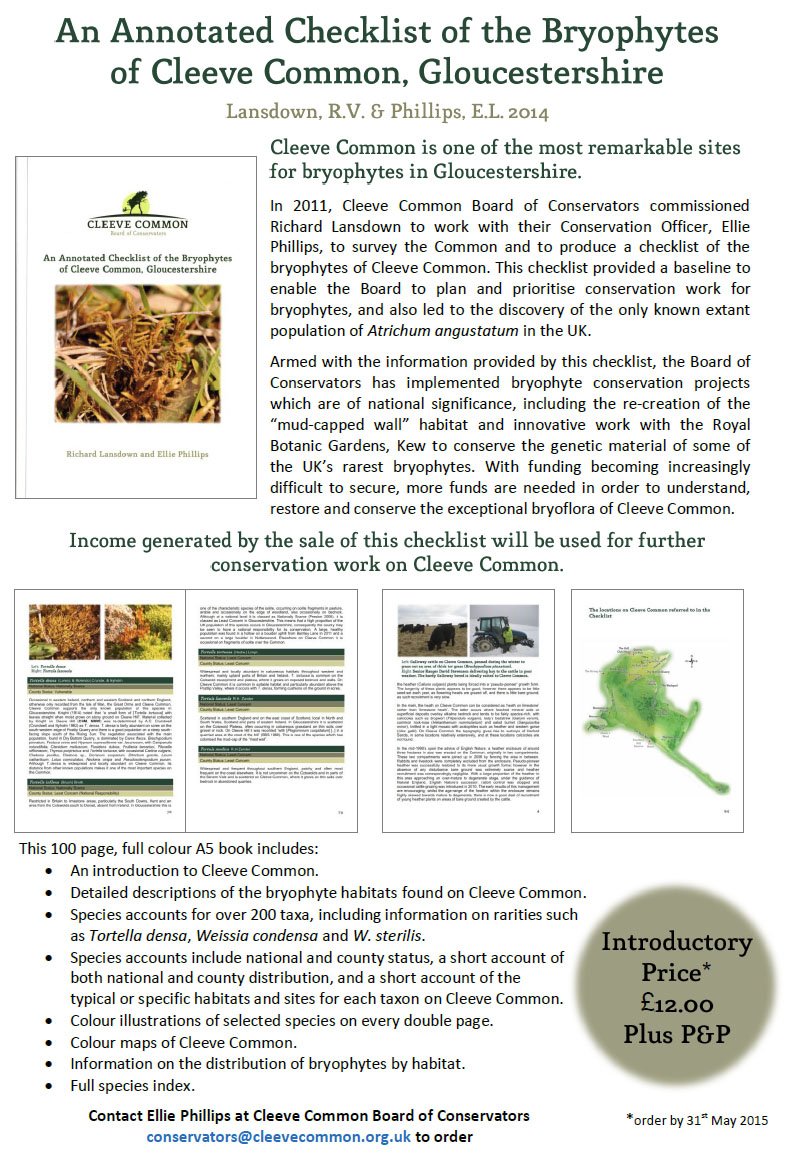
In a world where everything has to be the biggest, fastest, newest and best, any description of Cleeve Common can sound like another dose of all too familiar hype. However, at Cleeve, the superlatives do go on and on, at least for the present.
As well as being the highest point and largest area of common land in Gloucestershire, Cleeve includes significant areas of two of southern England’s most threatened types of habitat i.e lowland heath and unimproved limestone grassland. The presence of a wide-range of nationally rare species means that the Common is certainly the best site in the Cotswolds for moths and is of national importance for lepidoptera as it holds stable populations of scarce species such as Lace Border and Chalk Carpet as well as a range of Red Data Book micro-moths. The Common is large enough to support a large and healthy population of Adders, whereas at other smaller, isolated sites, in-breeding threatens the viability of the species. The flora includes the very rare Purple Milk-vetch and the orchids present include the rare frog and musk species. Among the breeding birds on the Common are Linnet and Yellowhammer and the area is a traditional stopping-off point for migratory Ring Ouzels. All three of these species are “red listed” in the UK, i.e. they have the highest conservation priority as they need urgent action
Management is the key to understanding the rich bio-diversity of the Common and that management depends on a carefully considered conservation plan, based on data from detailed survey work, and on a skilled and knowledgeable workforce who can implement the plan to produce the all-important mosaic of grassland, heather, gorse and woodland.
All of this essential work is under threat. Changes in DEFRA policies have resulted in a reduction of the vital income needed to finance conservation work on the Common. Cleeve Common does not have the financial backing of a major conservation charity, but has depended instead on the range of payments which I am sure we all thought were made available by DEFRA under it is environmental remit. Given the amount of money DEFRA has just written off for yet another failed IT system (for the EU’s Basic Payment Scheme), the funds required to maintain the quality of conservation management on the Common are minute. Whether an under-resourced, tunnel-visioned department can show some flexibility regarding the Common’s finances is anyone’s guess, but a little persuasion from interested naturalists would not go amiss. Finally a point worthy of any “strange but true” column; DEFRA’s the new approach means handing over money to grazing-rights holders, even if they don’t turn out any animals on to the Common!
Robert Homan
Gloucestershire Plant Gall Recorder and East Gloucestershire Moth Recorder

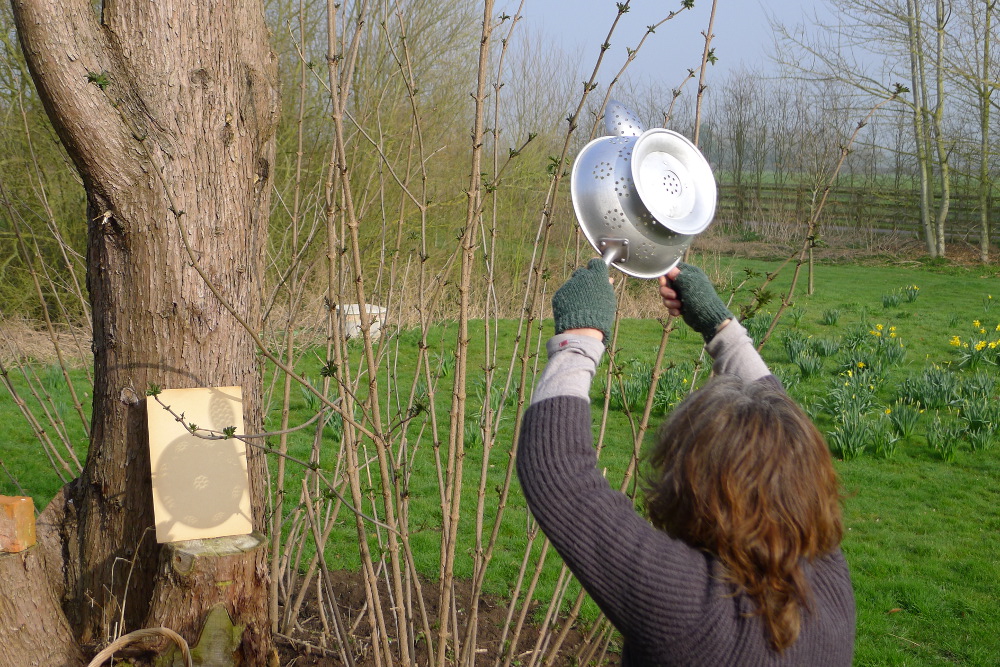
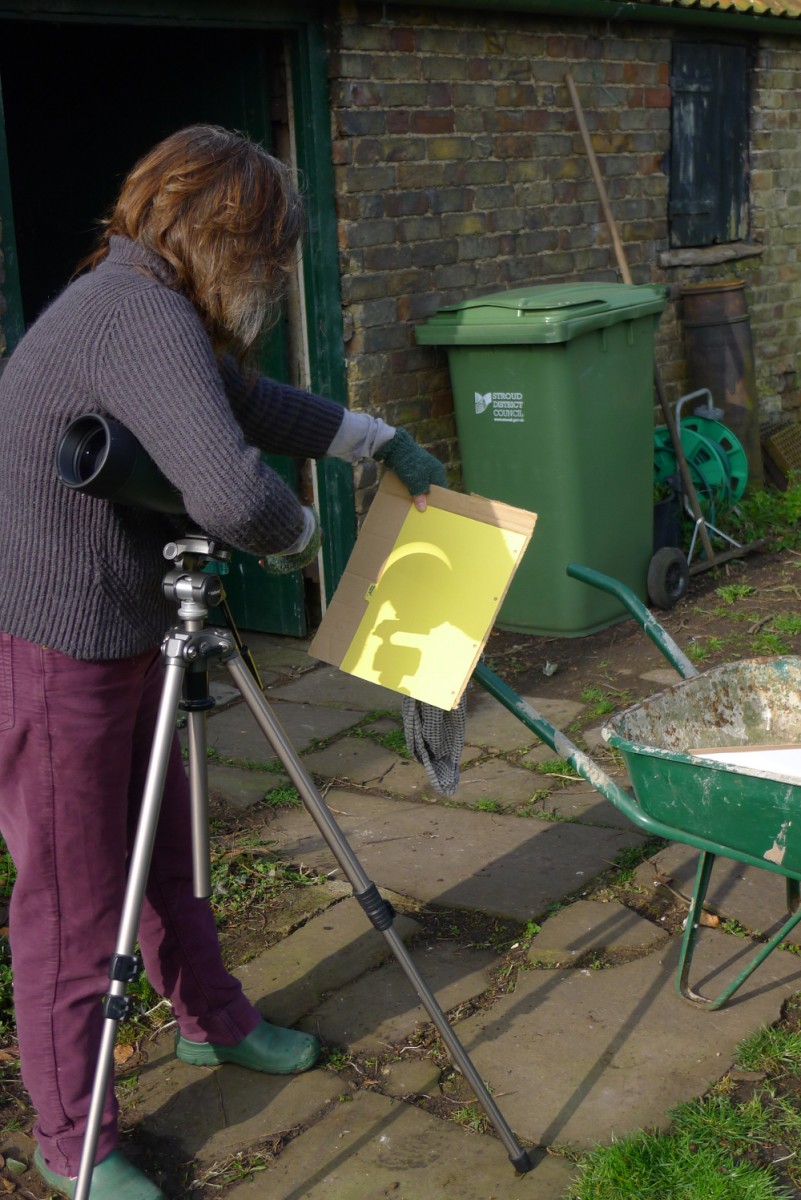
A beautiful partial solar eclipse this morning. The sky was clear in Standish, and we were able to view it using both the telescope projection, and the pin-hole method using a colander and slotted spoon. It peaked at about quarter past nine, and finished about ten thirty.
At its height, it was noticeably colder and the light had a darkling evening quality.
At 10am on Tuesday 9th June 2015 at Cleeve Common, near Winchcombe, this guided walk will feature Ellie Phillips (Conservation Officer) and David Stevenson (Ranger) from the Cleeve Conservators, the charity responsible for the management of Cleeve Common, and is organised in association with the Cotswold Wardens.
The walk, part of the Magnificent Meadows project, aims to show by practical example the intrinsic link between farming and other land uses and conservation. Managing a very special area like Cleeve Common for wild flora and fauna presents many of the same problems as those faced by conventional farmers, but the solutions are often even trickier! The walk will give an insight into the ongoing work of preserving and enhancing rare habitats in the context of modern pressures on the land and rapidly changing landscapes.
The walk will take up to 3 hours – PLEASE wear sturdy footwear as the route may be steep/muddy in places.
This year’s foray at 10 am on Thursday 23rd July 2015 will range across Cleeve Common SSSI, incorporating Cleeve Common itself and some of the surrounding nature reserves. This walk is led by the Cotswold Wardens, and we will be joined by Ellie Phillips (Conservation Officer) from the Cleeve Conservators, the charity responsible for the management of Cleeve Common.
The walk is aimed at those with an interest in wild flowers but no prior knowledge is assumed – we hope to put a name to as many species as possible and questions will be welcomed. Seasons are always unpredictable but hopefully we will find a lot of uncommon species and perhaps some real rarities – last year we spotted over 100 different species in flower.
The walk will take up to 5 hours – Please bring a packed lunch and PLEASE wear sturdy footwear as the route may be steep/muddy in places.
Ellie Phillips
Cleeve Common Conservation Officer/Farm Conservation Adviser

The next GNS Field Meeting will take place on Saturday 21st March 2015 and is entitled “Botany around Dymock”. This is an appropriate time of year to visit the “Golden Triangle” and potentially sample a Daffodil tea.
Meet on the minor road just north of the M50 beside Dymock Wood at SO 691 286 at 11am. The meeting is to continue all day and will be led by Mark & Clare Kitchen (01453 810958 or mobile 07783 448203 on the day). Please dress appropriately for the weather and bring a packed lunch.
On 18th January 2015 I was carrying out some pruning in my Woolaston garden when I saw a torpid slow worm on the ground, out in the open among the pruned branches.
It can only have come from a cut oak branch, the trunk and branch are covered in ivy and honeysuckle, which seems unlikely, although I know slow worms can climb as I once found one (active) in the eaves gutter to a small stone building;
OR
more likely, I had brushed it out from the base of a pampas grass when dragging a branch past.

It was very torpid and had previously lost its tail. I put it deep into a pile of branches, left for invertebrates and other wildlife, where it had some frost protection and should have been safe from cats and foxes.
David Priddis
An Otter (Lutra lutra) was seen from the Grundon Hide on Saturday 28 Feb 2015 from 08:15. The animal spent about half an hour hunting along the edge of the Short Pool. It caught at least three fish, each time coming out onto the bank to eat the fish. A Grey Heron (Ardea cinerea) seeing the otter , walked near the otter seemingly hoping for some scraps to come its way – but made no attempt to take the fish from the otter. Observers: David Anderson and Les Brown.

Members are reminded that the Annual General Meeting of the Society is due to take place on Friday 27th March 2015 at 7.30pm at the Gala Club, Fairmile Gardens, Gloucester GL2 9EB.
The meeting will consist of the usual reports of the Society’s activities over the previous year, our current membership and financial position, the election of officers and other business matters.
There will be a Special General meeting within the Annual General Meeting to consider and vote on the proposed rule changes (see the previous “News” item) and after the business element of the meeting, a talk by Mervyn Greening on the new Gloucestershire Barn Owl Monitoring Group (see previous “News” item).
If you have any thoughts, queries, questions or suggestions, please communicate them to any member of the Executive Committee, to the Membership Secretary at gnsmembership@btinternet.com or better still come along to the meeting, meet the Exec., meet other members and have your say.