GNS News December 2013

GNS News December13

I hope the latest issue of GNS News provided some interesting reading over the Christmas period.

Feature articles included: Reed warblers without reedbeds, the CPRE Awards 2013 for Churchdown Park Ponds project, an update to The Forest of Dean willow tit project, the mystery of the little owl in Gloucestershire and reports from this autumn’s field meetings.

Please contact GNS if you are interested in becoming a member and receiving the quarterly journal, or if you would like to contribute any notes, articles or pictures for the next issue. Please send any input to the editor (details in the News) by February 1st 2014.

Birds and flooding in the Severn Hams

In winter, the Severn floodplain, especially the area between Gloucester and Tewkesbury, regularly welcomes many thousands of wintering waterbirds.  After the dry summer, there was a light local flood in late October and early November, then a much deeper one beginning just before Christmas.  The November flood attracted large numbers of Wigeon and Teal (much higher numbers of Wigeon than were present on the estuary in the Frampton/Slimbridge area at the time); when the flooding receded in late November, many of these birds moved to the estuary.  They came back to Coombe Hill as waters began to rise again in mid-December.  So the link between the estuary and floodplain sites inland was clearly demonstrated.  (For a full account of birds in the area between October and December, see “Birds in the Severn and Avon Vales October to December 2013” under Published reports on this website).

However, as has been widely reflected in the media, the flooding has got much more serious since Christmas, and there were Severe Flood Warnings (the highest category, indicating danger to human life and property) on either side of New Year.  The top of a spring tide cycle in early January pushed water up the estuary and into the flood plain, coinciding with a flush of water coming down the Severn, following heavy rain at the top of the Severn catchment in north Wales and in the northwest Midlands; this flush was exacerbated by inflow from the Avon, not to mention other local streams like the Leadon, Chelt and Swilgate, which could not flow out into the Severn and so back-flooded riverside meadows.   As a result, there is very deep flooding between Gloucester and Tewkesbury, with main roads closed by flooding – the A417 from Gloucester to Ledbury round Maisemore, the B4213 at Haw Bridge.  The Gloucestershire Wildlife Trust had only just inaugurated its new hide and boardwalk at the Coombe Hill Meadows reserve, replacing the one washed away by the previous winter’s floods; the hide is now totally inaccessible and will remain so for many weeks – it is to be hoped that it will survive intact!

The effect on waterbirds has been striking: wild birds don’t like deep flooding any more than humans do.  So the thousands of surface-feeding ducks which were in the Coombe Hill and Ashleworth area only ten days ago, grazing and feeding round the edges, have disappeared (as far as one can tell in the flooded conditions!).  Some of them may well have moved downriver to the estuary, but a fair proportion have sought out shallow flooded areas upriver, just into south Worcestershire.  On 4 January there were about 3,000 surface feeding ducks on Longdon Marsh, including about 1,400 each of Wigeon and Teal, with nearly 150 Pintail and about 35 Shoveler.  But where have the thousand odd Greylag and Canada Geese gone, the ones that were previously shared between the Coombe and Ashleworth Ham reserves?  Perhaps to Ripple Lake, the former gravel extraction area along the Severn opposite the outflow to the Severn from Longdon Marsh – there are many hundred geese there.

Plenty to look out for in the New Year then!

Ash Dieback conference

Anyone wanting serious information on Ash Dieback should look at the webcasts of a recent conference “Living with Ash Dieback in Continental Europe”. http://www.youtube.com/channel/UCI810ZkJIgiS9ALeeT5tq3g

This was held at the Linnaean Society in London on 29 November 2013. In all, there are more than 6 hours of footage, with 23 papers.

They consider country by country the disease’s spread across Europe; the commercial implications; ways of combating it by plant hygiene or plant breeding. For naturalists, particularly concerned by the potential damage of the disease in the wider environment, the two opening talks of Session 3 (http://www.youtube.com/watch?v=qxNcNUYigMw) – Ash Dieback as a conservation biology challenge, and The impact of Ash Dieback on veteran and pollarded trees in Southwestern Sweden – are very valuable.

For modelling the Epidemiology of Ash Dieback in the UK, see the paper by Professor Chris Gilligan starting at 38 minutes into the webcast of Session 4. (http://www.youtube.com/watch?v=3eBKXElvVxQ). This is a brief paper, lasting only 10 minutes. Towards the end, he shows slides which indicate that before the end of the decade Ash Dieback will be across England and Wales.

In case one gets too depressed by the preceding papers, the final presentation by Professor Steve Woodward is on the Emerald Ash Borer beetle which is heading our way. He says that if Ash Dieback doesn’t get our Ash Trees, then the Emerald Ash Borer will.

Witcombe Reservoir WeBS count

Hi Members

Here is the list of birds seen at the reservoir midday.

SpeciesNumber
Grey Lag Goose30
Canada Goose4 (plus 4 hybrid young)
Teal41 (a good count for this site)
Mallard71
Pochard9
Teal47
Cormorant10
Little Grebe4
Great Crested Grebe7
Moorhen12
Coot74
Black-headed Gull27
Common Gull5
Herring Gull5

Best wishes
Gordon & Margaret Avery

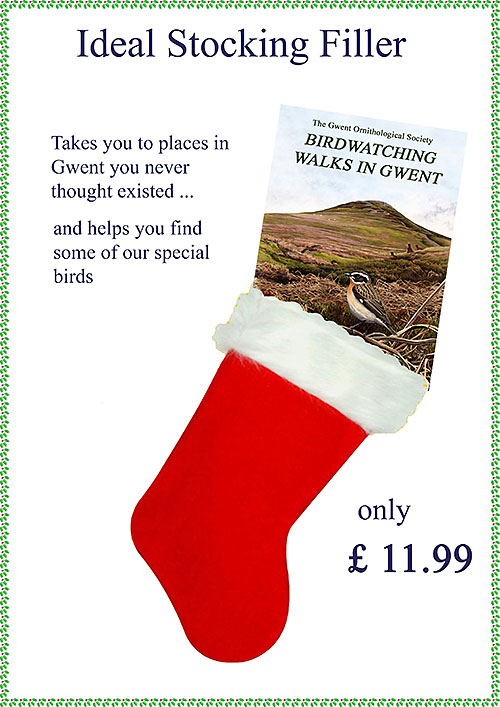
Birdwatching Walks in Gwent

Gwent flyer

This book offers unbeatable quality at only £11.99.

It describes over 60 walks in Gwent, each of which provides an interesting selection of wild bird species.  The walks vary in length from less than one mile to over six miles, while some can be extended beyond this distance.  Each route, provided by an expert birdwatcher who knows the area intimately, has been checked for accuracy by other walkers.

The walks cover an astonishing range of habitats including:

  • the Wye Valley with its ancient woodlands and spectacular viewpoints
  • the deep valleys, fast-flowing rivers and high moorlands of the north and west
  • the broad agricultural sweeps of the Usk and Monnow valleys
  • the wetlands and reedbeds of the Gwent Levels
  • the saltmarshes and mudflats of the Severn Estuary

For each walk there are:

  • superbly detailed maps and directions
  • lists of birds you are most likely to encounter
  • your approximate chances of seeing the most notable species
  • tips on how to see birds

Other features include:

  • an introduction to Gwent’s habitats
  • a checklist of Gwent’s birds
  • what birds to expect at each season and where to find them
  • information on public transport and wheelchair access

Not just for the birds!

You don’t have to be a birdwatcher to enjoy the enormous variety of walks presented.  Even regular walkers in the county will be bound to find something new here.

The book can be ordered from the GOS website www.gwentbirds.org.uk

Port Ham area, Gloucester 09/12/2013

A midday walk produced: 2 male Peregrines flying towards Gloucester Tip over Castle Meads west at 1113hrs. A female Sparrowhawk was seen by Port Ham Pool, a Little Grebe was on the pool.
On Port Ham itself was 3 Snipe and the pair of Stonechats were found to be still present as was the lone female down on the Oxlease/Castle Meads area. 25 Goldfinches were by the Llantony Lock House on the walk back.
2 Buzzards were also in the general area.

Gordon

Horsbere Brook Flood Area & Witcombe Reservoir 08/12/2013

In the flood area a good number of gulls were present. A male Peregrine flew over towards Brockworth at 1130hrs. Wildfowl present were: 2 Mute Swans, 4 Wigeon and 17 Mallard also a juvenile Grey Heron was seen as well.
Witcombe Reservoir: I was surprised to find a Little Egret here, amongst the wildfowl was 28 Teal and 9 Pochard. 3 Little Grebes were seen as well.

Field Meeting – Soudley Valley Rural Geology (Blue Rock Trail)

Derek & Chris Foster were joined by Mike Smart, Tiz Butler, Pam Jones, Daphne Lane and Andrew Bluett on a field trip following the Blue Rock Trail (more properly known as the Soudley Valley Rural Geology trail) from Soudley towards Ruspidge (Cinderford). This was to be a field meeting of general interest but based on the geological trail that follows the old railway line towards Cinderford for the first half of its length before looping back over the Eastern United colliery spoil heaps on the edge of Staple Edge Wood and back down into Soudley Village.

It was bright, sunny and relatively warm day so that even deep in the valley the temperature was quite comfortable. The party met in the car park of the Soudley Village Hall and walked up onto the road and through the village to Upper Soudley where the trail commences by taking to the former railway track to Cinderford running parallel to and above the Soudley Brook. At the beginning of the trail and information board gives and outline of the geological interest which consists of a base of up to 400 million year old Old Red Sandstone, overlaid successively by Quartz Conglomerate, Tintern Sandstone, Limestone Shale, Lower Dolomite, Crease Limestone, Whitehead Limestone, Drybrook Sandstone and above that, the coal measures.

Chris Foster explained various points of interest and gave some background to the geology and quarrying activities, methods and uses of the materials extracted. Each of the strata are visible along the way, especially so in the Old Quarry, Blue Rock Quarry and Shakemantle Quarry. The party also found a large slab of Limestone containing traces of Crinoidal fossils in the Blue Rock Quarry. The last quarry to operate was the Shakemantle Quarry from which limestone was extracted and crushed down to provide aggregate for the manufacture of Danygraig Concrete Commons (bricks) as recently as the late 1980s.

As the party gathered a Green Woodpecker flew overhead and Stock Dove called from the woodland; bird life was plentiful with another Green Woodpecker, Crossbills, Magpie, Carrion Crow, House Sparrows, Blue, Coal, Great and Long Tailed Tits, Chaffinch, Robin, Wood Pigeon, Goldcrest, Wren, Raven, Nuthatch and Buzzard, the special highlights were a male Goshawk circling overhead at the beginning of the trail proper and a male Peregrine further along. A solitary butterfly appeared, large and dark against the light so that it was not possible to be 100% sure but was thought to be a Peacock.

For anyone interested in following the trail, a guide is available from Gloucestershire Geology Trust or from the nearby Dean Heritage Centre. The Dean Heritage Centre is worth visiting in its own right and has a delightful café serving a variety of food and drinks.

BRT IMG_0993

Geology Trail Information Board

BRT IMG_1372b

The party at the “Hod Boy” sculpture. Hod Boys were literally boys, small and young, who dragged hods or drams full of coal from the coal face to the main shaft through some of the very low (2ft or less) working tunnels.

BRT IMG_1377

Blue Rock Quarry – site of limestone quarrying and a place where crinoidal fossils can be seen. Hollows cut in the rock face were filled with timber which was then burnt to heat up and crack the rock to facilitate extraction

BRT IMG_1381

Shakemantle Quarry – now being reclaimed by nature, was the site of the Danygraig Brick manufactory until the 1980s.

Cinderford Northern Quarter Statement

Gloucestershire Naturalists’ Society

Position Statement regarding Cinderford Northern Quarter Development

Having discussed all aspects of the Cinderford Northern Quarter (CNQ) Development and the Cinderford Regeneration Environmental Forum at the Executive Committee Meeting on 27th November 2013, the Executive Committee of the Gloucestershire Naturalists’ Society (GNS) has concluded that the Society’s standpoint and course of action should be as follows:-

The Society does not in any way support or condone the CNQ development as proposed and very much regrets the effect that the development is likely to have on the wildlife and habitats across and in the immediate vicinity of the development area.

The Society believes that whilst the investment and potential improvement for the economy and employment prospects is warranted and welcome in the Forest of Dean, especially in the current economic climate, the development as proposed is in the wrong location and would be far better sited elsewhere for a variety of reasons, not least the conservation of the species and habitats in the area.

The Society believes that if protest against the Area Action Plan fails, and no engagement in the mitigation process takes place, any future planning applications within the Area Action Plan framework are likely to be approved with little or no change.

The Society believes the best means for influencing planning and development decisions will be via the Cinderford Regeneration Environmental Forum. For that reason, the Society will participate in the Forum and promote the interests of wildlife within that arena as best it can, alongside the representatives of Gloucestershire Wildlife Trust (GWT) and other organizations.

The Society notes the six identified “Purposes” within the remit of the Forum and will endeavour to ensure that these are properly applied in the interests of wildlife. (N.B. a copy of the “Role & Remit” draft is attached below for information).

The Society believes that the presence of Colin Studholme of GWT as vice-chair of the Forum and of Roger Mortlock of GWT on the Regeneration Board offers the opportunity to ensure that the interests of wildlife and habitats are properly represented and considered and that the deliberations of both groups, where relevant to wildlife, will be recorded and reported.

Andrew Bluett will represent GNS on the Environmental Forum and will take notes and report back to the GNS Executive Committee on the proceedings.

The Society intends to organize and carry out a series of field meetings and visits to the CNQ site and surrounding area with the intention of monitoring the situation and carrying out of further recording of wildlife before works commence, during and after the works are complete.

The Society, through the Environmental Forum, will attempt to ensure that any mitigation measures considered or proposed are the best that can be achieved in the interests of species and habitats, and will endeavour to monitor the results of the mitigation measures in progress and after completion.

The Society is aware of the belief that the Forum and its output could be misused to represent the interests of the Forest of Dean District Council, the Homes and Communities Agency and the Developers in a positive light and has discussed this with GWT.

GWT has made clear that if it believes this to be the case it will if necessary disengage from both the Forum and Regeneration Board; GNS similarly reserves the right to do so and to make public its reasons for doing so, both to the GNS membership and the wider public.

Whilst GNS as a body is not a campaigning organization, its members, including those on the Executive Committee, are not in any way precluded or discouraged from legitimate protest against the CNQ Development through the planning process or by any other means they choose to exercise.

Finally, GNS will endeavour to widen the development debate if the opportunity arises in an effort to have Forest of Dean District Council more carefully consider species and habitats wherever developments are proposed within the constituency and to consult with wildlife interest groups both earlier and in more detail during the planning process in the hope that this situation will be less likely to arise in future.

Gloucestershire Naturalists’ Society

1st December 2013

CREF Role & Remit

Letter from the Chair, November 2013

Dear Members

GNS is – as we repeatedly affirm – a body which records natural history in Gloucestershire, and publishes its findings. No less important however (as we never tire of saying either) is passing on our knowledge and expertise to younger generations; not so much training future naturalists, rather giving them a sense of the interest, beauty and sophistication of the natural world around us. If I may quote my own experience, I joined GNS as a schoolboy, when biology lessons didn’t really hold my attention; but the regular outdoor meetings of GNS, with a host of older naturalists, who really knew their subjects – be it botany, birds, butterflies, dragonflies – and were keen to pass on this knowledge and at the same time to reveal corners of the county that I didn’t know: that was what caught my attention for good, and made me a lifelong naturalist.

I was incidentally reminded directly of those times by an enquiry about a record in the “Journal” for November 1956: in those days the predecessor of GNS NEWS was a roneotyped monthly document, lovingly printed on a duplicator, and distributed by hand to members, to save postage. Someone had found a reference to “Cheltenham and District Naturalists’ Society (the former name of GNS), Volume VII, 11.3” to a record of Epipactus purpurata near Wickwar. Could the document be unearthed? It was probably at Lower Woods, the area studied by my correspondent. After some searching (the relevant issue of the Journal was not in the Society library at Hartpury College, which raises a whole separate matter of concern), we found the reference: “Owing to the energy and initiative of Mrs Holland, a small party went on August 29th to the woods above Wickwar to see the Violet Helleborine, which is in fair quantity in parts of the woods. In addition to the type we were able, through the kindness of Mr E. P. Bury of Wootton-under-Edge (sic) who led the party, to see the very lovely pink variety of this plant. Some excellent photographs were taken, of both forms, by Mr C. Swaine, who intends, I think, to make lantern slides from them, which we hope to see at some future date. C.E de V.”

“Energy and initiative”, those were the quality which Miss de Vesian, Mrs Holland and Mr C. Swaine had in very full measure. Most GNS members will know the names of Sonia Holland from their publications on the county’s flora, dragonflies and birds. I well remember Miss de Vesian: a Cheltenham Ladies’ College teacher with ramrod straight back, always carrying her vasculum to collect plant specimens (that would be prohibited nowadays!), and an authoritative voice on all matters botanical. I wonder what happened to those lantern slides?

How do we maintain and pass on this enthusiasm and deep-seated knowledge, regard and respect for the natural environment around us? This is a question often discussed within the GNS Executive Committee. Of course, wonderful work is still being done by volunteer naturalists – witness the new “Birds of Gloucestershire” a worthy successor (with breath-taking artwork) to the 1982 volume by the same Christopher Swaine who was at Wickwar in 1956; or the regular reports from County Recorders in “The Gloucestershire Naturalist” to which David Scott-Langley devotes so much time and effort. But in our era when there is so much natural phenomena shown on television from far-flung corners of the earth, and when there are many more jobs for people with formal qualifications in environmental sciences than there were 50 years ago, how to keep people, especially young people, interested and informed about the fauna and flora on their very doorsteps?

We have come up with one answer: in 2014, we plan to run a trial series of joint workshops with the Gloucestershire Wildlife Trust on a series of natural history topics. They will last for half a day, and be an introduction to recording a wide range of natural history subjects: birds, botany, invertebrates, dragonflies, lichens. We hope these initial courses will attract new recorders, and lead them to develop and deepen their interest, and in turn to take over the reins from the current team of recorders, many of whom are greying and getting far too long in the tooth. Further details in future issues of GNS NEWS and on the website.

A word on conservation issues in the Forest of Dean. Andrew Bluett has provided regular updates in GNS NEWS on the situation at Cinderford Northern Quarter, where the Master Plan for a large regeneration project, which should provide much-needed jobs, has been approved, in a brownfield site very rich in wildlife, notably bats, butterflies, reptiles and amphibians. GNS has been invited to take part in the Cinderford Environmental Regeneration Forum, which is to advise the developers on mitigation measures for wildlife. Your Committee has discussed this issue at great length and decided that, although some GNS members are opposed to the whole concept of the project, it is better to engage with the Forum, and at the same time to record exactly what happens on the ground. A statement of GNS’s position will be posted on the website and this statement will appear in the next issue of GNS NEWS. Another Forest issue: an application was made by a consortium of bodies, including GNS, to the Heritage Lottery Fund for several million pounds for an ambitious project to conserve nature and heritage in the Dean: sadly, the first application was turned down, but all is not lost as there is a chance to revise the application and re-apply in the New Year.

Speaking of New Year, may I offer all of you my best wishes for 2014: I hope you will all derive great pleasure and stimulus from Gloucestershire’s natural history in the coming year, and that you will be as assiduous as ever in recording what goes on out there, and in submitting records to the appropriate recorders. May I suggest a New Year’s Resolution? Your Executive Committee currently numbers eleven members (quorum of six!); we would welcome volunteers to join the Committee; please contact Committee members or put your name forward at our AGM in March.

Best wishes

Mike Smart
Hon Chairman

Skip to content