This is the report from CES visits 5 to 9 to Ashleworth Ham:
Ashleworth Ham CES visits 5-9 (PDF).
Posted on behalf of Mervyn Greening.

 gnsadmin
This is the report from CES visits 5 to 9 to Ashleworth Ham:
Ashleworth Ham CES visits 5-9 (PDF).
Posted on behalf of Mervyn Greening.
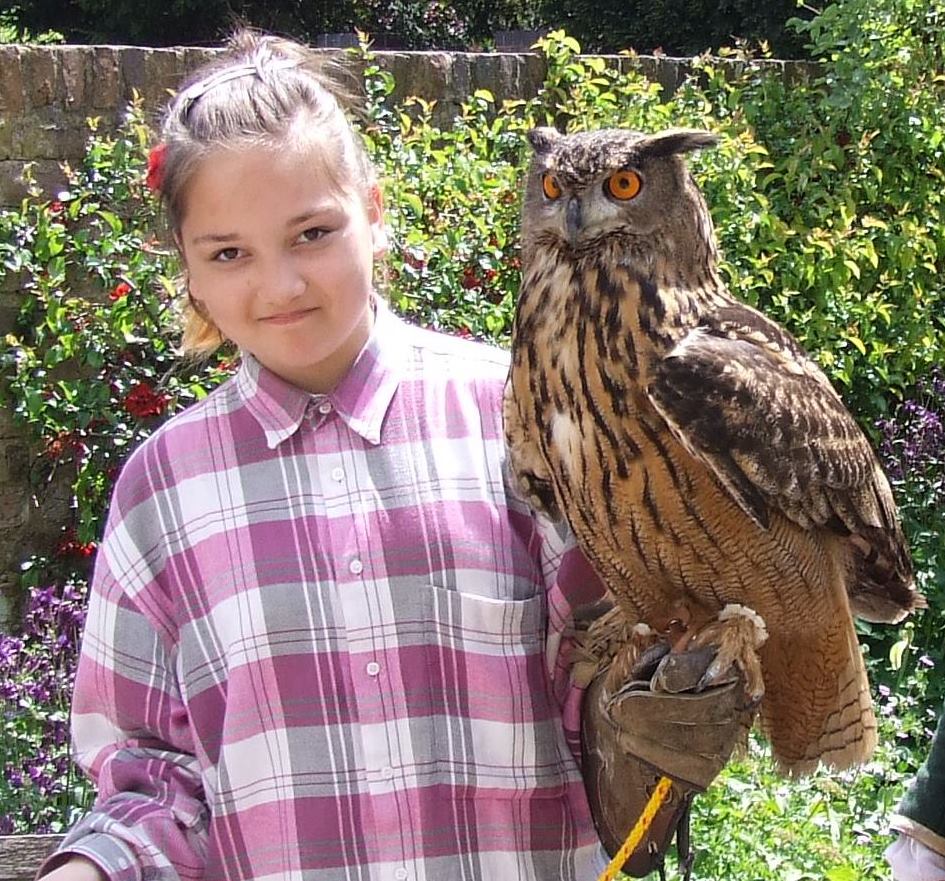
A Live Animal Event for the Summer Holidays 2018
| Organiser | John Moore Museum |
| Date | Saturday 18th August 2018 |
| Time | 10am to 1pm & 2pm to 5pm |
| Venue | John Moore Museum, 41 Church Street, Tewkesbury, GL20 5SN |
| Details | For the summer holidays the museum welcomes back J.R.C.S Falconry who will be bringing along a selection of birds of prey from their extensive collection. Visit us to meet a Golden Eagle, a Hooded Vulture, an Eagle Owl, a Little Owl, an American Kestrel and a Barn Owl. An opportunity to see birds of prey, from some of the largest to the smallest. A falconer will be on hand to answer all your questions about these amazing birds as well as on the ancient art of falconry. Four sessions to choose from: 10.00am to 11.15am Admission Adult: £6.00, Seniors & Students £4.50, Children £2.00 (Tickets include admission to the John Moore Museum, the Merchant’s House & the Old Baptist Chapel) |
| Contact: Simon Lawton (Curator) E-Mail: curator@johnmooremuseum.org Website: www.johnmooremuseum.org Telephone: 01684 297174 |
I have probably 12 Broad-leaved Helleborine in our garden. One appeared between 10 and 12 years ago. Since then the numbers have increased annually without any conscious assistance on my part. This is the 2018 photograph of the original plant which has grown stronger each year.

They appear spontaneously in cracks between walls and the tarmac drive; in beds and borders, in shade or in sunny places. And I have been delighted that they have thrived here in our garden in Eastcombe (GL6 7DW)
We are both members of the GNS (my husband has been a member since 1984) and attend the Cirencester winter meetings and occasional field meetings in the summer.
I hope this report is of interest.
Kind regards
Pam Perry
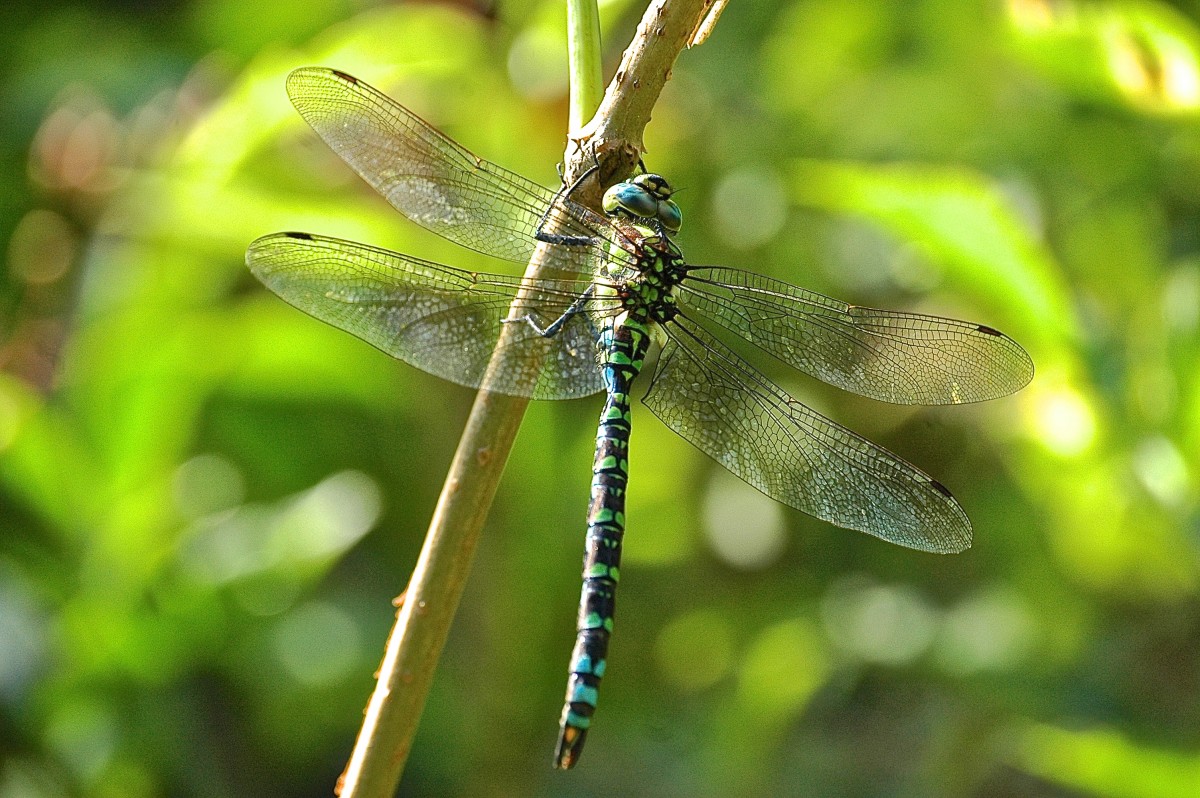
Dragonflies and damselflies emerge from their larval skins in an immature state and necessarily spend some time away from water, avoiding contact with others of their own kind while their wings and external skeleton harden and their adult colours gradually develop. The immature males of many species pass through a distinct juvenile phase during which they resemble females until their true colours as adult males become apparent.
The Southern Hawker (Aeshna cyanea) is a large dragonfly which is quite common in our area. It may be familiar even to urban dwellers as it will visit quite small garden ponds. The species is readily identified by the conspicuous pair of large oval spots on top of the thorax (behind the eyes) and by the bands of colour across the tail end of the abdomen (whereas similar species have paired spots there). According to W.J. Lucas (British Dragonflies, London 1900): “At first the ground-colour is rather light brown, and the spots are yellow. The latter change through green to blue, while the former becomes darker. The pterostigma is at first yellow.” (The pterostigma is the spot close to the outer end of the leading edge of each wing.) In females the colouration of the abdominal spots normally stabilises as yellowish-green (although a blue form occurs very rarely). The typical appearance of a mature male can be seen in the photograph below.

Recently I noticed a hawker which looked almost ghostly as it flew above me in the shade of a tree. When it settled I was able to photograph it and the image below shows that it was clearly an immature male Southern Hawker. However, rather than the greenish tint I would have expected to see in the abdominal spotting, this specimen was displaying a powder blue colour. It would be interesting to know if I have captured a temporary phase in the development of this individual or whether it is destined to be an exceptionally blue adult when fully mature.


The pond with the newt larvae mentioned in the post of 25 June has shrunk to a miserable puddle 2 foot across.

As the water level descended I have been watching the newt larvae becoming bigger, coming up vertically to gulp for air in the fashion of adult newts. These larger ones are no longer visible. However, there are still some very small ones with external gills and feeble little legs that I am certain would be incapable of terrestrial life.
Will they survive in the mud? I’ve seen no dead newts, but what about predators? A week ago there were many diving beetles in the pond. This morning I saw a mole pushing its way round the soft earth of the perimeter. It appeared briefly from the tunnel, its fur patched with wet black gloop, before scuttling back off along the new tunnels. Are these newt predators?

 There are hundreds of newt larvae in the pond in this wild garden in Standish. In the late afternoon they were near the surface, not gulping for air but just hanging there. Perhaps on this hot day there was more oxgen in the surface water than at depth (they still have feathery gills), or perhaps they seek out warmer places which would speed development.
These are great crested newt larvae Triturus cristatus, because of the filament along the tail and the black blotches, which larvae of smooth and palmate newts lack. They are about 5cm long at most.

Hornet Moths (Sesia apiformis) are emerging from poplars in Standish.  They spend several years as larvae feeding on the wood and roots of the tree, emerging often by burrowing out at the base of the trunk, so you can see signs at any time of year by looking for the exit holes which are about the size of the thickness of a pencil.


 These three visits took place on 18th May, 28th May and 7th June. Visit 2 on the 18th was a quiet visit, with 31 birds caught which is exactly on the average for this visit. It is always a quiet visit, with the adult birds getting on with the business of breeding, territories have been sorted out, females are laying or sitting, so there is little movement. All the regular migrants were caught, and probably the most notable thing about the visit was the catching of six linnets, of which two were re-traps from previous years.
 Visit three on 28th May was a day with ideal weather conditions, still and overcast, but despite this we recorded a well below average catch of 24 birds. It was notable in that no Redd Buntings or Willow Warblers were caught, and only one Whitethroat. All the Sedge Warblers caught were re-traps, so it looks as though there have been no new arrivals recently.
Visit four on the 7th June, was another good weather morning, with plenty of cloud and only a gentle breeze. The grass is now long, and it took only a few paces into the fields for us to be soaked. The bird song by now is much reduced, but the bubbling calls of curlew, which are an ever-present feature of the early visits continued. Male redstarts being an exception and singing well.
 It is usually on visits three or four that the first juveniles are caught. With the Spring that we have had, it was no surprise not to catch any juveniles on visit three, but it was nice to find that there has been some successful breeding, as the first youngsters were caught on this visit. Four species of resident bird provided the newly fledged birds, in the form of Blue Tits, a Blackbird, Chaffinch and a Robin. Any time soon we should get some juvenile Song Thrushes, because we have had the best year ever for adult Song Thrushes with eight new birds ringed and a couple of re-traps. Unfortunately, the one Song Thrush nest found was predated before the young could be ringed and fledge. Two Carrion Crow nests along the reserve boundary have been successful with visible young in each of them.
 As would be expected, all the female birds caught on the last two visits have had brood patches that indicate they are sitting on eggs. A female Grasshopper Warbler was caught with an incubating brood patch, so they are here this year, trying to breed, despite the fact that we thought there weren’t any, as we have not heard a singing male on any visit.
Cuckoos have been very active around the site, with up to two males seen regularly, and a female heard on several occasions.
Botanically, the fields are in their prime, with lots of Yellow Iris providing splashes of colour, and the meadow sweet, the Oenanthe and the great Burnet all flowering now.


