As many members will know, GNS held a photographic competition in past years at the Cirencester Branch Annual Members Night in March.
As a result of Covid-19 restrictions, we have not been able to hold meetings at Cirencester since March 2020, so in 2021 it was decided that the photographic competition would be an on-line event, with entries shown and judged at the last Zoom meeting of the year in December.
The entries and winners for that event are now available as downloadable pdf files using the links below.
We do plan to hold another competition in 2022, members are invited to submit entries in the form of digital images by e-mail or any other means to the membership secretary, Andrew Bluett at gnsmembership@btinternet.com.
Photographs should be of anything in the natural world, taken in (or very close to) Gloucestershire, and preferably during the calendar year 2022. We will decide what classes the entries will be placed in at a later date and will remind members to send in their entries from time to time during the year.
Spring is fast approaching, wildlife is coming to life and the light is improving (between the storms!) so get your camera out and venture into the fields, woodland and along the rivers of this beautiful county and see what you can capture.
All members are invited to take up the challenge of sharing their garden observations of wildlife.
What can be included? Just about any original observations made in your garden or from the windows of your residence.
What form might these observations take? • An account or accounts of a memorable wildlife sighting or sightings. • A report of a study made of wildlife in your garden. • A diary of what you have observed. • Annotated list of organisms encountered in your garden. • Original artwork illustrating an observation or study. • Anything you think worth sharing about wildlife from your garden
Some guidelines: • A maximum of one account per month to be submitted. Diary entries and lists should be submitted monthly • Pictures can be included. E.g. photographs or original artwork. • All submissions should have a clear title and name of author. • Your first submission should include a brief introduction about your garden.
How to take up the challenge: Each submission should be sent to our website manager for posting on our website. Some pieces may be used in the “News”. If you do not use the internet, you may still enter, and we will try to include some of your material in the “News”. Post your submission to M. Greening who will get it digitised for the website. Best to send a copy of your work if you can, but if you send original work and want it returned, please include an SAE.
Award: This is not a competition; it is an opportunity for us to share our thoughts about the wildlife we encounter in our gardens. We want to recognise the efforts made by entrants by awarding a prize to the entrant we feel has made the most inspirational contribution each year. The award is a vase, bequeathed to the society by the late Mornee Button. The decision about the recipient of the award will be made by a committee nominated by the executive committee.
Contact details: For entries via e-mail please send to our website manager : mail@benlocke.co.uk For paper entries please send to: Mervyn Greening, 23, Lakeside, Newent, Glos. GL18 1SZ.
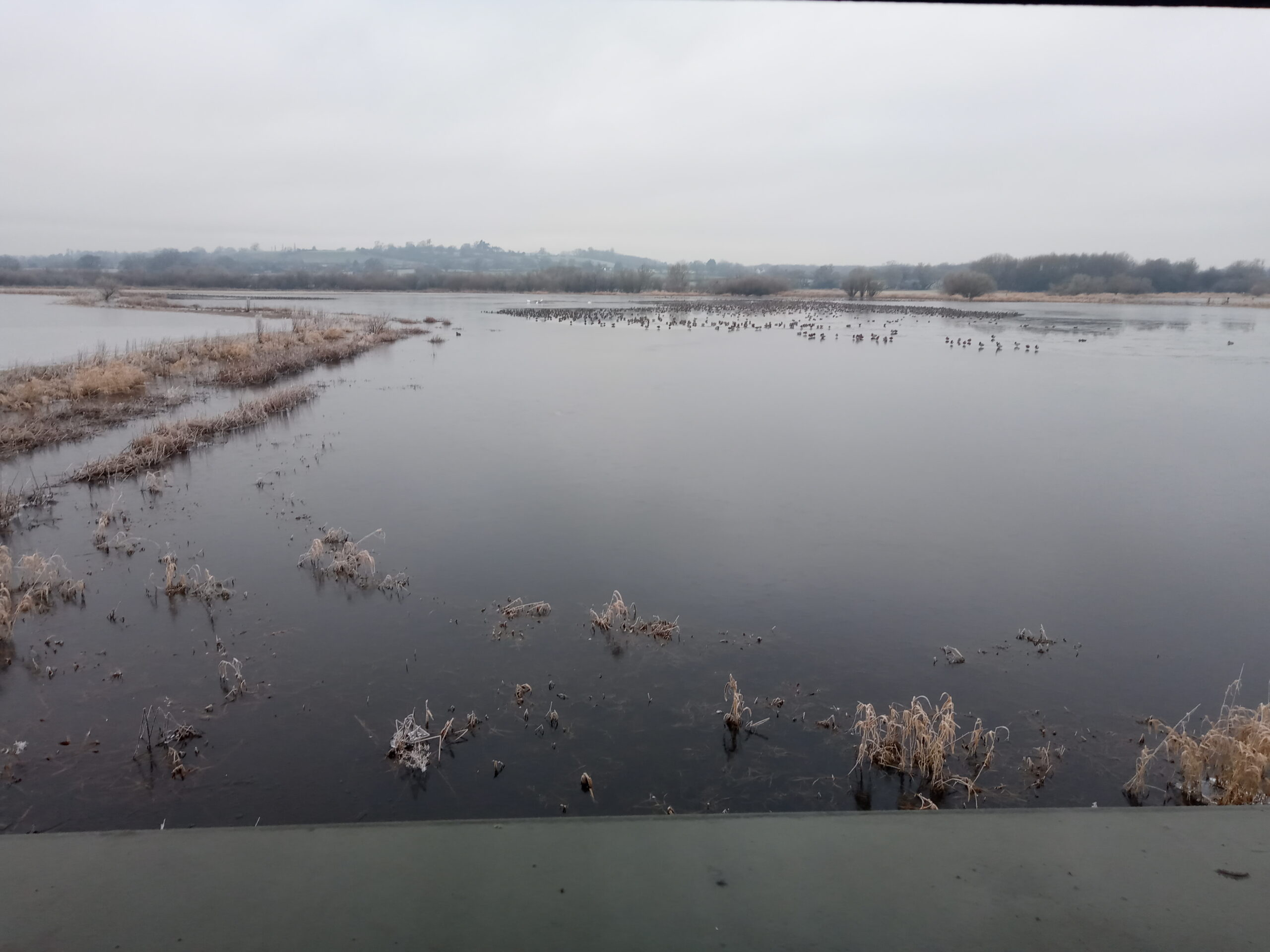
Mike Smart’s most recent Severn Vale bird report covering the period October to December 2021 has been added to the publications library (see menu at top of site). Click here to download a copy of the report (Word document).
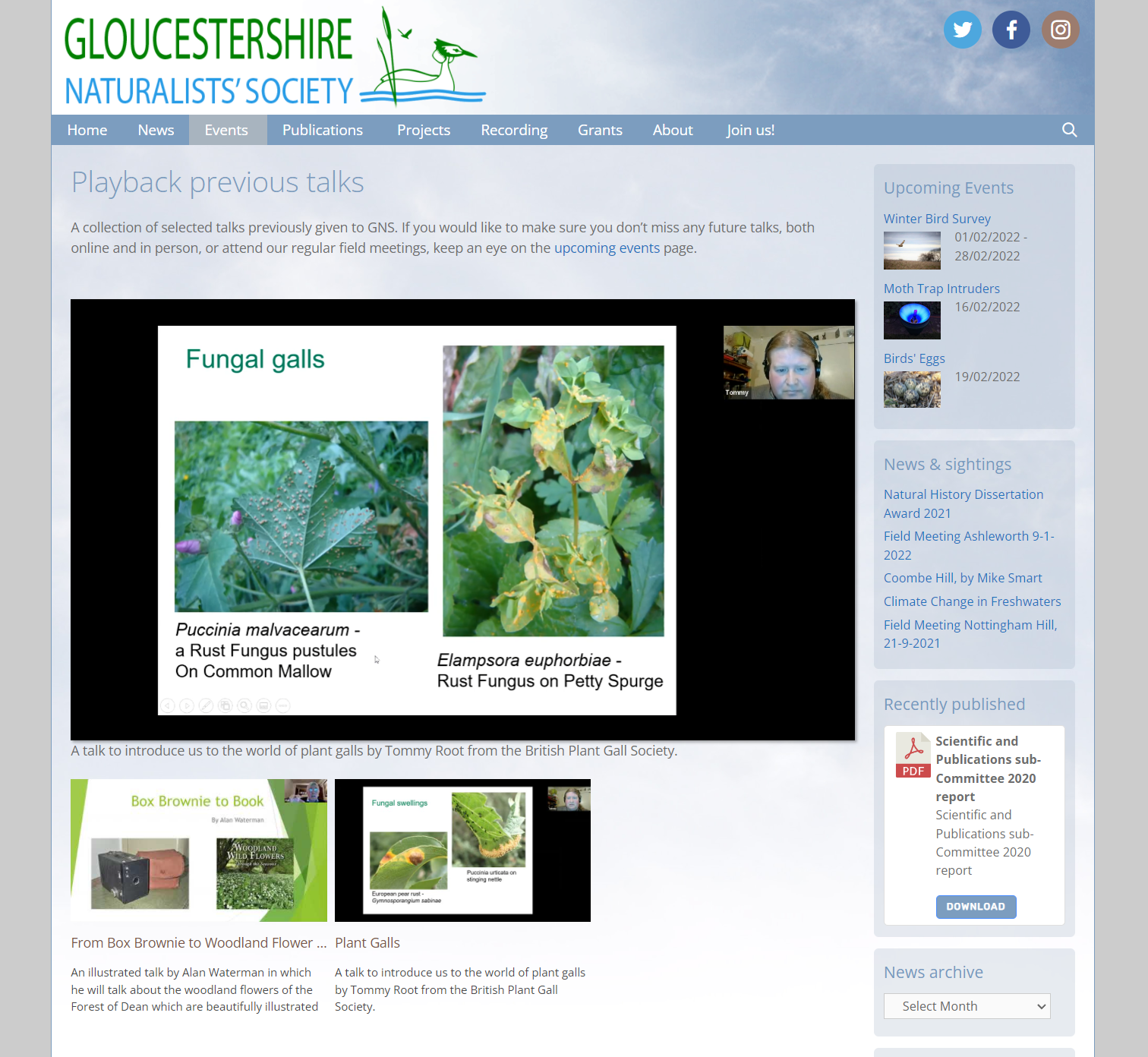
Please note that from February 2022, selected GNS talks will be recorded and made available to view on the GNS website. However, we can’t guarantee that any specific talk will be recorded, so it’s always best to attend talks that interest you as they take place. Keep an eye on the upcoming events to see what’s planned. Two previous talks are currently available already. These recordings are also accessible via the Events menu, as below.
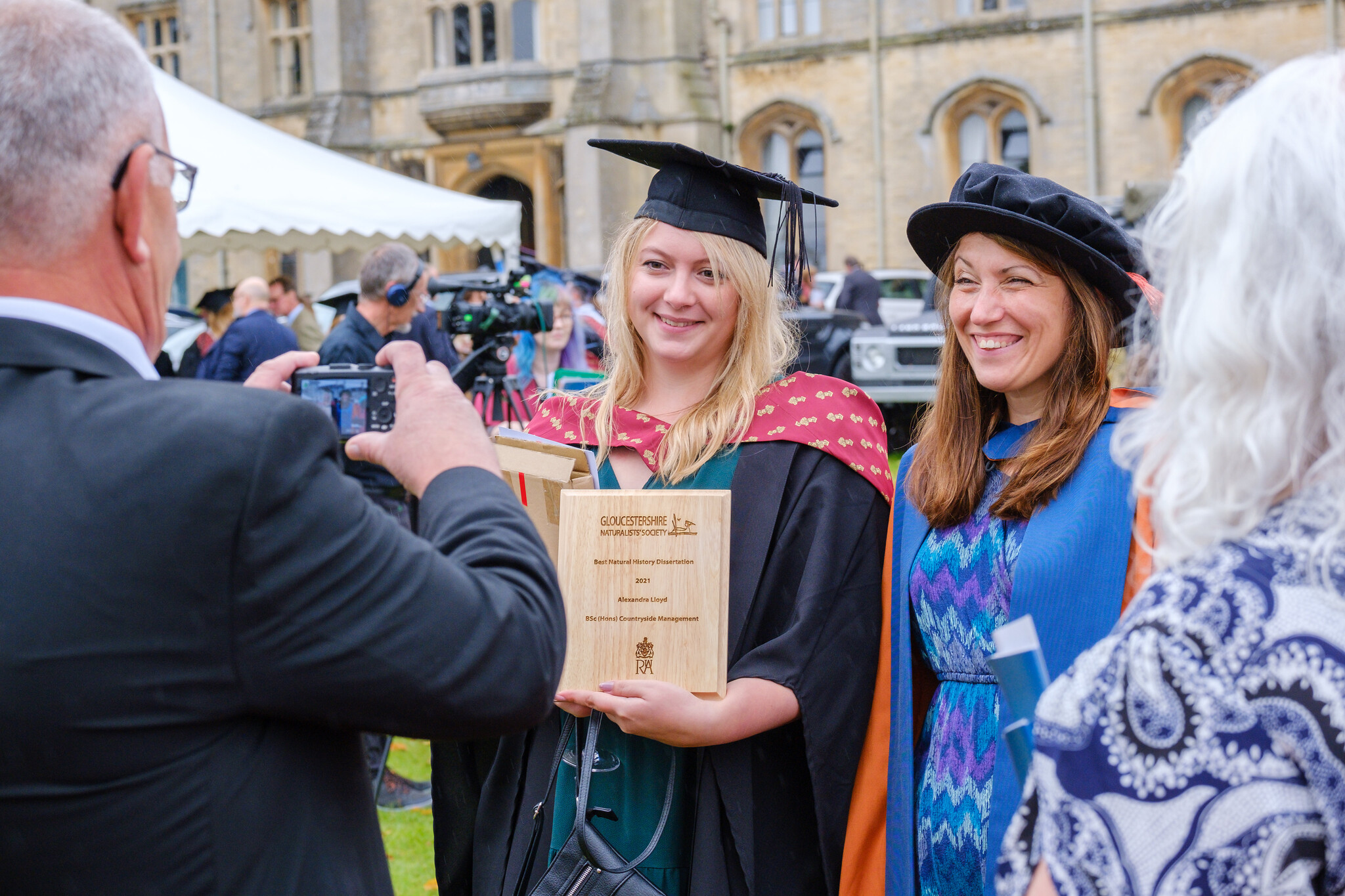
Alexandra (Lexi) with her prize and dissertation supervisor Dr Felicity Crotty
The Royal Agricultural University presented GNS’s sustainable bamboo plaque for the best natural history dissertation at their short graduation ceremony to Alexandra Lloyd studying the BSc (Hons) top-up in Wildlife and Countryside Management for her highest scoring dissertation under the criteria on ‘Tramline orientation effects on aboveground invertebrate dispersal’.
Globally, invertebrates have been found to have declined in abundance and diversity, in part due to the intensification of agriculture. However, with agricultural land covering 70% of the UK and forming a habitat for invertebrates within the soil, crops and hedgerows, farmers and scientists need to work together to discover the best ways to reduce this decline. The relationship between terrestrial invertebrates and agricultural management practices has been widely investigated, however this study aims to assess an area that is often overlooked; whether invertebrate dispersal from field edge is impacted by the orientation of tramlines in relation to the field boundary.
Overall, 646 invertebrates were collected via pitfall traps placed along 100m tramlines from the field boundary, an established hedgerow, to field centre, set over a twenty-four-hour period. These transects were orientated either parallel to the tramline or perpendicular to the tramline. Individuals were identified to the taxonomic family level. Soil compaction data was also collected, using a penetrometer, along the transects. An analysis of variance was used to analyse abundance of total fauna; Collembola; and predatory species (consisting of combined Coleoptera and Araneae data). In each of the three groups abundance was significantly higher in the perpendicular orientation than the parallel; total fauna (p<0.001), Collembola (p=0.001), predators (p=0.018). No significant difference was found over distance from hedge to field centre for any of the groups studied, nor was there a difference in diversity of samples collected across the transects. There was no significant difference in field compaction between orientation of measurements from the tramlines, however the distance from the hedgerow into the centre of the field did show significant differences (p=0.036), with greater compaction near the hedgerow.
Overall, the results of this study show that tramline orientations in relation to field boundary do influence some above ground invertebrates ability to disperse from the field edge to the field centre. This should be taken into consideration when surveying above-ground invertebrates within agricultural fields. Compaction had little direct impact on the above ground terrestrial invertebrates movements here, however it could affect flora species on which invertebrates rely for habitat and food source which encourages dispersal. Further research is needed to confirm these findings across season and at a range of different field sites.
In the run up to COP26, the World Aquatic Scientific Societies highlight the immense threats faced by aquatic ecosystems and call for urgent action on climate change. This alarming message puts water resources and aquatic biodiversity front and centre. Indeed, freshwaters are both disproportionately important and disproportionately at risk from climate change and other human pressures. Although freshwater ecosystems host 10 times the biodiversity per area than the land and the sea, they are often overlooked.
Freshwater vertebrate populations are declining at a rate almost double that of those on land and in the sea surface, while the planet’s lakes are warming much more quickly, on average at almost three times the rate of the latter. And yet freshwaters are severely underrated in calls for action on climate change and the global biodiversity crisis. The Convention on Biological Diversity’s framework “to preserve and protect nature and its essential services to people” focuses on the land and the sea, overlooking the pivotal role of freshwaters in the earth system.
The Freshwater Biological Association provides essential conservation actions, long-term data, and training to equip amateurs and professionals to engage with the nature and climate emergencies. In the midst of COP26, we echo the call from WWF and the World Aquatic Scientific Societies to encourage world leaders to recognise the extraordinary importance of freshwaters. This is easily achieved by making a small textual change – focus on the land, freshwaters, and the sea. That tiny change has huge implications for the natural world and our place in it. Freshwater ecosystems must no longer be an afterthought. They are the planet’s most essential support for life – human and beyond.
We are planning to have two meetings a month for the next season: one a fixed meeting on the first Sunday of the month, usually starting at 10.30 and lasting about 2 hours. This will always be a general meeting to see what we can find. The second meeting of the month has no fixed date and might be more specialist to a particular habitat or taxonomic group. Some meetings may require pre-booking, in which case this will be flagged up in the listings. Otherwise there is no need to book. Please do not attend if you have, or have recently, tested positive for Covid-19.
A list of currently scheduled meetings is now available on our upcoming events page.
If you’ve enjoyed the recent articles from Pete Jeans in the last couple of issues of GNS News, then you might also be interested to know that he is going to be giving a talk entitled ‘The Upper Windrush valley: how does it illustrate some of the landforms of the N.Cotswolds, and their evolution’ to the Upper Windrush Local History Society on Tuesday 5th October at the Temple Guiting Village Hall at 7.30pm.
Any GNS members are welcome to attend, non-members of the UWLHS must pay £3.
GNS are planning to have two meetings a month for the next season: one a fixed meeting on the first Sunday of the month, usually starting at 10.30 and lasting about 2 hours. This will always be a general meeting to see what we can find. The second meeting of the month has no fixed date and might be more specialist to a particular habitat or taxonomic group. Some meetings may require pre-booking, in which case this will be flagged up in the listings. Otherwise, there is no need to book. Please do not attend if you have, or have recently, tested positive for Covid-19.
The first two meetings of the new season are general interest ‘all-taxa’ meetings – further details on the events page.
Sunday 12 September. 10.30–12.30. Newent Lake. Park and meet in the car park behind the Good-News Café, opposite the library at the western end of Newent, SO722 260, GL18 1AN. There is a small charge to park. Leader Mervyn Greening, 07999 883247.
Tuesday 21 September. 10.30–12.30. Nottingham Hill, Bishop’s Cleeve. On the B4632 Cheltenham to Winchcombe road turn north-west opposite the road up to Cleeve Hill Golf Club, into Wickfield Lane. Park and meet at the north-west part of the lane where several tracks meet, SO987278, approx. GL52 3PN. Leader Des Marshall, 07968 419813.
As mentioned in last night’s Curlew talk given by Mike Smart, some further information relating to various organizations and websites concerned with Curlews…
Curlew Forum
A very informal body, which brings together local groups studying breeding Curlews in lowland England. Set up following the “Call of the Curlew” website held at Wildfowl and Wetlands Trust, Slimbridge, in February 2017. The website, www.curlewcall.org which is supported by GNS, posts field observations about Curlews, notably on breeding Curlews, colour-ringed birds and practical advice and comments. Steering Committee: Mary Colwell (Curlew author), Geoff Hilton (WWT), Phil Sheldrake (Salisbury Plain), Mike Smart (GNS).
Curlew Action
An officially registered Charity established in 2020 with the aim of raising funds for Curlew Projects, and of promoting outreach and public awareness. Appoints Curlew Ambassadors (aims at 100), Ambassadors Abroad, and Junior Curlew Network which engages with junior schools. Mike Smart is a Trustee. Website at www.curlewaction.org. Supports Curlew Recovery Partnership, and will be active for World Curlew Day (normally celebrated on 21 April, but on Saturday 23 April 2022).
Curlew Recovery Partnership England
Formal body established in March 2021 with support from the Department of Environment, Food and Rural Affairs. Brings together the major Curlew conservation bodies and upland organizations. Will be influential in application to Curlew conservation of the new Environmental Land Management Schemes to be established in the government’s 25 year Environment Plan. Website www.curlewrecovery.org . Individuals may sign up as members. Chair: Mary Colwell. Manager: Prof. Russell Wynn.
Books
“Curlew Moon” by Mary Colwell.
This website uses cookies to improve your experience. We'll assume you're ok with this, but you can opt-out if you wish. Cookie settingsACCEPT
Privacy & Cookies Policy
Privacy Overview
This website uses cookies to improve your experience while you navigate through the website. Out of these cookies, the cookies that are categorized as necessary are stored on your browser as they are essential for the working of basic functionalities of the website. We also use third-party cookies that help us analyze and understand how you use this website. These cookies will be stored in your browser only with your consent. You also have the option to opt-out of these cookies. But opting out of some of these cookies may have an effect on your browsing experience.
Necessary cookies are absolutely essential for the website to function properly. This category only includes cookies that ensures basic functionalities and security features of the website. These cookies do not store any personal information.
Any cookies that may not be particularly necessary for the website to function and is used specifically to collect user personal data via analytics, ads, other embedded contents are termed as non-necessary cookies. It is mandatory to procure user consent prior to running these cookies on your website.