Broad-leaved Helleborine

I have probably 12 Broad-leaved Helleborine in our garden. One appeared between 10 and 12 years ago. Since then the numbers have increased annually without any conscious assistance on my part. This is the 2018 photograph of the original plant which has grown stronger each year.

They appear spontaneously in cracks between walls and the tarmac drive; in beds and borders, in shade or in sunny places. And I have been delighted that they have thrived here in our garden in Eastcombe (GL6 7DW)
We are both members of the GNS (my husband has been a member since 1984) and attend the Cirencester winter meetings and occasional field meetings in the summer.
I hope this report is of interest.
Kind regards
Pam Perry

Colour variation in the Southern Hawker Dragonfly

Dragonflies and damselflies emerge from their larval skins in an immature state and necessarily spend some time away from  water, avoiding contact with others of their own kind while their wings and external skeleton harden and their adult colours gradually develop.  The immature males of many species pass through a distinct juvenile phase during which they resemble females until their true colours as adult males  become apparent.

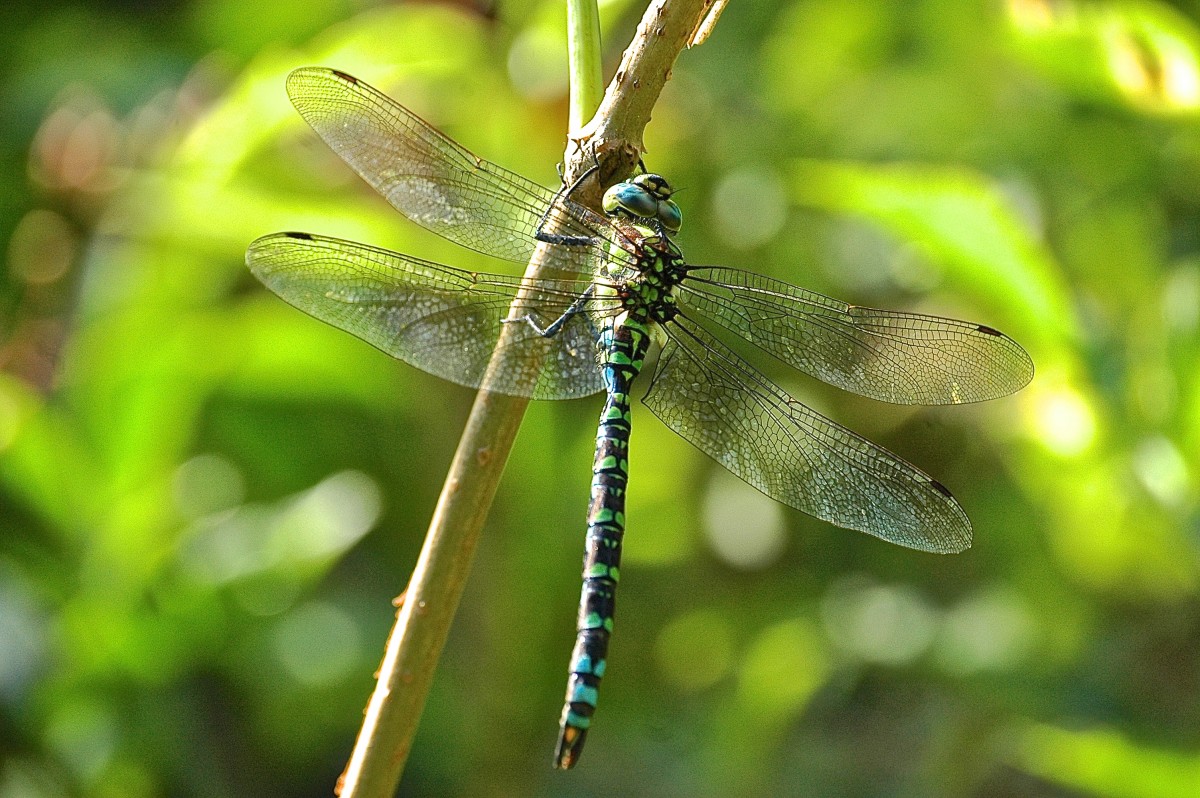
The Southern Hawker (Aeshna cyanea) is a large dragonfly which is quite common in our area. It may be familiar even to urban dwellers as it will visit quite small garden ponds. The species is readily identified by the conspicuous pair of large oval spots on top of the thorax (behind the eyes) and by the bands of colour across the tail end of the abdomen (whereas similar species have paired spots there).  According to W.J. Lucas (British Dragonflies, London 1900):  “At first the ground-colour is rather light brown, and the spots are yellow.  The latter change through green to blue, while the former becomes darker. The pterostigma is at first yellow.” (The pterostigma is the spot close to the outer end of the leading edge of each wing.)  In females the colouration of the abdominal spots normally stabilises as yellowish-green (although a blue form occurs very rarely).  The typical appearance of a mature male can be seen in the photograph below.

A mature male Southern Hawker; The Mythe, 8 August 2007

Recently I noticed a hawker which looked almost ghostly as it flew above me in the shade of a tree.  When it settled I was able to photograph it  and the image below shows that it was clearly an immature male Southern Hawker.  However, rather than the greenish tint I would have expected to see in the abdominal spotting, this specimen was displaying a powder blue colour.  It would be interesting to know if I have captured a temporary phase in the development of this individual or whether it is destined to be an exceptionally blue adult when fully mature.

An immature male Southern Hawker; The Mythe 20 July 2018


Newt Larvae

There are hundreds of newt larvae in the pond in this wild garden in Standish. In the late afternoon they were near the surface, not gulping for air but just hanging there. Perhaps on this hot day there was more oxgen in the surface water than at depth (they still have feathery gills), or perhaps they seek out warmer places which would speed development.

These are great crested newt larvae Triturus cristatus, because of the filament along the tail and the black blotches, which larvae of smooth and palmate newts lack. They are about 5cm long at most.

Lichens on the Web

An illustrated atlas of Gloucestershire lichens is available on-line at http://gloslichens.potsherd.net. The website is a working tool for lichen studies which will be particularly useful for beginners and intermediate lichenologists. There is a non-technical description and photos of the commonest species and distribution maps for all species.

There are about 2000 lichens in the UK, about 700 of which have been seen in Gloucestershire. The maps reveal patterns of distribution and frequency that were not hitherto evident.

The aim is eventually that all tetrads (2km x 2km on the Ordnance Survey national grid) in Gloucestershire should be visited. About half the squares are still virtually blank so there is plenty still to be done. Added to this, the lichen scene is in flux, particularly as a result of decreasing pollution levels and new information from DNA analysis. With climate change also implicated in arrivals and disappearances, it is an exciting time to be involved in lichenology.

For information on this site, or for details of the field meetings of the Gloucestershire and Bristol Lichen Groups, contact glos.lichens@gmail.com

Pittville Park BioBlitz 8th – 9th June

As per my piece in the March edition of GNS news; here is more information about this bioblitz


Here is the website link from that poster:

Pittville BioBlitz site

Students from the University of Gloucestershire will be identifying many of the species from as many taxon groups as they are able to. Come and help the next generation of naturalists if you can make it.

Many Thanks

Rob Curtis
rob.curtis@gloucestershirewildlifetrust.co.uk

World Curlew Day at Upton and elsewhere

World Curlew Day was celebrated on 21 April. Listen to Mary Colwell being interviewed on the Radio 4 Today Programme on 21 April. Available to listen to until 20 May 2018. Interview starts at 1:17:40.

Here is an excellent video of courting Curlews made by Billy Clapham in the Shropshire hills:

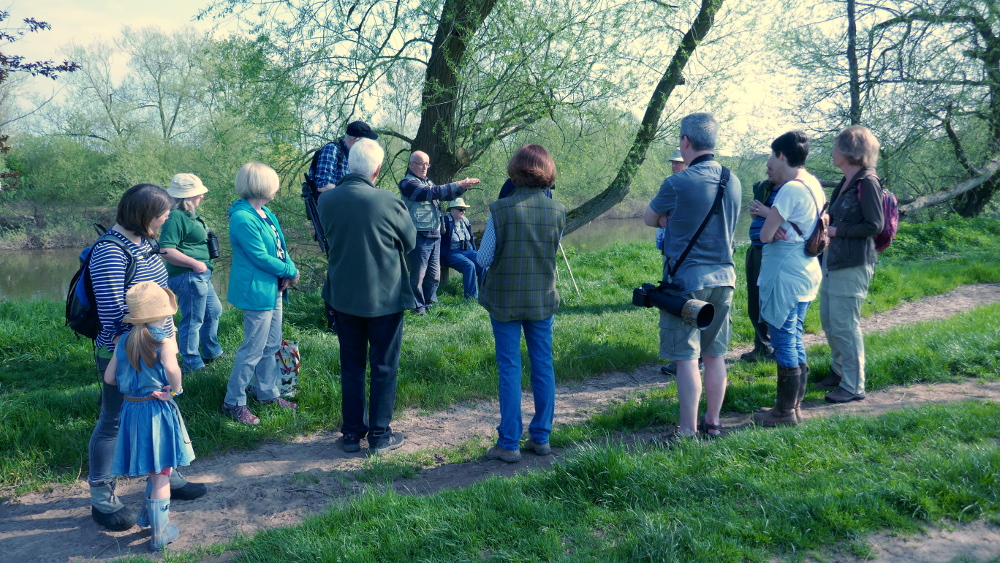
To celebrate World Curlew Day on Saturday 21 April, residents of Upton on Severn and members of the Worcestershire Wildlife Trust and Gloucestershire Naturalists’ Society gathered on Upton Ham alongside the Severn, with the support of the Upton Town Council and the Upton Ham Owners Association. The Ham is the best botanical site alongside the Severn and has been designated a Site of Special Scientific Interest by Natural England. Among those present was Mary Colwell who had just given an interview about World Curlew Day to BBC Radio 4.

Now that the recent floods had gone down, the spring vegetation was coming along, notably the carpet of Ladies’ Smock or Cuckoo Flower; a Cuckoo duly obliged with its spring song, and two pairs of Curlews were seen, apparently preparing to nest.

Upton is one of the classic riverside hay meadows which, through maintenance of their traditional farming regime, provide nesting habitat for Curlews and other ground-nesting birds like Skylarks.

Skip to content