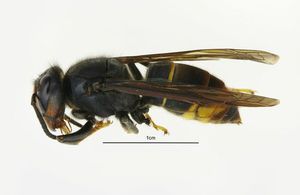
Asian hornet identified in Gloucestershire

The National Bee Unit has confirmed a sighting of the Asian hornet in the Tetbury area of Gloucestershire – the first time the hornet has been discovered in the UK. The Asian hornet is smaller than our native hornet and poses no greater risk to human health than a bee. However, they do pose a risk to honey bees. The hornet found in Tetbury is currently undergoing DNA testing at the National Bee Unit in North Yorkshire to help establish how it arrived in the UK. The hornet arrived in France in 2004 and is now common across large areas of Europe. It was discovered for the first time in Jersey and Alderney this summer. It is believed the species will not be able survive in the north of the UK due to colder winters.

Defra press release:
https://www.gov.uk/government/news/asian-hornet-identified-in-gloucestershire
Links to the ID guide:
http://www.nonnativespecies.org/alerts/index.cfm?id=4
Online recording page:
http://www.brc.ac.uk/risc/alert.php?species=asian_hornet

Field Meeting – Sunday 25th September

The next GNS Field Meeting is due to take place on Sunday 25th September at Cleeve Hill to be led by Ellie Phillips.

BIOLOGICAL RECORDING – What it is and how to record your observations.

Biological recording is the main purpose of the GNS and this is an important chance to learn or update your skills. You can stay for as much or as little of the meeting as you wish, there will be a mixture of background context and practical sessions.

There is a handout booklet to help with this event; it would therefore be helpful to have some idea of numbers beforehand. Please contact Des Marshall 01242 245143 or catullus@uwclub.net to register your interest.

Meet in the Quarry Car Park (next to the Golf Club), Cleeve Hill, at SO 989 271 at 10.00am (bring a packed lunch).

Preliminary report on 2016 breeding Curlew survey

Curlews are a familiar breeding bird along the Severn Vale from Gloucester up to Worcester, and along the Avon from Tewkesbury to Evesham. They nest in hay meadows, and their bubbling call is one of the sounds of summer.   Upwards of 50 pairs may nest in this area, making it one of the most important areas for the species in the South-West.  So in spring and summer 2016 a small group of observers has tried to assess the number of breeding pairs, to identify the fields where they nest (they are known to be strongly faithful to breeding fields), and to make an estimate of productivity – given that many chicks are known to fall a prey to predators (notably foxes, and probably crows and gulls as well), and that some fall victim to early mowing, particularly of silage.

The preliminary results are as follows (a more detailed report will appear in due course):

  • About 30 pairs that attempted to nest were found in Gloucestershire and Worcestershire.
  • This is probably an underestimate, as some known sites were not covered, and nesting birds were often difficult to find in long grass, remaining particularly discreet when they had young chicks in June.
  • Nesting began late, as many riverside meadows remained flooded until well into April, rather later than in most recent years.
  • Several pairs, presumed (from their behaviour) to be nesting, were located in April and May; very few nests were found, since they are well hidden in the long grass, and it is important not to disturb grass around the nest, thus making them more liable to predation.
  • Some nesting pairs appeared to lose their eggs or young early in the season; the adult birds tended to stay on for a short time at the breeding site, and then to disappear, no doubt departing to the moulting and wintering areas around the coast, including the Gloucestershire sector of the Severn estuary.
  • When the chicks hatch, the females leave the breeding site fairly early (before the young are full-grown), leaving just the male to care for the  chicks in late June and July when the young are learning to fly.
  • At least six adult males with just-flying chicks were found during July, and at least one more was suspected to have young because of the agitated behaviour of the male.
  • When the chicks are able to fly, the male departs for the coast, leaving the chicks to fend for themselves.  For a few days chicks may be seen on their own near the breeding place; at one site six flying juveniles were seen together in early August, suggesting that the total number of successful broods may have been above seven.
  • There are a few records of young birds appearing at non-breeding sites along the Severn, presumably young birds on their way to the coast.
  • It was notable that the majority of farmers and landowners, on whose land Curlews were nesting, were very favourably disposed towards the birds: they were very familiar with the species, recognised them as returning to the same field or fields year after year; in many cases they made special arrangements to avoid disturbing the nesting birds, in some cases suspending hay making if young birds were present.

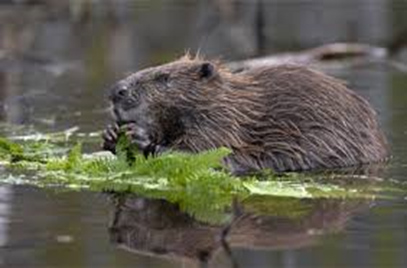
Returning the Beaver – the Welsh Experience

20160729 Beaver

Dear Partner
Wetlands West would like to invite you to a half day presentation and discussion on beaver re-introduction at Apperley Village Hall on TUESDAY 27th SEPTEMBER 2016, starting at 12.30 pm.  The presentation will be given by Adrian Lloyd Jones and Alicia Leow-Dyke from the Welsh Beaver Project.  The Welsh Beaver Project is investigating the feasibility of bringing wild beavers (Castor fiber) back to Wales. This work is being led by the Wildlife Trusts in Wales as part of their Living Landscapes strategy. Programme for the afternoon is as follows:
12.30   Arrive and registration
13.00   Lunch
13.45   Update from Partners on Wetland Project activity
14.30   Returning the Beaver – the Welsh Experience.  Adrian Lloyd Jones and Alicia Leow-Dyke from the Welsh Beaver Project.
15.30   Questions discussion and next steps
16.00   Topics for future meetings
16.15   Close and Depart

If you wish to attend please email Colin Studholme by FRIDAY 9th SEPTEMBER.  colin.studholme@gloucestershirewildlifetrust.co.uk

Forest of Dean Horseshoe bat survey – 13 August 2016

Natural England are leading on the Forest of Dean and Wye Valley Batscape Project (being delivered through the Foresters’ Forest HLF Landscape Partnership Programme), working in close partnership with the Gloucestershire Bat Group and Gloucestershire Wildlife Trust. As part of this project a Lesser Horseshoe bat survey is being carried out on Saturday 13th August and volunteers are needed!

PDF file with details: 20160729 Forest of Dean Lesser Horseshoe Bat survey 13

Please contact Forest Voluntary Action Forum (FVAF) for more details of how to get involved and to book a place: Tim Fretter or Deb Cook contact@fvaf.org.uk or 01594 822073

In Memoriam Lawrence Skipp

LawrenceLawrence Skipp, who died in a road accident in the Forest of Dean on 2 July at the age of only 38, was a general naturalist of exceptionally broad interests.  I have known him for fifteen years or more, and usually met him in the hides and lanes round the reserves at Ashleworth and Coombe Hill.  His base was in the Hartpury/ Tibberton area, and the Severn Vale and the Forest of Dean of the county were the two areas where he was particularly active. I am grateful to his father, Dave, who has provided more details about the life and interests of his son.

He would sit for hours in the hides, usually wearing his green and brown camouflage gear, often very late in the day, or even into the night, since he knew that birds often become more active at that time and do interesting things that can’t be seen by day.  As Dave notes ‘Several times this year I have been in a hide with him around dusk time, when you can hardly see your hand in front of your face, and there he is scribbling away without really looking at what he was writing. He seemed to have a knack at writing “blind”.  I will miss him coming round to check on weather forecasts and sighting websites, to be followed by a running commentary from him on what he expected would be seen in the next few days here & there based on wind / weather/ migration patterns’.

In his youth, as his father relates ‘Lawrence was a keen Gloucester Young Ornithologists Club member, a captain of the Hartpury School Nature Team and a mean sprinter on the track. He always had a wildlife pond wherever he lived, and would spend hours with his backside in the air and his head at the water surface, marvelling at the antics of the newts and general pond life as they went about their daily business. When he wasn’t doing that, he was reading natural history books, drawing, or bird watching. His first real job was with the Gloucestershire Trust for Nature Conservation, until he unfortunately suffered a back problem that needed spinal surgery which left him plagued with pain. Later he did voluntary care work for the Animal Rescue Centre, allied to Hartpury College, where they called him the “Bird-Man”. He was always coming home covered in cuts, bites and bird poop but he absolutely loved it. He was the sort of person who wouldn’t kill a fly, but he would fairly happily feed it to the resident wild spiders in the webs around his flat unless of course it was something special or one he hadn’t seen before, in which case he would capture it under a glass tumbler to view and sketch it thoroughly before release’.

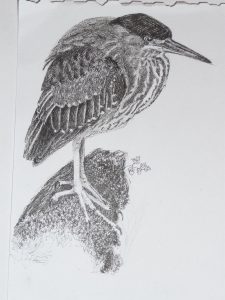
His strength was his attention to detail, of which there are many testimonies in the hide log books at Ashleworth and Coombe Hill, in his characteristic neat and elegant handwriting, done with a fine nibbed pen: he had real artistic flair. As his father notes ‘He loved his art, and was gifted with a keen eye for detail and an ability to transfer it to a beautifully drawn replica. He was so excited when was asked to contribute bird studies for inclusion in the “The Birds of Gloucestershire”, but unfortunately had a bad car accident in 2011 which left him wheelchair bound for almost a year and unable to follow that through. His love of nature, art, and bird-life in particular kept him strong and got him through those bad times back up to relative fitness and back out into “the field” and into drawing again. He never really fully recovered, and pain still plagued him daily, but he soldiered on and fought his demons head on.  Perhaps that’s why he loved his “camo-gear” so much, as you would never really catch sight of him out of uniform, ready for action in the hunt for an elusive rarity or just simply marvelling in the beauty of the humble iridescent Starling’.

He did find quite a number of rare birds in the county: he was one of the few who saw the Scarlet Rosefinch at Ashleworth; he was the one who actually identified the Stilt Sandpiper at Coombe Hill (after Les Brown had seen it without identifying it); he found the singing Spotted Crake at Coombe Hill (late at night of course) last year.  I remember him persuading half a dozen of us to join him at Ashleworth round midnight in early June, when an unusually loud and voluble warbler song had convinced him a Marsh Warbler had turned up: it proved to be ‘just’ a Sedge Warbler, one that had probably failed elsewhere, and had moved in for a fresh breeding attempt, which would explain the sudden bursts of song.  He was with us on 10 May this year when Coombe Hill had such a succession of unusual migrants brought in by a south east wind – Grey Plover, Turnstone and Sanderling, plus overflying Black and Arctic Terns, and he was the one who first picked out the terns.  The log books reveal him writing down details of things as they happened in front of him: he would record individual variations in the plumages of Curlews as they arrived (he was the one who most frequently recorded the colour ringed bird at Ashleworth, and he showed me Curlew chicks in a hayfield near Haw Bridge); he recorded not only birds, but invertebrates too, especially dragonflies.  One of the last text messages I received from him (in his usual textspeak) on 19 June ran as follows: “Would you mind asking Ingrid Twissel if teneral Lestes sponsa ever show pale pterostigma pls?  If not, i saw Lestes viridis at coombe the day I last saw you”.  Sadly he died before I could pass on Ingrid’s reply, so let me pass it on here: “Chalcolestes viridis (Willow Emerald Damselfly) is larger than Lestes sponsa (Emerald Damselfly), and has pale wing-spots outlined in black, but at present is only found in south-east England. Other immature/teneral species of Lestes have pale wing-spots which darken on maturity, so this is likely to be what Lawrence saw. L.sponsa is the only species that breeds at present in Gloucestershire. The only other sighting of another Emerald (Southern Emerald Lestes barbarus) occurred on the R. Avon, east of Keynsham in August 2006.”

So sad that such a gifted and observant naturalist should be snatched away so soon, and that many of his observations die with him.  There will be a simple non-religious ceremony at Gloucester Crematorium at 3.p.m. on Monday 1 August, at which all will be welcome.
P1000939

Cinderford Northern Quarter Update

20130428 CNQ Meet 1

Dean Natural Alliance who with Forest of Dean Friends of the Earth and others have been continuing the legal fight against the development of the Cinderford Northern Quarter today (Tuesday 12th July) sent out a press release after their latest appearance at the High Court.

GNS agrees wholeheartedly with the sentiments that the CNQ development is ill advised, misplaced and seriously detrimental to the mosaic of habitats and plethora of wildlife on and around the site. The regeneration of Cinderford would have been far better carried out much closer to the town, community and infrastructure that already exists for many reasons over and above the damage that will be caused to a wildlife rich area.

It seems perverse that across the Forest, many groups and individuals are working hard to enhance the wildlife, culture, heritage, history and other facets of the area in pursuit of the Heritage Lottery Fund bid under the banner of The Forester’s Forest whilst on the CNQ site, the local authority and Homes and Communities Agency are bent on continuing with a development that will so adversely affect all of these things.

The text of the DNA press release is given below:

“Dean Natural Alliance greatly regrets the decision last week in the High Court not to allow an Appeal to go forward challenging the Planning Consent for the Hybrid Planning Application at Cinderford Northern Quarter.

We continue to believe that the selection of this site by the Forest of Dean District Council and the Homes and Communities Agency was ill-informed and deeply flawed. DNA feel the CNQ is unsuitable both because of its great environmental richness and because the mining legacy and contamination mean this development can never be economically viable; it will continue to be a great drain on the Public Purse and to damage wildlife.

As the Gloucestershire College still does not seem to be in a position to proceed with their proposed move from Five Acres, we believe there is no justification for yet commencing a section of a Spine Road which will lead nowhere, will increase traffic through Steam Mills and will require Public Forest Estate land.

Dean Natural Alliance feel that because the Cinderford Northern Quarter is such poor value for money with the speculative spending of some £18 Million and is so damaging to our heritage that we will continue to oppose it.”

Further information is available at http://www.deannaturalalliance.org/

Nightjar evening walks 2016

Following the success of previous year’s Nightjar evening walks in the Forest of Dean, I plan to do more this year, proposed dates are:

Thursday 30th June

Thursday 7th July

Thursday 14th July

If anyone is interested, please contact me by e-mail and let me know your preferred date.

As previously, the evening meetings will begin with a 9.30pm start and will be weather dependent. The chance of seeing Nightjars on cold, wet or windy evenings is poor, we will therefore be hoping for reasonably clear and still evenings and if necessary, will revise the dates.

I will send out full instructions ahead of the proposed dates to all who wish to attend.

Andrew Bluett, Membership Secretary – gnsmembership@btinternet.com

GNS Field Meeting, Saturday 11th June

Field Meeting Edge Common IMG_1031

The next GNS Field Meeting is due to take place on Saturday 11th JuneA Walk on Edge Common – to be led by Linda Moore (01452 389950). Edge Common is an area of unimproved limestone grassland with woodland and scrub, good for limestone vascular plants and other botanical gems. 11.00 am to 14.00 pm.

Meet at SO 846 095 on the road from Edge to Haresfield Beacon, parking is available in a number of places along the road but please take care, the road can be busy and traffic does not always travel at an appropriate speed.

Diamond-back Moth Migration

We are currently on the receiving end of a large-scale migration of Diamond-back Moths (Plutella xylostella) into the UK.  I thought I was doing well with a count of 16 caught at dusk in my Cheltenham garden on 2 June, but have just heard from a recorder in the Stroud area who gave up counting at 100 in his moth trap.  The migration has been mentioned on Springwatch and there is a short video clip of one observer’s experience in Norfolk here:
http://www.norfolkmoths.co.uk/micros.php?bf=4640

It would be interesting to record the full scale of the migration in the county, both numbers and locations, so please send in any records.  The web page noted above has a good range of ID photographs; in essence the Diamond-back Moth is small (about 15 mm wingspan), pale in colour and probably in a garden or field near you!

R Homan, VC 33 Moth Recorder

Skip to content