Letter from the Chair, November 2018

Dear Members

The Society’s Rules stipulate that we must give members three months’ notice of the Annual General Meeting; we have duly observed this obligation, by posting advance notice of the meeting both in GNS NEWS, and on the Society’s website; (by the way, I wonder whether you are in the habit of looking at the website, in between quarterly issues of GNS NEWS? Lots of interesting information there, plus reminders of upcoming events, both indoors and outdoors, of interest to GNS members; do take a look at www.glosnats.org). Just to confirm, the AGM will be held on Friday 22 March 2019, at the Gala Club, Fairmile Gardens, Gloucester, with the Society’s President, Mrs Anna Ball, in the Chair.

However the 2019 AGM will see a number of changes to the Society’s Executive Committee. David Scott-Langley is stepping down as Vice Chairman, after a very long stint, during which he has also been Chairman of the Cirencester branch and of the Scientific and Publications Committee, and in addition has been County Recorder for a variety of invertebrate groups; and as if that was not enough, he has continued to edit the annual volume of “The Gloucestershire Naturalist”. David is moving out of the county, but the good news is that he plans to continue acting as an invertebrate recorder, and to continue editing “The Gloucestershire Naturalist”. Since David stepped down as Chairman in 2016, the Cirencester Branch has continued its activities (notably the indoor meetings), with a group of three members – Ken Cservenka, Andrew Bluett and Rob Curtis – acting as a steering committee. Furthermore, Juliet Bailey took over from David as Chair of the Scientific and Publications Committee in 2016; Juliet is a long-standing member of the Society, is active in many fields of natural history in the county (notably botany and ornithology), and has for some time been the county Lichen Recorder; so we can be confident that the Society’s scientific activities and publications are in good hands.

Since I became Chairman of GNS in 2003, I have tried to strengthen links between the Society and the Gloucestershire Wildlife Trust; to pursue this end, I have for many years been a Trustee of GWT, but my permitted period as Trustee is now up and I stood down in September. Both GNS and GWT were keen to maintain the close links, so Andrew Bluett, the GNS Membership Secretary, was elected to the GWT Board in September. An initial meeting has already taken place to look more closely at how GNS, with its corps of very experienced volunteer naturalists, can cooperate even more closely with GWT. So, all in all, this seems to me to be a good opportunity for me to step down as GNS Chairman at the 2019 AGM.

The Society’s Executive Committee has obviously been considering this situation, and a number of existing members of the Committee have indicated that they would be happy to stand for election at the coming AGM. All are active field naturalists, with a long record of involvement in the Society’s activities: Mervyn Greening (a trained biologist, until recently a science teacher in Gloucestershire secondary schools, an active bird-ringer, and a keen botanist) will stand for Hon. Chairman. Juliet Bailey is to stand for Hon Vice Chair. In addition, I am delighted to say that Barrie Mills, who has recently been co-opted to the Executive Committee, is standing as a candidate for the post of Hon Secretary, a position which has remained vacant for far too long. Most of the other current Committee members are standing for re-election, notably Andy Lewis who has been a member of the Committee during the amalgamation between GNS and the North Cotswolds Ornithological Society, which is now happily almost complete. I too (with the approval of the other members of the Committee!) shall be standing again, as an ordinary member of the Committee.

Please note that there will be an election at the AGM. The members mentioned above are for the moment candidates for the various positions in the Society; if any other GNS members wish to put their names forward, this will be very welcome: don’t hesitate to contact me. Above all, please do come along to the AGM, to join in the latest episode in the history of GNS, which began way back in 1948.

After the AGM there will be an address by Dr Keith Alexander on ‘Gloucestershire’s best beetles’. Keith is an Honorary member of the Society, a former invertebrate recorder, author of the recent GNS publication in the TGN series on “Beetles of Gloucestershire”, and he took part in the field surveys in the county in the last two summers of Cosnard’s Net-winged Beetle. His presentation will undoubtedly throw new light on the invertebrates – often the most neglected, yet perhaps the fundamental component of biodiversity. Do come along to hear him speak; it should be an interesting and inspiring  event.

Until then, I send compliments of the season to all members and wish you a year full of inspiring natural history experiences in 2019.

With very best wishes

Mike Smart
Hon Chairman

Micro Eden in Gloucestershire

To date Graham Tompsett has recorded 379 species in his garden since June.

It covers a wide range of taxa including but not limited to: lichens, flowering plants, spiders, flies, birds and mammals

https://microeden.co.uk/

Have a look at what he’s found so far. He appreciates any feedback.


Discovering Bats Day, 27th October

OrganiserJohn Moore Museum
DateSaturday 27th October 2018
TimeFour sessions to choose from:
10.30am to 11.30am
11.45am to 12.45pm
2.30pm to 3.30pm
3.45pm to 4.45pm
VenueJohn Moore Museum, 41 Church Street, Tewkesbury, GL20 5SN
DetailsWhy do bats hang upside-down?
How do they find their way in the dark?
What different types of bats live in the UK?
How can I encourage them to visit my garden?
Bat expert David Endacott will be at the museum with a selection of live, rescued British Bats to explain all about these fascinating creatures of the night.  Also displays by the Gloucestershire Bat Group where you can learn about their work and how to join.  This is the perfect opportunity to find out the truth about these much misunderstood animals.
PLUS
Pick up FREE information on how you can help bats, and craft activities for children – make your own origami bat or bat mask!
 
Tickets available on the door or in advance from the museum
Adults £6.00 / Seniors & Students £4.50 / Children £2
(Includes admission to the John Moore Museum & The Old Baptist Chapel).
Contact:Simon Lawton (Curator)
E-Mail: curator@johnmooremuseum.org
Telephone: 01684 297174

Northern Goshawk, the phantom of the forest, an illustrated talk by Steve Watson, 16th November

Steve Watson will cover the natural history of the goshawk, including its ecology, population dynamics, biology, foraging, courtship and breeding behaviour.

Further information here

Location: Catholic Church Hall, Cinder Hall, Coleford, Glos, GL16 8HN

Event details

Date: Friday 16 November 2018
Time: 19:30 to 21:30

About the event: This event is organised by the Forest of Dean Group of the GWT. Tickets are available are on the door.

Booking

Price/donation: £2 including tea/coffee and biscuits, free for children.

Know before you go

Mobility: Suitable for people with limited mobility.
Wheelchair access: Suitable for wheelchair users.

Contact us

Philip Mugridge
Contact number: 01594 510384
Contact email: info@gloucestershirewildlifetrust.co.uk

Ashleworth Ham CES Visit 11, 2018

Ringing at Ashleworth Ham

Visit 11 on 21 August 2018

The conditions for catching birds were perfect, slightly overcast, and only a light breeze. The trouble is that, in order to catch birds, there need to be birds present. The complete absence of bird sound whilst putting up the nets, soon materialised into the second lowest catch of the year. Whilst not totally unexpected, it is always disappointing to have fears confirmed. The catch of 30 birds was well below the averages (48 for last five years, and 52 for the full twenty previous years). The hedgerows are full of fruit, and a few insects are around, but for the time being, the birds appear to have left the site, a feature that has been noted in previous years. Numbers pick up again in mid- to late September, and good catches are obtained in October.

Whitethroat topped the list with six birds caught, closely followed by Blackcap and Redstart with five of each species. All five Blackcaps were re-traps, of which two were adults in full annual moult. Two each of Redstart and Whitethroat were re-traps, one of the Whitethroats being an adult in annual moult.

The Redstarts were all juveniles at different stages of their post juvenile moult. Two were females fully moulted out, but still recognisable as juveniles by the orange fringes on the greater coverts, the other three were males, one obviously so as it was nearly through its moult, the other two were only just recognisable as males, as their moult had just reached their heads, and a few white feathers were just beginning to show through their protective sheaths. It is this opportunity to see these intimate details of a bird’s life cycle, that is one of the major appeals of ringing. For the scientists studying populations, the data from Ashleworth show that in this area, Redstarts have had a successful breeding season, with 22 of the 31 individuals handled this year being juveniles.

Chiffchaffs on the other hand appear not to have done so well locally.  Most years at this time, the sound we hear most frequently is the disyllabic call note of the young birds keeping contact with each other. This year there is little or no sound of them, and the catching figures reflect this, each visit yielding an average of just over one bird per visit, compared with last year when each visit yielded 8.4 birds per visit, and 5.8 birds per visit in 2016. It will be interesting to see if visit 12 (the final CES visit) does anything to change these statistics, but it is doubtful if it will.

Mervyn Greening

Ashleworth Ham CES Visit 10, 2018

Ringing at Hasfield Ham

by Mervyn Greening

Visit 10 on Tuesday 14 August 2018

The electric fence, to protect the netting area from cattle, was re-instated yesterday, and was still standing when operations started this morning. Weather-wise, the conditions could not have been better, slightly overcast and with the gentlest of breezes. Whilst the nets were being erected it was noted that there was virtually no bird sound. So, despite the perfect conditions, it was no surprise that catching was very slow.

.

If it hadn’t been for the arrival of good numbers of migrating Swallows and House Martins, some of which descended low enough to be caught, the catch would have been well below the average of 57. As it was the catch, with the hirundines, was slightly above average at 63. Of the regular birds, Whitethroat was top of the list with nine caught, followed by Bullfinches with six.

.

.

Of the 63 birds caught, only five were adults, four of which were in post-breeding moult, while one had completed its moult. All the hirundines were birds of the year which had completed their rapid, short, and incomplete post-juvenile moult, which will be finished when they reach their winter quarters. Young Swallows look like adults, but with much subdued colours, especially the throat which is rusty rather than red. House Martin juveniles on the other hand look quite different from the adults. Their plumage is more the colour of Sand Martins, as the blue tinge to the black feathers is not developed until post-juvenile plumage. When the birds are in the hand, and the rump (which is white) and the underparts are not readily visible, then the head alone could easily be mistaken for a Sand Martin.

.

During the morning the cattle paid us a visit, and the effectiveness of a fully operational electric fence was demonstrated, when the herd tried to walk through the hedge where the nets are, only for the leading cows to touch the fence and jump back; this in turn caused confusion for the cows behind which ran off. Question now is, do the others learn from the ones in front? Or do they all have to touch the fence at some time to know what it does?

.

One of the interesting things for me at this time of year is seeing young birds at different stages of post-juvenile (PJ) moult. A multi-brooded species like the Robin, can have young ranging from birds still completely in juvenile plumage, up to birds of the year that have completed their PJ moult and look exactly like adults. It’s also interesting to see the difference in the speed at which PJ moult happens. Long distance migrants like Swallows have a rapid and incomplete PJ moult; Chiffchaffs and Willow Warblers have a partial PJ moult of all their body feathers (but not flight feathers) which takes a few weeks; Wrens which have a similar strategy, stay in juvenile plumage a long time, then have a rapid moult; and Long-tailed Tits have a complete moult so are indistinguishable from adults by September.

.

.

Not all birds are healthy, and sometimes individuals are caught which cannot be ringed. Bullfinches and Chaffinches sometimes have mite infestations that cause their legs to develop growths. Such was the case with one of the adult Bullfinches caught today. In this male bird, the infestation has made the legs and claws grow unevenly and bigger.


Birds of Prey Day, John Moore Museum, 18 August 2018

A Live Animal Event for the Summer Holidays 2018

OrganiserJohn Moore Museum
DateSaturday 18th August  2018
Time10am to 1pm & 2pm to 5pm
VenueJohn Moore Museum, 41 Church Street, Tewkesbury, GL20 5SN
DetailsFor the summer holidays the museum welcomes back J.R.C.S Falconry who will be bringing along a selection of birds of prey from their extensive collection.

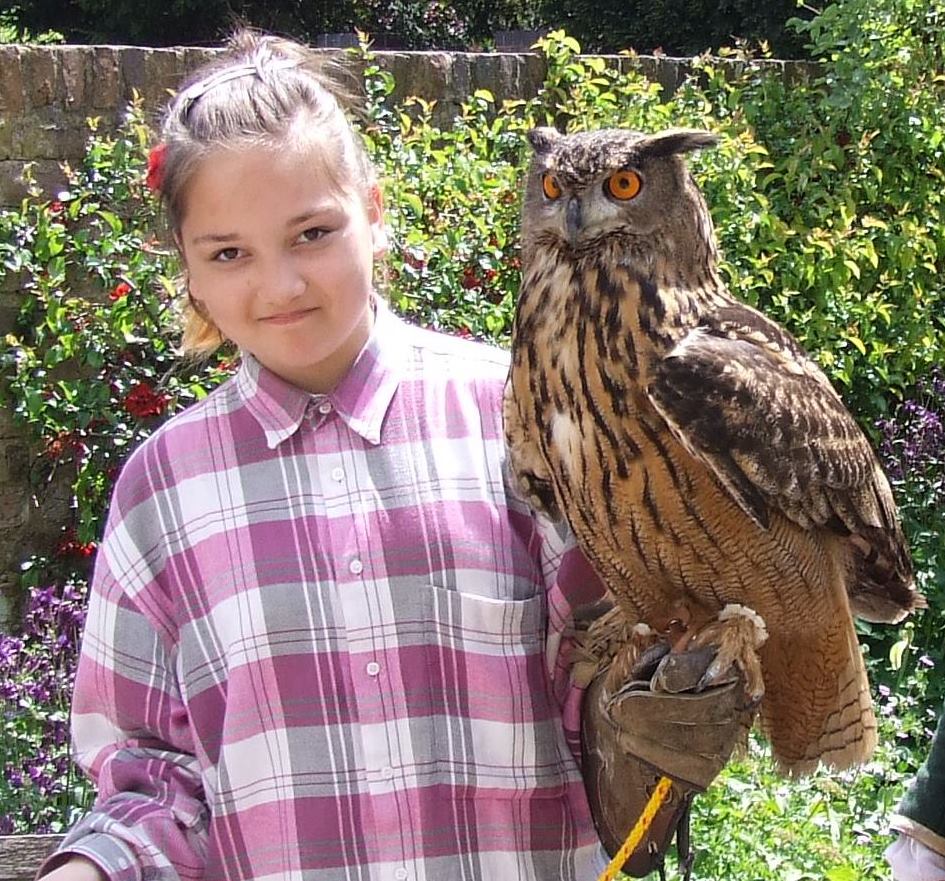
Visit us to meet a Golden Eagle, a Hooded Vulture, an Eagle Owl, a Little Owl, an American Kestrel and a Barn Owl.  An opportunity to see birds of prey, from some of the largest to the smallest.

A falconer will be on hand to answer all your questions about these amazing birds as well as on the ancient art of falconry.

Four sessions to choose from:

10.00am to 11.15am
11.45am to 1pm
2pm to 3.15pm
3.45pm to 5pm

Admission

Adult: £6.00, Seniors & Students £4.50, Children £2.00

(Tickets include admission to the John Moore Museum, the Merchant’s House & the Old Baptist Chapel)

 Contact: Simon Lawton (Curator)
E-Mail: curator@johnmooremuseum.org
Website: www.johnmooremuseum.org
Telephone: 01684 297174

Broad-leaved Helleborine

I have probably 12 Broad-leaved Helleborine in our garden. One appeared between 10 and 12 years ago. Since then the numbers have increased annually without any conscious assistance on my part. This is the 2018 photograph of the original plant which has grown stronger each year.

They appear spontaneously in cracks between walls and the tarmac drive; in beds and borders, in shade or in sunny places. And I have been delighted that they have thrived here in our garden in Eastcombe (GL6 7DW)
We are both members of the GNS (my husband has been a member since 1984) and attend the Cirencester winter meetings and occasional field meetings in the summer.
I hope this report is of interest.
Kind regards
Pam Perry

Colour variation in the Southern Hawker Dragonfly

Dragonflies and damselflies emerge from their larval skins in an immature state and necessarily spend some time away from  water, avoiding contact with others of their own kind while their wings and external skeleton harden and their adult colours gradually develop.  The immature males of many species pass through a distinct juvenile phase during which they resemble females until their true colours as adult males  become apparent.

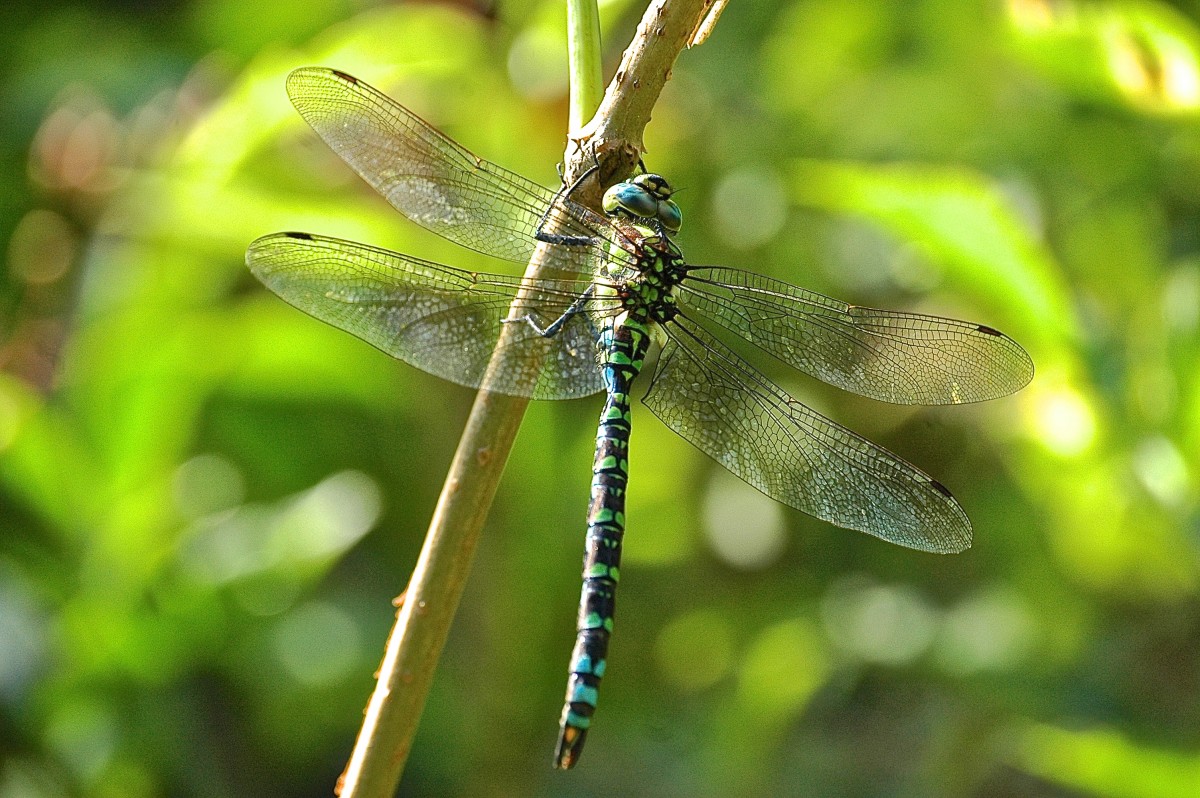
The Southern Hawker (Aeshna cyanea) is a large dragonfly which is quite common in our area. It may be familiar even to urban dwellers as it will visit quite small garden ponds. The species is readily identified by the conspicuous pair of large oval spots on top of the thorax (behind the eyes) and by the bands of colour across the tail end of the abdomen (whereas similar species have paired spots there).  According to W.J. Lucas (British Dragonflies, London 1900):  “At first the ground-colour is rather light brown, and the spots are yellow.  The latter change through green to blue, while the former becomes darker. The pterostigma is at first yellow.” (The pterostigma is the spot close to the outer end of the leading edge of each wing.)  In females the colouration of the abdominal spots normally stabilises as yellowish-green (although a blue form occurs very rarely).  The typical appearance of a mature male can be seen in the photograph below.

A mature male Southern Hawker; The Mythe, 8 August 2007

Recently I noticed a hawker which looked almost ghostly as it flew above me in the shade of a tree.  When it settled I was able to photograph it  and the image below shows that it was clearly an immature male Southern Hawker.  However, rather than the greenish tint I would have expected to see in the abdominal spotting, this specimen was displaying a powder blue colour.  It would be interesting to know if I have captured a temporary phase in the development of this individual or whether it is destined to be an exceptionally blue adult when fully mature.

An immature male Southern Hawker; The Mythe 20 July 2018


Skip to content