Gloucester (4 January 2011, contributed by Gordon Avery)
5 Golden Plover flew west over Llantony Wier at 12.18pm today.

Gloucester (4 January 2011, contributed by Gordon Avery)
5 Golden Plover flew west over Llantony Wier at 12.18pm today.
Gloucester (2 January 2011, contributed by Andy Jayne)
I flushed a Bittern at Port Ham, Gloucester today at 10.15am. Also two Shoveler there.
Minsterworth (1 January 2011, contributed by Andy Jayne)
At Minsterworth today near Upper Moorcroft Farm (SO7918) there were 3 (two adult and one juvenile) Whooper Swans and 6 (two adult and four juvenile) Bewick’s Swans in a field with two adult Mute Swans. The Whooper Swans were still present at dusk.
Stratton (1 January 2011, contributed by Ken Cservenka)
In my garden at Stratton today were 1 male and 3 female Bramblings; 1 female Blackcap and 8 Yellowhammers among more usual garden birds. In the tall trees at the Stratton House Hotel there were 8 Siskins.
Coombe Hill (1 January 2011, contributed by Mike Smart and Les Brown)
The Severn level at Haw Bridge is a bit higher today (8.23 m, after months round the seven metre mark) so the Chelt and other small tributaries are higher too and there will no doubt be a little more surface water at Coombe Hill and Ashleworth after an unusually dry autumn The birds have already found the water: this morning, Les Brown recorded 420 Wigeon and 200 Teal at Coombe Hill, with 175 Canada Geese and 35 Greylags.
Hempsted (31 December 2010, contributed by Gordon Avery)
A male Little Owl was calling from the Priory, Hempsted at 00.50 this morning. The first record for this species in the area since 2007.
River Severn (28 December 2010, contributed by Mike Smart and Les Brown)
Still ice floes floating on the Severn between Lower Lode and Wainlodes, though most of the snow hAS melted on the fields. River and ditch levels are still very low everywhere.
Most of the ducks in the area were on the river: on the Mill Avon at Tewkesbury: 11 Tufted, 3 Wigeon, 50 Mallard and 5 Coot, also the male Mute Swan (3AY) that nests by the wharf at Coombe Hill. Downstream from Lower Lode: 3 Cormorants, 200 Mallard, 8 Teal, 120 Wigeon, 13 Tufted Ducks, 2 Pochard, 5 immature or female Goldeneye.
Standish (26 December 2010, contributed by Juliet Bailey)
I had to disturb a roost of ladybirds a couple of weeks ago as a window frame in which they were overwintering needed repainting. I have just got around to looking at them today, and there are about 70 Harlequins together with four Two-spots. There are other roosts evident round the house, but I haven’t looked at these in detail. However, they appear also to be largely Harlequins.
Longlevens, Gloucester (23 December 2010, contributed by Andy Jayne)
There were 27 Waxwings briefly by the church at about 8.30am before flying off south.
Cheltenham (21/22 December 2010, contributed by Robert Homan)
In a Swindon Lane orchard, for the 2nd day, a flock of 150 Fieldfares eating and squabbling over the few remaining fallen apples. In the same area and in Prestbury, each garden Pyracantha had its own small flock of Redwings on 21st.
Tewkesbury (22 December 2010, contributed by Gordon Avery)
A single female Goosander was on the R. Severn by the Mythe Bridge, Tewkesbury at approximately 12.40pm.
Stratton (21 December 2010, contributed by Ken Cservenka)
8 Yellowhammers under the garden feeders today at Stratton.
Woodmancote, nr. Bishop’s Cleeve (20 December 2010, contributed by Peter Fitchett)
Over 30 Blackbirds in local gardens this morning along with about 20 Redwings feeding on Pyracantha berries (See Peter’s picture below). Also two male Blackcaps, a Pied Wagtail and Great Tit.

Walmore and Aylburton (17 December 2010, contributed by Andy Jayne)
At Walmore Common there was a family of six Bewick’s Swans this morning.
At Aylburton Warth, an adult Mediterranean Gull on fields with Black-headed and Common Gulls. Also two Wigeon, 20 Teal, two Sparrowhawks, 13 Golden Plovers, 123 Lapwing, seven Ruff, a Snipe, 17 Curlews and 80 Redwings.
At Littledean just 12 Waxwings still present at 3.20pm.
Cheltenham (17 December 2010, contributed by Robert Homan)
17 waxwings feeding in a pink/white berried Rowan at 10.30am in Albemarle Gate, near Pittville Park. At 2.30pm both the berries and the birds had gone, leaving some red berried Rowans to a handful of Redwing.
North Cerney (15 December 2010, contributed by Robert Homan)
The “usual” Little Egret by the River Churn, mid-morning.
Cheltenham (15 December 2010, contributed by Robert Homan)
21 Waxwings in trees at the junction of Swindon Lane and Windyridge Road this afternoon.
Sudmeadow (12 December 2010, contributed by Gordon Avery)
60 Goldfinches this morning feeding mostly on Teasels at the back of Phelps yard, Sudmeadow Road. Along the river below Llantony Weir, a Tawny Owl was trying to be invisible in the middle of a Willow tree, being mobbed by all and sundry. This is a species seen less than annually in the Sudmeadow area.
Ashleworth (11 December 2010, contributed by Mike Smart)
Ashleworth is still extremely dry with very little water in the ditches and little or no surface water on the reserve despite the thaw. During an RSPB Members Group field trip, about 12 Goosanders flew over to the north, 6 Wigeon flew upriver, 2 Peregrines on the pylons, a Stock Dove singing already, but not much else.
Leigh Meadows are equally dry with two Snipe, 4 Mute but no other swans. There were 2 Cormorants perched on trees by the River Chelt.
Coombe Hill and Ashleworth (9 December 2010, contributed by Mike Smart)
At both Coombe Hill and Ashleworth, the water levels remain low and what little water there is, is frozen over. So not much about. At Coombe Hill, the only ducks were 13 Mallard on a hole in the ice in the canal; 1 Grey Heron, 200+ fieldfares, 30 Redwings. About the same at Ashleworth with 100+ Fieldfares, no ducks. No sign of Whooper Swans at either site or on Leigh Meadows.
Tewkesbury (9 December 2010, contributed by Gordon Avery)
A Curlew flew low over the A38 just outside Tewkesbury flying towards Southwick Farm at 1.35pm. This unseasonal record was almost certainly a result of the cold weather.
Hempsted, Gloucester (7 December 2010, contributed by Gordon Avery)
3 Waxwings feeding in a ornamental berry tree outside Hempsted Motors, Hempsted Lane at 3.15pm at approximately SO 822179.
Cheltenham (6 December 2010, contributed by Robert Homan)
3 Blackcaps on bird feeders (2f and 1m) in Swindon Lane this afternoon. Earlier a presumed pair of Sparrowhawks in nearby Pittville Park with the smaller of the 2 birds carrying a prey item and being pursued by the larger bird.
Staverton (5 December 2010, contributed by Gordon Avery)
2 Waxwings in Down Hatherley Lane in the vicinity of the electricity substation opposite the side entrance to the former Dowty factory. There until early afternoon.
Sudmeadow (2 December 2010, contributed by Gordon Avery)
A Woodcock this morning in the osier at Sudmeadow.
GNS Field Meeting at Brim’s Pill, Awre (12 December 2010, contributed by Juliet Bailey with pictures by Sheila Lisster)
This GNS walk was at the Gloucestershire Wildfowlers Association reserve at Brim’s Pill and was led by Mike Smart.
It was foggy and frosty, and the hoped for waterbirds were hardly evident. There was the occasional Lapwing appearing out of the mists, and Redshank and Curlew calls, but the ice and fog, with bursts of watery sunlight from time to time, made it a most atmospheric meeting. We walked across the field where channels have been dug to turn the field back to saltmarsh, by frozen rhynes lined with golden reed, through secondary woodland of a failed dockside railway development, and out onto the Severn-side pastures where stacked metal putchers witness the last remnants of the once thriving salmon fishery. The pictures below show the GNS group, the reed lined rhyne and the metal putchers.


Guscar Rocks and Westbury-on-Severn (28 November 2010, contributed by Andy Jayne)
Guscar Rocks to Pillhouse Rocks – sightings included three Ringed Plover, 31 Golden Plover, a Grey Plover, c.150 Dunlin, two Snipe, c.90 Curlew, four Redshank and a Rock Pipit.
At Westbury-on-Severn, a roost of at least 16,000 Starlings at the water gardens with most arriving between 3.30 and 4.00pm.
Severn Hams (18 November 2010, contributed by Mike Smart and Les Brown)
There was a real wintry feel at last today, with the water level rising, even if only slightly, an easterly wind and more ducks and geese present.
Coombe Hill: there is some water now in the scrapes in front of the Grundon hide, though they are still pretty low: there was a nice concentration of geese early morning, even if they were mostly Canadas and Greylags. They clearly behave like major goose flocks and may well attract wild geese to join them; the water level is quite high in the Long Pool, but there are not so many birds there now. 240 Canada Geese, 65 Greylags (one with a colour ring B6P), 1 Barhead, one white Farmyard Goose. 160 Wigeon, 70 Teal, 4 Shoveler, 63 Mallard, 9 Lapwings. At least 500 Fieldfares mainly feeding on hawthorn berries.
Ashleworth Ham was rather quiet because of a pheasant shoot in neighbouring fields. Three and a half boards were inserted in the sluice which should allow water levels to rise.
Lower Lode, Tewkesbury (18 November 2010, contributed by Gordon Avery)
32 Cormorants in the loafing site at Lower Lode at lunchtime today.
Aylburton Warth (31 October 2010, contributed by Andy Jayne)
At Aylburton Warth today 25 Teal, a Curlew Sandpiper, three Ruff, four Snipe, a Turnstone, three Rock Pipits and a Wheatear with approximate counts of 150 Golden Plover, 500 Dunlin, 200 Curlew and 85 Skylarks. Also three Brambling in a nearby game-strip.
Sudmeadow/GLS (30 October 2010, contributed by Gordon Avery)
Seen today were: 1 Green Sandpiper (this bird has been around all month), 1650 Starlings, a minimum of 15 Raven and 30 Linnets.
Coombe Hill and Deerhurst (30 October 2010, contributed by Mike Smart and Les Brown)
It was still very dry with little or no water in scrapes, but the Long Pool was still holding plenty of water. Most birds were on the Long Pool; 4 Mute Swans, 65 Greylag Geese, 30 Canada Geese, only 53 Teal, 3 Shoveler, 10 Wigeon, 1 Little Grebe, 6 Snipe, 1 Kingfisher; still only 10 Fieldfares, 5 Redwings.
Deerhurst: 1 Sparrowhawk, gulls feeding on a field where slurry had recently been spread: 200 Black-headed, 10 Common Gull and 20 Lesser Blackbacks.
Standish (22 October 2010, contributed by Juliet Bailey)
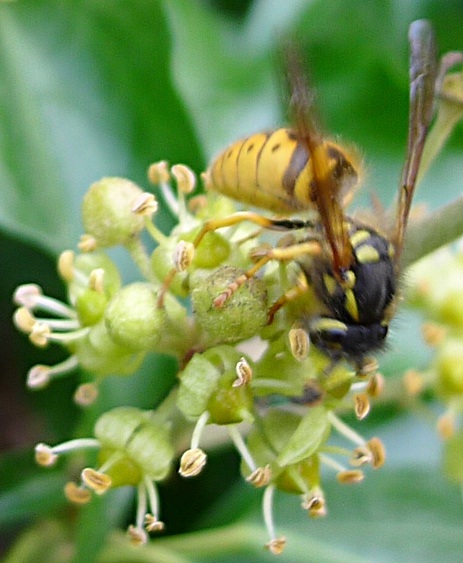
The flowering ivy is still feeding a range of insects, especially flies and wasps. A Red Admiral was seen fluttering around a sheltered sunlit ivy bush, though there are very few butterflies about now.
Coombe Hill and Ashleworth (22 October 2010, contributed by Mike Smart)
Following reports from Slimbridge of a Whooper and two Bewick’s which seem to spend their nights at Slimbridge but disappear by day, I spent the morning in the Coombe Hill/Ashleworth area, checking whether they are in the Severn Hams area. No swans were seen, not even a Mute, so they are not in this part of the county. Both areas are very dry, with little or no surface water; the only place with water is the Long Pool at Coombe Hill.
Coombe Hill: 280 Teal, 7 Shoveler, 1 Snipe, 25 Fieldfares, 5 Redwings; very small Meadow Pipit movement with not more than six birds to south west.
Cobney Meadows (west end of Coombe Hill); 100 Fieldfares, 1 Raven.
Ashleworth: nothing to report.
Aylburton and Guscar (10 October 2010, contributed by Mike Smart)
There was a very high tide this morning (9.6 metres), which covered much of the shoreline and almost flooded Aylburton Warth. There were at least 660 Curlews in the high tide roost with at least of eight them being colour-ringed birds marked at Wibdon on 26 September; five of the eight rings were read and so could be individually identified. Also 30 Wigeon, 13 Teal, 1 Little Egret, 150 Lapwings, 3 Grey Plover, 1 Golden Plover, 1 Ringed Plover, 200 Dunlin, 1 Little Stint, 1 Snipe, 1 Bar-tailed Godwit, 8 Redshank. About 50 Swallows (moving upriver, against the wind: maybe it’s easier to catch insects against the wind?), 30 Meadow Pipits, 10+ Ravens.
Standish (10 October 2010, contributed by Juliet Bailey)
Further to report for the 4 October Harlequin Ladybirds, it was the same on my house and garden walls yesterday, both the white-painted house wall, where there must have been four or five per square metre, and the old brick garden wall. Curiously, I only saw harlequins doing this, though other species of ladybird are still common round the garden. The other garden joys currently are the insects on the Michaelmas Daisies and flowering Ivy. Red Admiral is the commonest species of butterfly there – I see several a day if the weather is sunny like it was yesterday – also Comma, Speckled Wood and Small Tortoiseshell.
Northleach (4 October 2010, contributed by David Scott-Langley)
The warm early autumn sunshine has warmed up the walls of the parish church and this afternoon they were covered in Harlequin Ladybirds in all their different colour forms.
Coombe Hill area (28 September 2010, contributed by Mike Smart and Les Brown)
Coombe Hill was quiet today with the water level low (no water in scrapes, but still some in the Long Pool). The extension to the board walk has been completed completed and looking good; it should now be possible to reach the Grundon Hide in low to moderate flooding. 72 Teal, 3 Shoveler, 4 Snipe, 1 Green Sandpiper, unusually large flock of 150 Goldfinches, some passage of Meadow Pipits, maybe 50 over to southwest.
River Chelt near Prior’s Norton: 1 Kingfisher.
Barrow Ponds: 6 perching Cormorants.
Wibdon Warth (26 September 2010, contributed by Mike Smart)
On Sunday 26 September at Wibdon Warth (on the Severn Estuary between Lydney and Chepstow) an experienced team of BTO ringers, led by Steve Dodd and Dave Coker, caught and ringed 67 Curlews out of about 300 present on a high tide roost; another larger roost of 500 birds remained entirely undisturbed. The catch was carried out on the Severn Estuary SSSI/SPA, with the permission of the landowner, and with authorisation from Natural England.
The purpose was partly to provide additional data for assessing the effect of possible tidal barrages on the Severn, and partly to contribute to a larger BTO project of monitoring turnover of waders at sites they regularly use. This was almost certainly the first Curlew cannon-net catch in Gloucestershire, and produced interesting new information about Curlews in the county; nearly all the Curlews were adults which had almost finished their moult, with only a single first year bird; there were three ringed birds (an excellent proportion for such a catch), one with a British ring, one with a Dutch ring and one with a Finnish ring. This suggests that the 800 odd Curlew regularly found in this area from late summer through autumn and winter may be adults from the Low Countries and Fenno-Scandia (as reported in the BTO Migration Atlas), rather than birds from the Gloucestershire breeding population; the finding of few young and lots of adults ties in with findings from Curlew catches in North Wales.
All the birds were marked with a combination of colour rings, and it is very much hoped that local bird watchers will note any observations of colour-ringed Curlews very carefully and report them to BTO. Please report them to Niall Burton of BTO at niall.burton@bto.org or on 01842-750050, giving details of the colour and position of all colour and metal rings.
Walmore (25 September 2010, contributed by Andy Jayne)
At Walmore Common today sightings included a Sparrowhawk, a Snipe, a Green Sandpiper, a Kingfisher, a Sand Martin, a Whinchat, a Wheatear and four Siskins overhead.
Coombe Hill and Walmore (21 September 2010, contributed by Mike Smart)
At Coombe Hill, everythingis still very dry with little or no water in the scrapes, although there is still some water in the Long Pool. 2 Herons, 4 Teal, 1 Green Sandpiper, 10+ Chiffchaffs calling from the bushes, one or two bursts of song. The scrub has now been cleared along the north bank of the canal as far as the footbridge, and the hedges cut back further down, making it more open and making access easier. The extension to the broadwalk is under construction; this will allow access to the Grundon hide in light flooding.
At Walmore there was one Green Sandpiper (unusual here) 2 Snipe, 2 Stonechats, 1 Whinchat, about 100 Swallows and at least 20 Meadow Pipits.
SUD/GLS (15 September 2010, contributed by Gordon Avery)
Fairly quiet, although a single juvenile Dabchick and a Green Sandpiper around the pools today.
Aylburton Warth, Guscar Rocks and Wibdon Warth (12 September 2010, contributed by Mike Smart)
The high tide of 9.2 metres today did not flood the riverside warths. 560 Curlews, 2 Bar-tailed Godwits, 1 Redshank, 1 Common Sandpiper, 2 Lapwings, 1 Little Egret, 200+ Swallows and 40+ House Martin going downriver in little parties, one Yellow Wagtail, 3 Wheatears, Meadow Pipits much more in evidence than of late, maybe 30 individuals.
Hasfield Ham (12 September 2010, contributed by Andy Jayne)
In the afternoon there were three Hobbies, a Stonechat and five Spotted Flycatchers.
Aylburton Warth (11 September 2010, contributed by Andy Jayne)
Seen at the warth this morning were: a Merlin (presumed same as 29th Aug), a Peregrine, one Little Stint, one Curlew Sandpiper, two Dunlin, 98 Curlew, one Common Sandpiper, two Sand Martins, one Yellow Wagtail, six Wheatears plus a flock of 13 Knot and c.20 Bar-tailed Godwits flying upriver.
Aylburton Warth, Guscar Rocks and Wibdon Warth (10 September 2010, contributed by Mike Smart)
I went to Guscar /Aylburton again yesterday on what was (as noted in the latest GNS NEWS) one of the highest tides of the year (9.8 meters at Sharpness). A most impressive sight as the river surges upstream with huge energy on such occasions and floods areas that normally remain dry; the whole of Aylburton Warth was under water, as was much of the warth between Pillhouse and Wibdon. Newspaper reports last weekend suggested that funding for the largest version of the proposed Severn barrage was unlikely to be forthcoming in the current financial situation.
The main bird interest was the large concentration of Curlews, many of them in full wing moult with about 850 individuals moving their roost site from Aylburton via Guscar to Pillhouse and Wibdon as the tide rose. With them were three Knot and four Bar-tailed Godwits, two Common Sandpipers and (on Aylburton Warth) a Green Sandpiper. Four Yellow Wagtails went high downstream, at last a few passage Meadow Pipits, not many, perhaps half a dozen; one Wheatear and two Whinchats at Guscar; the hedges full of the calls of young Chiffchaffs, at least one singing. Ravens everywhere, with at least ten.
Aston Down (2 September 2010, contributed by Gordon Avery)
There were 2 Wheatears at midday at the airfield.