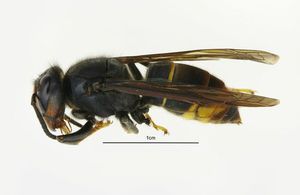
Asian hornet identified in Gloucestershire

The National Bee Unit has confirmed a sighting of the Asian hornet in the Tetbury area of Gloucestershire – the first time the hornet has been discovered in the UK. The Asian hornet is smaller than our native hornet and poses no greater risk to human health than a bee. However, they do pose a risk to honey bees. The hornet found in Tetbury is currently undergoing DNA testing at the National Bee Unit in North Yorkshire to help establish how it arrived in the UK. The hornet arrived in France in 2004 and is now common across large areas of Europe. It was discovered for the first time in Jersey and Alderney this summer. It is believed the species will not be able survive in the north of the UK due to colder winters.

Defra press release:
https://www.gov.uk/government/news/asian-hornet-identified-in-gloucestershire
Links to the ID guide:
http://www.nonnativespecies.org/alerts/index.cfm?id=4
Online recording page:
http://www.brc.ac.uk/risc/alert.php?species=asian_hornet

An extensive floating colony of Water Fern

Water-Lily and Water Fern at Willersey, 7September 2016
Willersey, 7 September 2016

During several recent journeys through Willersey, in the north of the county, I had noticed that the ornamental pond on the village green seemed to have become largely covered by some kind of vegetative growth, much of it a reddish colour. I eventually took an opportunity to park nearby and had a closer look. It turns out that the surface of most of the pond has been colonised by the Water Fern (Azolla filiculoides), an introduced species from the Americas which was first recorded over here, at Pinner in Middlesex, in 1883. I have come across this fern from time to time but it is sensitive to our winter temperatures and I am not aware of any persistent colony in our part of the country. It is quite likely that there will be no sign of it at Willersey next year!

Water Fern is very different from any of the other ferns found in the British Isles. It does not root itself in the soil, but floats free on the surface of still waters it has colonised. The individual plants remain tiny and reproduce readily by simply breaking apart. By this means the plant can spread quickly across the surface of a suitable body of water.


dsc_0008
Water Fern close-up, Willersey

Although it is not well-known in this country (as a non-native, it has been given rather limited cover in the standard field guides) Azolla is a significant member of the flora elsewhere, particularly in rice-growing areas. Pockets within the leaf lobes floating at the water surface usually house the nitrogen-fixing cyanobacterium Anaboena azollae. In China and Vietnam the native Azolla pinnata was cultivated for hundreds of years so that the nitrogen rich ferns could be used as fertiliser for the rice crop;  quite recently  A. filiculoides has largely taken over this role as it has proved to be a little more cold-tolerant and a great deal less susceptible to insect attack.  Azolla is also used as animal feed in its native regions, and for mosquito control (principally by denying egg-laying females access to the water surface).

Like other ferns, Water Fern can reproduce by means of spores, but very little seems to be known about the extent and significance of this within the British Isles.

dsc_0007
The pond at Willersey, showing the extent of the Water Fern cover this year

Elsewhere, attempts to stimulate significant spore production for commercial purposes have apparently failed, so taking advantage of the plant’s capacity for prolific vegetative reproduction remains the only viable option where cultivation is practised. It is likely that accidental and deliberate introductions by aquarists account for much of the Water Fern’s British distribution but transport of spores and plant fragments on the feet and feathers of birds is also a possibility.

There is evidence that Water Fern has become more common in recent years; this could be a reflection of our changing climate. Perhaps we should be showing more interest in this introduced fern that may have become an established resident, particularly in view of the unique features of its biology and lifestyle. It would be interesting to know whether it is, in fact, persistent at any Gloucestershire sites and whether there is any obvious pattern to its occurrence in the county.

Martin Matthews


“Lighthouse gall” on ground ivy

Some of the ground ivy Glechoma hederacea leaves in my garden are pocked with white-rimmed craters reminding me of rivet washers on jeans. On closer examination, there are hairy green columns also present on some leaves.  These are caused by the fly Rondaniola bursaria.   Each column, known as a “lighthouse gall”, contains a single larva which falls off the leaf in late summer leaving the hole.

20160806 Lighthouse Gall

Robert Homan, the GNS county recorder for plant galls, confirmed the identification and says that it seems to be a good year for “lighthouse galls”. There are a lot on beech and lime, though these are caused by other invertebrate species. He would no doubt appreciate more records.

Posted on behalf of Juliet Bailey.

Breeding birds in the Severn and Avon Vales this year

The bird breeding season in the Severn and Avon Vales is almost over, so this seems a good time to offer an update on the results, based on observations made by the many birdwatchers active in this area, particularly, but not exclusively, at the two Gloucestershire Wildlife Trust reserves at Coombe Hill and Ashleworth Ham; and not just waterbirds, though they have been the main focus.  We have paid particular attention this year to identifying fields on which Curlews are breeding.

The beginning of the season was unpromising, because of the flooding which lasted well into April; we haven’t had spring flooding for several years now.  Three pairs of Shelducks (rather more than usual; they are more numerous on the estuary, where they nest in rabbit holes) produced duckings  – at Coombe Hill, Ashleworth and Cobney Meadows; two of these were unusually early in mid-May, despite the flooding, which suggests that they were nesting, as is traditional, in the boles of pollarded willows; the Ashleworth pair was seen to lose their young to a passing fox, but at least some of the other two broods seem to have survived.  The usual breeding pairs of Mute Swans, Greylag and Canada Geese and Mallard occurred, but no other ducks have as yet been proved to nest; some Tufted Ducks will no doubt be nesting somewhere.

Grey Herons and Little Egrets have nested at the usual Vale heronries; today at Coombe Hill, the unusually high number of nine Little Egrets was present, most of them clearly recently fledged juveniles, which no doubt originated in a local heronry.  As for waders, Coombe Hill has been the star site, even though successful rearing of chicks has been very poor. For the first time ever, a pair of Avocets attempted to nest; this was hardly unexpected, as there are colonies at Slimbridge and on the Worcs Wildlife Trust reserve at Upton Warren near Droitwich; sadly, they abandoned their attempt fairly early on, but we may hope to see them trying again in future years.  A pair of Oystercatchers successfully raised two chicks on the island.  At least nine Lapwing nests were seen from the hide, but only two produced chicks and both broods seem to have disappeared, which is pretty depressing; there have been few reports from other sites, though one or two pairs seen to be nesting on maize fields in the Vales .  A pair of Redshanks also nested at Coombe Hill for the first time for several years; they produced two chicks, but neither reached the flying stage; no records of nesting Redshanks at any other site have been received.  At Ashleworth, only Coot and Mallard seem to have nested successfully on the reserve, though two pairs of Curlews nested on the SSSI, just outside the reserve, one of them successfully raising two chicks.  No nesting Redshanks and very few Lapwings have been found on other sites in the Vales in Gloucestershire, though several have been successful at other sites on the Severn and Avon in Worcestershire.

As for Curlews, the wet weather of recent weeks has meant late hay cutting, which may have helped them to bring off young chicks successfully.  We have found three adult Curlews with definite broods of chicks in the last ten days, and strongly suspect (from the agitated behaviour of the parent) that at least three more pairs have raised chicks, which are notoriously difficult to find in the long grass.  The Curlew is a well recognised and much loved species in the area, and many farmers are willing to delay hay cutting when they know there is a nesting Curlew on their land.  It is very striking that these adult Curlews (which are highly faithful to the same breeding field, year after year) nest predominantly in ancient hay meadows, so we have been paying greater attention to botany; if you look after the hay meadows (a very desirable conservation objective in itself), you will look after the breeding Curlews – and other ground-nesting birds like Skylarks and maybe other waders too.

Among other breeding birds, there have been no signs of Quail or Sported Crake this year (both probably bred last year).  Ringing at Ashleworth produces good data on nesting songbirds, and it seems that Sedge Warbler, Lesser Whitethroat, Whitethroat and Reed Bunting have had a good year, with at least one pair of Grasshopper Warbler.

Autumn migration has already begun, with a lone Spoonbill at Coombe Hill in June, the first returning Snipe and Green Sandpipers from mid-June, and already returning Teal, Greenshank, Whinchats and (rather unusually away from the estuary) a Bar-tailed Godwit.

Latest news on the breeding Curlew survey in the Severn and Avon Vales

Below are further notes on the survey of breeding Curlews in the Severn and Avon Vales in Gloucestershire and Worcestershire, as of mid July. The survey is being carried out because of the increasing realisation that conservation of Curlews (both on breeding sites and in wintering areas) is one of the principal bird conservation issues in UK. Similar breeding surveys have been carried on in other parts of lowland England, as well as on the upland breeding areas throughout UK.

  • The nesting season started late because of flooding which continued into mid-April.
  • Although the breeding Curlews were quite obvious and vocal (with lots of bubbling song-flights) over their territories in May, they went quiet and became much more difficult to find during June.  In June, when the eggs would be expected to hatch, the adults became much more discreet; they often kept out of the way in the long grass, only emerging if you got fairly close to the area of grass where the chicks were presumably located; if they did have chicks, their very agitated calls made this pretty obvious.
  • Some birds clearly lost their eggs or young; but the adults seemed to hang about close to the breeding sites, remaining much quieter than birds with young; this makes the picture much more complicated and difficult to interpret.
  • Several farmers in the area have contacted me before hay cutting, asking me to check whether there were breeding Curlews on their fields, and offering to delay hay making if breeding Curlews are found with young.
  • By mid July, the breeding season is almost over.  Several adult Curlews have been seen with full-grown young on hayfields.  This rather early date is something of a surprise to me: I thought it was a late year because of the April flooding, but the young seem to be fledging slightly earlier than usual.
  • Because of damp, miserable weather in the last couple of weeks, hay cutting has been delayed; this extra period of grace may well have helped more breeding Curlews to bring off their young successfully.
  • Curlews will no doubt disappear from the Severn and Avon meadows in the next couple of weeks, moving off to wintering sites on estuaries and round the coast; some birds from further north may be seen moving through. From early August, the focus on Curlew observations will change to the estuary.
  • Over the Hasfield/Ashleworth area in Gloucestershire, a Curlew was seen on 6 July, flying high downriver and taking no notice of local breeding birds – probably a bird that had finished the breeding cycle further north and was on its way to the estuary.
  • In the same site (where two breeding pairs had been noted throughout the spring and early summer) a very anxious adult male was giving alarm calls over a hayfield on 7 July; it was still there, equally anxious, on 9 July, accompanying two full grown chicks, which could just fly (an early date, it seems to me); by 12 July there was no sign of them and they had probably moved off to wintering areas.
  • At Upham Meadow, Twyning (Gloucestershire), where hay cutting is always relatively late, and is staggered (leaving large swathes of uncut hay as a refuge for young Curlews), another anxious male was seen on 15 July, with two flying birds of the year nearby.
  • Near Bredon’s Hardwick on the Worcestershire bank of the Avon, another anxious male was found on 16 July and, shortly afterwards, a flying young bird was seen.  This is a site recognised by the famer as a regular Curlew breeding field; he had seen a non-flying young Curlew a week earlier, and had therefore not cut the hay over a large part of the field.
  • It is probably significant that all three of the above sites are very secluded, with little or no disturbance from visitors (especially dog-walkers).
  • At several other sites along the Avon, both in Gloucestershire and Worcestershire, very agitated adults with the characteristic alarm call have been seen in the last ten days; young (flying or not) were not found, but were almost certainly present; the chicks’ natural reaction, even if they can fly, is to crouch in the grass, where they are very difficult to find.  So it is thought that at least three other pairs successfully raised young.
  • At some sites where breeding attempts had been noted earlier in the season, adult Curlews have been noted, but without the alarm calls and with no sign of anxiety.  It is thought that at these sites, the adults had lost eggs or young and were staying on near the site after the failure of their breeding attempt.
  • Thus, at the Severn Ham, Tewkesbury, (where a pair successfully brought off chicks last year), the farmers who had hay cutting rights were all ready to delay hay making if young Curlews were found.  But although one (perhaps two) pairs of Curlews had tried to nest there, it seems they lost their eggs or young (probably to predators such as fox, crow or badger), so had no chicks by the time of hay making.
  • I am sure that there are more pairs that I don’t know about, especially further up the Worcestershire Avon.  I would be very pleased to have any more reports on the progress of the season, there or elsewhere.

More long-term issues:

  • Mary Colwell, who earlier in the year undertook a 500 mile from Northern Ireland to Lincolnshire to highlight the plight of the Curlew (see page 61 of the latest RSPB magazine, in a broad article on Curlews and other waders), has been back to Gloucestershire, together with Phil Sheldrake of RSPB.  We are planning an all-day workshop as a follow-up to Curlew surveys throughout lowland England (and as a prelude to efforts next year), probably on next World Wetland Day, Thursday 2 February 2017; watch this space for further details.
  • Despite my limited botanical knowledge, I have been looking more closely at the botany of hay meadows in the Severn and Avon Vales.  It seems to me that most Curlews are nesting on herb-rich ancient hay meadows, and that if you look after good hay meadows (a highly legitimate conservation aim in itself), you will protect many of the nesting Curlews (and other ground nesting species too – Skylark, Yellow Wagtail, Corn Bunting – and probably other nesting waders such as Lapwing, Redshank and Snipe, though these tend to prefer rather wetter sites than Curlew).   So I shall be talking to county record centres about marshalling botanical data, so that it becomes easier to identify and monitor the best hay meadows in each county (Top Twenty? Top Fifty?  Are they all recognised as SSSIs or Key Wildlife sites?).

GNS Nightjar Walks June / July 2016

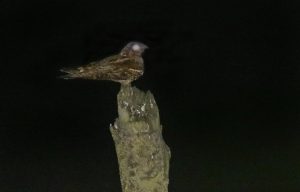
Nightjar IMG_3375a      Nightjar IMG_3358b

30th June 2016

For the first of the series of Nightjar meetings the weather didn’t look promising, heavily overcast with low cloud, almost constant drizzle, strong wind from south-west and pretty chilly, so there wasn’t a great deal of optimism. However, 4 brave souls gathered with Andrew Bluett and set off into the gathering gloom in search of crepuscular quarry.

In view of the weather, and with only 5 people to accommodate, we cheated and drove to the viewing area rather than walking, which made things rather easier and also provided for a quick escape route if the weather became significantly worse.

As things turned out we had a real treat, 3 males churring and flying around from 9.45pm, with excellent views of birds coming close to investigate who we were and hunting low over the heath in pursuit of the moths. Several times the birds perched on one of a number of favoured perches and stayed there churring for extended periods. There was also much “chirping” as they flew and some wing clapping at times. We were favoured with 3 sightings of Woodcock, a few Bats and a frog or two, 3 large male Wild Boar and several Fallow Deer. A young Tawny Owl called from the trees on the way back to the main road.

On the way home, Colin & Ingrid Twissell who had travelled with Andrew Bluett were treated to excellent views of two family parties of Wild Boar – a female with 12 boarlets and a second female with 8, in both cases the adult lactating females being accompanied by a couple of “nursemaids” helping to care for the young.

8th July 2016

This meeting originally planned for the 7th had to be changed to the 8th. The weather was not quite as poor as for the previous meeting but was again overcast, chilly and windy. Given the success of the previous meeting, there was rather more hope of decent views of Nightjar which proved to be well founded.

6 members and guests duly met with Andrew Bluett and the party walked through the forest to the viewing area, within a very few minutes after reaching the viewing point at 9.40pm, the first Nightjar started churring, closely followed by others and much aerial activity with birds flying around, coming close and at times chasing one another around over the heath. The same favoured perches were used making it quite easy to keep track of the birds for almost two hours.

The Woodcock was heard several times but not seen and on this occasion no Boar or Deer appeared. On the walk back to the cars, the juvenile Tawny Owl was heard calling again and proved to be visible in the outer branches of a Birch tree by the side of the track before slipping away into cover.

14th July 2016

Eight members and guests turned up for the best of the three evenings weather-wise. It was relatively warm, still and fairly clear with some moonlight. Very shortly after arriving on the viewing point the first Nightjar was sighted and the activity gradually built up as darkness closed in. Again at least three males were performing, floating across the heather and bracken, perching in their favoured spots and churring, some wing clapping was seen and much chirping was uttered as the birds flew about. Several times one bird chased another and at one point, a bird took off from a high perch and rose into the sky in a display flight, quickly joined by a second bird, they then drifted off high overhead towards the woodland.

Very good views were had of birds coming close to the party – Nightjars are innately curious and will investigate intruders and foreign objects on their patch – as was the case with the video camera set up in front of one particular favoured perch with a bird lifting off the dead tree stump and almost landing on the camera and tripod before returning to the perch.

On the way back after a very good evening, a solitary Wild Boar scuttled off through the trees and two deer appeared, they also bounded off into the darkness. David Priddis discovered a few bats with his detector which added something to the evening and finally, the reliable young Tawny Owl was again head calling from the depths of the trees.

My thanks to all who turned out on the series of evening walks, their faith was rewarded and the whole venture was a great success.

A short video clip of a Nightjar can be seen here –


Diamond-back Moth Migration

We are currently on the receiving end of a large-scale migration of Diamond-back Moths (Plutella xylostella) into the UK.  I thought I was doing well with a count of 16 caught at dusk in my Cheltenham garden on 2 June, but have just heard from a recorder in the Stroud area who gave up counting at 100 in his moth trap.  The migration has been mentioned on Springwatch and there is a short video clip of one observer’s experience in Norfolk here:
http://www.norfolkmoths.co.uk/micros.php?bf=4640

It would be interesting to record the full scale of the migration in the county, both numbers and locations, so please send in any records.  The web page noted above has a good range of ID photographs; in essence the Diamond-back Moth is small (about 15 mm wingspan), pale in colour and probably in a garden or field near you!

R Homan, VC 33 Moth Recorder

Results of the Bioblitz 700 at The Park and Poor’s Allotment 25th – 26th July 2015

Results of this bioblitz were assembled months ago. I did mention in the September 2015 issue of GNS news that they will be published on this website. I have been busy in the meantime but unfortunately this slipped my mind. So thank you Maris for the reminder!

Number of species found in each taxon group

Fungi
4
Mosses
52
Liverworts
12
Stonewort
1
Ferns
10
Flowering plants
223
Conifers
2
Millipedes
2
Woodlice
4
Spiders
3
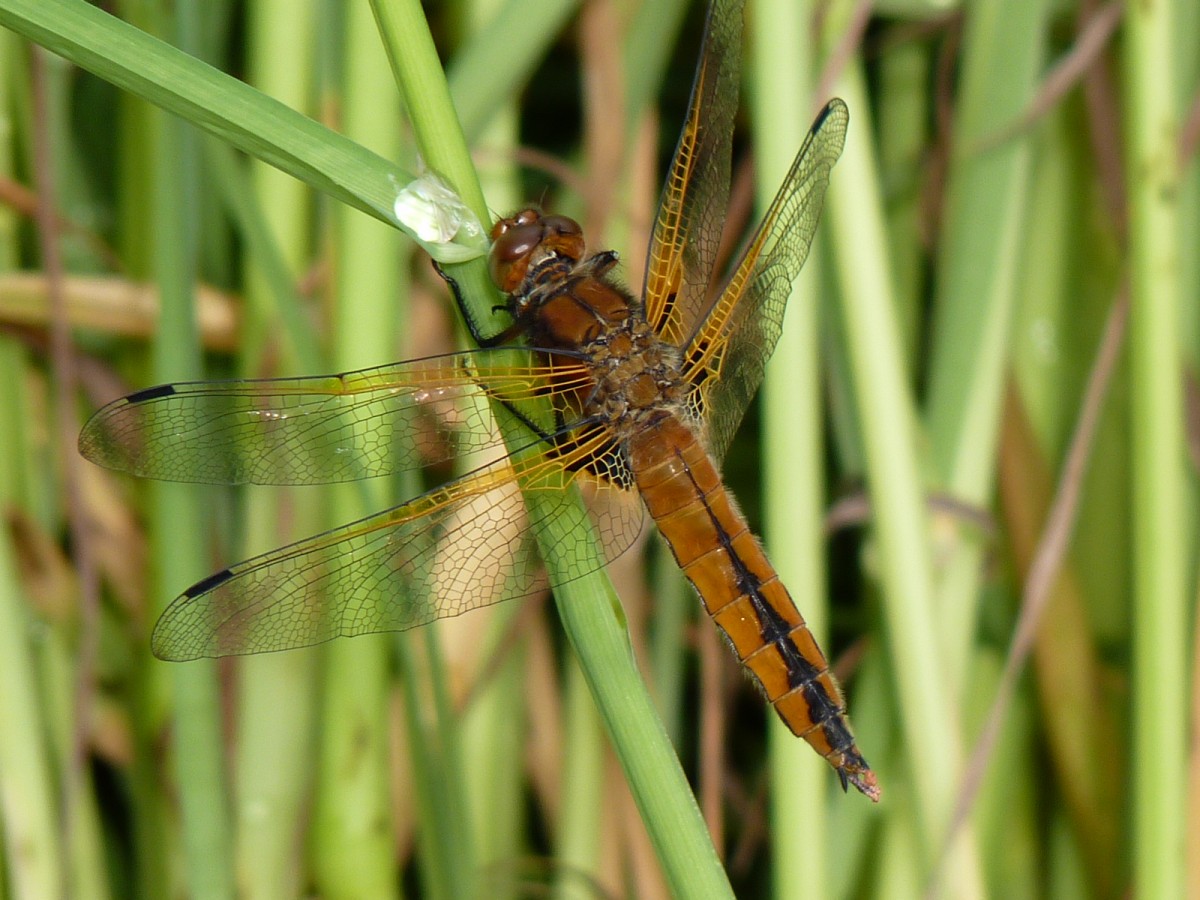
Dragonflies & Damselflies
11
Grasshoppers & Crickets
3
True Bugs
7
Beetles
12
Scorpion fly
1
Moths
176
Butterflies
22
True Flies
42
Ants, Wasps & Bees
12
Molluscs
12
Amphibians
5
Reptiles
3
Birds
40
Mammals
16
Total677

As you can see we didn’t quite make the 700 species. The persistent rain on the second day dramatically reduced recording effort.
Here’s the full list:

Heathland 700 The Park & Poor’s Allotment Species list

Just as a reminder: there will be another bioblitz at Crickley Hill, the new Gloucestershire Wildlife Trust reserve and SSSI from Friday 8th to Saturday 9th of July. Here’s hoping for optimum conditions to hit a realistic target!

http://www.gloucestershirewildlifetrust.co.uk/events/2016/07/08/crickley-bioblitz?instance=0

Scarce Fungus Weevils at The Mythe

During a morning walk through The Mythe Railway Reserve on 20 April I was surprised to find at least six of these beetles (Platyrhinus resinosus: Coleoptera, Anthribidae) resting on a log at the side of the track. The weather was sunny but cool and it appeared likely that the beetles, scattered along the top of the log, were warming themselves there.

Scarce Fungus Weevils at The Mythe 20.4.16

On previous occasions when I have encountered this beetle I have only seen single individuals, and it was strange to find so many in one place. David Atty (Coleoptera of Gloucestershire: 1983) particularly associated them with the fungus Daldinia concentrica (King Alfred’s Cakes) and seems to have regarded the species is as a relatively uncommon one in our area.

Scarce Fungus Weevil at The Mythe 20 April 2016

As the adult beetles spend a lot of their time keeping quite still, their resemblance to bird droppings probably provides both protection from potential predators and effective concealment from wandering naturalists; perhaps they are more widespread than we realise. When I passed the same log again a little later most of the beetles had disappeared, and after an hour they had all vanished, presumably to explore the nearby vegetation.

Martin Matthews

Skip to content