The Cuckoo Flower

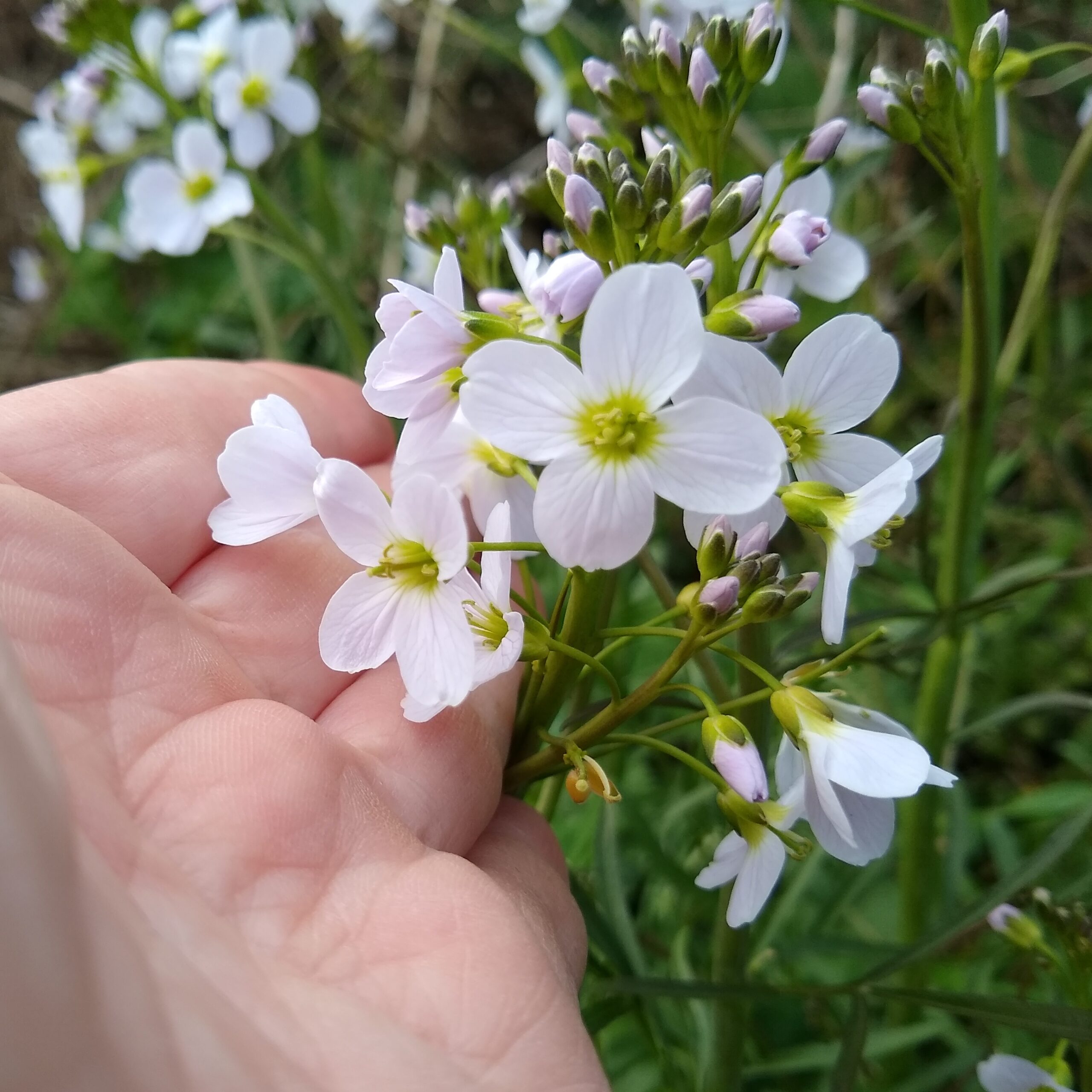
Cardamine pratensis, Cuckoo Flower also known as Lady’s Smock.

This is a flower that blooms in early Spring in damp rich soil, especially on road verges and in damp fields. It is abundant in the meadows of the Severn and Avon floodplain.

It comes up every year (ie it is a perennial) from a short underground stem (a rhizome).

It is a crucifer, meaning it is a member of the cabbage family and it has four petals in the shape of a cross. They come in various shades of lilac, pink or white.

Cuckoo Flower is easy to see in April but by mid May when the flowers will have faded and the surrounding vegetation will be taller it can be hard to find. The trick at any time other than early spring is to recognise the leaves at the base of the plant which have paired leaflets and a round end lobe, very different from the skinny leaflets on the stem of the flowering plant.

  • Fun facts:
  • The Gloucestershire local name is Cuckoo Flower because it comes with the Cuckoo.
  • It is one of the food plants of the Orange Tip Butterfly that lays its eggs on the flower buds and the caterpillars feed on the developing seed pods.
  • Shakespeare refers to it in the song from Love’s Labours Lost

When daisies pied and violets blue
And lady-smocks all silver-white
And cuckoo-buds of yellow hue
Do paint the meadows with delight,
The cuckoo then, on every tree,
Mocks married men; for thus sings he:
“Cuckoo; Cuckoo, cuckoo!” O, word of fear,
Unpleasing to a married ear!

Love’s Labours Lost, William Shakespeare

April Curlew news

An update on the ongoing Curlew Meadows project, from Mike Smart.

A good deal has happened in the Curlew population of the Severn and Avon Vales in the last couple of weeks, so I thought it was time for an update.

Firstly, a disappointment: we have not succeeded in re-sighting the ringed bird, possibly one of those raised from eggs at Slimbridge in 2019, so cannot say whether this really is a bird returning to the Vales to breed; it may still be found, so we are keeping a careful watch.

The Coombe Hill public enquiry continues (its final session will be on World Curlew Day, 21 April), and the Inspector’s report and decision is not expected for some weeks afterwards.

The weather has remained very dry, though those watching Curlew at first light have noted the very sharp early morning frosts; this may have delayed nesting a little. The communal night roosts noted in March have declined in importance, most of them now holding birds only in single figures, as the birds begin to spend the night close to their nest sites. Pairs of birds have been seen walking together (the grass has not yet grown too high, though it will do so very soon). They often indulge in courtship chasing, where the male chases the female at some speed, its wings raised and quivering; this is sometimes, but not by any means always, followed by mating. Some have already begun laying: a first nest was found on 13 April, a nest with a single egg, giving a good indication of the date of first laying.

We expect the nest formation and egg-laying to speed up considerably in the next few days. We shall be aiming to find as many nests as possible, both by traditional fieldcraft (watching them back to their nests from a distance with a telescope) and by using heat-seeking drones to identify nest sites.

The biggest development has been in catching Curlews, for colour ringing. To understand their behaviour and actions, we need to be able to distinguish one individual from another, which means marking them with colour rings that can be read in the field. Our previous attempts to catch them with mist nets at roosts were unsuccessful, so we have been trying a different technique, with the help of Tony Cross from the Mid-Wales Ringing Group and the Curlew Country project. Tony uses a “whoosh net”, which is a placed flat net on the ground, propelled by strong elastic; the birds are attracted in by a stuffed decoy Curlew and by recordings of the bird’s song. It is extraordinary to see how rapidly the birds react to an apparent intruder in their territory – the males especially, but we have also caught several females. You set up the net, retreat to the car, pull the string, and almost every time, catch a bird.

The net set, ready to catch, with the decoy in the catching area.

So far, we have caught five adults in Gloucestershire, while Tony has caught another three in Herefordshire. The Gloucestershire birds are marked with a yellow inscribed ‘flag’, each one different from the other, and easier to read than the rather small rings used on the 2019 Slimbridge birds. We hope to catch more in the coming days, marking some with flags, but also marking some with satellite tags, so that we get even more information on their movements.

Finding Curlews and their nests remains very difficult. At some traditional sites we have not yet had many signs of the presence of Curlews; have they failed to appear this year, or are we just failing to pick them up? They can be very secretive, and we could be overlooking them.

A male Curlew, caught with a whoosh net.

The male is distinguished by his smaller size and shorter bill, more sharply curved than the bill of the female.

As always, our observations depend on the efforts of a large number of observers, and on the kindness of farmers and land-owners who allow us to  visit their land. Many thanks to both.

Best wishes

Mike Smart

Project overview


The Background


The GNS “Curlew Meadows” project is a development of the long-standing concern to conserve the
fauna and flora of the Severn and Avon floodplain hay meadows, which extend from Gloucestershire
into Worcestershire.


Around 2000, Natural England and the Environment Agency set up the ‘Severn and Avon Wetland
Management Partnership’ which identified some floodplain meadows suitable for restoration and
helped farmers to recreate wetlands on their land.


In 2002 the British Trust for Ornithology organised the second survey of “Breeding Waders of Wet
Meadows” (a year late because of Foot and Mouth Disease in 2001); the first survey had been held
in 1981, and the third is this year, 2021. The 2002 survey documented the continuing decline of
breeding waders (traditionally Lapwing, Snipe, Curlew and Redshank) in the Vales. After 2002, GNS
members and other local ornithologists attempted to keep a record of breeding waders each year,
with the results being published in the Gloucestershire Bird Report. The story is a gloomy one: the
last drumming Snipe in Gloucestershire was recorded in 2003, Lapwing nests have continued to
decline both on arable fields and on pastureland, while breeding Redshank are now confined to a
very few sites. Curlew which generally nest in slightly higher, drier hay meadows have fared slightly
better.


Particular attention has been paid in the last few years to these Curlews, and also to the botany of
the hay meadows in which they nest. From 2015 onwards, more intensive surveys of nesting Curlews
have been made in the Severn and Avon Vales, and indeed in other areas of lowland England where
small groups of nesting Curlews still survive: the Wye Valley in Herefordshire, along the Upper
Thames, Somerset Levels, North Wiltshire and Salisbury Plain, New Forest, Brecklands. It is
estimated that there are no more than 300 pairs of Curlews remaining south of Birmingham (in
addition of course to the much large numbers nesting in upland Britain). A 2015 article in the journal
‘British Birds’ suggested that the decline of Curlews, caused largely by the poor production of chicks,

made them the most important bird conservation issue in the UK. Mary Colwell’s book “Curlew
Moon” gives the background to this decline. A workshop was held at Slimbridge on World Wetlands
Day (2 February 2017) and this led to the creation of the ‘Curlew Forum’ which promotes
conservation of lowland Curlews across southern Britain and has a website at www.curlewcall.org.


GNS and Wildfowl and Wetlands Trust


GNS decided to support a project to conserve Curlews in its area, the first time that the Society has
used its financial resources in a major targeted plan. The first Curlew surveys aimed to monitor
Curlew nests from a distance, without disturbing them or opening the way for nest predators like
foxes, badgers or crows. But the Curlew Meadows project aims to be more interventionist and to
take positive measures to improve chick production, such as erecting electric fences round nests,
taking eggs and raising them in incubators so that the chicks might be released, erecting signs calling
on dog-walkers to keep their animals under control. At the same time, more intensive studies of the
botany of the hay meadows were undertaken.


In the last couple of years (despite the intervention of COVIDcovid), these plans have progressed.
The studies of Curlews have developed in collaboration with the Wildfowl and Wetlands Trust
(which in 2019 released 50 young Curlews from eggs taken at airfields where the eggs would
otherwise have been destroyed to prevent bird strikes); intensive searches for nesting Curlews in the
Vales are proceeding in 2021.


GNS and Floodplain Meadows Partnership


The botanical surveys have made spectacular progress, in coordination with the Floodplain
Meadows Partnership, and the extent and quality of the hay meadows along the Severn have now
been recognised, with the prospect of new Sites of Scientific Interest being created to conserve
them.


Future measures


It is clear that these meadows, their fauna and flora (not forgetting the invertebrate life, as yet little
studied, though the Gloucestershire Invertebrate Group is becoming involved) depend on the
maintenance of traditional floodplain farming practices (wet in winter, late hay cut in summer,
aftermath grazing), so all. All these conservation efforts rely heavily on the support and interest of
the farming community in the Vales, which is gratefully acknowledged. Further survey is required,
plus greater interaction with the local communities and land managers. This will inform the practical
measures to conserve the flora and fauna including advice on when and how to manage the
meadows to help the wildlife.


Get Involved


Naturalists, land managers, individuals and organisations are welcome to become involved –
whether as surveyors, promoters, funders or land managers. Contact Juliet Bailey or Mike Smart of
the Gloucestershire Naturalists’ Society – Juliet on jabailey99+cm@gmail.com and Mike Smart.

Field Meetings

The society is proposing to organise some more walks this spring, though any plans put in place may of course change at a moment’s notice. Outdoor meetings with groups of up to six are permissible, given the following guidelines:

  1. Members will need to pre-book through Des Marshall and receive a confirmation that they have a place.
  2. Equipment and books should not be shared or passed round.
  3. Members are asked to maintain a two-metre distance between each other.
  4. Members are advised to bring hand sanitiser and face mask.
  5. Members should be aware of their own risk level and the suitability of this activity.
  6. Please do not come if you are showing any symptoms of Covid 19 or have recently been in contact with anyone who has contracted Covid.

We have arranged six walks for spring/early summer 2021. They are spread around the county, and each will last about two hours, though members can come and go in the usual way. Most are general walks to see what natural history is around. They are not primarily intended as recording exercises, though we shall record what we see.

For more information please see the upcoming events page.

Annual General Meeting

The GNS Annual General Meeting is due to take place on the evening of Friday 26th March 2021; as we are unable to hold conventional meetings at present, the AGM will be carried out as a virtual Zoom meeting via computers, tablets and smart phones. Please don’t be discouraged by Zoom, it’s not that difficult.

Members can participate in this meeting free of charge – please e-mail our secretary, Barrie Mills at bazmills48@outlook.com and he will send you an invitation link to the meeting. If you have any comments, questions or other observations relating to GNS and its business, please e-mail either Barrie or Andrew Bluett at gnsmembership@btinternet.com as soon as possible before the meeting so that they can be properly considered.

Some of the documents that will be referred to during the meeting can be downloaded from here.

You are all welcome, please do join us if you would like to.

Winter twig identification

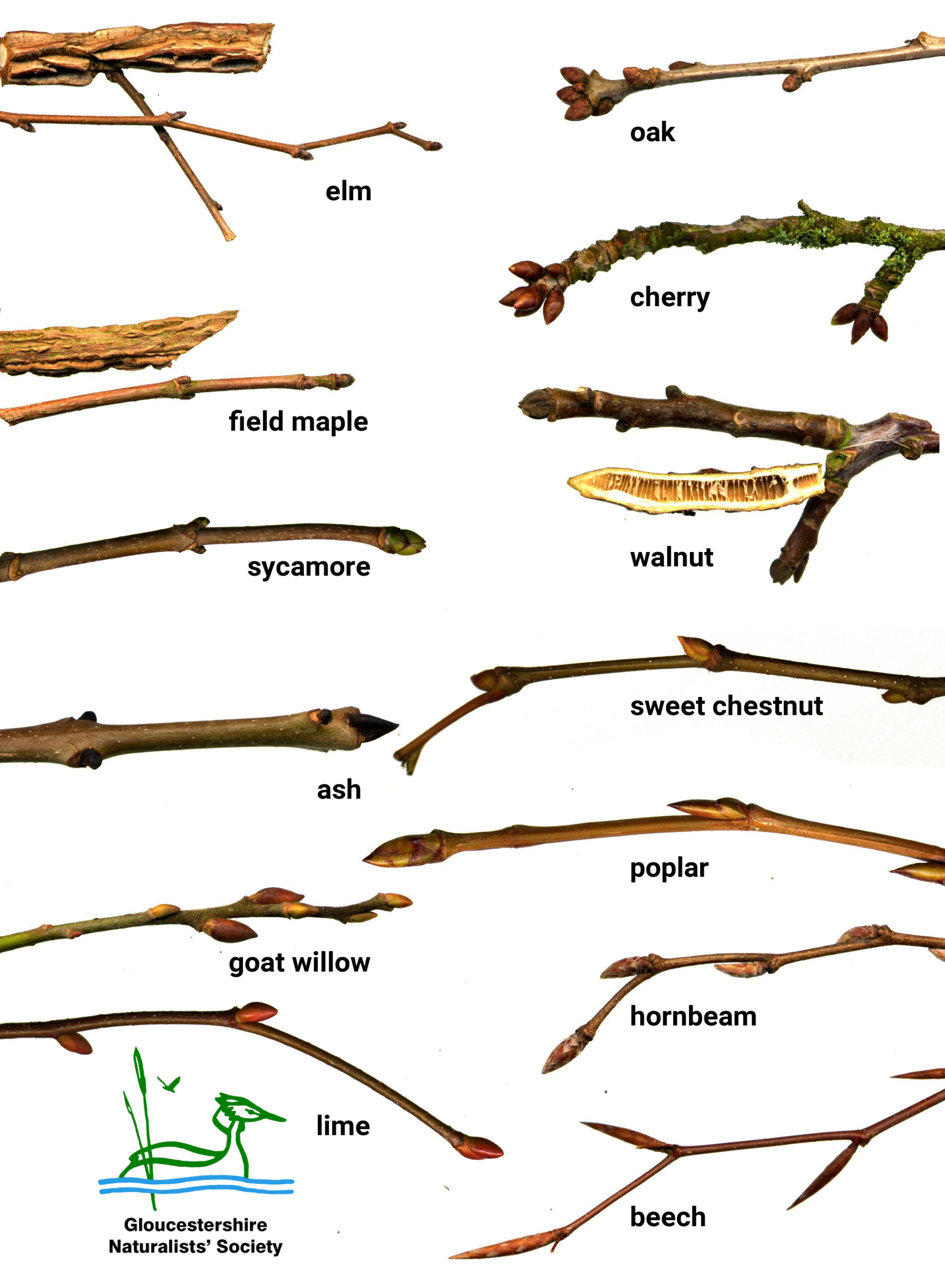
The sheet illustrates twigs of common trees in the British countryside. It was used during the GNS Zoom members’ meeting on 20 January 2021. The twigs are arranged so that twigs with similar features are close to each other.

Thus, both elm and field maple often have very ridged bark on quite small twigs, but the buds on an elm twig zigzag along it, whereas field maple buds are opposite each other.

Sycamore is another member of the maple family, and it shares the feature of buds opposite each other, but its buds, especially the end one, are much larger and usually bright green.

Another twig with opposite buds is ash, but in this case the buds are sooty black (ash – sooty – get it?).

Willows are very confusing, with twigs in a range of colours often with buds in a matching colour. If you look closely you will see there is just one scale covering the bud, which comes off as a single unit when the bud bursts in spring. Lime twigs can look quite like willow, with the twigs often coloured red on the sunny side, but the buds are placed zig-zag fashion. The buds of lime are often a rich red, and each bud has a covering of two or three bud scales which are different in size to each other making the bud look a bit like a mitten.

Both oak and cherry can have clusters of buds together on the end of twigs with side buds spiralling up the stems. You may see long extension twigs on cherry with more evenly spaced buds and just two or three at the top. If in doubt, look at the ground because oak leaves are very tough and will survive the winter intact. Cherry leaves are less durable but you may be lucky.

From a distance a walnut tree can look quite like ash. Walnut has dark buds, but they are not opposite each other. In walnut the leaf scar, where the previous year’s leaf stalk dropped off, is a bit like a monkey’s face, broad, with the marks of the vascular bundles looking like two round eyes with a smiling up-turned mouth below. In ash you just get the smile. Another fun clue to walnut is that the twigs have laddered pith, which is a rare feature not found in other common trees in the British countryside. There will always be twigs on the ground that can be split to check.

The twigs of sweet chestnut are rough, unlike the silky smoothness of lime, for example. The sweet chestnut leaf scar is offset at the side of bud, not directly below it which is the more normal placement.

In poplars the buds spiral up the stems, but the side-buds sit directly over last year’s leaf scar. The illustration is of a twig with leaf buds, but beware that in poplar, and indeed in many trees, flower buds can look very different, much larger and rounder. In poplar, at least, they are often on little side-shoots. The balsam poplars are easy because the buds are sticky and smell strongly of sun-tan lotion. Poplars sucker, so you will often see young stems coming up in the field 50 yards or more away from the parent tree, and they can
grow fast – more than 6ft in a year.

Beech separates out easily because the buds are very long and pointed, zigzagging up the twig and sticking out at an angle of more than 45 degrees. Hornbeam buds are pressed tight up against the twig, sometimes with the tip curving inwards. Both beech and hornbeam can retain dead leaves on lowest branches over the winter, especially as hedges, but the angle at which the buds are held will easily differentiate them.

This is an introduction to get you looking at some of the important features. There will be plenty of exceptions and of course many more species to examine. For rigour, consult John Poland’s The Field Key to Winter Twigs (2018).

Juliet Bailey

Winter Bird Survey cancelled

Just a note to remove any doubt – the Gloucestershire Winter Bird Survey for February is cancelled.

As you know, the situation has become worse since November and we now have a do-not-travel-if-avoidable rule.

The intention is to start the survey up again this November, and if you took part in the last one you’ll be contacted in October unless you decline in the meantime.  If you have not taken part and would like further information please email glosbirdsurvey@btinternet.com

‘Connecting People to Nature’

How connected do you feel to nature?

This inspiring, short 5-minute film from Foresters Forest and Wye Valley River Festival shares
how National Lottery Heritage funding in the Forest of Dean has helped improve the habitats of
birds, reptiles and butterflies whilst also encouraging us to feel more connected to the local
landscape. Explore the natural world around you and experience a sense of well-being.

Skip to content