Finally a lovely sunny day with no rain. There is a patch of Lesser Celandine (Ficaria verna) in bloom in Randwick churchyard on a warm and sheltered south-facing bank. Usually this is a March flower. A golden welcome for 2013.


 gnsadmin
Finally a lovely sunny day with no rain. There is a patch of Lesser Celandine (Ficaria verna) in bloom in Randwick churchyard on a warm and sheltered south-facing bank. Usually this is a March flower. A golden welcome for 2013.
Thanks to everyone who has give their time, support and records to Gloucestershire Centre for Environmental Records during 2012: here’s to a biodiverse (and hopefully a bit more clement) 2013!

We are currently enjoying some armchair recording of the birds in Gloucestershire Wildlife Trust’s wildlife garden here in Robinswood Hill Country Park. It’s lovely to see the birds from the office window, but I can’t help feeling they’re a bit depleted in diversity, if not numbers. Not seen so far: Greenfinch, Starling or any kind of thrush (although Fieldfares and a Songthrush have been spotted nearby).
We’ve had one unwelcome visitor: an apparent case of Avian pox. Earlier this week a Great tit turned up which appeared to have a growth on its face, about peanut-sized, next to the beak. I chucked out a couple of old, grubby feeders yesterday and gave the remaining ones a good clean with dilute bleach. I haven’t seen the bird since but will try to get a picture if it turns up. It’s such a nasty condition; we need to remind everyone to keep bird feeders as clean as possible to reduce the risks.
Seen on our feeders, apple tree and bird table in December:
Goldfinch, Blue tit, Great tit, Coal tit, Dunnock, House sparrow, Chaffinch, Jay, Rook, Blackcap (only a male), Collared dove, Blackbird
The Jay is great fun: almost worth seeing the peanut feeder get trashed just to watch him/her figuring out how to get the lid off!
The cold snap with freezing fog has produced some lovely sights. Here again is one of my favourite plants.

Ken Cservenka led a walk round some of the lakes in the Cotswold Water Park, starting from the car park at Lower Mill estate. It was bright, but with a biting cold wind. The main focus of the walk was waterfowl. Special birds seen included about a dozen Goosander, and 3 female Smew, but the most spectacular sight was a raft of 70 Red-crested Pochard. These can turn up as genuine wild vagrants, though the Water Park birds are probably the results of an original introduction or escapees. Remarkably, given the time of year and the cold wind, a butterfly was seen, flying too fast for certain identification but most likely a Red Admiral.

Views of Ashleworth/Hasfield Ham (1st photo) and Coombe Hill Meadows (2nd) from Sandhurst Hill. Just the top few inches of the Coombe Hill Grundon Hide was visible in the distance, so it would have been completely submerged a few days ago.


Dear Fellow GNS Members
GNS was established in 1948, as a Society to encourage an interest in natural history; in the last ten years, the emphasis has been on recording of natural history in Gloucestershire, and in encouraging greater interest and expertise in recording, particularly among young people. Our Society has never aimed to own or manage nature reserves, which is why many GNS members were involved in the establishment of the Gloucestershire Wildlife Trust in 1961, and have supported GWT over the last 50 years.
For over 30 years, Dr Gordon McGlone has been the Chief Executive Officer of GWT, and has led it from being a small local initiative, to its present status as a body with 27,000 members, a highly qualified staff of 40, an annual budget of two million pounds, a portfolio of over 60 reserves, and the major voice in the county for nature conservation. He was awarded a well-merited OBE for his services to conservation. As Chairman of GNS, I have always felt that it is essential for GNS to be in close contact with GWT, which is why I have been a member of the Board of Trustees of GWT for the last ten years. From this privileged position, I have been able to see at close quarters Gordon’s immense achievements: among them (though there are many others!) I would highlight:
Gordon has recently announced that he is standing down as CEO of the Gloucestershire Wildlife Trust, though – happily – he will continue in a personal capacity to be involved in local and national conservation issues. At the Annual General Meeting of the GWT in mid-November, the Chief Executive of The Wildlife Trusts, Stephanie Hilborne, and Professor Adrian Phillips (former Director of the Countryside Commission) paid moving tributes to Gordon and his work.
I am sure that members of the Gloucestershire Naturalists’ Society would wish to join me in paying tribute to Gordon, and wishing him well in his future activities. GNS has signed a Memorandum of Understanding with GWT, pledging our cooperation in providing data on the county’s wildlife. Those of us who attended the GWT 50th anniversary event at Stanway House in 2011 will recall that Gordon explicitly singled out GNS in his review of bodies that had cooperated with GWT in the previous half century. I am sure members will wish GNS to continue along these lines, and to work with the new CEO (and also with the new Chairman of the GWT Board of Trustees) when they take up their positions. I shall make it a priority to contact them both on your behalf at the first opportunity.
Yours sincerely
Mike Smart
Hon Chairman
P.S. I haven’t written the usual piece on the weather in the last three months, as it’s been so complicated, that it needs a bit more reflection and data collection. An account of the Gloucestershire monsoon in the second half of 2012 will therefore appear in the first GNS NEWS of 2013. Let’s hope 2013 will be a bit drier!
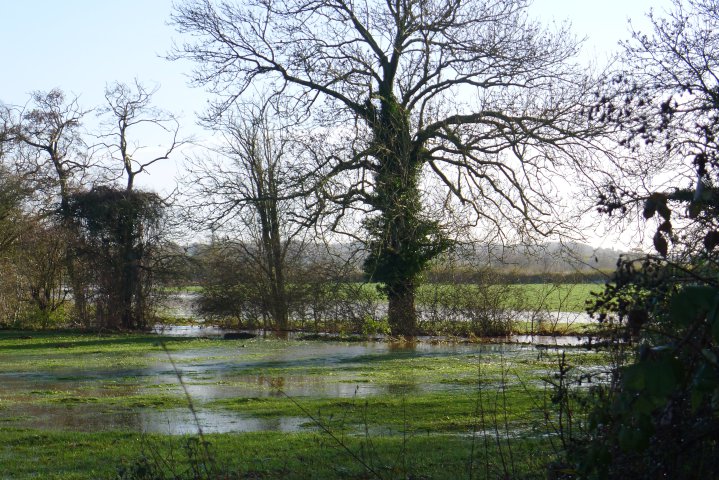
The standing water in the fields has either drowned out a lot of worms, or at least brought them to the surface. I have watched gulls and corvids feeding on them in a seedling oil-seed rape field in Standish. At Brand Green a big puddle on permanent pasture attracted a Buzzard which was lolloping round and feeding in the shallow water. My mother tells me there was a Heron feeding there today.
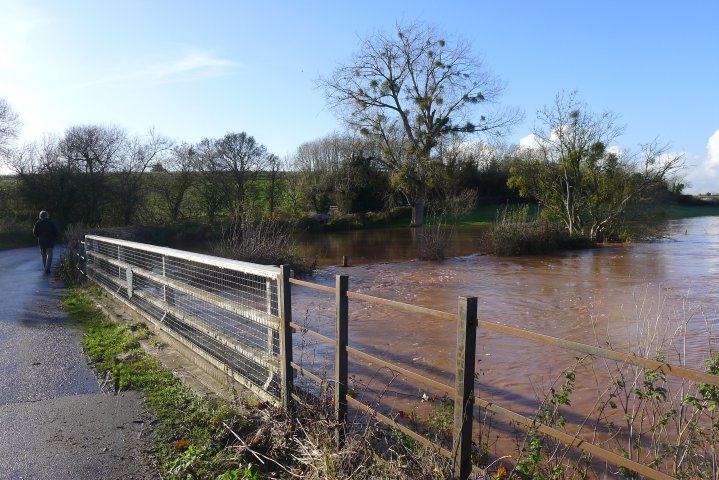
Following heavy rain many rivers are in flood, including the Leadon, and its tributary the Ell Brook.
Lovely clear autumn day on Tuesday 30 October, just a little mist early on, but no wind, and sharp clear visibility showing the colours in the trees and grassland. Water levels continuing to drop, at Coombe Hill, Cobney Meadows and Ashleworth, as the Severn drops, allowing remaining floodwater to flow off the meadows.
At Coombe Hill, an unusual sighting, probably a first for the reserve: an immature Long-tailed Duck, a maritime species more often seen in Scotland or the North Sea; well seen diving in the ditch in front of the Grundon Hide, then waddling across the bank to the main scrape, which proved too shallow for its liking (it bumped its head when it tried to dive, so returned to the ditch). Presumably a straggler, blown in during the cold conditions with strong northerly winds at the end of last week? Phot below by Will Allen.

Then an object lesson in the difficulty of identifying birds of prey: a brown bird of prey seen in the top of a tree. Head on, it looked quite large and puffed up; at first sight it might have been a Buzzard, then the eye-stripe suggested a Sparrowhawk; but when it flew it was obviously a falcon (because of the long pointed wings) and was thought to be a Kestrel chasing a corvid; until it landed at the top of another tree, giving beautiful views from side on, and was obviously a female Merlin.
Otherwise 220 Teal, 55 Wigeon, 35 Shoveler, 3 Little Egrets, 2 Dabchicks, 80 Lapwings, 5 Snipe, 200+ Fieldfares, 50+ Redwings.
At Ashleworth one Green Sandpiper, 200+ Fieldfares.
At Cobney Meadows two Green Sandpipers, two Little Egrets (maybe the Coombe Hill birds).
Note on the Whooper Swan: The lone adult first seen at Coombe Hill on 13 October, which seems to have been roosting there and feeding by day on Cobney Meadows, was last seen at Coombe Hill on Friday 26 October, and was not found at Coombe Hill or Cobney Meadows either on Saturday 27 October or today. Wonder where it’s gone?
I was at Ashleworth early on the morning of 20 October and noticed that, on a coldish morning with a hint of frost, there was a huge quantity of spiders’ webs, all looking white and liquid, and showing up well in the cold air; at the top of the vertical stems of docks and bullpate (Deschampsia), and also in horizontal carpets on the grass. I don’t remember seeing quite so many before, but it may be that I just didn’t notice beforehand. It was a very attractive sight: pity I didn’t have a camera with me!
The hay had not been cut this year on some of the reserve hayfields, nor on the fields in the SSSI beyond. I wondered if the fact that the hay hadn’t been cut might have allowed more spiders to survive.
I asked the Gloucestershire Naturalists’ Society’s Spider Recorder, David Haigh for his comments, and his answer is reproduced below.
Certainly Mike, undisturbed grassland provides a greater opportunity to exploit the increased vertical structure to attach webs. I am sure your conclusion was correct, re absence of a hay cut. The taller plant stems are used as scaffolding to support webs of a greater variety of spider species compared with a mown sward. These silvery sheets of silken web are generally called gossamer and most often seen on autumn mornings when dew condenses on the threads.
The majority of spiders’ webs you have been observing come from the family Linyphiidae (Money Spiders). ‘The World of Spiders’ by W.S. Bristowe (Collins New Naturalist, 1958) quotes the following species responsible for gossamer on an undisturbed field in Surrey: Dicymbium nigrum, Oedothorax fuscus, Savignia frontata, Erigone dentipalpis, Erigone atra, Bathyphantes gracilis and Lepthyphantes tenuis. Such are the numbers of these spiders that Bristowe calculated densities of over a million Linyphiidae per acre from August to December in Surrey.
Previous pit-fall trapping programmes at Ashleworth, 2008, recorded all the above and additional Linyphiids. Webs at the top of docks and Deschampsia will probably belong to the family Dictynidae (Lace-Web spiders), genus Dictyna. These spiders produce a veil of silk at the tops of old flower stems, the web only being easily visible on dew laden mornings. These spiders would not normally be recorded from pit-fall traps.
Gossamer has exercised poets, e.g.
Chaucer: ‘Sore wondren some on cause of thonder, on ebb and flow, on gossamer, and on mist.’
Thomson spoke of gossamer as ‘filmy threads of dew evaporate’
Qharles: ‘and now autumnal dews are seen to cobweb every green’.