As a further comment on Robert Homan’s post of 18 September about the start of autumn, there were Chiffchaff’s singing in my garden this morning (they’ve been quite noisy again for several weeks now)and Redwings flying overhead (the first I’ve seen or heard in Gloucestershire this season). So it has to be the changeover time when there are still the summer migrants present, yet the winter visitors are beginning to arrive.
 gnsadmin
Kites and roadkill, Shipton Oliffe, 8 October 2012
Coming along the A40 saw two Red Kites above the road, manoeuvering between the trees that line the road here, and dodging the heavy traffic, very interested in a large roadkill which I guess was a Roe Deer.
Farmland Walk, Standish, 23 September 2012
Six members attended the Farmland in Autumn meeting. Because of heavy rain, the walk was shortened to a quick tour of the new orchard where there are nearly 90 varieties of Gloucestershire apple. Despite stories to the contrary in the press about the fruit harvest in Britain this year, there is a reasonable crop here, though it is ripening several weeks later than usual.

GNS Library catalogue online
The catalogue of the GNS Library, which is held at Hartpury College, is now online at http://library.hartpury.ac.uk/liberty/opac/search.do
Include gns in the search. Only the first 200 results are returned for any search, so be specific, for example search for gns beetles.
Thanks from GNS to Emma Stevens, manager of the Learning Resource Centre at Hartpury.
The start of autumn?
When autumn starts depends on where your interests lie. If it birds then it could be when the first non-breeding waders return on their passage south; for me it when the first of the typically autumn moth species starts to fly. The picture shows one of the most common species – the Lunar Underwing. The name refers to a feature that is not usually visible – a small dark cresent on the underwing.

Another Hawthorn Gall
Following on from the recent post about Phyllocoptes goniothorax galls on the leaf edges of hawthorn, here is another gall on the plant. Familiar enough to have a common name (Hawthorn Button-top Gall), the gall consists of a thickened terminal bud with a cluster of distorted leaves. Known more formally as Dasineura crataegi, the gall former is a midge and inside the gall are orange larvae.

Standish, 13 September 2012
A naturalist never need go 20 yards beyond their front door to find subjects of wonder.
Today, in my garden I wasted plenty of time enjoying the insects on the ivy bush that is currently in full bloom, with flies, hoverflies, bees, and butterflies such as Red Admiral and Comma.

The leaves on one of the hawthorn bushes in the hedge were curling tightly under at the edge. Checking in Redfern and Shirley’s book British Plant Galls the likely culprit seemed to be the mite Phyllocoptes goniothorax. There were thick discoloured hairs inside the roll, but no longer any mites present. This is said to be very common, but I’d never knowingly seen it before.


Thanks to the county recorder for galls, Robert Homan, who confirmed the identification.
Fretherne, 31 August 2012

The banks of the Severn at Fretherne remind us that Gloucestershire is a coastal county. The tide was way out mid afternoon, exposing vast areas of estuarine mud with deep gullies.
There is a narrow band of saltmarsh where the Sea Aster is in full bloom, and busy with insects. The main Sea Aster here is the variety that is largely lacking the long mauve strap petals, so it always looks a bit tatty.

I spent a good half hour watching a Migrant Hawker (Aeshna mixta) dragonfly egg-laying on polystyrene on the strandline at the top of the saltmarsh – very high and dry. She had a few tentative stabs at some old flat reed stems as well, but quickly abandoned them to return to the polystyrene. I could really see her digging in the ovipositor (the prong visible in the photo under the end of the “tail”), and she didn’t fly (or co-operate) when I gently tried to shift her with a finger into a better pose.

Migrant Hawkers often lay above the waterline, apparently anticipating rising water levels in the winter, as their larvae are aquatic. This one was using debris thrown up, I guess, on a very high bore, and unlikely to become submerged.
There were also several Common Darters (Sympetrum striolatum). This photo is of an old female.

Thanks to Ingrid Twissell, the county dragonfly recorder, for checking and commenting on the dragonfly photos.
Letter from the Chair, August 2012
Dear Members
The members of the GNS Executive Committee are largely active field naturalists, who like to be out and about recording natural history in the summer months; so there is a general agreement not to have summer Committee meetings – though you may be sure that we keep in touch by email and other methods. As a result, there is little to report on formal business in the last few weeks, other than the news that the application to establish a Local Nature Partnership (LNP) for Gloucestershire has been formally approved by the government; this was not a foregone conclusion, as only a limited number of such partnerships were intended. Much of the groundwork was carried out by staff of the Gloucestershire Wildlife Trust, to whom great credit is due. It is intended that the new LNP will be made up of a small number of influential organizations and members, who will play a major role in promoting conservation of nature: so we shall all be following the future activities of this body with interest.
It never rains but it pours! After two dry winters, the heavens finally opened in late April, and it has barely stopped raining since. The area where I spend most of my recording time is the Severn Vale, which has seen a very wet summer indeed: not a summer of dangerous flooding threatening life and property, as in 2007, when exceptional local rainfall in July was followed by an onrush of rain coming down the Severn from higher up the catchment, but a constant succession of very wet days, which provoked very high water levels and meant that much of the Vale has been subjected to a series of moderate floods. Even now in early August, many Vale farmers have been unable to make hay in their lower-lying fields, and some of them despair of ever doing so, with standing water still remaining in many places. One concern, expressed by the Floodplain Partnership, which keeps a close watch on the botany of the Vale and of similar sites in other part of the country, is that failure to cut hay will produce added nutrients in the meadows (on top of all the organic material and fertilisers carried by the floodwater), thus affecting and altering the vegetation; even so, some key plants are well adapted to the occasional summer wetting, notably my own particular favourite, Great Burnet, which seems to my very amateur botanical eye, to have prospered in many areas.
These wet conditions have of course affected the birdlife: it is clear (not only from general observations, but also from more intensive ringing studies), that small birds have had a poor time of it, with many species that nest in thick vegetation near the ground being washed out by repeated rises in water level. Birds like Reed and Sedge Warblers, Willow Warblers and Chiffchaffs, even Reed Buntings which do not undertake such long migrations, have clearly produced very few young, partly because many of their nests were washed away, but also because the damp conditions must have reduced available insect food. Species which nest directly on the ground, including many waders – notably Lapwings, Curlews and Redshanks, all of them in national decline – have registered almost zero productivity. The onset of the season in late March and early April looked promising, with Lapwing chicks already hatched, and Curlew and Redshank preparing to breed by the middle of April; but many clutches of eggs and most of the chicks were overcome by rising floodwater in early May; when the first floods dropped in late May, several Lapwings and even a few Curlews laid replacement clutches (unusually for Curlew, it would seem, as they have a very long incubation and fledging period, and repeat clutches would continue very late into the summer). Many of these replacement clutches came to grief however in the second period of flooding in July, though one or two Curlews (perhaps nesting on slightly higher ground) were successful, and young fledged Curlews were seen at relatively late dates in late July and early August.
On the other hand, some birds which favour deeper water provided a pleasant surprise by successfully bringing off young. Every year, small numbers of Shelducks, familiar from the estuary but much less numerous in the Vale, occur in spring; they nest in holes, either rabbit holes or cavities under hollow trees or the boles of pollarded willows, but rarely seem to breed successfully. This year several pairs succeeded in bringing off broods of ducklings, a rare event. Similarly Tufted Ducks and Little Grebes, not to mention hordes of Coots, have done well and an unusually large number of family parties have been seen. Perhaps the extensive floodwater meant that their nesting sites were less accessible, and hence less disturbed, so they were able to raise their families without intrusion from external factors?
Thus differing conditions produce variable outcomes. Recording the subtle variations in the reaction of flora and fauna to weather conditions remains an ever rewarding and interesting occupation. I’m glad to note that more and more members are noting their observations in the “Sightings” section of the GNS website www.glosnats.org . All these observations from people with different interests and specialities contribute to the overall picture. Please continue to post your sightings, even the smallest note is of interest. Keep up the good work!
With best wishes
Mike Smart
Hon Chairman
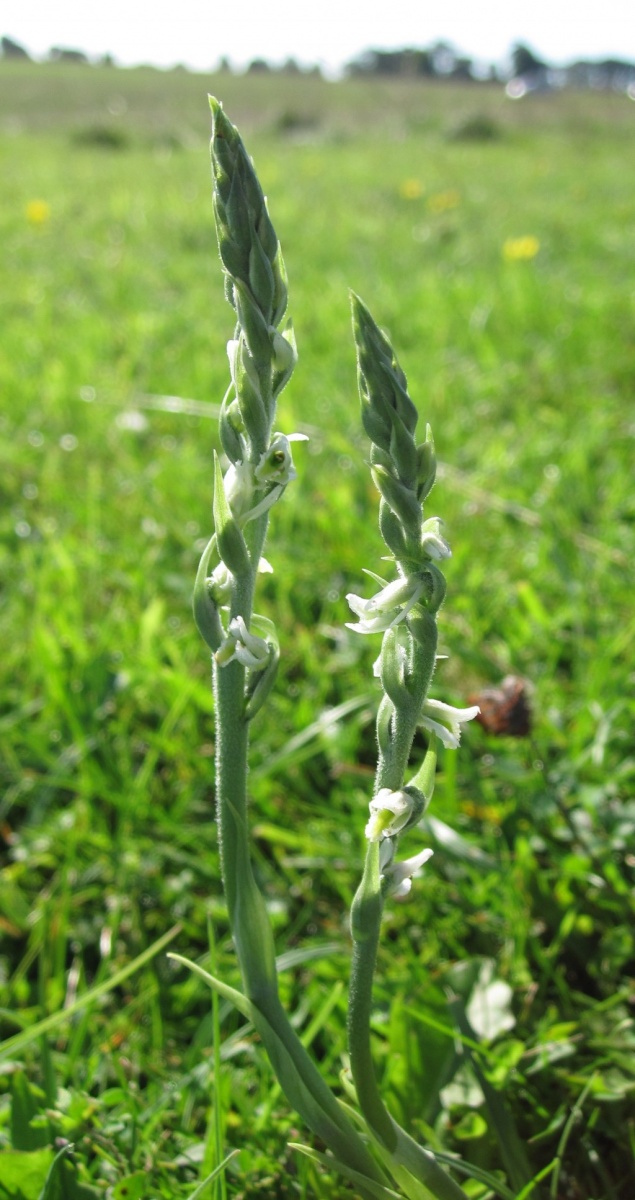
Autumn Lady’s Tresses on Minchinhampton and Selsley Commons
After many years of walking on Minchinhampton Common we have eventually seen several (16) Autumn Lady’s Tresses in flower – literally by my daughter almost putting her foot on one. They can be found in the grazed turf to the west of Brimscombe Hill.
They are also flowering on Selsley Common – we saw 3 on the side of the common above Woodchester village.