
| Organiser | John Moore Museum |
| Date | Saturday 24th October 2015 |
| Time | Four sessions to choose from: 10.30am to 11.30am 11.45am to 12.45pm 2.30pm to 3.30pm 3.45pm to 4.45pm |
| Venue | John Moore Museum, 41 Church Street, Tewkesbury, GL20 5SN |
| Details |  Discovering Bats! Why do bats hang upside-down? Renowned bat expert David Endacott will be at the museum with a selection of live, rescued British Bats to explain all about these fascinating creatures of the night. Also displays by the Gloucestershire Bat Group where you can learn about their work and how to join. This is the perfect opportunity to find out the truth about these much misunderstood animals. PLUS Pick up FREE information on how you can help bats, and take part in our craft activities – make your own origami bat! Tickets available on the door or in advance from the museum |
| Notes for editors | Contact: Simon Lawton (Curator) – very happy to give interviews E-Mail: curator@johnmooremuseum.org Telephone: 01684 297174 |
Headline news
CPRE & Horsebere Flood Alleviation Scheme


Mike Smart and Andrew Bluett both as representatives of GNS and as “Friends of Horsebere” attended the 2015 awards meeting of the Campaign to Protect Rural England at Gambier-Parry Hall, Highnam on Wednesday 7th October.
Each year the Campaign to Protect Rural England Gloucestershire Branch selects a variety of projects against a set of criteria (Well considered buildings; Innovative use of natural resources; and Projects developed by and for the local community) and presents them with awards under the overall slogan “Change is inevitable, it should be for the better”
Amongst the judges for the CPRE are Anna Jones, president of GNS.
Awards were presented by Viscount Bledisloe of Lydney Park Estate this year to
- Tirley (Gas) Pressure Reduction Installation – against a background of huge local opposition on the grounds of aesthetics, disturbance by construction traffic, blighting properties in surrounding villages, this project was designed and constructed with a screen of embankment and trees and is now near-invisible in the landscape. CPRE originally objected to the construction and yet, have now been able to make an award.
- Coln Valley Village Hall – a new community centre and facility that replaced a near derelict shed of a building, innovatively and sensitively designed and constructed in timber and which has provided for and brought together communities in the Coln Valley.
- Rural Innovation Centre, Harnhill, Royal Agricultural University, Cirencester; the conversion of an old unwanted barn with solar panels and cutting edge facilities
- Sly’s Close, Northleach – construction of village social housing in a former builders yard by a family charitable trust.
- Restoration of Whitecroft Station on the Forest of Dean Steam Railway which has retained and made useable, one of the original railway buildings.
However, the award of most interest to GNS and those interested in Birds and Odonata was that given to Horsebere Brook Flood Alleviation facility on the outskirts of Gloucester with a plaque being presented to Brian Smith, Toby Willis and Anthony Perry of the Environment Agency and a certificate to Felicity Davies-Birks of Gloucester City Council.
Horsebere was created by the movement of 120,000 tonnes of earth and subsoil, redistributed across the site to create a holding pit, thereby buffering the floodwaters potentially arising from the Horsebere Brook that in 2007 was so devastating for some of the residents of Longlevens.
The by-product of this project was the creation of meadow, woodland and wetland with public access pathways that has already become a haven for birds, Dragon & Damselflies and other wildlife. The management of the site as a public access and wildlife site has been taken over by Gloucester City Council, primarily through the Ranger, Felicity and her assistant, Ian Elphick, who have plans for further enhancement with trees to be planted, fencing installed, management grazing to take place, information boards and other improvements in the pipeline.
The habitat created has been particularly good for birds with large numbers of Gulls visiting to roost and bathe, passing waders, Herons, Egrets, Swans, Ducks, Geese, Coots and Moorhens, flocks of finches, Wagtails, dozens of Dragonflies and Damselflies, a visiting Otter and the Kingfishers that use the brook for both feeding and breeding and as a highway to and from the River Severn.
In the past few weeks, several GNS members including Mike Smart, Andrew Bluett and Martin Greenish have been part of a working party that has removed a large number of pioneer Willows from the bed of the flood alleviation area.
More working parties are planned, if you would like to become involved and be a “Friend of Horsebere”, contact Felicity at felicity.davies@gloucester.gov.uk (or Andrew Bluett / Mike Smart at GNS).

Mike Smart (GNS) speaking to Anthony Perry (Env Ag), Felicity Davies (Glos CC) speaking to Brian Smith (Env Ag) and Toby Willis (Env Ag) speaking with another guest – photo by Andrew Bluett.

Horsebere Flood Alleviation Scheme
GNS Meetings Autumn/Winter 2015/2016


Field Meeting, Edge Common Indoor Meeting, Cirencester
The following programme of GNS meetings for the next few months are dates for your diary – all are welcome to come along, both members and non-members alike. There is a nominal £1 charge for non-members at the Cirencester indoor meetings.
Indoor meetings at Cirencester Branch take place at Watermoor Church Hall, Watermoor Lane, Cirencester GL7 1JR, 7pm for a 7.30 start.
Meetings are listed in date order…
Field Meeting – Tuesday 13th October – Lichens of Wilsbridge Valley Avon Wildlife Trust Reserve, 11.00am, meet at ST 664 707 – the car park is on Long Beach Road at ST 663 710 (approx. BS30 9UG) to be led by Juliet Bailey (01452 722310)
Field Meeting – Sunday 1st November – Birds of the Estuary at Aylburton Warth on the high tide. Meet at Plusterwine Railway Crossing ST 601 991 (turn off the A48 just south-west of Alvington onto Station Road and follow the lane to the end at the railway crossing). To be led by Mike Smart, 01452 421131.
Joint Indoor Meeting with Painswick Bird Club – Thursday 5th November – 7.30pm at Painswick Town Hall – Jim Almond: Wildlife Photographer and Keen Birder with a seasonal look at the main Bird Reserves of the North Norfolk Coast.
Indoor Meeting – Friday 13th November – Chris Sperring – British Owls, their natural history and practical conservation
Field Meeting – Sunday 6th December – Coombe Hill Canal, meet at 11.00am at The Wharf car park at SO 887 273 (follow the lane downhill, westwards from the traffic lights on the Tewkesbury Road at The Swan at Coombe Hill), to be led by Mike Smart
Indoor Meeting – Friday 11th December – Mike Martin – History and Natural History of Lower Woods GWT Reserve
Indoor Meeting – Friday 8th January – David Dewsbury – Reptiles and Amphibians at Home
Field Meeting – Sunday 10th January 2016, 11am-1pm – Winter wildfowl and general interest, CWP West. Meet at Neigh Bridge car park, Somerford Keynes, just off Spine Road at SU018947. To be led by Ken Cservenka, 01285 656480 or 07773 797168.
Indoor Meeting – Friday 12th February – Helen Mugridge – Wildlife Photography at home and abroad
Indoor Meeting – Friday 11th March – Annual Business Meeting. Member’s night / Photographic and artistic competitions.
Indoor Meeting – Friday 8th April – Andrew Bluett – Scotland, Landscape & Wildlife, a personal view.
Additional Field Meetings for 2016 will be listed when arranged and ready for publication.
Birds of Prey Day for the Summer Holidays – Sat 8 August
Event at John Moore Museum
A Live Animal Event

| Organiser | John Moore Museum |
| Date | Saturday 8th August 2015 |
| Time | 10am to 1pm & 2pm to 5pm |
| Venue | John Moore Museum, 41 Church Street, Tewkesbury, GL20 5SN |
| Details | Come along to the museum to meet JRCS Falconry who, amongst others, will be bringing along a Barn Owl, a Tawny Owl, a Harris Hawk, a Buzzard, a Peregrine Falcon and an Eagle Owl. Learn all about these fascinating creatures from a falconer, who will be in the museum to answer all your questions about birds of prey and the ancient art of falconry. Enjoy seeing these magnificent birds in our beautiful cottage garden. Admission |
| Contact | Contact: Simon Lawton (Curator) – very happy to give interviews E-Mail: curator@johnmooremuseum.org Telephone: 01684 297174 |
BIOBLITZ 700 at The Park & Poor’s Allotment: 25th – 26th July 2015
The Gloucestershire Wildlife Trust is holding a 30 hour recording session at its newest reserves – The Park and Poor’s Allotment, Tidenham, Forest of Dean – over the weekend on 25th and 26th July. The aim of the event is to find out as much as possible about the reserves ahead of producing management plans for the sites. Our aim is to record at least 700 species across the weekend. We would like as many people as possible to come along to help with the recording effort so that we can reach our target by 4.00 pm on Sunday afternoon. If you are available and would like to join in all the details are in the attached programme and also on our website. You will see that we have a whole series of guided walks for the public during the weekend to get them involved in and enthused about recording. You can either join in with these or wander at your leisure across the sites to see what you can find. We will have the Old School Rooms in Rosemary Lane as the Recording Hub for the weekend where sightings will be collated and specimens displayed. Drop in any time to see how we are doing.
Here are all the details: Bioblitz Programme 25-26 July 2015 v2 (Word document)
Victoria Park Bioblitz and Wildlife Day, Windmill Hill, Bristol. July 3 and 4.
Dear Glos Nats
I am organising a bioblitz and wondered if any of your members may be interested in coming along?
Some of my friends at Bristol Naturalists Society and Somerset Rare Plants are coming, but I thought you might be interested too as we are in West Glos vice county.
Thanks and best wishes
Alex Morss
Victoria Park Bioblitz and Wildlife Day, Windmill Hill, Bristol
Fri July 3 & Sat July 4, 2015
Please bring your curiosity, or your specialist knowledge, and your friends to this natural history fun event – all ages and abilities welcome. As part of the Bristol Festival of Nature, our free, public Bioblitz involves two days of activities aimed at finding, identifying and discovering more about Victoria Park’s wildlife.
* 9.15am – 3pm Friday July 3: This period is exclusively for primary school children – but BNS helpers are welcome to come along to assist with species identification.
* 9.15pm, Friday July3: Public bat walk led by David Brown.
* 9pm, Friday July 3: Public moth trapping evening led by Neale Jordan-Mellersh.
* 10am – 4pm Saturday July 4: public bioblitz, mixing science and discovery with a wildlife-themed day of walks, talks, identifying things, arts, crafts, family fun, story telling, games and more.
This year, the mowers have been turned off, across half the park, and efforts made to welcome back wildlife – so it’s a good opportunity to find what’s here. Victoria Park is on an important urban wildlife corridor through the heart of our city. As well as its wonderful trees and curious moving springs, the park was chosen as a study site by Bristol University researchers, who recently made some promising finds here as part of their UK-wide Urban Pollinators research experiment.
For detailed activity times, please visit: www.bnhc.org.uk/festival-of-nature
To help, please contact the organiser Ms Alex Morss: morzojunk@yahoo.co.uk
Nightjar Field Meetings planned for 2015

Following the success of last year’s Nightjar evenings I plan to do more this year, proposed dates are Thursday 18th June, Wednesday 24th June and Thursday 9th July. If anyone is interested, please contact me and let me know your preferred date.
As for last year the evening meetings will begin by meeting at 9 pm for a 9.30 start and will be weather dependent. The chance of seeing Nightjars on wet or very windy evenings is poor, we will therefore be hoping for reasonably clear and still evenings and if necessary, will revise the dates.
I will send out full instructions ahead of the proposed dates to all who wish to attend.
Andrew Bluett
GNS Membership Secretary – gnsmembership(at)btinternet.com
Next Meetings – 10th and 14th April 2015

The next GNS Indoor meeting will be at Watermoor Church Hall, Watermoor Road, Cirencester on Friday 10th April at 7.30pm – Ed Drewitt will be speaking about “Urban Peregrines” which of course we have in Gloucestershire at Christ Church, Cheltenham and on the Gloucestershire Royal Hospital tower in Gloucester. Ed’s book of the same name is the authoritative work on Peregrines that have taken to living in cities across the UK in most recent times.
Lichens of Crickley Hill
The next Field Meeting will take place on Tuesday 14th April, to be led by Juliet Bailey and featuring the Lichens of Crickley Hill, meet at SO 929 163 at 11.00am for an insight into this diminutive but fascinating world.
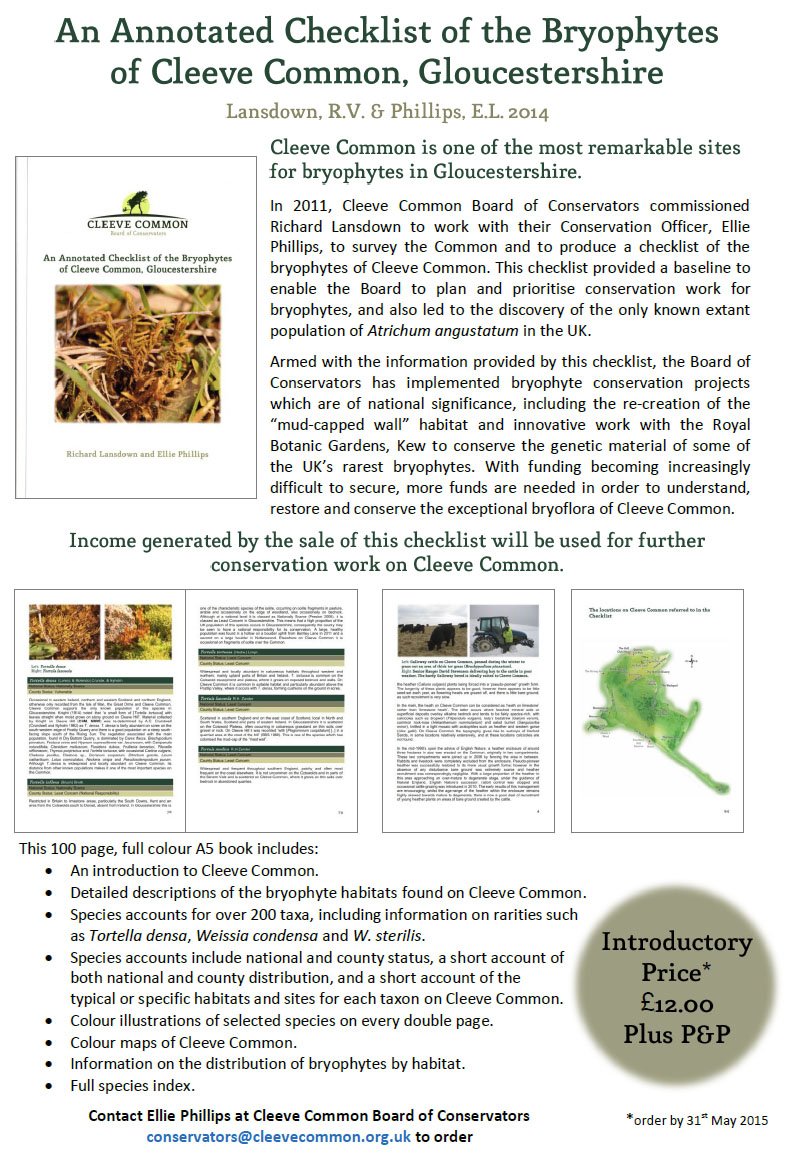
Bryophtes checklist – new book
A new book has been published, “An Annotated Checklist of the Bryophytes of Cleeve Common”.
Will DEFRA pull the plug on Cleeve Common?
In a world where everything has to be the biggest, fastest, newest and best, any description of Cleeve Common can sound like another dose of all too familiar hype. However, at Cleeve, the superlatives do go on and on, at least for the present.
As well as being the highest point and largest area of common land in Gloucestershire, Cleeve includes significant areas of two of southern England’s most threatened types of habitat i.e lowland heath and unimproved limestone grassland. The presence of a wide-range of nationally rare species means that the Common is certainly the best site in the Cotswolds for moths and is of national importance for lepidoptera as it holds stable populations of scarce species such as Lace Border and Chalk Carpet as well as a range of Red Data Book micro-moths. The Common is large enough to support a large and healthy population of Adders, whereas at other smaller, isolated sites, in-breeding threatens the viability of the species. The flora includes the very rare Purple Milk-vetch and the orchids present include the rare frog and musk species. Among the breeding birds on the Common are Linnet and Yellowhammer and the area is a traditional stopping-off point for migratory Ring Ouzels. All three of these species are “red listed” in the UK, i.e. they have the highest conservation priority as they need urgent action
Management is the key to understanding the rich bio-diversity of the Common and that management depends on a carefully considered conservation plan, based on data from detailed survey work, and on a skilled and knowledgeable workforce who can implement the plan to produce the all-important mosaic of grassland, heather, gorse and woodland.
All of this essential work is under threat. Changes in DEFRA policies have resulted in a reduction of the vital income needed to finance conservation work on the Common. Cleeve Common does not have the financial backing of a major conservation charity, but has depended instead on the range of payments which I am sure we all thought were made available by DEFRA under it is environmental remit. Given the amount of money DEFRA has just written off for yet another failed IT system (for the EU’s Basic Payment Scheme), the funds required to maintain the quality of conservation management on the Common are minute. Whether an under-resourced, tunnel-visioned department can show some flexibility regarding the Common’s finances is anyone’s guess, but a little persuasion from interested naturalists would not go amiss. Finally a point worthy of any “strange but true” column; DEFRA’s the new approach means handing over money to grazing-rights holders, even if they don’t turn out any animals on to the Common!
Robert Homan
Gloucestershire Plant Gall Recorder and East Gloucestershire Moth Recorder