Cannop Ponds (28 November 2008, contributed by Waltraud Englefield and Mike Burke, Lakers School, Coleford.)

This was a lunch time birdwalk with Lakers School Birdwatching Group, led by Mike Smart, Andrew Bluett and Juliet Bailey. Birds seen recorded:
Blue Tit, Great Tit, a good show of Marsh Tit, Coal Tit, Greenfinch, Chaffinch, Bullfinch (heard), Robin, Dunnock, Blackbird, Carrion Crow, Jay, Buzzard, 6 Redpoll flying over, Siskin flying over, one Wren, several Nuthatch, Mallard, Tufted Duck, one Greylag Goose, one Cormorant, Moorhen, Coot, ringed Mute Swan with several cygnets, several Mandarin Duck and Woodpigeon. The walk was enjoyed by all and the group learned a great deal, including not to trust botanists who invite you to lick some white lichen which tastes very bitter! This was a great experience and we hope to work together again in the future.

And a note from Juliet (the botanist in question):
“Just to defend botanists from accusations of perfidy – I had a quick look at the lichens on the trees when we were at Cannop Ponds with the group from Lakers School. The standard field test to confirm one species – Pertusaria amara – is to moisten the end of the finger and rub it over the white powder (soredia) on the thallus surface. You then gingerly dab it onto your tongue, and wait a few seconds to see if a bitter taste develops. Then spit! I invited Andrew Bluett to try the test and describe what he noticed. He said it was like juniper berries – news to me, I think it is just nastily bitter. Then the students wanted to try too, so having confirmed with their teacher that this was all right, most people had a go.”

Midger Wood, joint GNS-Bristol Naturalists’ moss meeting (30 March 2008, contributed by Juliet Bailey)

During the course of the meeting as well as recording some 50 mosses, we saw at least six Brimstone butterflies together with early Bluebells and Butterbur and heard the song from many Chiffchaffs.

Photographs from the Midger Wood Meeting

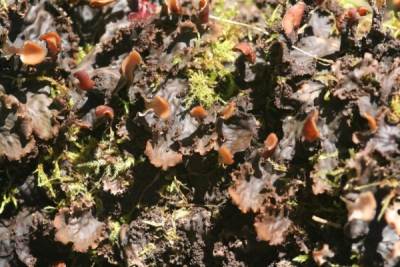
The pictures below were taken by Rob Bacon during the joint GNS-Bristol Naturalists meeting. They are of a variety of mosses, liverworts, fungi and lichen. Of the species shown the liverwort Nowellia curvifolia was a particularly good find.

Dicranum scoparium on Nowellia curvifolia

Thuidium tamariscinum and Polytrichum formosum

Reticularia lycoperdon

Scarlet Elf-cup (Sarcoscypha austriaca)

Scleropodium purum

Euryhnchium praelongum

Yellow Brain (Tremella mesenterica)

Thuidium tamariscinum

Isothecium myosuroides

Peltigera praetextata

Pellia epiphylla

Nowellia curvifolia

Mnium hornum

Frullania dilatata

Plagiochila asplenoides

December Field Meeting – Recognising trees in winter, Haresfield Beacon (15 December 2007, contributed by Juliet Bailey)

Nine members met near Haresfield Beacon for a session identifying trees and shrubs in winter. We saw 20 different kinds up close, plus alder, pine and larch at a distance. We considered many aspects – the twig characteristics, any remaining leaves and fruit, leaves on the ground, and distance recognition from silhouette.

We used the winter twig pdf from the Nature Detectives website as our crib sheet in the field. This shows 18 common species in colour. http://www.naturedetectives.org.uk/NR/rdonlyres/344CA3AC-3973-465F-9E30-828247B9770D/0/twigs.pdf

The Science and Plants for Schools website has an excellent twig key, but you need to take the specimen to your computer. http://www-saps.plantsci.cam.ac.uk/trees/index.htm

Also useful are the tree identification activity sheets on the Woodland Trust website http://www.woodland-trust.org.uk/discovery/images/treeid_activity.pdf

The Cotswold top woodlands of Haresfield Hill are dominated by ash and beech, with hazel and hawthorn in the understorey. The adjacent limestone grasslands have a light smattering of scrub species, especially hawthorn and blackthorn with ash, oak and birch also colonising. Other highlights of the meeting were 5 Roe Deer. Some of us were lucky enough to see a Woodcock fly across the lane as we made our way back to the cars in the twilight.

GNS Field Meeting Haresfield Beacon, Paul Tyers, December 2007

Coombe Hill, GNS Field Meeting (6 October 2007, contributed by Mike Smart)

Five members gathered on a calm morning at the top of the Canal, then walked along the former towpath to the meadows; they completed the circular walk round the Gloucestershire Wildlife Trust reserve, visiting the Grundon hide, which overlooks the shallow pools excavated in the meadows, then the hide looking into through the old withy bed into the willow-encircled pool, returning along the towpath. At this early stage of the winter, only a few ducks had arrived, but Wigeon, Teal, Mallard and Shoveler were noted on the Long Pool. A few passage waders, including a Greenshank and a Ruff had joined the wintering Snipe on the scrapes. The heavy southward passage of Swallows and Meadow Pipits noted in the previous week had diminished sharply, and instead a pair of Stonechats, just arrived for the winter, was noted.

Much interest was devoted to the state of the vegetation: many of the meadows had been “topped” by neighbouring farmers ie. a mower had been driven over them in an attempt to remove the mat of dead vegetation caused by summer flooding; in fact this seemed to have had little effect other than compacting the matted dead grass; however the leaves of many typical meadow plants (cinquefoil, burnet, silverweed, grasses and sedges) were pushing through the gaps in the matting, and there seemed hope that the mat of dead vegetation would disappear naturally with the frosts and rain (and probably more flooding, hopefully light) of the winter. Along the hedgerows a tidemark several feet up was still clearly visible, but the tops of the bushes and tress seemed t have survived and there were some signs of new shoots, and even some flowers, among the dead branches of hawthorn and dog rose. But it look like a poor crop of berries for the wintering thrushes.

Hatherop church, GNS Lichen Group meeting (22 April 2007, contributed by Juliet Bailey)

Seven members met for the group’s first meeting of the year. This set us off to a good start, recording more than 80 species (our average for a Gloucestershire churchyard would be more like 50-60). The Cotswold churchyards of east Gloucestershire do seem to be better than average – have they escaped the pollution of the Severn Vale? – and this one had a surprisingly large number of old siliceous tombstones for a Cotswold site, boosting the chance of picking up a large number of species.

Purton Field Meeting (14 April 2007, contributed by Juliet Bailey)

Five people met for a beautiful hot afternoon at Purton on the south bank of the Severn. We followed the towpath of the canal towards Sharpness, then went out onto the saltmarsh and shore, examining the barge hulks beached there, distant views of Gatcombe where Sir Francis Drake kept a mistress and more recently Railtrack cut down the rare Service Tree (Sorbus domestica), and the site of the Severn Rail Bridge disaster which fell into the river one foggy night in 1960. This was very much a recording meeting, with highlights including finding of a rare Notaris weevil, refinding the canal spider (Larinioides scopetarius), the bug Podops inuncta, the ants Lasius nylanderi and L brunneus, and the pseudoscorpion Roncus lubricus. We counted six Little Egrets on the river, and heard Reed Bunting and Cetti’s Warbler from the timber ponds. Botanically there was a very fine show of English Scurvy Grass (Cochlearia anglica). We discussed the implications of the proposed barrage on the natural history of the area.

Purton Field Meeting, April 2007, Andrew Bluett

Cooper’s Hill Wood Field Meeting (24 March 2007, contributed by Juliet Bailey)

Under the leadership of the county bryologist Peter Martin, a select band of members enjoyed the mosses and liverworts of Cooper’s Hill Wood, recording some 50 species including the local speciality Oxyrrhynchium schleicheri (Eurhynchium schleicheri) seen here in the foreground with the much commoner Eurhynchium striatum behind.

Mosses at Cooper’s Hill Wood, March 2007, Juliet Bailey

GNS Field Meeting to the Cotswold Water Park (9 July 2006, contributed by David Anderson)

A group met at Keynes Country Park for a walk around a number of gravel pits at various stages of development. Working, recently worked out, almost restored and flooded pits were visited to see the lifecycle of gravel extraction. The trip included visits to areas usually inaccessible to the general public.

A highlight was the vigorous discussion on the processes of restoration, contradictory habitat demands for different species and the impact of a pit’s final use on habitat regeneration. The effect of a gravel pit’s lifecycle on the movement of Sand Martin colonies was discussed as the group watched c.250 pairs on a temporary sand cliff face in a working quarry.

The best technique for creating the profile of a restored gravel pit’s floor was described along with the effect the profile has on sedimentation and aquatic plant development. For most present this raised a new and interesting point that we could see was clearly important for plant diversity.

Observations made during the trip included:

Immature Hobby that perched on a bank about 100m metres from the group and gave all a chance to examine the raptor in detail and at leisure. Common Terns including a nest with chicks; Little Egret; Sand Martin colony; Stock Dove; Grey Herons; Roosts of Black Headed Gulls in the gravel quarry floor; Lapwings; and singing Skylark.

This was a very interesting and informative trip that included usually inaccessible reaches of the water park.

GNS Field Meeting – Guscar Rocks (10 May 2006, contributed by Juliet Bailey)

One of the highlights of this meeting were 4 Painted Lady butterflies, presumably newly arrived migrants, on the banks of the Severn near Guscar Rocks. Among the birds seen were: Whimbrel, Lapwing, Cormorant, Dunlin, and Shelduck. There were some spectacular drifts of English Scurvy Grass (Cochlearia anglica) in the saltmarsh channels. The meeting was cut short by a thunder storm.
English Scurvy Grass (Cochlearia anglica), May 2005 (J Bailey)

GNS Field Meeting – Russel’s Inclosure, Forest of Dean (6 May 2006, contributed by Juliet Bailey)

This was a very productive meeting in terms of species recorded. Birds included, Wood Warbler, Blackcap, Treecreeper, Nuthatch, Goldcrest and many other woodland birds. Also Tree Pipit and Mandarin. There were beautiful displays of bluebell and wood spurge. Hundreds of violet ground beetles were to be seen along the forest track, most of them dead, and there was a bird pellet (possibly that of a crow) shiny with elytra. A few St Mark’s Fly appeared when the sun eventually came through. Finally, the group saw two fallow deer.

Skip to content