The GNS Annual General Meeting is due to take place on the evening of Friday 26th March 2021; as we are unable to hold conventional meetings at present, the AGM will be carried out as a virtual Zoom meeting via computers, tablets and smart phones. Please don’t be discouraged by Zoom, it’s not that difficult.
Members can participate in this meeting free of charge – please e-mail our secretary, Barrie Mills at bazmills48@outlook.com and he will send you an invitation link to the meeting. If you have any comments, questions or other observations relating to GNS and its business, please e-mail either Barrie or Andrew Bluett at gnsmembership@btinternet.com as soon as possible before the meeting so that they can be properly considered.
Some of the documents that will be referred to during the meeting can be downloaded from here.
You are all welcome, please do join us if you would like to.
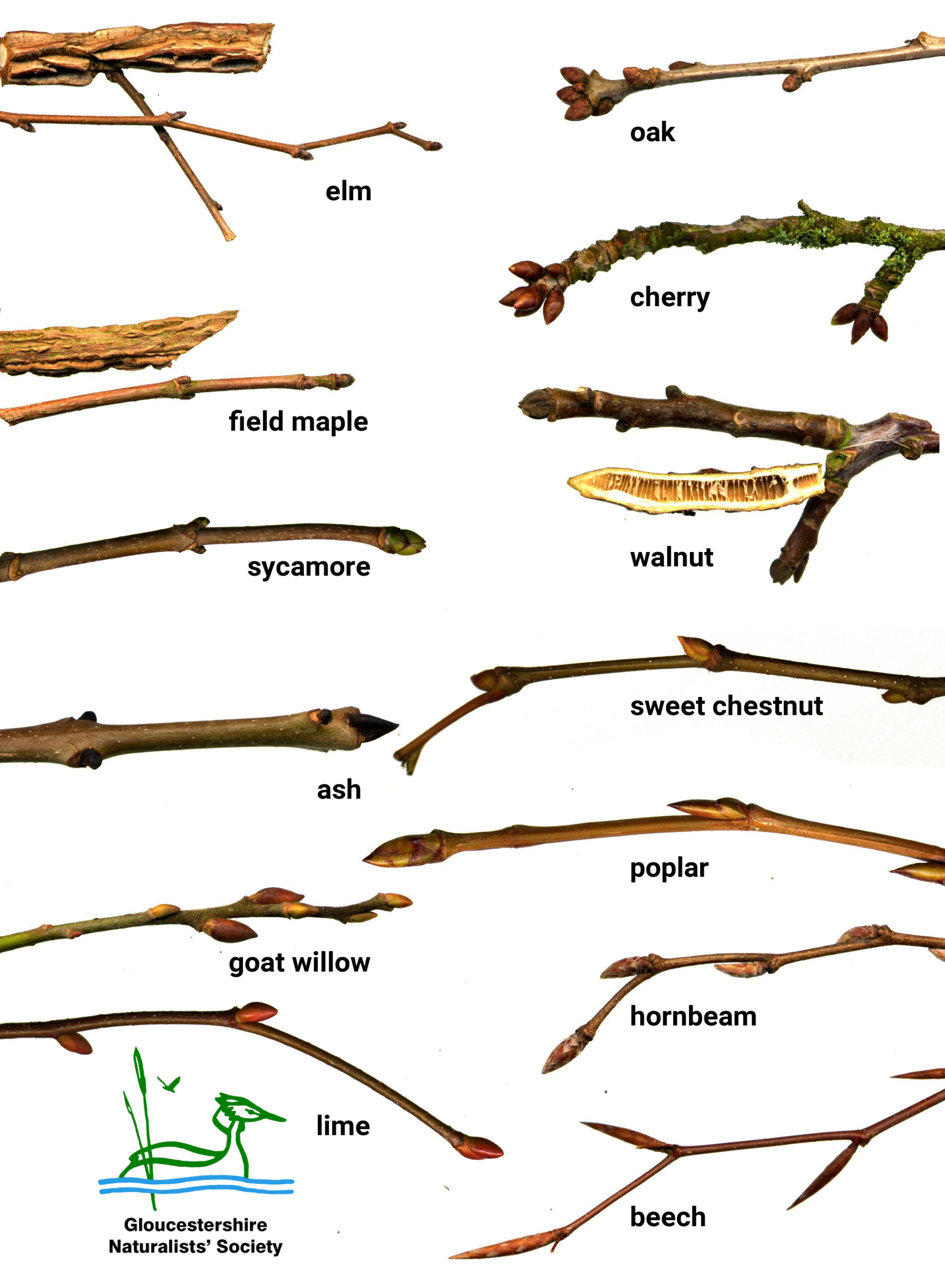
The sheet illustrates twigs of common trees in the British countryside. It was used during the GNS Zoom members’ meeting on 20 January 2021. The twigs are arranged so that twigs with similar features are close to each other.
Thus, both elm and field maple often have very ridged bark on quite small twigs, but the buds on an elm twig zigzag along it, whereas field maple buds are opposite each other.
Sycamore is another member of the maple family, and it shares the feature of buds opposite each other, but its buds, especially the end one, are much larger and usually bright green.
Another twig with opposite buds is ash, but in this case the buds are sooty black (ash – sooty – get it?).
Willows are very confusing, with twigs in a range of colours often with buds in a matching colour. If you look closely you will see there is just one scale covering the bud, which comes off as a single unit when the bud bursts in spring. Lime twigs can look quite like willow, with the twigs often coloured red on the sunny side, but the buds are placed zig-zag fashion. The buds of lime are often a rich red, and each bud has a covering of two or three bud scales which are different in size to each other making the bud look a bit like a mitten.
Both oak and cherry can have clusters of buds together on the end of twigs with side buds spiralling up the stems. You may see long extension twigs on cherry with more evenly spaced buds and just two or three at the top. If in doubt, look at the ground because oak leaves are very tough and will survive the winter intact. Cherry leaves are less durable but you may be lucky.
From a distance a walnut tree can look quite like ash. Walnut has dark buds, but they are not opposite each other. In walnut the leaf scar, where the previous year’s leaf stalk dropped off, is a bit like a monkey’s face, broad, with the marks of the vascular bundles looking like two round eyes with a smiling up-turned mouth below. In ash you just get the smile. Another fun clue to walnut is that the twigs have laddered pith, which is a rare feature not found in other common trees in the British countryside. There will always be twigs on the ground that can be split to check.
The twigs of sweet chestnut are rough, unlike the silky smoothness of lime, for example. The sweet chestnut leaf scar is offset at the side of bud, not directly below it which is the more normal placement.
In poplars the buds spiral up the stems, but the side-buds sit directly over last year’s leaf scar. The illustration is of a twig with leaf buds, but beware that in poplar, and indeed in many trees, flower buds can look very different, much larger and rounder. In poplar, at least, they are often on little side-shoots. The balsam poplars are easy because the buds are sticky and smell strongly of sun-tan lotion. Poplars sucker, so you will often see young stems coming up in the field 50 yards or more away from the parent tree, and they can grow fast – more than 6ft in a year.
Beech separates out easily because the buds are very long and pointed, zigzagging up the twig and sticking out at an angle of more than 45 degrees. Hornbeam buds are pressed tight up against the twig, sometimes with the tip curving inwards. Both beech and hornbeam can retain dead leaves on lowest branches over the winter, especially as hedges, but the angle at which the buds are held will easily differentiate them.
This is an introduction to get you looking at some of the important features. There will be plenty of exceptions and of course many more species to examine. For rigour, consult John Poland’s The Field Key to Winter Twigs (2018).
Just a note to remove any doubt – the Gloucestershire Winter Bird Survey for February is cancelled.
As you know, the situation has become worse since November and we now have a do-not-travel-if-avoidable rule.
The intention is to start the survey up again this November, and if you took part in the last one you’ll be contacted in October unless you decline in the meantime. If you have not taken part and would like further information please email glosbirdsurvey@btinternet.com
This inspiring, short 5-minute film from Foresters Forest and Wye Valley River Festival shares how National Lottery Heritage funding in the Forest of Dean has helped improve the habitats of birds, reptiles and butterflies whilst also encouraging us to feel more connected to the local landscape. Explore the natural world around you and experience a sense of well-being.
The golden plover survey is this weekend Sat 17/Sun 18 Oct: Post your GP, Lapwing and Curlew sightings on BirdTrack for the International Wader Study Group’s once-every-6-years survey. Photo: Richard Tyler
The society is proposing to organise some walks this autumn, though any plans put in place may of course change at a moment’s notice. Outdoor meetings with groups up to six are possible given the following guidelines:
Members will need to pre-book with the walk leader and receive a confirmation that they have a place.
Equipment and books should not be shared or passed around.
Members are asked to maintain two metres between each other.
You are advised to bring hand sanitizer and face masks.
Be aware of your own risk level and the suitability of this activity.
Please do not come if you are showing any symptoms of Covid-19.
We have arranged six walks before the turn of the year. They are spread around the county, and each will last about two hours, though members can come and go in the usual way. Most are general walks to see what natural history is around and are not primarily intended as recording exercises, though we shall record what we see.
Please see the events page for the full list of upcoming walks.
The latest edition of the Gloucestershire Bird Report covering the years 2014 to 2016 is now available to purchase from Gloucestershire Naturalists’ Society, cost £15.00 + £3.25 Post & Packing = £18.25. Click here to purchase.
Published by Gloucestershire Ornithological Co-ordinating Committee, this is a combined 3-year report in a new size and format for the 21st century with a fresh and different look from previous issues and is intended to deliver all of the essential information required from a county report whilst being rather more interesting and entertaining than a bland dates and numbers document.
In essence it takes some of its design features from the Birds of Gloucestershire (2013) by Gordon Kirk and John Phillips, features many photographs and personal views of the Gloucestershire avifauna, contains a wealth of information and is an essential document for ornithologists with any interest in the county’s bird life.
Like many others I had never heard of Wuhan and was only vaguely aware that there were a group of viruses known as Corona viruses. When first reports of a virus came from China in December 2019 I did not think much of it. We had after all got used to such outbreaks. There had been Swine Flu, Avian Flu, Ebola, MERS and SARS and they were somewhere far away and never really had much impact on my life. It did register and I was vaguely worried when it was reported that the Chinese were rapidly building complete new hospitals to deal with the outbreak and had also shut down an entire province, but still it was over there.
Bit by bit it worked its way over here, and slowly the name Covid 19 came into use. Officially the name of this corona virus is 2019 nCov. The 19 is because it first made its appearance in the year 2019. I had not realised that. The first definite case in Britain was identified on 20th January 2020. Soon after this we left Britain for a two week holiday in Gran Canaria and it was during this fortnight that it really took off in Italy followed by serious outbreaks in France and Spain.
On our return the writing was very much on the wall and we decided to stop visiting the gym. I stopped going to my regular Monday night camera club meetings, no more restaurant visits and only essential shopping trips. At this point, which was still about two weeks before the stay home message and lockdown was eventually introduced on the 26th March, we started our home fitness regime. Walks of about one hour on four days of the week, home gym exercises on two days of the week and on Saturday we chilled out.
Living very close to two beautiful areas, the Forest of Dean and the Wye Valley, we already enjoyed a decent repertoire of walks. Most of them involved a short drive but some were direct from the house. During the pre lockdown period we extended our number of routes and in particular we discovered some new paths through the Forest of Dean, some with excellent views. I normally take with me a small Olympus camera which will easily fit into my pocket so that views and any interesting wild flowers can be photographed. I am hoping to publish a book on woodland wildflowers and the publishers had instructed me to top up on and improve some of my photographs. With that in mind I did a round trip just before the lockdown first to the area of Gloucestershire known as the Daffodil Triangle, then across to Inkpen in Berkshire to find the Wild Crocuses and finally stopped off at a spot just outside Gloucester to photograph the very rare Yellow Star of Bethlehem.
So pre lockdown it was not so much blues as yellows and even when the stay home restriction was first introduced it still remained largely yellow the dominant wild flower at that time being the Primrose.
As I am sure will be the case for many people fortunate enough to live in a rural situation we soon discovered many more walks that could be undertaken direct from the house. We basically had three directions to head off in. We live in a valley, so there are lots of ups and downs involved in any walk. The right hand direction provided several routes, some involving a region known as Clearwell Meend. There are quite a few Meends in this area. Meend is a local name which might have its origin in the Welsh Myndd which means mountain but now it denotes a sort of common land. Clearwell Meend had quite a few Primroses on it and a later some Cowslips and even a couple of False Oxlips. In these early days of the pandemic there were lots of Sallow bushes with the beautiful Pussy Willow flowers. On this right hand route we could walk through some ancient woodland with wierd rock formations caused by excavations carried out way back in prehistoric times. These are known as scowles, and some of these local regions have been used for filming such epics as Star wars and Harry Potter films. Here too were Primroses and also Lesser Celandine.
PrimroseLesser CelandineCow slipFalse Oxlip
To the left of the house and through the village are various footpaths and some charming little lanes with quaint names like Pingry Lane, Rookery Lane and Margery Lane. We gave the different routes our own names. Some are based on the actual names but others are based on our own observations. For example there is rat junction so called because at one time a rat was regularly to be found on the stile there, not a live version but a cuddly stuffed rat. It was there for a few weeks but eventually disappeared. Possibly the child who left it there passed by again and picked it up. Another walk is the Julie Andrews “the hills are alive” walk which passes through a meadow reminiscent of an alp. A third set of walks starts over the road from the house and involves climbing what we were told was called the burial path and passes a chicken farm. It all means something to us and each walk is different and provides a variety of views, habitats and wild flowers. We can often see across to the Welsh Brecon Beacons with the Sugar Loaf and Hay Bluff frequently visible.
Gradually the yellows gave way to more blues. Green Alkanet, which despite its name has bright blue flowers grew in a big patch by the side of the village church and along the lanes and through the woods the Bluebells made their presence felt. You always seem to get a few precocious ones that start flowering in early April but the main flush is towards the end of the month. There were also several places where Periwinkle was established, sometimes in gardens, sometimes as escapes but their blue to purple colour also added to the general blueness. Even the Violets did their bit although occasionally one could see a white variety.
Dog VioletGreen AlkanetLungwortLesser PeriwinkleGround Ivy
Hard on the heels of the Bluebells were the Ramsons and white now seemed to be in the ascendancy. The Wood Anemones had provided a little taste of the whiteness to come and combined well with the Bluebells but in Mid Spring there was Cow Parsley in the lanes and Ramsons in the woods There was also a lot of White Dead Nettle and Hedge Bedstraw to be seen to contribute to the whiteness.
Some plants, such as the Ramsons have a very short flowering period. Others such as Herb Robert, one of the Pinks, seem to go on for ever and is still flowering now as I write this in August . Another pink that puts in an appearance at the same time as the Cow Parsley is the Red Campion combining well with the Cow Parsley. I suspect many casual observers do not see the sequence of changes especially with the white umbellifers in the Hedgerows. Cow Parsley appears first followed by Ground Elder and then Hogweed which has a longer season and overlaps several of the others. Hogweed can err on the side of pink and is more robust than the other umbellifers. Later some Common Vallerian may be seen and by mid summer there can be quite a show from the more delicate Hedge Parsley. In the woods there may be Pignuts, quite delicate but another white umbellifer and in the fields there is Wild Carrot.
Once lockdown was lifted we were allowed to travel and so we have done, but not that much. We still walk four times a week and three of those walks are from the house with only one involving driving to somewhere local. We did have a trip over to Stroud to photograph a rare orchid, a Narrow leaved Helleborine, but we are mostly maintaining the local nature of our walks. After all in years to come I expect Covid will be a memory but climate change will still be with us. I have managed to carry out my publisher’s instructions and I think I have improved my photographs. I have certainly discovered quite a few species that I never knew grew so close to home. I expect there are still more out there waiting to be discovered… maybe during the next lockdown!
A Purple Emperor was seen on Wednesday 22nd July in the copse south of the car-park at Guiting Woods. It was seen again on the track across the road through the main woodland on Thursday 23rd.
Adult robberflies (Order: Diptera, Family: Asilidae) are effective daytime hunters, relying on sight to target moving insect prey which they then seem able to immobilise by injecting posion through their mouthparts. Martin Matthews has prepared a basic introduction to the adults of the 16 species of robberflies (12 of them illustrated) that have been recorded in Gloucestershire at least once since 1950. The guide can be downloaded from the invertebrates section of our publications pages.
This website uses cookies to improve your experience. We'll assume you're ok with this, but you can opt-out if you wish. Cookie settingsACCEPT
Privacy & Cookies Policy
Privacy Overview
This website uses cookies to improve your experience while you navigate through the website. Out of these cookies, the cookies that are categorized as necessary are stored on your browser as they are essential for the working of basic functionalities of the website. We also use third-party cookies that help us analyze and understand how you use this website. These cookies will be stored in your browser only with your consent. You also have the option to opt-out of these cookies. But opting out of some of these cookies may have an effect on your browsing experience.
Necessary cookies are absolutely essential for the website to function properly. This category only includes cookies that ensures basic functionalities and security features of the website. These cookies do not store any personal information.
Any cookies that may not be particularly necessary for the website to function and is used specifically to collect user personal data via analytics, ads, other embedded contents are termed as non-necessary cookies. It is mandatory to procure user consent prior to running these cookies on your website.