On Friday 3rd July @ 7 p.m. Red Kite was spotted circling over bungalow in Winchcombe Gloucestershire before heading off in 160 degree SSE direction. No mistaking the shape witnessed via binoculars.
Cath Symons

On Friday 3rd July @ 7 p.m. Red Kite was spotted circling over bungalow in Winchcombe Gloucestershire before heading off in 160 degree SSE direction. No mistaking the shape witnessed via binoculars.
Cath Symons
In my back garden in Warden Hill, Cheltenham I have used an old white Belfast style sink to create a water feature. This has been in-situ for around 5 years, so I’d say is ‘mature’. Initially I filled it with rain water, placed in some local rocks (to allow larger animals to escape if they fell in) and then ‘kick-started’ it with some water from a local pond (which included some pond weed and a few snails). For the last couple of years I’ve noticed the moults of damsel flies and this year just happened to be outside recently when I noticed the latest nymphs climbing up the reeds and changing to adults. They are not brilliant photographs (I’d left my good camera at work and these are from my iPhone), but are not too bad. I think they are Large Red Damselfies (Pyrrhosoma nymphula). It just goes to show that nature will find a way!


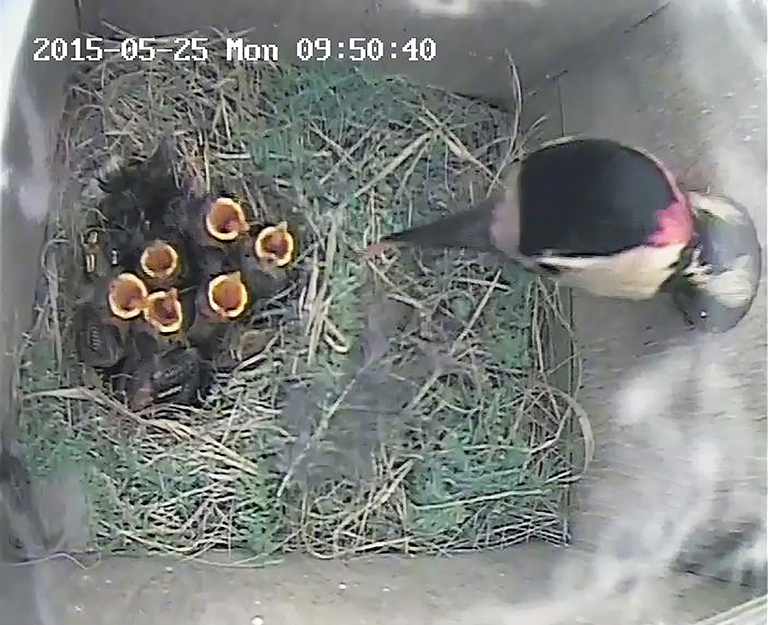
This is a still from the recording of our nestbox camera this morning. We saw a woodpecker flying to it and poking his head in. When we played back the video, there he was. Luckily the chicks were just out of reach of his beak.
He tried a second time, and interestingly this time the chicks kept low in the nest with their beaks closed.
The mother was back within seconds of him leaving.
 We have over a dozen nest boxes in our 1.5 acre garden at Woolaston. For the fourth year, Stock Doves are nesting in a kestrel-design box fixed to a shed wall where squirrels find access more difficult.
This year, for the first time, we have nuthatches in one box. There seem to be two chicks nearly ready to fledge (24th May 2015)
It is a larger box than my standard tit boxes. Internal dimensions are approx. 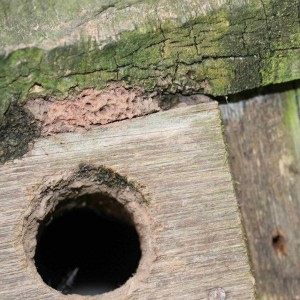 30cm high at front x 15cm deep x 10 cm wide. After woodpecker damage I nailed on a new ply entrance, still enlarged by the woodpecker. The nuthatches have added mud above the entrance to seal it and have also adjusted the entrance size and shape to make it downward sloping inside and a little smaller.

The nest is made from large pieces of thin bark from our paper-bark maple. They must have struggled to pull them through the entrance hole.
David Priddis
Most of us are aware that Red Kite are being seen more often across the county as each year passes so that a sighting is now perhaps a little less exciting than just a few years ago. However, once in a while something more than a simple sighting and record occurs, a good example of that is seen in the two photographs below from David Priddis, better known as our resident Bat expert in the Forest of Dean. David has seen Kites over his home patch of Woolaston Common before, but this bird is clearly carrying, and was observed eating whilst in flight, a large Rat, probably a Brown Rat (R. norvegicus) on Friday 17th April.
The diet of Kites is usually said to be small birds, mammals and invertebrates with carrion (often road kill) thrown in but unless this bird found the Rat already dead, it must have managed a kill which is no mean feat against a resourceful, agile and feisty animal.


Stunning and large tube web spider. Found in sand pit, Cheltenham, Gloucestershire. 10th April 2015.

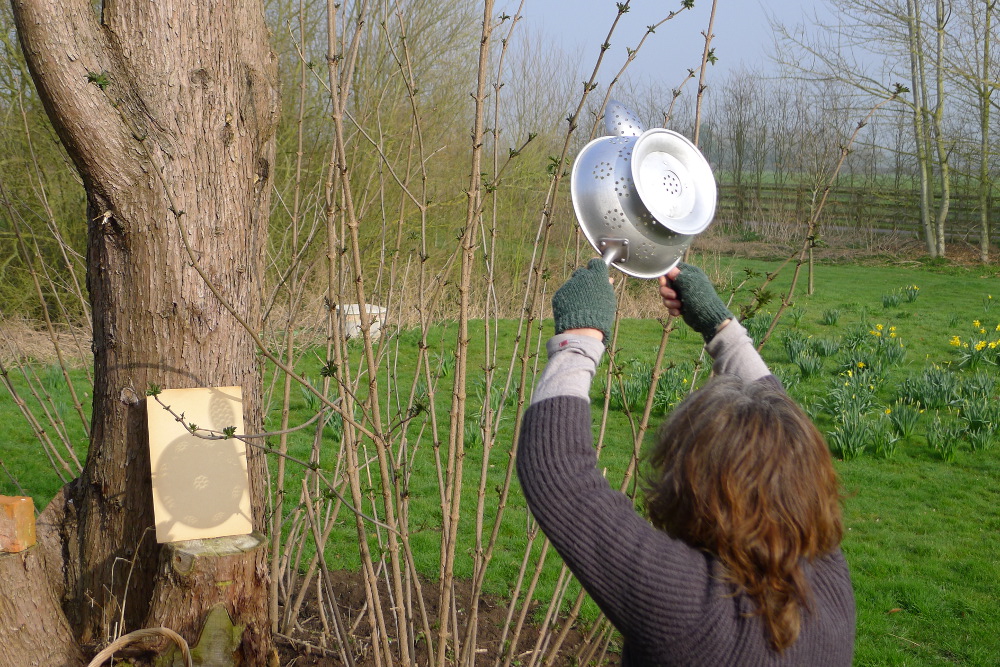
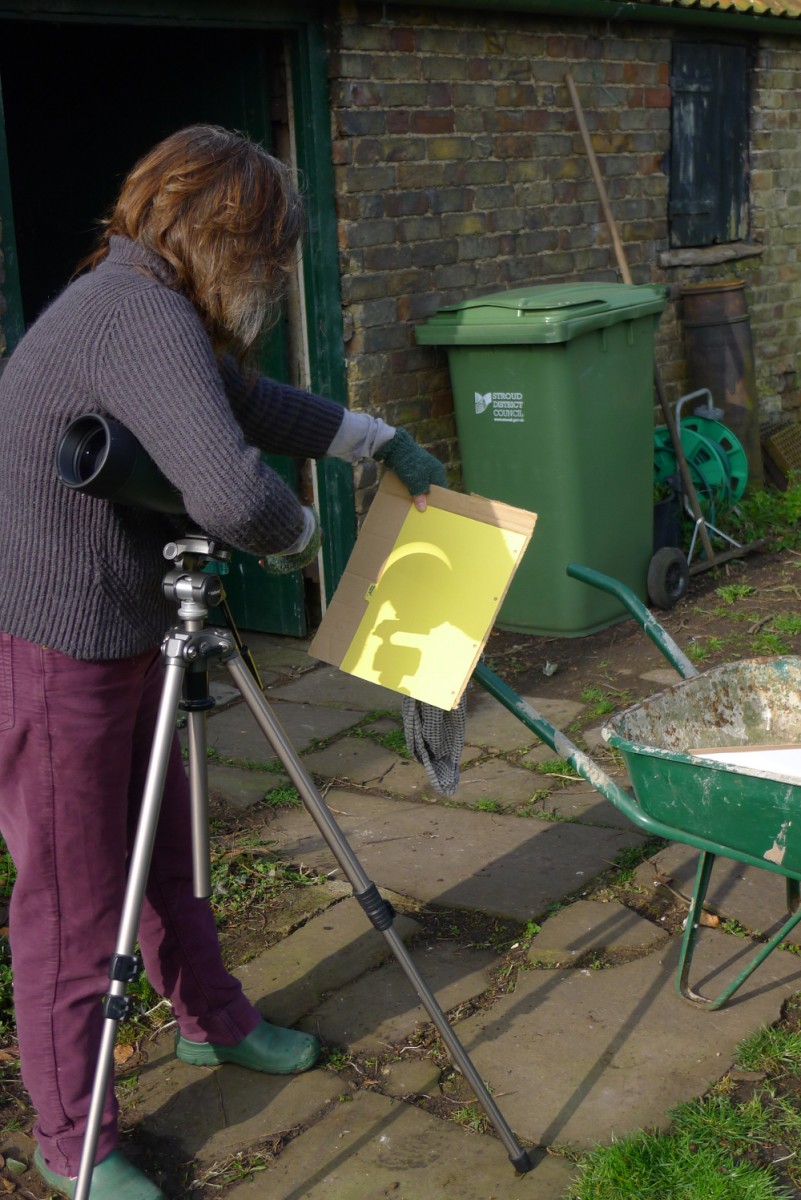
A beautiful partial solar eclipse this morning. The sky was clear in Standish, and we were able to view it using both the telescope projection, and the pin-hole method using a colander and slotted spoon. It peaked at about quarter past nine, and finished about ten thirty.
At its height, it was noticeably colder and the light had a darkling evening quality.
On 18th January 2015 I was carrying out some pruning in my Woolaston garden when I saw a torpid slow worm on the ground, out in the open among the pruned branches.
It can only have come from a cut oak branch, the trunk and branch are covered in ivy and honeysuckle, which seems unlikely, although I know slow worms can climb as I once found one (active) in the eaves gutter to a small stone building;
OR
more likely, I had brushed it out from the base of a pampas grass when dragging a branch past.

It was very torpid and had previously lost its tail. I put it deep into a pile of branches, left for invertebrates and other wildlife, where it had some frost protection and should have been safe from cats and foxes.
David Priddis
An Otter (Lutra lutra) was seen from the Grundon Hide on Saturday 28 Feb 2015 from 08:15. The animal spent about half an hour hunting along the edge of the Short Pool. It caught at least three fish, each time coming out onto the bank to eat the fish. A Grey Heron (Ardea cinerea) seeing the otter , walked near the otter seemingly hoping for some scraps to come its way – but made no attempt to take the fish from the otter. Observers: David Anderson and Les Brown.

At Severn Vale sites there was a distinct decrease in ducks and geese today, and a slight increase in waders, the majority of which appeared to be excited passage birds, while a few couples seemed already to be territorial.
Today at Coombe Hill; fine frosty morning, water levels much lower (south scrape 0.71, north scrape 0.68), partly frozen over; distinct decrease in geese and ducks, but good numbers of waders which looked like wintering birds preparing to depart. 6 Mute Swans, only 2 Canada Geese, NIL Greylags, 16 Shelducks, 248 Wigeon, 485 Teal, 38 Mallard, 38 Pintail, 16 Shoveler, 6 Tufted Ducks, 2 Pochard, 4 Grey Herons, 3 Little Egrets, 17 Coot, 1 Water Rail, 2440 Lapwings (very lively and excited, many coming into summer plumage with red legs but not many with full bib yet), 7 Ruff (up to 11 have been seen by other observers in recent days, according to the logbook), 4 Snipe, 1 Curlew, 22 Dunlin, 1 drumming Great Spotted Woodpecker, 2 singng Skylarks, 3 singing Song Thrushes, 1 Reed Bunting.
Since in the last couple of weeks Canada and Greylag Geese seem to have been moving out from Coombe Hill early on, perhaps towards Ripple Lake, I went to Ripple (just in south Worcestershire, south of the M 50);Canada Geese were still present, but not in any numbers, so I assume that, as usual, the wintering Canadas have moved out, leaving only a couple of breeding pairs; on the other hand there were still fair numbers of Greylags present, so they may not have left yet. Birds seen at Ripple: 1 Mute Swan, 8 Canada Geese (paired probably local breeders), 120 Greylags (including a couple of pairs that appeared to be defending territories on the island), 2 Shelducks (a pair), 2 Mandarins (a pair), 490 Wigeon, 160 Teal, 40 Mallard, 2 Pintail (females), 1 drake Shoveler, 26 Tufted Ducks, 12 Pochard, only 1 Cormorant, 2 Oystercatchers (first I have seen in the Severn or Avon Vales this year), 450 Lapwings (a couple of pairs looking territorial on the island), 1 Golden Plover, 6 Skylarks, 1 Reed Bunting.