As many members will know, GNS held a photographic competition in past years at the Cirencester Branch Annual Members Night in March.
As a result of Covid-19 restrictions, we have not been able to hold meetings at Cirencester since March 2020, so in 2021 it was decided that the photographic competition would be an on-line event, with entries shown and judged at the last Zoom meeting of the year in December.
The entries and winners for that event are now available as downloadable pdf files using the links below.
We do plan to hold another competition in 2022, members are invited to submit entries in the form of digital images by e-mail or any other means to the membership secretary, Andrew Bluett at gnsmembership@btinternet.com.
Photographs should be of anything in the natural world, taken in (or very close to) Gloucestershire, and preferably during the calendar year 2022. We will decide what classes the entries will be placed in at a later date and will remind members to send in their entries from time to time during the year.
Spring is fast approaching, wildlife is coming to life and the light is improving (between the storms!) so get your camera out and venture into the fields, woodland and along the rivers of this beautiful county and see what you can capture.
All members are invited to take up the challenge of sharing their garden observations of wildlife.
What can be included? Just about any original observations made in your garden or from the windows of your residence.
What form might these observations take? • An account or accounts of a memorable wildlife sighting or sightings. • A report of a study made of wildlife in your garden. • A diary of what you have observed. • Annotated list of organisms encountered in your garden. • Original artwork illustrating an observation or study. • Anything you think worth sharing about wildlife from your garden
Some guidelines: • A maximum of one account per month to be submitted. Diary entries and lists should be submitted monthly • Pictures can be included. E.g. photographs or original artwork. • All submissions should have a clear title and name of author. • Your first submission should include a brief introduction about your garden.
How to take up the challenge: Each submission should be sent to our website manager for posting on our website. Some pieces may be used in the “News”. If you do not use the internet, you may still enter, and we will try to include some of your material in the “News”. Post your submission to M. Greening who will get it digitised for the website. Best to send a copy of your work if you can, but if you send original work and want it returned, please include an SAE.
Award: This is not a competition; it is an opportunity for us to share our thoughts about the wildlife we encounter in our gardens. We want to recognise the efforts made by entrants by awarding a prize to the entrant we feel has made the most inspirational contribution each year. The award is a vase, bequeathed to the society by the late Mornee Button. The decision about the recipient of the award will be made by a committee nominated by the executive committee.
Contact details: For entries via e-mail please send to our website manager : mail@benlocke.co.uk For paper entries please send to: Mervyn Greening, 23, Lakeside, Newent, Glos. GL18 1SZ.
Mike Smart’s most recent Severn Vale bird report covering the period October to December 2021 has been added to the publications library (see menu at top of site). Click here to download a copy of the report (Word document).
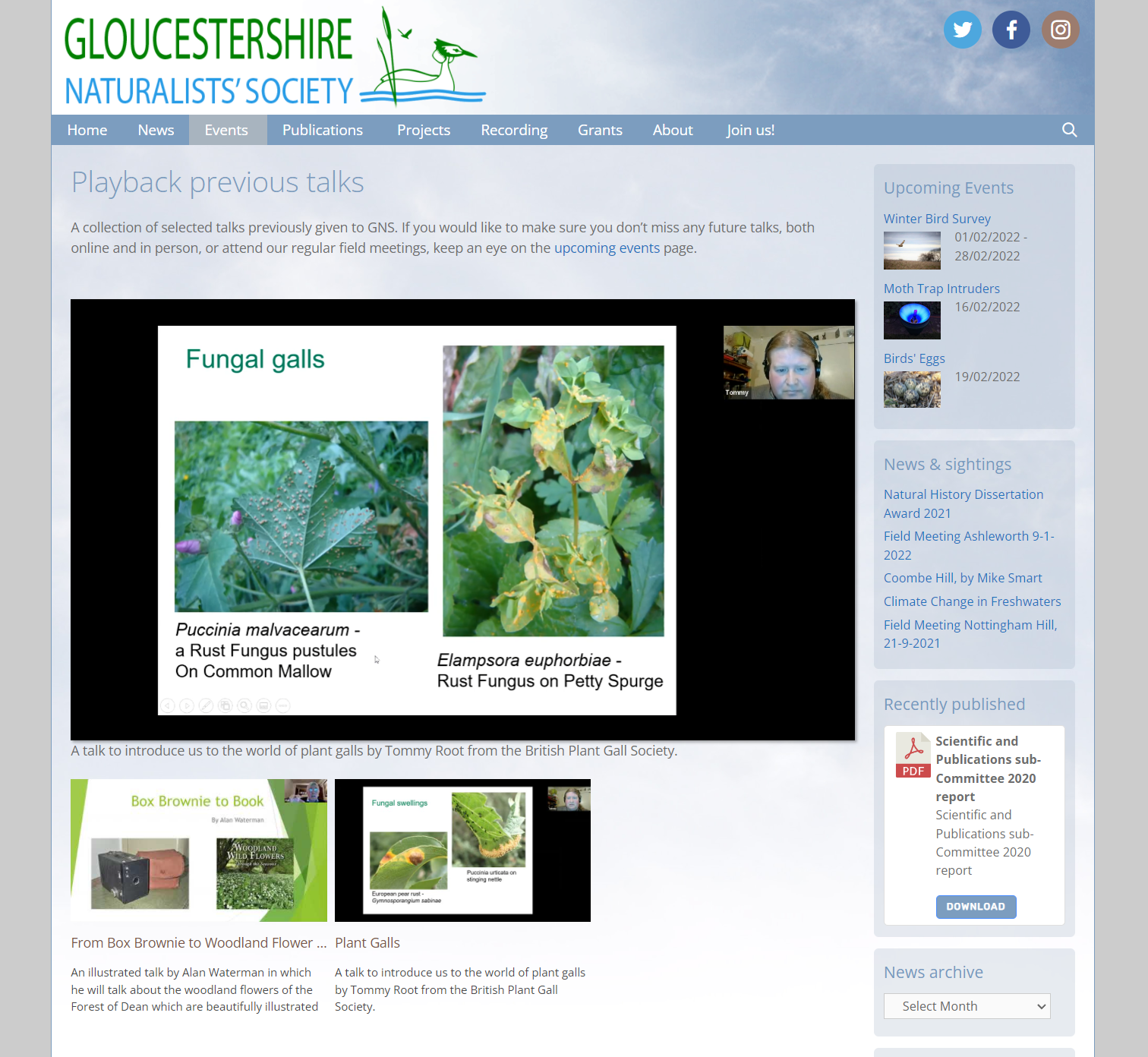
Please note that from February 2022, selected GNS talks will be recorded and made available to view on the GNS website. However, we can’t guarantee that any specific talk will be recorded, so it’s always best to attend talks that interest you as they take place. Keep an eye on the upcoming events to see what’s planned. Two previous talks are currently available already. These recordings are also accessible via the Events menu, as below.
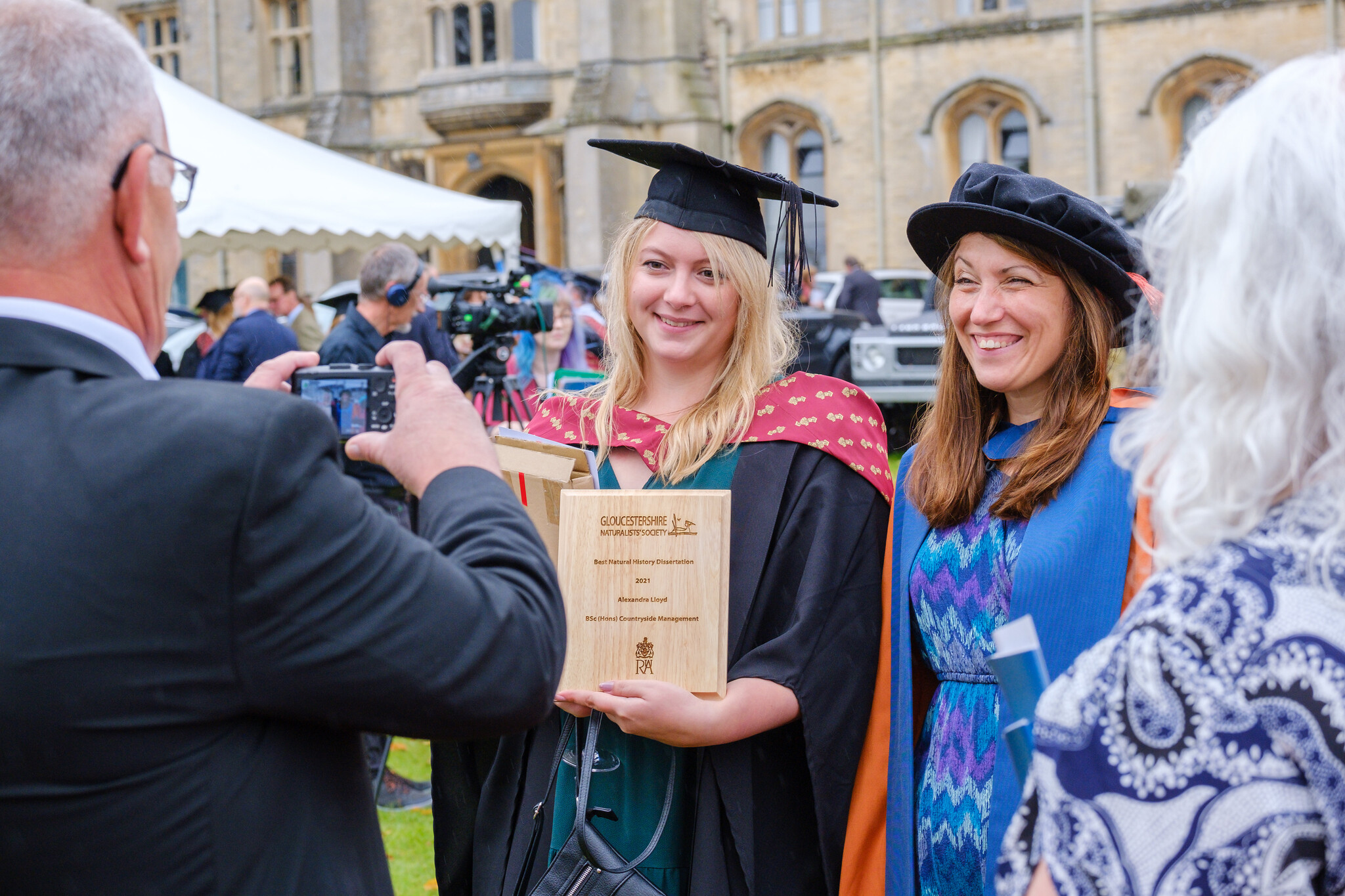
Alexandra (Lexi) with her prize and dissertation supervisor Dr Felicity Crotty
The Royal Agricultural University presented GNS’s sustainable bamboo plaque for the best natural history dissertation at their short graduation ceremony to Alexandra Lloyd studying the BSc (Hons) top-up in Wildlife and Countryside Management for her highest scoring dissertation under the criteria on ‘Tramline orientation effects on aboveground invertebrate dispersal’.
Globally, invertebrates have been found to have declined in abundance and diversity, in part due to the intensification of agriculture. However, with agricultural land covering 70% of the UK and forming a habitat for invertebrates within the soil, crops and hedgerows, farmers and scientists need to work together to discover the best ways to reduce this decline. The relationship between terrestrial invertebrates and agricultural management practices has been widely investigated, however this study aims to assess an area that is often overlooked; whether invertebrate dispersal from field edge is impacted by the orientation of tramlines in relation to the field boundary.
Overall, 646 invertebrates were collected via pitfall traps placed along 100m tramlines from the field boundary, an established hedgerow, to field centre, set over a twenty-four-hour period. These transects were orientated either parallel to the tramline or perpendicular to the tramline. Individuals were identified to the taxonomic family level. Soil compaction data was also collected, using a penetrometer, along the transects. An analysis of variance was used to analyse abundance of total fauna; Collembola; and predatory species (consisting of combined Coleoptera and Araneae data). In each of the three groups abundance was significantly higher in the perpendicular orientation than the parallel; total fauna (p<0.001), Collembola (p=0.001), predators (p=0.018). No significant difference was found over distance from hedge to field centre for any of the groups studied, nor was there a difference in diversity of samples collected across the transects. There was no significant difference in field compaction between orientation of measurements from the tramlines, however the distance from the hedgerow into the centre of the field did show significant differences (p=0.036), with greater compaction near the hedgerow.
Overall, the results of this study show that tramline orientations in relation to field boundary do influence some above ground invertebrates ability to disperse from the field edge to the field centre. This should be taken into consideration when surveying above-ground invertebrates within agricultural fields. Compaction had little direct impact on the above ground terrestrial invertebrates movements here, however it could affect flora species on which invertebrates rely for habitat and food source which encourages dispersal. Further research is needed to confirm these findings across season and at a range of different field sites.
A small group of about eight GNS members gathered for the first field meeting of the new year at Ashleworth Ham on Sunday 9 January 2022, in bright fine conditions, after a light early frost. The Gloucestershire Wildlife Trust reserve of Ashleworth Ham comprises the lowest area of flood meadows on the west bank of the Severn and surrounding fields and hedges, and has always flooded when the Severn is high, attracting good numbers of wintering waterbirds. for which Ashleworth and Hasfield Hams are designated as a Site of Special Scientific Interest. (Its old name “The Duckeries” reflects its former status as the hunting ground of the Hasfield Estate). The Severn at Haw Bridge reached a peak of over 10 metres on 27 December, not high enough for the river to overtop its flood-bank, but high enough to prevent local tributaries from discharging into the Severn, so that they back up and flood Ashleworth Ham. (‘Ham’ is a word of Anglo-Saxon origin, meaning a riverside hay meadow that may flood in winter). On the day of the GNS field meeting, water levels on the reserve were fairly high, perhaps a little too high for surface-feeding ducks to feed comfortably, but not enough to spill over onto the road, which happens when the Severn breaks its banks.
The main aim of the meeting was to look for waterbirds, but these were eclipsed, right at the beginning of the session, by the sight of three otters in the floodwater. Otter spraints and footprints are often found in the Severn Vale nowadays, but it is rare to have such good views of these extremely sleek and elegant creatures; they swam and played for several minutes in full view, so that their graceful shape, almost recalling a porpoise could be well seen. These were probably the same three individuals seen and photographed here in December by John Fletcher.
The usual ducks were present, but numbers were difficult to gauge, as many were hidden in the thicker vegetation under the ancient willows: roughly 200 Wigeon, 300 Teal, 4 Gadwall, 100 Mallard, at least 5 Pintail, 10 Shoveler; the Teal and Wigeon calling loudly. In the old days Bewick’s Swans and White-fronted Geese regularly came up from Slimbridge to Ashleworth and other flood meadows (the “Severn Hams”) at time of flood, but with the decrease of both species on the estuary, sightings have been rare in the Hams in recent years. Instead, the wintering goose population is now made up mainly of feral Greylag and Canada Geese, occurring in some numbers (at times over a thousand) and making an impressive spectacle with the sound of their calls and wingbeats, as they move between the water and grazing areas. At Ashleworth the greatest numbers of geese are found at dawn and dusk when they come in to roost, but one sizeable group of just over 100 Greylags was grazing on a grass ley (not very popular with the farmer!). Closer examination showed that one Greylag had a fair extent of white feathering on its crown and forehead, which might have made a casual observer mistake it for a Whitefront, but it wasn’t, just a Greylag a heavy orange bill and white on the head. However there was also a genuine Whitefront in the flock, much smaller than the Greylags and with a clearly demarcated white patch on its forehead, rather than a white smear all over the front of the crown; it had little or no barring on the breast and may have been the one that has been seen of late at the GWT reserve at Coombe Hill, only a few miles away as the goose flies. The Greylag flock also held an unusual hybrid, a cross between a Grey and a Swan Goose, a huge beast with a massive bill and a dark streak along its crown and nape betraying its Swan Goose ancestry. These hybrids stand out and are useful markers, making it possible to follow the movements of goose flocks: this one had been seen in previous winters, and was noted at Ripple Lake, just up the Severn between Tewkesbury and Upton, in October last; at that time there was little or no floodwater, so the birds stayed mainly at Ripple; now, with more water at Ashleworth, they have moved downstream.
Other waterbirds present included a small flock of perhaps 50 Lapwings (at the height of the flood in late December there had been 1,500 at nearby Longdon Marsh), and about 15 Snipe, most of them resting by day in the long damp vegetation, and waiting for dark when they fly out from their daytime roosts to feed with their extremely long bills in soft ground around the reserve. Some passerines also appeared in the hedges and willow pollards: Robins and Dunnocks, singing and defending territories already; a male Stonechat in the long dead Reed Canary Grass (probably with his mate nearby, since they remain in pairs in winter, though we could not find her), and a flock of a hundred wintering Redwings and Fieldfares, looking for invertebrates in the long grass, then flying up into the hedges as we approached. And surveying all from a discreet distance were two raptors, a Peregrine on the electric pylon and a Buzzard on a fence post.
The final observation was of two hares, now happily a relatively frequent sighting in this characteristic Gloucestershire Severn landscape of flooded hay meadows bordered by hedges of hawthorn with the occasional oak and many ancient, twisted crack willows (the Latin name is curiously Salix fragilis – they look anything but fragile with their boles appearing for all the world like Mediterranean olive trees).
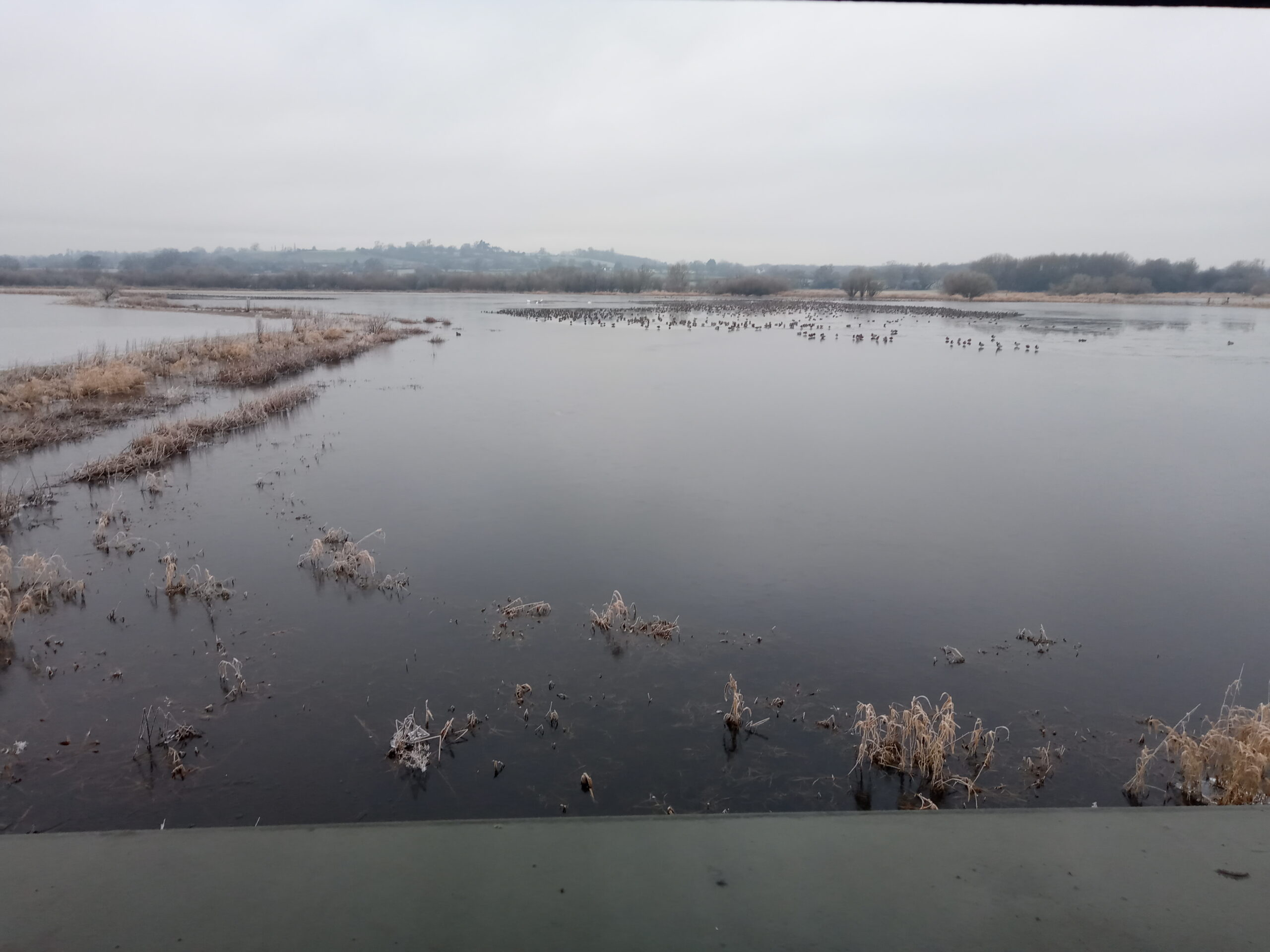
Although the Severn level at Haw Bridge has peaked, the level has not dropped enough for water to flow out from riverside meadows. So the levels on the meadows, and especially Coombe Hill, continue to rise; this morning the southern meadows were still quite deeply flooded and the north scrape was on about 1.05 (up at least 10cms since Monday), and there is now a lake in front of the Grundon Hide, and the circular walk is not passable. Continuing rise in duck numbers.
At least 3 Mute Swans, 160+ Greylag Geese (probably others grazing nearby), 5 Canada Geese, 445 Wigeon (considerable increase), only about 10 Teal (maybe more on the Long Pool or they may have moved out to shallower sites nearby), 4 Gadwall, 15 Mallard, 3 Pintail (first of the winter for me, though five were seen on Tuesday), 52 Shoveler (good number for this early in the season), 1 Tufted Duck, 2 Grey Herons, 2 Lapwings, 2 Dunlin, 1 or 2 Skylarks going over, flock of 20 Pied Wagtails (feeding round edge of floodwater), 1 Stonechat, about 80 Redwings in the hedges, 1 Cetti’s Warbler (song), 1 Blackcap (subsong), 1 Chiffchaff (calling), at least 1 Reed Bunting.
11/11/21
Now that the Severn level is dropping. I thought I ought to have another look for the missing Teal.
At Coombe Hill, water levels have dropped quite a bit: there is still extensive water in front of the Grundon Hide (level 0.95) but the circular walk round the back of the Long and Short Pools is now just about passable, with wellingtons. Water levels are high on the Long Pool and Short Pool – Long Pool didn’t seem to have any Teal on it, some hiding in the willows on the Short Pool.
5 Mute Swans (one very aggressive resident pair), 31+ Greylags, 20 Canadas (geese very mobile, flying in and out), NIL Shelducks, 392 Wigeon, 140 Teal, 20 Mallard, only 23 Shoveler, NIL Pintail, 1 Lapwing, 4 Snipe, big numbers of Redwings (150+), smaller numbers of Fieldfares (40+) along the canal bank, 1 Cetti’s Warbler singing well.
The Teal numbers were a bit higher than on Saturday when the circular walk was not accessible, but not very high, so I had a quick look at Hill Court in Worcs (from the northern Hill Court Farm end) thinking that the Teal might have taken refuge there. But water levels were not very high (only the scrape proper held water), and there were no very large numbers of Teal: 55 Teal, 1 Mallard, 20 Greylags, 45 Canadas.
So it looks as though there hasn’t yet been a very large influx of Teal.
13/11/21
Coombe Hill: Water levels continuing to drop on reserve, though area of floodwater in front of Grundon Hide still quite extensive: north scrape on 0.89. Water levels on Long and Short Pools still high.
5 Mute Swans, one male as usual very aggressive. Most geese had probably already left: only 40 Greylags, 20 Canadas left. Duck numbers a bit lower than in recent visits: only 133 Wigeon, not more than 15 Teal, 12 Shoveler, 2 Gadwall, but nice group of 11 Pintail, in fresh plumage (7 males, 4 females). Two Grey Herons, 2 Cormorants drying their wings on the island, 1 Buzzard and a lone Lapwing, 1 Snipe. At least two Water Rails squealing. Two or three Skylarks going over (no song) one or two Meadow Pipits. Good numbers of winter thrushes in the hedges along the canal bank – at least 50 Fieldfares and probably 150 Redwings. One Cetti’s Warbler singing.
Went on to Mitton, along the Avon just north of Tewkesbury (still just in Glos), to see if there were any ducks there: on the field with open water by the sailing club, a nice gathering of 125 Wigeon, 40 Mallard, 5 Shoveler and 10 Teal, with 125 Greylags. Also large numbers of Fieldfares (50) and Redwings (100).
On Bredon’s Hardwick Pits and Meadows (adjacent to Mitton, just in Worcestershire); on the pits 35 Tufted Ducks, 1 Little Grebe; on the meadows: 5 unringed Mute Swans, 220 Canada Geese, 60 Greylags.
16/11/21
Coombe Hill: I went at first light yesterday, in an attempt to see the ducks and geese before they dispersed, and to get a better count. Of course it was foggy, so I could hear the geese leaving, but couldn’t see or count them.
Water levels continuing to drop: north scrape on 0.84, but water still extensive in front of Grundon Hide. 13 Mute Swans roosting, most flew out early on, leaving the aggressive resident pair. Many hundreds of Greylags flew out to the northeast while it was still foggy. 35+ Canada Geese. Counts of ducks: 111 Wigeon, 76 Teal (don’t think there are many on the Short Pool); 200 Mallard (surprisingly large number); only 8 Shoveler and two Pintail; 1 Sparrowhawk; at least one Water Rail squealing from Broadmere; 4 Lapwings; 3 Snipe asleep, huddled together on the island; no Redwings in the hedges at first light, about 20 later; 1 female Stonechat; 1 Cetti’s Warbler singing.
In the run up to COP26, the World Aquatic Scientific Societies highlight the immense threats faced by aquatic ecosystems and call for urgent action on climate change. This alarming message puts water resources and aquatic biodiversity front and centre. Indeed, freshwaters are both disproportionately important and disproportionately at risk from climate change and other human pressures. Although freshwater ecosystems host 10 times the biodiversity per area than the land and the sea, they are often overlooked.
Freshwater vertebrate populations are declining at a rate almost double that of those on land and in the sea surface, while the planet’s lakes are warming much more quickly, on average at almost three times the rate of the latter. And yet freshwaters are severely underrated in calls for action on climate change and the global biodiversity crisis. The Convention on Biological Diversity’s framework “to preserve and protect nature and its essential services to people” focuses on the land and the sea, overlooking the pivotal role of freshwaters in the earth system.
The Freshwater Biological Association provides essential conservation actions, long-term data, and training to equip amateurs and professionals to engage with the nature and climate emergencies. In the midst of COP26, we echo the call from WWF and the World Aquatic Scientific Societies to encourage world leaders to recognise the extraordinary importance of freshwaters. This is easily achieved by making a small textual change – focus on the land, freshwaters, and the sea. That tiny change has huge implications for the natural world and our place in it. Freshwater ecosystems must no longer be an afterthought. They are the planet’s most essential support for life – human and beyond.
Notes from the field meeting that took place on 21st September. Keep an eye on forthcoming events on the events page.
The walk on Nottingham Hill took place during a period of late summer sunshine and warmth, though the wildlife was in autumnal mode, with few plants flowering and few birds in evidence. There was therefore the opportunity to look in a little more detail at some confusing species of plants and practise identification using fruits, seeds and vegetative characters.
Using the shape of partially withered seed heads, we looked at several common grasses to try to establish their unique character. We also identified some yellow Asteracaea, bindweeds and thistles to genus level. At an old wall covered with bryophytes, we looked at the remarkable rehydration abilities of Rambling Tail Moss, Anomodon viticulosus, and in Gotherington Wood at some epiphytic mosses and liverworts.
The walk ended at the permanent short grassland of the old quarries on Longwood Common, where we found the remains of the summer flowers of thiss limestone community.
The Nottingham Hill circuit, with its extensive views across the Severn Vale, makes a varied walk. There are stretches of ‘high Cotswold’ arable fields, two former coppice woods and some short permanent grassland overlying old quarry works.
It is hoped to use the site for a dawn chorus meeting next year.
Click here for a list of selective species in the order encountered.
We are planning to have two meetings a month for the next season: one a fixed meeting on the first Sunday of the month, usually starting at 10.30 and lasting about 2 hours. This will always be a general meeting to see what we can find. The second meeting of the month has no fixed date and might be more specialist to a particular habitat or taxonomic group. Some meetings may require pre-booking, in which case this will be flagged up in the listings. Otherwise there is no need to book. Please do not attend if you have, or have recently, tested positive for Covid-19.
A list of currently scheduled meetings is now available on our upcoming events page.
This website uses cookies to improve your experience. We'll assume you're ok with this, but you can opt-out if you wish. Cookie settingsACCEPT
Privacy & Cookies Policy
Privacy Overview
This website uses cookies to improve your experience while you navigate through the website. Out of these cookies, the cookies that are categorized as necessary are stored on your browser as they are essential for the working of basic functionalities of the website. We also use third-party cookies that help us analyze and understand how you use this website. These cookies will be stored in your browser only with your consent. You also have the option to opt-out of these cookies. But opting out of some of these cookies may have an effect on your browsing experience.
Necessary cookies are absolutely essential for the website to function properly. This category only includes cookies that ensures basic functionalities and security features of the website. These cookies do not store any personal information.
Any cookies that may not be particularly necessary for the website to function and is used specifically to collect user personal data via analytics, ads, other embedded contents are termed as non-necessary cookies. It is mandatory to procure user consent prior to running these cookies on your website.