At Oakhill Wood (Tidenham Chase) this morning a singing male Firecrest, a Wood Warbler, two Spotted Flycatchers, five Siskins (including a downy juvenile) and two Hawfinches.
Posted on behalf of Andy Jayne.

 gnsadmin
At Oakhill Wood (Tidenham Chase) this morning a singing male Firecrest, a Wood Warbler, two Spotted Flycatchers, five Siskins (including a downy juvenile) and two Hawfinches.
Posted on behalf of Andy Jayne.
Whatever the conditions were for the Thames pageant, the warm conditions and light rain of mid-afternoon of 3 June suited Swifts very well. A big number – maybe 200 but hard to tell – were swarming like gnats over the surrounding corn fields, with a generally northerly drift of the flock, then returning southwards about half an hour later. A lesser number of House Martins and Swallows were with them. The Swifts were silent, feeding, which somehow makes them even creepier.
Waters continue to drop gradually after the flooding of early May.
The female Red-necked Phalarope, not seen since Saturday last and thought to have departed towards its northern (Shetlands?) breeding grounds, was nevertheless still present and showing well on the north scrape. A rare visitor to Gloucestershire, particularly in spring. This is a family where the female is the brightly-coloured one; she lays the eggs, then leaves the male to incubate them and raise the young.
Otherwise, no great surprises: ten Mute Swans (nearly all non-breeding immatures, the nesting adults having lost their nests and eggs in the floods); 29 Canada Geese (presumably also non-breeders); two Shelducks (both males: are there females sitting on eggs somewhere?); a pair of Gadwall; just three drake Tufted Ducks (which occurred in good numbers on the floodwater, but have decreased since the flooding dropped); one Sparrowhawk; 50 Coot (with a family of three chicks on the canal); one Oystercatcher (which lost their eggs in the floods; are they going to try again?). The Lapwings were very interesting: only about five adults present, against fifteen or twenty before the flooding, (one pair apparently beginning a replacement nest), plus three full grown and flying juveniles, which had come through the floods unscathed, possibly because they were moved by human hand to higher unflooded ground. Only two or three Curlews: will they try to lay a replacement clutch? Similarly a single Redshank, perhaps nesting again? Two Cuckoos singing; one Yellow Wagtail, a species which has decreased greatly in hay meadows in recent years; four singing Redstarts, a typical species of the site, unlikely to be affected by flooding because they nest in holes in trees; only two Sedge Warblers singing, rather less than might have been expected, (perhaps because they nest near the ground and had suffered from flood waters); one or two Whitethroats in song.; two or three Reed Buntings in song.
The floodwater is retreating, but levels in and around the scrapes are still relatively high for the spring/early summer. The female Red-necked Phalarope in summer plumage (which has attracted nationwide attention and a large number of visitors to the hides over the last ten days) was nowhere to be seen, and may have moved on to northerly breeding areas. Plenty more to watch however, notably two passing migrants, a full plumage Black Tern which circled the scrapes for a few minutes before moving on to the northwest (along the Severn), and a Greenshank, which landed for a few minutes before moving on northeast.
Also 25 Mute Swans, 32 Greylags and 16 Canada Geese (all probably non-breeding immatures or birds whose nests have been washed out), 1 Wigeon, 8 Gadwall: all the numerous Tufted Ducks which appeared during the flooding had disappeared, as had most of the Great Crested Grebes.
In addition three Cormorants, a Grey Heron, 4 Little Egrets, 3 Buzzards, 1 Sparrowhawk, 1 Oystercatcher. As for Lapwings, there were eight round the scrapes on the GWT reserve, together with three large chicks that had survived the floods (perhaps with help from human well-wishers who moved them to higher ground?); off the reserve there was one Lapwing with eggs on arable, another on eggs on grassland near Southern Meadows – both no doubt replacement clutches after the flooding. Two Curlews, about 20 Black-headed Gulls (moving through to northeast), 30 Lesser Black-backed Gulls (eating dead fish on the tideline – one of them with a blue colour ring, originally ringed at the Gloucester Landfill Site by the Severn Estuary Gull Group in April 2010 and re-seen in late 2011, first on the French Atlantic coast and then in southern Spain. Plus two Cuckoos, one Little Owl (becoming increasingly scarce here), 1 Yellow Wagtail over, 4+ Redstarts singing, only 1 Sedge Warbler singing, 1 Raven (also piscivorous).

There has been much publicity about the programme to re-introduce Cranes to south-west England. Eggs taken from wild Cranes’ nests in Germany have been brought to the Wildfowl and Wetlands Trust’s centre at Slimbridge, Gloucestershire, where the young Cranes have been hatched and raised, before being released in suitable Crane habitat on RSPB reserves in the Somerset Levels. Earlier this week there were reports of four of these Cranes, all colour-ringed and two of them fitted with satellite transmitters, which had returned to Slimbridge under their own steam.
On Wednesday 16 May, while listening out at about 22h00 for nocturnal species at the Gloucestershire Wildlife Trust’s reserve at Ashleworth Ham, I was astonished to hear what I thought was the call of a Crane. I didn’t really believe my ears, until I received a message the next day from Lawrence Skipp, saying that he had found four Cranes, all colour-ringed, doing the Cranes’ dancing display on the Hasfield side of the SSSI. I passsed this message on to the RSPB, who sent me the image shown above, which is what the satellite transmits to them. The fields at Hasfield Ham are clearly recognisable (on a Google Earth image, obviously taken in a dry period, and the blue circle around the yellow and red image confirms that this is a night shot. So this is what the information from the satellite-marked bird looks like, when it reaches the researcher’s computer.
Interestingly, all four birds were back at Slimbridge on Thursday evening, 17 May, but one of them was at Ashleworth again on Friday 18 May at midday, and one was still present at Ashleworth at 0530 on the morning of Saturday 19 May. No computer pictures from these birds as yet!
Clearly the habitatat at Ashleworth and Hasfield on a dropping flood suits Cranes (see picture below of Hasfield Ham, taken on 19 May). This whole area floods when the Severn is high (the course of the Severn is about two fields below the bottom of the satellite picture above). A few days before the Cranes arrived, the whole area would have been under shallow water, about a foot deep with a little emergent vegetation; once the Severn drops, the water recedes rapidly. The RSPB comments that the site looks very like the area where the Cranes have been released in the Somerset Levels. As a matter of fact, when the RSPB was first looking at suitable sites for Crane release, an invertebrate specialist visited this area, to make samples of potential crane food, and to judge whether this might have been a suitable site for crane release; but in the end the Somerset Levels were chosen in preference.

The Severn has dropped considerably, but flood levels on the riverside meadows are slow to recede, because the outfalls to the river are so narrow. The Grundon and Long Pool hides on the GWT reserve are still inaccessible (unless you have chest waders), though likely to become accessible with wellingtons only in a day or two. Excellent views across the floodwater are available from the canal towpath however.
The feature of the last week’s flooding has been an incursion of unusual numbers of species which like deep water, in larger numbers than at any time over the last couple of winters. Where did they come from at this advanced stage of the breeding season? And how did they know about the flooding? Today there were still 9 Great Crested Grebes (two doing the display dance), 2 Little Grebes (doing the whinnying display call), 36 Shelducks (some of them first summer immatures), 65 Tufted Ducks (very lively and active); also a pair of Shoveler and five other males, together with six Gadwall. The flooding had also attracted fair numbers of gulls, all feeding (no doubt like the other species) on the water surface, apparently on aquatic insects: 100 Black-headed Gulls, perching on posts and behaving as though they were in a colony, perching on fence posts and calling noisily (though most were first year immatures), about 150 Herring Gulls (the vast majority immatures) and 50 Lesser Blackbacks; plus an immature Mediterranean Gull; in addition large numbers of hirundines were feeding low over the flood water – difficult to assess numbers, but there were at least 200 Sand Martins early on, joined by 200 Swallows and 20 House Martins in mid-morning, together with 30 Swifts mid-morning ( several hundred seen later, round midday).
Two Little Egrets, a pair of Oystercatchers in display flight, at least two bubbling Curlews, and ten Lapwings, one female with three large young (almost flying) that had escaped the floodwater somehow; but no sign of Redshanks. A pair of Coot along the canal with four newly-hatched red-headed young. Among songbirds at least six singing Redstarts, two Lesser Whitethroats and a Reed Warbler (first of the year at this site?).
Today there were two families of Great Tits round the garden, the first of the year out of the nest. I noticed them because of the fledglings’ reedy wheezy calls, then the harsh squawk of the adult warning them, probably to be quiet, at my approach.
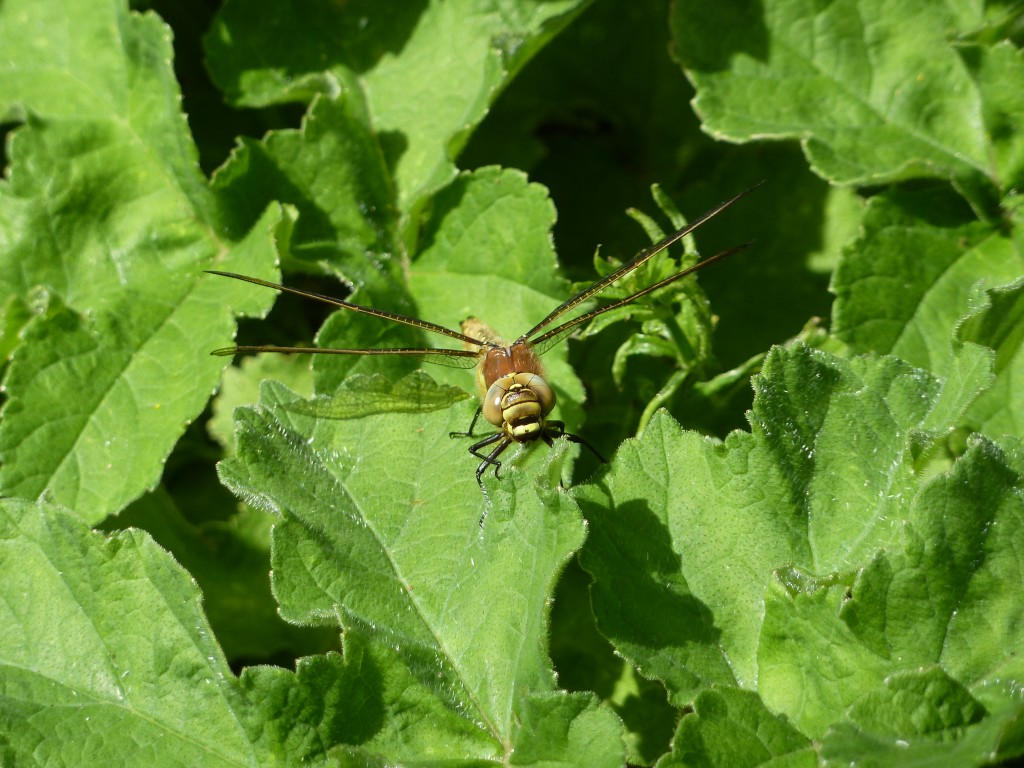
On 6th May, as there was a “weather-window” we decided to make a visit to Green Lane, Frampton, to look to see if any Hairy Dragonflies were on the wing. After looking for some time a female Hairy Dragon was spotted resting on the vegetation, obviously a newly-emerged one which hadn’t yet flown. On walking slowly back up the lane, but still searching diligently, a male Hairy Dragon was seen; another which had emerged on the day, but not yet taken its first flight. In between these two sightings, we ventured onto the 100-acres viewing platform, and had wonderful views of 4 Hobbies flying close by. I’m just hoping that the Hobbies don’t eat the Hairy Dragons!

 Bulbous Buttercup (Ranunculus bulbosus) is in full bloom on my front lawn in Standish. This is the first of the big three buttercups of the year to bloom. It can be recognised by the bent-back sepals under the yellow petals. It prefers slightly drier ground to the Meadow Buttercup (Ranunculus acris) which is just starting to flower.

The River Severn continues to rise: at Haw Bridge this morning it was beginning to overtop its banks, causing increased flooding of the meadows along the River Chelt, which is also high and swollen. As a result water levels at the Coombe Hill and Ashleworth Ham GWT reserves are rising sharply. At Coombe Hill, the Grundon Hide was just about accessible this morning, water not quite overtopping wellingtons, but it was harder getting out again. Robinson Crusoe syndrome?
High water levels at Coombe Hill are disastrous for breeding waders, but often brilliant for migrants. The two Lapwings with chicks still have a full complement: female B (hatched 16 April) still has three chicks, female E (hatched last Friday) still has four tinies; but they are limited to a small and diminishing patch of grassland between the scrape and the willows, which will get smaller and smaller as waters rise. Will they survive?
The main feature of the morning however was a massive passage of swifts, swallows and terns. At least a thousand or more Swallows, a couple of hundred each of Sand and House Martin, maybe 30-40 Swifts, moving through to the north east in a constant stream, stopping to feed over the water en route. Two Common Terns (which have in the past nested in the area) appeared early on, feeding over the water, perching on fence posts to preen and rest. Then between 09h45 and 11h15, there was a movement of Arctic Terns, very similar to Common Terns and probably the longest bird migrant in the world (they winter in the Antarctic and breed as far north as Finland). Four flocks, each of 30-40 (a total of 150 birds), not stopping for a second, powered past to the northeast, clearly birds which had come up the estuary and were taking the overland route to The Wash. A phenomenon often suspected in the past, but rarely observed, and certainly not in such numbers so far inland.
A variety of other passing migrants too: four excited, calling Black-tailed Godwits, at least nine Whimbrel, one Common Sandpiper, one Snipe; one Wheatear, and five Yellow Wagtails. Plus sundry songbirds along the canal towpath: a Cuckoo, Sedge Warblers, Lesser Whitethroats, a Redstart.