Sightings – January 2008

St Briavels (25 January, contributed by Roger Gaunt)

Frog spawn seen today in a spring fed garden pond.

Macaroni Downs and Eastleach (24/25 January, contributed by Ian Ralphs)

A small bat species was seen at 12.45am on the 24th in flight between Ladbarrow Barn and Macaroni Downs Farm, and at least partly being chased by a Kestrel. The temperature out of the wind in the sun was 9 degrees celcius, but in the brisk wind it must have been several dergees lower.

On Eastleach Downs on 25th were 2 Roe Deer, 8 Fallow Deer and 2 Hares.

Cranham area (24 January, contributed by Juliet Bailey)

A real sign of spring, Lesser Celandine (Ranunculus ficaria), was in bloom yesterday at Cranham, Upton St Leonards and Brookthorpe. It joins other early flowers. Hazel (Corylus avellana) is shaking long yellow catkins in many places. According to my mother in Ashleworth, who keeps a phenological diary, Winter Heliotrope also known as Cherry Pie (Petasites fragrans), and Primrose (Primula vulgaris), are earlier than last year, and Sweet Violet (Viola odorata) later.

Gloucester (21 January, contributed by Gordon Avery)

A fine adult Yellow-legged Gull was on the roof of platform 4 at Gloucester railway station at 1050 this morning.

Severn Hams (14 January, contributed by Mike Smart)

The Severn rose a bit between Saturday and Sunday, but not much; however, as it had broken its banks on Saturday, the meadows at Coombe Hill and Ashleworth, which are lower-lying than the river itself, have filled up rapidly and will continue to do so, as the water is still coming over the banks at Wainlodes and Chaceley.

At Coombe Hill, the water is up to the car park, and the towpath is inaccessible and likely to stay that way for some time; the Red Lion road is deep under water and entirely impassable; so the only way of approach is from the north at Apperley, by footpaths over the fields.

At Ashleworth, the Ham Road is flooded, so the normal route to the hide is closed; you can however come at it from over the top on the northern side if you really want to.

At Walmore, the water has risen considerably, and there is extensive flooding; there were at least 18 Bewick’s there this morning, including a family with two cygnets: they were all feeding on the flood water (so not possible to read ring numbers), apparently collecting food from below the water surface: what could they have been feeding on? More ducks (Wigeon, Shoveler, Teal), a few Canada Geese, eight Shelducks.

The flood situation is not desperate (for the moment, at least; it might change if there is any more rain!). The main roads are still easily passable – both the A 417 Maisemore road and the B 4213 Haw Bridge road. And the Boat remains open, though you will have to climb in via the Churchyard and the metal walkway.

Walmore (14 January, contributed by Mike Smart)

There were 21 Bewick’s (2 juveniles) at Walmore today. My count also produced 15 Mute Swans, 21 Canada Geese, eight Shelduck, 82 Wigeon, five Gadwall, 280 Teal, 220 Mallard, eight Pintail and 26 Shoveler. Also an adult Peregrine and a Water Rail calling.

Severn Hams (12 January, contributed by Mike Smart and Les Brown)

Heavy rain on Friday has caused local streams to rise sharply; they can’t get out to the Severn which has also risen, so the small streams are flooding back over the meadows. As usual when floods rise, birds are widespread and difficult to observe.

Coombe Hill this morning: flooding extensive, as River Chelt water backs up over the whole area; from midday, the Severn was overtopping its banks near Haw Bridge, bringing even more water. The Grundon Hide no longer accessible, even with wellingtons, though viewing is still possible from the towpath. About 10 Mute Swans, no sign of any Bewick’s at first light, 100 Canada Geese, 13 Greylag Geese, 10+ Wigeon, 20 Snipe.

Leigh Meadows: extensive flooding as Leigh Brook and Collier’s Brook overflowed, with Chelt is beginning to overtop. The field where the swans have been feeding is partly flooded: three Whoopers there, but the three Bewick’s have disappeared – gone to Slimbridge? About 10 Mutes.

Ashleworth; water levels are higher, but the hides are still easily accessible: 140+ Wigeon, 1 Water Rail, 20 Snipe.

Walmore (11 January, contributed by Mike Smart)

The rain of recent days has caused water levels to rise and there are now more extensive areas of water on the fields at Walmore; it might be quite good for ducks and waders over the weekend. Today between 14h00 and 14h30, through the squalls there were: 11 Mutes, 10 Bewick’s, all apparently adults and including the same three ringed birds seen earlier in the week (TUV white ring reading up on left leg; BCH white ring reading up on right leg; 607, yellow ring reading up on left leg). Also 4 Shelduck.

Severn Hams (8 January, contributed by Mike Smart)

At Ashleworth this morning, there was no sign of roosting Whoopers at 07h00; none could be seen looming against the lights of Gloucester or Cheltenham, and as the light improved, they were not obvious. However, at about 07h40, calls could be heard and the three birds emerged onto the open water from the thicker vegetation at the back where they must have been roosting. After some calling and head bobbing, all three flew off towards Leigh Meadows, where they were found grazing a few minutes later in the company of 20 Mute Swans and three Bewick’s, which had obviously roosted somewhere else.

35 Snipe on Cobney Meadows (Wainlodes end of Coombe Hill), and a large female Sparrowhawk flew over putting up several hundred Fieldfares and Redwings; rather little on the scrapes at Coombe Hill.

Sudmeadow (7 January, contributed by Gordon Avery)

A Common Sandpiper at the Lower Parting was a suprise this afternoon. Also the wintering pair of Stonechats still by the first pylon past the Lower Parting and a pair on Port Ham near Lower Parting.

Leigh Meadows (7 January, contributed by Mike Smart)

Since about Christmas, the two Whoopers (an obvious pair) have been grazing by day on the Leigh Meadows, and were joined by a third adult on 4 January. Since 3 January there have been from one to three Bewick’s with them, one of which has a colour ring, which shows it to be a bird ringed at Slimbridge in winter 2006/07, though intriguingly it has not yet visited Slimbridge this winter. Both Whoopers and Bewick’s have been feeding on the same field of agriculturally improved grassland; with them are up to 25 Mute Swans, so that – as in previous winters – all three British swans can be seen feeding together on the same field.

The question has been however, where do they roost? Swans normally like to roost on water as a protection from foxes and other predators. Various observers have tried to find this year’s roosting site (in previous winters it was often Ashleworth but they haven’t been seen there yet at roosting time this winter), so far without success. So this afternoon at about 16h00, I took up a position on a height overlooking the feeding field, intending to see where they go to roost. As expected there were three Whoopers, three Bewick’s and 25 Mutes, all grazing (actually right under the power lines). The sun set, the light began to fade and nothing had happened by 16h45; then most of the Mutes started to walk across the feed with their necks up, and after doing this for some time, 16 of them flew off, heading northwest into the light westerly breeze; they circled a bit and I saw no less than three of them hit the overhead lines and drop to the ground some way off; the others may have landed on the nearby Severn. Then at about 17h10, when it was nearly dark, eight of the Mutes and the three Bewick’s, after more walking round with their necks up, took off in the opposite direction, northeast towards the Coombe Hill scrapes. Finally when it was almost completely dark at 17h25, the three Whoopers went off together, this time going southwest towards to Ashleworth. I rushed round to Ashleworth, but it was too dark to see anything on the water; tomorrow morning maybe?

Interesting that as in previous winters the same feeding group are clearly using different roosting sites; and that the Bewick’s followed the Mutes rather than the Whoopers.

The power lines are clearly a real danger to all three species.

Severn Hams (4 January, contributed by Mike Smart)

The Severn level is down, so water is flowing slowly off the marshes into the river; most marshes are now at the normal optimum winter level.

Whooper numbers on Leigh Meadows have increased, from two to three! They appeared to arrive at first light from the Ashleworth direction. Still accompanied by a single Bewick’s, with a yellow ring, number 675; this is apparently a yearling, ringed in winter 2006/07 which has not yet been to Slimbridge this winter. Also about 20 Mute Swans with all three swan species grazing together in the same field of agriculturally improved grassland. About 60 Snipe on a nearby wet field, with a Green Sandpiper and a Little Owl.

At Ashleworth, the water level is just right with about 1,000 ducks; maybe 600 Wigeon, 150+ Teal, 50 each of Shoveler, Pintail , Mallard and a couple of Gadwall; a couple of Stonechats and maybe 10 Snipe on one wet field.

Walmore and Rodley (2 January, contributed by Mike Smart)

At Walmore there was no flooding, but the pools on the Common are full. 16 Bewick’s Swans, all on improved agricultural grassland: one flock of nine adults and two yearlings, none of them ringed; separate group on another nearby field was a family party of two adults and three cygnets; both adults had white rings, one was a yellowneb, reading TXF up on the left leg, the other a pennyface, reading BAT up on right leg; all three cygnets were ringed, (recently because the sellotape was still on the rings, making them more difficult to read: 701, 702, and 703 all on left leg reading up). Also four adult and five cygnet Mutes, on same field as and in close proximity to the 11 Bewick’s.

At Rodley, no flooding either, though the fields were plashy underfoot: 2 Grey Herons, 2 Mute Swans, 11 Shelducks, 8 Lapwings and a Kingfisher sitting on a fencepost.

Sudmeadow (1 January, contributed by Gordon Avery)

Seen today were 1 Green Sandpiper, 1 Kingfisher and 1 Grey Wagtail.

Sightings – December 2007

Severn Hams (31 December, contributed by Mike Smart)

Severn and Chelt are rising again, but the meadows are not back-flooding yet.

Walmore at 12h30, water levels low, just a little surface water, no real flooding: 15 Mutes, 11 Bewick’s Swans (all feeding on agriculturally improved grassland with no mat of dead grass, all adults, still quite nervous – “talking” to one another and raising necks when I approached – all definitely unringed), 2 Shelducks, 200 Teal, 6 Snipe, 1 Stonechat.

Leigh Meadows (from above Red Lion): 2 adult Whoopers, 1 adult Bewick (not checked for rings), 20 Mute Swans: all together on field of lush agriculturally improved grassland without mat of dead grass.

Walmore Common (29 December, contributed by Andy Jayne)

An adult male Merlin stooped unsuccessfully at a Meadow Pipit. Also nine Bewick’s Swans, 180 Teal, six Shoveler, 14 Snipe, a Kingfisher and five Stonechats.

Plusterwine/Aylburton Warth (29 December, contributed by Andy Jayne)

A huge flock of up to 1000 Bramblings with 500+ Chaffinch in a field of sunflowers and an oiled adult Kittiwake resting in a stubble field. Also 45 Teal, adult Peregrine, 500+ Lapwing, 50+ Dunlin, 205 Curlew, 21 Redshank and a Common Sandpiper in Cone Pill.

Severn Hams (29 December, contributed by Mike Smart and Les Brown)

Although the level of the Severn is slightly down, water is still rising on the riverside meadows as it cannot escape to the river. At Coombe Hill, the Grundon Hide is still accessible with wellingtons, though the water is over the boardwalk; shallow flooding has submerged the scrapes. 240 Canada Geese and 1 Barnacle roosting – the biggest group so far this winter – but all had left (mostly to the north going beyond Apperley) by 08h30. A few Mutes Swans roosting, but they also left early. 2 Shelduck, 340 Wigeon grazing round the edge of the flood, 30 Shoveler; on the Long Pool 120 Teal. One large female Sparrowhawk. The most unusual observation was probably a trio of Great Black-backed gulls that landed on the floodwater with the more familiar Lessers and Black-headed. At the Wainlodes end, a Little Owl, about 60 Snipe on one flooded field.

On the Leigh Meadows, same field as on Boxing Day had a flock of 17 swans grazing: two adult Whoopers, and adult Bewick and 14 Mutes. The Bewick was the same bird as on 26th December, now cleared of its limp and looking fully recovered; ring yellow on left leg, reading up, read as 675 again; a penny face with a striking face pattern.

Severn Hams (26 December, contributed by Mike Smart)

The Severn has risen sharply, presumably following the heavy showers over Christmas, causing slightly increased flooding round the scrapes at Coombe Hill. At first light today there were about 170 Canada Geese and seven Mute Swans, most of which had left by 0815, presumably to graze elsewhere. Otherwise it was distinctly quiet: only 25 Wigeon, lots of Teal calling from the Long Pool; 15 Lapwings on floodwater. No sign of Whoopers on the fields where they have been grazing for most of the month, but these fields now have large numbers of sheep on them, and the grazing is nowhere near as good as it was.

However, the Whoopers were found again on one of their usual fields on the Chelt Meadows at 09h30 this morning. They were on one of the fields where silage was cut in May, so there is no mat of dead grass and the grazing is fresh and appetizing. There were two adults, presumably the same ones, plus an adult Bewick’s Swan, with a yellow ring number 675 reading up on its left leg. It has an injury to the left leg and is limping and avoiding putting its weight on the left leg (which means that it holds the ring leg in the air, making it easier to read for once!). Also a Green Sandpiper and a Grey Wagtail.

Severn Hams (24 December, contributed by Les Brown and Mike Smart)

The two Whoopers have not been seen at Coombe Hill since 15 December; two were at Ashleworth on 17 December, but they clearly hadn’t roosted at Coombe Hill on 22 December; so, the objective for 24 December was to find the missing Whoopers. Off to Ashleworth, arriving before first light at 07h00. But there was no sign of any roosting Whoopers; where have they gone? Every winter they seem to take a few days off and disappear.

Instead about 180 Canadas were roosting at Ashleworth; the water level is just right and fair numbers of duck were present: about 500 Wigeon, 200 Teal, 90 Pintail, 75 Shoveler, 50 Mallard, 7 Gadwall and a single Tufted; 300 Lapwings passed over, no doubt a weather movement; about 20 Snipe and 1 Jack Snipe at the bottom of Stank Lane; and a couple of Reed Buntings.

Severn Hams (22 December, contributed by Les Brown and Mike Smart)

After the recent flooding, water levels have dropped, and there is little floodwater left, just the usual waters in the scrapes and Long Pool. Still quite a bit of ice on fields and Long Pool, so rather few birds about: 16 Mute Swans and 80 Canada Geese had roosted, but no sign of the Whoopers. About 200 Teal but few other ducks. Whoopers not on Leigh Meadows either.

Rather more birds at the Wainlodes end: 1 Green Sandpiper, 40 Snipe, 1 Little Owl, 1 Grey Wagtail.

At Ashleworth, water returned to normal winter level: a few hundred duck including about 20 Pintail. One Jack Snipe and one Common Snipe at Hasfield. Still no Whoopers.

Tewkesbury (21 December, contributed by Andy Jayne)

Four Shelduck, 34 Snipe, 50 Pied Wagtails and two male Stonechats on Severn Ham. A Little Grebe, two Water Rails (heard) and a Cetti’s Warbler at The Mythe.

Longford (17 December, contributed by Andy Jayne)

This afternoon a Jack Snipe flushed from the Hatherley Brook near Longford was then taken by a Sparrowhawk.

Sudmeadow (17 December, contributed by Gordon Avery)

Seen this morning in Sudmeadow Marsh were a Water Rail and a Chiffchaff (nominate race); there were also 30 Meadow Pipits on Sudmeadow itself.

Cheltenham (13 December, contributed by Robert Homan)

After a long run of years in which a winter Goosander flock was a regular feature in Pittville Park, in last few winters the birds have made only erratic appearances. Therefore, a male on the boating lake today was a welcome sight. This Harlequin Ladybird on one of the Holm Oaks in the park was a surprise, perhaps the almost completely black colour enabled it to warm up in the early afternoon sunshine?

Harlequin Ladybird, Pittville Park December 2007, R Homan.

Sudmeadow (11 December, contributed by Gordon Avery)

2 Redpolls, trapped for ringing, were the first ever at this site! A single Woodcock in the marsh and also a Water Rail calling plus a Kingfisher nearby.

Severn Hams (8 December, contributed by Mike Smart and Les Brown)

The Severn is rising further (level of 9.4 m at Haw Bridge today – it overtops at 10.75), and the BBC reports that flood defences are being put into place at Worcester and Upton. The higher Severn level means that the streams in the Severn Hams area cannot flow out into the main river, so are backing up and flooding riverside meadows. This weekend is duck count day, or as it‘s now called WeBS (Wetland Bird Survey day).

At Ashleworth, the reserve is now flooded to the normal winter level. The increased water level has attracted additional Pintail and other surface-feeding ducks in the last couple of days. This morning there were: 300 Wigeon, 250 Teal, 70 Pintail, 60 Shoveler, 55 Mallard, 7 Gadwall, 1 Stonechat.

At Coombe Hill: 190 Canada Geese, 1 Barnacle Geese, 2 Whooper Swans, 290 Wigeon, 110 Teal, 6 Shoveler, 58 Pintail , 1 Redshank, 1 Green Sandpiper.

Framilode and Priding (7 December, contributed by Andrew Jayne)

106 Golden Plover on the sands this afternoon plus up to 1000 in flight overhead. Also 33 Curlew, an adult Yellow-legged Gull and four Chiffchaffs along the footpath just west of Priding House.

Walmore and Ashleworth (6 December, contributed by Mike Smart)

With continuing rain, the Severn is still rising and causing the Severnside marshes to back-flood. There was a little more surface water on Walmore Common this morning, though you could hardly call it flooding. Even so, it did not attract any Bewick’s Swans which have been few and far between there this autumn and early winter. Just one family of Mute Swans (two adults and three grown cygnets, the male still extremely aggressive to a pair of Mutes that flew in); 100 Teal; 2 Snipe; 1 Stonechat; about 40 Meadow Pipits.

At Ashleworth, water is still pouring into the reserve, and normal winter levels on the main reserve fields should soon be reached. The hedge in front of the hide has been cut to give excellent views over the reserve.

Sudmeadow area (6 December, contributed by Gordon Avery)

2 Woodcocks at Sudmeadow osier bed. At least 2 Stonechats on Port Ham and 1 Green Sandpiper over to Sudmeadow after being flushed by a jogger over on Port Ham.

Severn Hams (5 December, contributed by Les Brown and Mike Smart)

Following the rain of last weekend, the level of the River Severn above Gloucester has risen sharply (though, I hasten to add, there is no risk of serious flooding at present). Since the Severn level has risen, the local streams round Coombe Hill and Ashleworth cannot discharge into the main river, so are backing up, filling ditches and causing light flooding on many meadows.

At Coombe Hill, there is little extra flooding as yet, but at Ashleworth, water levels on the main reserve are gradually increasing and conditions are just about perfect for surface-feeding ducks. Already Pintail have found it, and there were 31 there yesterday and 47 today. Also 50 Shoveler, 250 Wigeon and 150 Teal.

Walmore and Wilmer (Rodley) Commons (3 December, contributed by Mike Smart)

The rain over the last couple of days had caused a slight increase in surface flooding; conditions looked ideal for Bewick’s at both sites, but none at all were found. No Teal or Snipe either, perhaps because of the strong wind. At Walmore a pair of Stonechats. At Wilmer: five Shelducks lekking already, plus the Common/Paradise Shelduck cross that was there last winter; another Stonechat, 15 Pied Wagtails and eight Meadow Pipits foraging round the edge of the floodwater.

Hempsted (2 December, contributed by Gordon Avery)

2 Green Sandpipers on Sudmeadow Marsh in the morning.

December Field Meeting – Recognising trees in winter, Haresfield Beacon (15 December 2007, contributed by Juliet Bailey)

Nine members met near Haresfield Beacon for a session identifying trees and shrubs in winter. We saw 20 different kinds up close, plus alder, pine and larch at a distance. We considered many aspects – the twig characteristics, any remaining leaves and fruit, leaves on the ground, and distance recognition from silhouette.

We used the winter twig pdf from the Nature Detectives website as our crib sheet in the field. This shows 18 common species in colour. http://www.naturedetectives.org.uk/NR/rdonlyres/344CA3AC-3973-465F-9E30-828247B9770D/0/twigs.pdf

The Science and Plants for Schools website has an excellent twig key, but you need to take the specimen to your computer. http://www-saps.plantsci.cam.ac.uk/trees/index.htm

Also useful are the tree identification activity sheets on the Woodland Trust website http://www.woodland-trust.org.uk/discovery/images/treeid_activity.pdf

The Cotswold top woodlands of Haresfield Hill are dominated by ash and beech, with hazel and hawthorn in the understorey. The adjacent limestone grasslands have a light smattering of scrub species, especially hawthorn and blackthorn with ash, oak and birch also colonising. Other highlights of the meeting were 5 Roe Deer. Some of us were lucky enough to see a Woodcock fly across the lane as we made our way back to the cars in the twilight.

GNS Field Meeting Haresfield Beacon, Paul Tyers, December 2007

Sightings – November 2007

Hempsted (29 November, contributed by Gordon Avery)

A pair of Stonechats again on Fieldings Playing Field, Sudmeadow Road.

Sharpness area (26 November, contributed by Gordon Avery)

Sharpness shoreline to Berkeley Pill in the morning

65 Wigeon
73 Dunlin
5 Redshank
2 Rock Pipits
3 Stonechats, a female by the coastguard cottages and a pair along the ditch passed the water works.

Berkeley Pill

6 Redshank
24 Snipe
2 Rock Pipits
1 male Stonechat

Sharpness Docks (midday)

Adult Peregrine at the Silo nest box
First winter male Black Redstart on the high gabled office building at the end of the road passed the Post Office.

Severn Hams (23 November, contributed by Mike Smart)

An early morning check at first light to see if any Whoopers were roosting on the water at Ashleworth reserve. None were found there, and none in the broader Ashleworth/Hasfield and Leigh Meadows area later in the morning.

The level of the Severn is still fairly high, holding up water in the ditches, and beginning to bring water on the reserve up to winter levels: there were fair numbers of ducks – 150 Wigeon, 50 Teal, 20 Shoveler, 5 Gadwall.

Sudmeadow (21 November, contributed by Gordon Avery)

An extremely quiet afternoon; the presumed same pair of Stonechats are in the field just past the Lower Parting.

Severn Hams (20 November, contributed by Les Brown and Mike Smart)

The scrapes at Coombe Hill are nicely filled: about 120 Wigeon doing just what Wigeon should do – moving out of the water to graze on the grass round the edge of the water, taking no notice of a passing fox; about 20 Teal; 12 Shoveler; nearly 200 Lapwing flew down river, which might be a weather movement; a Redshank which is unusual at this time of year. Birds of prey were much in evidence, including a Peregrine, a Sparrowhawk and a Goshawk. There 35 Meadow Pipits and 15 Pied Wagtails on the nearby damp fields.

At Ashleworth, the water rising on the reserve following recent rain and it looks as though winter water levels should be reached soon. About 30 Wigeon present and still one Water Pipit right in front of the hide.

Sudmeadow (20 November, contributed by Gordon Avery)

Male Stonechat on the edge of GLS behind Presswelds and a Kingfisher on the pool by the plantation on Sudmeadow.

Coombe Hill (19 November, contributed by Andy Jayne)

At Coombe Hill Meadows today there were two Water Pipits loosely associating with a flock of 35 Meadow Pipits on wet fields north of the Long Pool. Also two adult Whooper Swans, an immature Peregrine, a Water Rail, two Redshank, a Green Sandpiper, a female Stonechat and four Blackcaps along the canal.

Sudmeadow (18 November, contributed by Gordon Avery)

A Little Egret in flight over Sudmeadow, from Castle Meads towards the river at 9.34 this morning.

Nagshead RSPB Reserve (11 November, contributed by Robert Homan)

Not a lot in the way of birds, but still plenty of interest including many fallen leaves with “green islands” made by the larvae of micro-moths feeding as leafminers and able to maintain some green tissue in the leaves, probably by some type of chemical secretion. Two examples are shown below; on the left, the mine of Stigmella tityrella in a beech – a very common sight in beech woods at the moment and, on the right, Stigmella basigutella in an oak leaf – one of many species to be found on oak in the autumn.


Late Autumn leaf mines, Nagshead November 2007, R Homan.

In addition, this bird box, equipped for digital TV, was an interesting find – the only one seen on the reserve.

Birdbox, Nagshead November 2007, R Homan.

Cheltenham (10 November, contributed by Robert Homan)

A female Blackcap in Swindon Lane this morning and a male at lunchtime on the Honeybourne Cyclepath at St Pauls.

Sudmeadow (7 November, contributed by Gordon Avery)

Up to 2 Chiffchaffs in the marsh in the morning. One was trapped for ringing.

Sudmeadow area (5 November, contributed by Gordon Avery)

The female Stonechat still on Fieldings old playing field and it is posible the male is still around as well. Also 2 Red-legged Partridges – unusual here.

Frith Wood (3 November, contributed by Juliet Bailey)

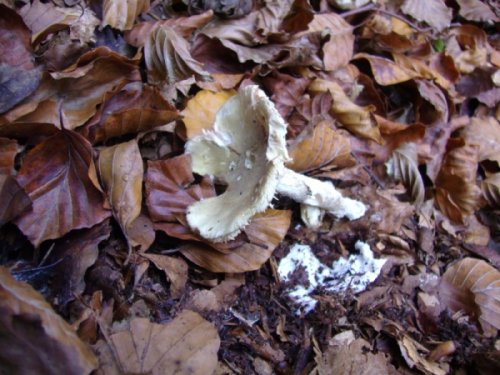
There was a GWT fungus foray in Frith Wood today, led by John Roberts. This has not been a good autumn for fungi, as it has been far too dry. Nevertheless, a wide variety of species was found, including the Death Cap, Amanita phalloides, shown below.

Deathcap Fungus, November 2007, Juliet Bailey

Beachley Point (3 November, contributed by Gordon Avery)

The highlights of a visit at high tide were:

Mallard – 75
Wigeon – 15
Peregrine – adult male on pylon
Lapwing – 80
Dunlin – 60
Curlew – 4
Redshank – 12
Jack Snipe – 1
Rock Pipit – 2
Stonechat – 1 male
Blackcap – 1 male

Sudmeadow (2 November, contributed by Gordon Avery)

The pair of Stonechats found on Fieldings playing field were still present this afternoon, quite nearby on the GLS slope behind Presswelds is yet another pair.

Sightings – October 2007

Severn Hams (30 October, contributed by Les Brown, Mike Smart and David Anderson)

Paradoxically after the flooding of the summer, water levels at Ashleworth and Coombe Hill are low for the time of year. At Ashleworth, the lack of recent rain means that it has not been possible to flood the main reserve area; however, the young willows which threatened to invade have been cut back and the brash burnt; at Coombe Hill, there is still water in the scrapes and ditches, but there is no surface flooding.

At Coombe Hill in the morning: 40 Wigeon, 20 Teal, 50 Shoveler, 1 Pochard, 1 Sparrowhawk, 5 Snipe, still 40 Meadow Pipits, 75 Fieldfares, 40 Redwings.

At Ashleworth Ham: 1 Sparrowhawk, 10 Snipe, 1 Jack Snipe on main reserve field, the Great Grey Shrike showing well at the bottom of Stank Lane on Hasfield Ham.

Coombe Hill (29 October, contributed by Gordon Avery)

The highlight of today was a juvenile female Peregrine that had a kill but kept getting disturbed by corvids after returning several times to its prize. Ironically the corvids never came back for the kill themselves. In addition, a juvenile male Sparrowhawk, 17 Wigeon and 6 Teal – all from the Grundon Hide. There were also small numbers of Redwings and Fieldfares in the canalside hawthorns.

Sudmeadow (30 October, contributed by Gordon Avery)

Stonechat numbers are still on the up with yet another pair found today. The new birds are on Fieldings old playing field (by Gloucester City F.C.) Sudmeadow Road, Hempsted.

Coombe Hill (29 October, contributed by Gordon Avery)

The highlight of today was a juvenile female Peregrine that had a kill but kept getting disturbed by corvids after returning several times to its prize. Ironically the corvids never came back for the kill themselves. In addition, a juvenile male Sparrowhawk, 17 Wigeon and 6 Teal – all from the Grundon Hide. There were also small numbers of Redwings and Fieldfares in the canalside hawthorns.

Sudmeadow (27 October, contributed by Gordon Avery)

An additional female Stonechat has joined the pair already in the area.

Sudmeadow (22 October, contributed by Gordon Avery)

Seen this morning during a ringing session:

270 Wood Pigeons east (in small flocks)
3 Grey Wagtails, 2 to the NE and one by Llantony Weir
2 Stonechats m and f Sudmeadow
Blackcap – 1f trapped for ringing
Starling – A dramatic rise from last Friday on GLS when about 120 birds were present. At least 1450 this morning.
A noticeable increase in Redwings as well but still no great numbers here. c.75 birds this morning.

Ashleworth Ham (15 October, contributed by Mervyn Greening and Mike Smart)

Another ringing session with some observation of visible migration. Only two Meadow Pipits were caught and maybe 25 seen. It looks as though passage is nearly complete. A few Skylarks and Pied Wagtails over to the SW. A Barn Owl screeching before first light and a Little Owl. 20 Redwings and 3 Fieldfares seen along with onne Raven and a female Stonechat. There were 5 Wigeon on the reserve.

Coombe Hill (11 October, contributed by Gordon Avery and Andy Jayne)

The following were seen late morning to early afternoon:

8 Buzzards up together over the reserve. Interestingly one very pale bellied bird with pale upper wing coverts and white looking rump.
2 Kestrels on the reserve
1 Ruff from Grundon Hide
2 Green Sandpipers – Parish Drain, canal
1 Grey Wagtail – Canal
2 Wheatears – meadows
25 Redwing – over meadows
1 Chiffchaff – Canal
3 Blackcaps 2m&1f – Canal. 1m in sub-song
1 Brambling – over calling

Ashleworth Ham (8 October, contributed by Mike Smart)

An early morning ringing session in near perfect ringing conditions, but the number of birds was rather low; it seems that the calm anticyclonic conditions in September have allowed many visible migrants to pass through already: only one skylark seen, 75 Meadow Pipits seen (15 caught), a dozen Pied Wagtails passed over, last week’s heavy Swallow passage now over, only ten seen. Small numbers of Reed Buntings about, sic caught. One Barn Owl screeching loudly as it hunted at first light, one Little Owl calling. One Golden Plover flew downriver calling.

The main field in front of the hide has now been mown, and willows pollarded, but water levels still low; maybe tonight’s forecast rain will raise levels. 25 Mallard, 2 Wigeon, 2 Green Sandpipers on pools. 2 Ravens flew over.

Cheltenham (4 October, contributed by Robert Homan)

20 Redwings were in an orchard in Swindon Lane early morning then flying off to the west. A little later 4 Redwings dropped into a hawthorn hedge by the disused Honeybourne line at Wyman’s Brook. In the Promenade, a Horse Chestnut with a single flower spike makes for an unusual October sight.

Coombe Hill, GNS Field Meeting (6 October 2007, contributed by Mike Smart)

Five members gathered on a calm morning at the top of the Canal, then walked along the former towpath to the meadows; they completed the circular walk round the Gloucestershire Wildlife Trust reserve, visiting the Grundon hide, which overlooks the shallow pools excavated in the meadows, then the hide looking into through the old withy bed into the willow-encircled pool, returning along the towpath. At this early stage of the winter, only a few ducks had arrived, but Wigeon, Teal, Mallard and Shoveler were noted on the Long Pool. A few passage waders, including a Greenshank and a Ruff had joined the wintering Snipe on the scrapes. The heavy southward passage of Swallows and Meadow Pipits noted in the previous week had diminished sharply, and instead a pair of Stonechats, just arrived for the winter, was noted.

Much interest was devoted to the state of the vegetation: many of the meadows had been “topped” by neighbouring farmers ie. a mower had been driven over them in an attempt to remove the mat of dead vegetation caused by summer flooding; in fact this seemed to have had little effect other than compacting the matted dead grass; however the leaves of many typical meadow plants (cinquefoil, burnet, silverweed, grasses and sedges) were pushing through the gaps in the matting, and there seemed hope that the mat of dead vegetation would disappear naturally with the frosts and rain (and probably more flooding, hopefully light) of the winter. Along the hedgerows a tidemark several feet up was still clearly visible, but the tops of the bushes and tress seemed t have survived and there were some signs of new shoots, and even some flowers, among the dead branches of hawthorn and dog rose. But it look like a poor crop of berries for the wintering thrushes.

Sightings – September 2007

The Mythe, Tewkesbury (30 September, contributed by Robert Homan)

Further evidence of the effects of the floods on the timing of the flowering of plants – the lower branches of a Guelder-rose (Viburnum opulus) which had been submerged in the summer floods, were in full flower today, contrasting with the upper branches which had many large clusters of bright red berries.

Hasfield Ham (27 September, contributed by Gordon Avery and Mike Smart)

A female Stonechat and a Wheatear were present early morning.

Coombe Hill (26 September, contributed by Mike Smart)

1 Greenshank still present and a continuing steady passage of Swallows and House Martins (several hundred of each) all day, with a few Meadow Pipits. Please note: the Long Pool Hide is now open again, as the floor which had floated up during the floods is now back in place.

Coombe Hill (25 September, contributed by Les Brown, Mervyn Greening, Mike Smart)

The geese are still roosting – 130 Canada Geese flew off to the south west and 90 Greylags separately to north east; 4 Little Grebes, 50 Shoveler, 30 Teal, 1 Pochard, a male Peregrine perched on a tree, 1 Water Rail at close range from the Grundon Hide, 10 Snipe and 1 Greenshank. There was a constant southwest passage all morning of Meadow Pipits and Swallows (probably a couple of hundred of each) with much smaller numbers of Skylarks; three Chiffchaffs singing, and a few Reed Buntings.

GWT volunteers are clearing dead vegetation along the towpath and pioneer willows from the islands in the scrapes, repairing the Long Pool hide and cutting vegetation in front of Grundon Hide to improve the views from the hide.

Severn Hams (24 September, contributed by Mervyn Greening, David Anderson and Mike Smart)

Ashleworth: for the last week Meadow Pipit passage has been very heavy, and good numbers have been caught for ringing, using a recorded song tape to attract them to the nets. On 17 September 60 were caught (and at least 200 were estimated present) and on 22 September another 58 were caught, out of several hundred passing through. Of the nearly 200 pipits caught so far every single one has been a juvenile (eggs laid this year), presumably on their way to wintering grounds in Iberia. On 22 September, a male Merlin was chasing the pipits which are frequent prey species for Merlin and nearly entangled itself in the nets. Also caught on 22 September, a late juvenile Redstart and a late juvenile Sedge Warbler, plus about 14 Reed Buntings. This was encouraging, given that this species fared badly in the floods, though these birds had probably come in from outside the immediate area. Also seen: two Wheatears, one Green Sandpiper, 15 Snipe and the two Hobbies, one of them still very noisy.

Coombe Hill: good numbers of geese are roosting but you have to get there very early to see them: on 20 September, 240 Canada Geese, 1 Barnacle and 80 Greylags left before 07.00am; also 50 Shoveler and 50 Teal.

Cheltenham (23 September, contributed by Robert Homan)

A Hobby flew low over Swindon Lane early this morning, trailing a few House Martins flying in a south easterly direction.

Sudmeadow (21 September, contributed by Gordon Avery)

On an otherwise quiet day, a Little Egret was on the marsh at Sudmeadow for 5 minutes just before 2.00pm then flew off towards the river in a westerly direction.

Standish (17 September, contributed by Juliet Bailey)

An albino Swallow flew over my garden at 8.30am, low but purposefully and not the zigzag feeding flight. It was on its own and flying at about 20ft, heading south west. It appeared off-white, maybe white with a hint of magnolia and I saw it for about 20 seconds before it was obscured by hedges.

Sudmeadow (13 September, contributed by Gordon Avery)

A Little Egret was pushed off the river by tide and flew over Sudmeadow towards Castle Meads at about 10.27am

Cheltenham (11 and 12 September, contributed by Robert Homan)

A far from complete survey of the trees along the Honeybourne Cyclepath between Malvern Road and the Prince of Wales Stadium produced counts of 51 adults and 115 larvae and pupae of Harlequin Ladybirds (Harmonia axyridis). In the sunshine on the afternoon of 11th the larvae were very active and all of the insects seen were found mainly on Sycamore leaves, especially where these were coated with honeydew from aphids. There was a wide range of colour forms of this highly variable ladybird present and some of these are shown below. The 18-spot form, shown in the top 2 pictures below, was by far the most common form. Also seen were the mines of Cameraria ohridella, the Horse Chestnut Leafminer, on Sycamore which is a foodplant that has also been recorded in other areas where the moth has reached very high numbers. Finally, a Blackcap was is full song near the Stadium on the 11th, and typically of mid-September, Chiffchaffs were singing on both mornings.

Newly hatched Harlequin Ladybird at 2.00pm (top) and 5.00pm (above), 11 September 2007, Robert Homan

Colour forms of the Harlequin Ladybird, September 2007, Robert Homan

Sudmeadow (11 September, contributed by Gordon Avery)

The Whinchat was still present this afternoon just below the Lower Parting. Also a Kingfisher at Llantony Weir.

Sudmeadow (8 September, contributed by Gordon Avery)

During the afternoon there was a Little Egret along the river. A Whinchat by the Parting and 5 Green Sandpipers on the marsh.

Hempstead (7 September, contributed by Gordon Avery)

A Kingfisher flew low over the garden at high speed this morning.

Sudmeadow (6 September, contributed by Gordon Avery)

2 Green Sandpipers again this morning in the marsh. Among the birds trapped for ringing were a Lesser Whitethroat and a young male Reed Bunting.

Severn Hams (1 September, contributed by Mike Smart and Les Brown)

Coombe Hill this morning: the Spotted Crake was still showing nicely on the bank and swimming but only until about 08:00 after which it went to ground. Also 2 Little Grebes, 1 Pintail, 14 Shoveler, 2 Green Sandpiper, 1 Common Sandpiper, but still no sign of any Skylarks, 5 very definite Pied, not White, Wagtails.

Ashleworth: at least two and probably three Hobbies, still very noisy and very obvious round the pylon at south end of reserve.

Sightings – August 2007

Severn Hams (30 August, contributed by Mike Smart and Juliet Bailey)

We walked from the Wharfe end of the Coombe Hill canal to the Wainlodes end, taking in the surrounding fields then went over to look at parts of Ashleworth and Hasfield Hams. The fields are beginning to green up again after the floods, particularly those where hay had been taken before the floods came. In most places the grass is still lying where it fell, forming a muddy dead crust about 3 inches off the ground though farmers are starting work on some of the fields, cutting or topping the fallen hay and breaking up the crust. The crust itself is dry, but underneath is still very damp. Certain plants seem to be doing absolutely fine. Creeping cinquefoil is sending its spidery rooting stems across the crust. Great burnet is vigorously pushing new leaf through (see photo). A few docks are already sending up leaf from the old stock, and there are masses of dock seedlings (will this be a problem next year?). New grass is now hazing across the brown; sometimes it is the old grass reshooting, elsewhere it is seedlings. The Carex beds are greening up nicely, though the known clumps of Carex vulpina that could be found are showing no signs of life as yet. Some hedgerow shrubs still look very brown and may have died, but others are pushing out fresh growth. On the whole, trees seem to have come through the floods unscathed, though there are fallen dead trees from windthrow earlier in the year. It is too early to say what the botanical outcome of the flooding will be. There will probably be changes, but it may not be an out-and-out disaster. We will have to wait till next year to see.

Great Burnet re-growth, August 2007, Juliet Bailey

Sudmeadow (30 August, contributed by Gordon Avery)

3 Green Sandpipers in the marsh this morning. 1 Yellow Wagtail over and 140 Mallard disturbed off the river by the tide. That is the first Yellow Wagtail that I have had on my patch since May 2002!

Ashleworth and Coombe Hill (28 August, contributed by Mike Smart, David Anderson, Les Brown and John Wiltshire)

At Ashleworth this morning, two Hobbies sitting on one of the pylons or in nearby trees; very vocal with constant calling and appeared to be recently fledged young birds waiting to be fed. One Peregrine, 15 Snipe, 90 Teal. Very few passerines, although we finally found two Reed Buntings after much searching, one burst of Willow Warbler song, a few Chiffchaffs calling, very little else other than Robins.

At Coombe Hill, a Spotted Crake showed itself in thick vegetation right in front of the Grundon Hide; shows it’s worth just sitting and waiting to see what turns up!

Walmore Common (27 August, contributed by Mike Smart)

The area has dried out a bit now, but it is still very soft and spongy underfoot with lots of midges. It has dried out enough for some hay (of poor quality and only usable for bedding) to be cut on western half.

Snipe have decreased but still about 70; 3 Lapwings; 60 Teal, 5 flava Wagtails; a Whinchat on a fence post; lots of Swallows and House Martins hawking for low flying insects.

Coombe Hill (25 August, contributed by Mike Smart and Les Brown)

It is still pretty brown and desolate with no hay cut, but some grass beginning to grow through the mat of dead hay. Some waders on scrapes, all no doubt passing migrants: 25 Snipe, 2 Ruff, one Greenshank, two Green Sandpipers, one Common Sandpiper. About 40 Teal, 7 Shoveler, a Pochard, 12 Tufted Duck. There were bursts of song from Chiffchaff and Willow Warbler. There is a total absence at Coombe Hill and Ashleworth, of Reed Buntings; it looks as though the flooding has caused them to leave early.

Walmore Common (24 August, contributed by Mike Smart)

Walmore too has been affected by the floods, and Andy Jayne has been recording unusual numbers of several species, that have been taking advantage of the conditions.

The Common side is unusually wet for the time of year: the flashes are all full of water, very soggy and uncrossable, and there are no grazing animals. The numbers of midges are of tundra proportions! There is a muddy mat of vegetation, as at Coombe Hill, but it is not as severe, and the clumps of rushes and sedges seem to have come quite well through the flooding and are standing proud. From the bird point of view, there are some ducks (150 Mallard and 25 Teal), but the absolutely extraordinary thing is the number of Snipe: on 19 August, Andy recorded 165, already unprecedented, with 80+ on 22 August, but this evening there were at least 270, flying up on all sides, then circling in little flocks like Dunlin at high tide. I don’t ever remember seeing such concentrations, anywhere. They must be migrants returning from central and northern European breeding grounds (to Ireland?), which would normally have gone straight over the top of us, but have come to earth this year because of the wet conditions after the Severn flooding.

Coombe Hill (23 August, contributed by Robert Homan)

A quieter day than the 21st (see below) with 14 Teal and 2 Tufted Ducks visible from the Grundon Hide and 2 Willow Warblers and a Chiffchaff singing by the canal. The pictures below give an indication of the damage done by the floods. The first shows the hedges along the path from the car park at the Wharf End; the second shows Mute Swans on the canal, but notice the colour of the water; even worse pollution is shown in the third picture taken of the southern end of the ditch at the entrance to the Meadows section of the reserve; fourthly, sections of the hedges and large areas of the fields are covered with this material which has hardened to a crusty brittle layer. Finally, the view across the reserve towards Lower Apperley.

Sudmeadow (23 August, contributed by Gordon Avery)

3 Lesser Whitethroats and 2 Whitethroats were ringed plus 13 Long-tailed Tits. The highlights of the ringing session were 3 new young male Linnets. 3 Willow Warblers were also trapped. A Green Sandpiper was seen over Sudmeadow and a Painted Lady butterfly was about too. 13 Shelduck were seen in a loose flock heading north during the morning.

Walmore Common (22 August, contributed by Andy Jayne)

Seen today were 30 Teal, 150 Mallard, an adult male Goshawk, a Little Ringed Plover, 26 Lapwing, still 80+ Snipe, two Curlew and eight Yellow Wagtails. Also two Brown Hawker dragonflies.

Sudmeadow (22 August, contributed by Gordon Avery)

A Kingfisher flew upriver over Llantony Weir and a Green Sandpiper was seen at Lower Parting.

Coombe Hill (21 August, contributed by Mike Smart and Les Brown)

My (MS) first visit to the area since the second and larger July flood subsided. The Grundon Hide at Coombe Hill is now accessible (with wellingtons), but the whole area is a pretty horrible sight: most of the hedges are dead to a height of five or six feet, the meadows are covered by a brown muddy carpet of dead grass, with the odd dead dock remaining vertical. There is still a fair amount of standing water on the fields, but much of the water in the ditches and water courses is anaerobic and black, and there is a strong smell of decay everywhere.

Birdwise, about 60 Teal, dibbling for seeds round the edge of the scrapes, and three Shoveler. One Ruff, a Greenshank and two Green Sandpipers, all no doubt passing migrants. Lots of Swallows and House Martins flying low in the cold north wind, and being chased by a Hobby. A flock of 15 Pied Wagtails and two Yellow Wagtails, with one Redstart giving alarm calls from the hedges, Lots of Willow/Chiffs in the tops of the hedges, and bursts of song from both Willow Warbler and Chiffchaff. Not a single Reed Bunting all morning; where have they all gone?

Walmore Common (19 August, contributed by Andy Jayne)

I thought my count of 60+ Snipe at Walmore Common on 11th was pretty good, but today I returned to find an incredible total of 165. Also six Swifts, five Sand Martins and about 100 each of Swallows and House Martins, plus eight Yellow Wagtails finding the damp conditions to their liking.

Sudmeadow (16 August, contributed by Gordon Avery)

7 Green Sandpipers feeding in the marsh this morning.

Walmore Common (11 August, contributed by Andy Jayne)

In the morning there was one Little Grebe, a Hobby, 60+ Snipe, a Kingfisher and a moulting adult Whinchat. Obviously the Snipe count is exceptional for the time of year. There could well have been quite a few more, maybe up to 80, but the boggy areas were not completely searched.

Ashleworth Hams (8 August, contributed by Juliet Bailey)

I went out to Ashleworth today, where an extraoridinary scene presents itself where the floods have lain The bottom 8 or 9ft of the hedges is coated in brown with a tuft of green at the top. I crunched through fields where a crop of hay should have been taken, like walking on thin ice. There is a layer of grass set solid at about 3 inches above the soil, with nothing underneath.” The pictures, taken by Juliet, give an indication of the extent of the damage: The pictures, taken by Juliet, give an indication of the extent of the damage:

Grass encrusted with silt deposited by the flood water.

Footprints through the grass crust.

The view from the hide with the “tide mark” along the hedge in the background.

Away from the floods (8 August, contributed by Juliet Bailey)

In contrast to the gloomy news about the flooded areas of the county near the River Severn, the return of higher tremperatures has brought a summery look to many areas. The Crown Vetch on the Fosse Way south of Stow is extraordinary, lining the road with confectioners’ pink and my newly re-excavated pond in Standish is producing all sorts of dragonflies – including this ovipositing Broad-bodied Chaser female.

Broad-bodied Chaser, Standish, August 2007, Juliet Bailey

Coombe Hill (6 August, contributed by Andy Jayne)

I visited Coombe Hill Meadows late this afternoon, walking from the Wainlode end. It was not a particularly pleasant experience. As Mike Smart has already observed, the state of the water is quite disgusting, hopefully just a result of the rotting vegetation rather than anything else. The water is black,oily and foul-smelling. The whole area looks as if it has been immersed in acid rather than water!

A lot of the vegetation looks quite dead up to height of 6 or 8 feet in places and there is little sign of it starting to recover yet. Along the towpath I found three fish (Rudd?), an eel and a Mallard all dead. The Grundon hide is easily accessible with waders and it may be possible to get there with wellies in a few more days. The hide was obviously completely submerged at the height of the floods and the log-book is lying ruined on the floor. There were also around 20 leeches crawling around the floor. Yuck! There is no obvious damage to the hide or the boardwalk however.

Despite all this I was quite surprised to find quite a number of birds tolerating the conditions. A few Mute Swans present and about 120 Canada Geese towards the west end were all noticeably brown stained. From the hide I noted two Gadwall, three Teal, 20+ Shoveler, a pair of Garganey (presumably the pair present during the spring), five Pochard, 10+ Tufted Duck and three Great Crested Grebes. Two Little Grebes and two Water Rails were heard calling and there was also a Little Egret and at least eight Grey Herons. An adult Peregrine flew over and a male Sparrowhawk was bringing prey to two juveniles that were hanging about near the hide. Apart from 34 Lapwing there was no sign of any waders. There were very few small birds about and not a single Swallow or martin over the floodwater.

So, still quite a bit of interest here, but certainly not a nice place to visit just now. It will be interesting to see how long it is before the area recovers. I suspect it will be several months at least.

Sightings – July 2007

Sudmeadow (23 July, contributed by Gordon Avery)

A Kingfisher landed for a few seconds on the washing line in my floooded back garden.

Severn Hams (20 July, contributed by Mike Smart )

The Severn level began to drop on Wednesday, and there was some outflow of water trapped on the meadows, but it’s very slow and the water is of an appalling quality: black in colour (the Chelt and the Deerhurst Parish both leave a black plume as they flow into the mud brown Severn). The black colour seems to be coming from decomposing plant matter which is using up all the oxygen, and there is an unpleasant oily film on the surface. This means that any small fish which were in the floodwater have died from lack of oxygen, and it seems that large numbers of earthworms and other invertebrates have died too. As a result, the hay crop has been completely spoilt, and no-one in the farming community knows quite what to do with the resulting dirty vegetation.

The Ham Road past Ashleworth is now open and the hide is easily accessible, but water levels on the reserve are very high and have prevented the Constant Effort ringing from taking place. The Red Lion road at Wainlodes is open; but the Coombe Hill hides are still only accessible with thigh waders. The heavy rainfall of today will only make things worse over the next few days.

The large number of dead fish attracted unusual numbers of herons: there were up to 30 Grey Herons on the Ashleworth reserve on Monday; some observers thought they had seen a Night Heron, but this was not confirmed. Little Egret numbers round the edges of the Coombe Hill floods have been unusually high (reports of 10 and 16), and a group of 21 were found roosting in a nearby wood.

A Hobby over Ashleworth on Tuesday, and an adult Mediterranean Gull flying over in the evening en route to the estuary.

Barn Owl calling from Meerend Thicket near Ashleworth late in the evening on Tuesday and Wednesday.

Sudmeadow (18 July, contributed by Gordon Avery)

A juvenile Nightingale trapped for ringing this morning at Sudmeadow was only the second ever ringed at the site. The first being an adult female as long ago as 9th June 1994!

Coombe Hill (15 July, contributed by Andy Jayne)

Seen in the evening were six Teal, three Shoveler, c.32 Tufted Duck, two Little Grebe, two Great Crested Grebe, 13 Little Egret, 19 Grey Heron, a Hobby, three Water Rail (heard), 38 Lapwing, a Dunlin, two Ruff, two Curlew, two Green Sandpiper, a Common Sandpiper and two Redstart.

Sudmeadow (14 July, contributed by Gordon Avery)

A Clouded Yellow seen at Sudmeadow this afternoon.

The Leigh (12 July, contributed by Gordon Avery)

6 Little Egrets flying south over the A38 near Leigh at 21:10.

Severn Hams (10 July, contributed by Mike Smart)

The level of the Severn is dropping now, but the Ham road at Ashleworth and the road past the Red Lion at Wainlodes are still under water. Since the river overtopped its banks a week ago, a lot of water has got behind the riverbank and can only flow out slowly through the small number of outlets; it’s not supposed to do this in July! At Coombe Hill, the Grundon Hide is still inaccessible and likely to remain so for some days yet, as much of the canal bank is still under water. At Ashleworth, the hide is still inaccessible from the road, though will probably become accessible fairly soon.

There is still quite a lot of shallowish floodwater about which is quite attractive to birds, but very difficult to get at!

At Coombe Hill this morning, about 28 Lapwings (21 adults and seven flying birds of the year), one Redshank, all undoubtedly passing migrants rather than local birds, and a Green Sandpiper. No sign of Curlews which must also have lost their young, just one adult by floodwater at Wainlodes.

At Ashleworth, three Shelducks, a Greenshank and ten Lapwings on floodwater; no sign of Curlews either.

Lots of gulls on the edges of the floodwater, about 1,000 Lesser Blackbacks and 1,000 Black-headed at the Wainlodes end of Coombe Hill, also 3 Little Egrets. About 300 Black-headed (all one year olds or adults, no juveniles) at Ashleworth.

Some Whitethroats still singing and a Reed Warbler in a new place by the Red Lion.

Coombe Hill (4 July, contributed by Andy Jayne)

Some of the effects of the deep flooding at Coombe Hill Meadows and Ashleworth Ham are demonstrated by the picture below taken by Andy. It is a young Willow Warbler displaced from its nest by the floodwater, but luckily still being fed by the parents. The bird was discovered about 100 yards along Coombe Hill Canal from The Wharf where the tow path is inundated by 2ft of water.

Tuffley (early July, contributed by Rob Purveur)

This female Misumena vatia was photographed in Rob’s garden and identified by David Haigh. David commented as follows:
“It seems to be a good year for this species. I had a record last week from a correspondent Up Hatherley She described as you did the crab-like attitude and surprisingly a white variety on a pink rose. There is another colour form – yellow, which usually takes up its position on the yellow disc of Ox-Eye daisies, but I have quite often seen the ‘wrong’ colour variety against unsuitably coloured flowers. If it is not disturbed you will probably have it with you until maturity, unless its lack of camouflage makes it prey to garden birds. You may see it with prey, it will take pretty well anything, bees, wasps, butterflies, hoverflies, etc..”

Misumena vatia, Tuffley, July 2007, Rob Purveur

Sightings – June 2007

Severn Hams (27 June, contributed by Mike Smart)

The Grundon Hide at Coombe Hill was only accessible with waders (or wet legs) the evening of 25 June, and the scrapes and islands were submerged by the following morning because of local streams backing up. On the evening of the 26th, the Severn started to come over its banks below Haw Bridge, thus making the floodwater even deeper and closing the road past the Red Lion. By the evening of the 27th, the Severn had also broken its banks above Haw Bridge on the west bank, which means that the Ham Road from Ashleworth to Tirley is closed and the Ashleworth roadside hides are no longer accessible. The current Severn level at Haw Bridge is 10.93m and rising, which compares with the highest of last winter on 8 March (itself unusually high) of 11.15 m.

The high levels and rainfall in May and early June meant that many ground and long grass birds were having a hard time of it: Sedge Warblers and Reed Buntings were already doing badly, with very few juveniles, but the higher levels of the last few days will undoubtedly drown any remaining nests. Curlews seemed to be doing quite well because the wet weather meant that the hay had not been cut; but any Curlew chicks will not survive the deep flooding that has now occurred. The Sand Martin colonies in the Severn banks were already under water before the river broke its banks, so they will have to start again.

On the other hand, the Redstarts which nest in holes in willows seem to have done fairly well; at least three broods of young birds shave been seen at Ashleworth.

Seen at Coombe Hill on the 26th were a flock of 9 Black-tailed Godwits in full summer plumage by the floodwater, clearly failed breeders returning south already. A Flock of 19 Lapwings, including the only two fledged young produced by the ten pairs which attempted nesting, apart from a tiny non-flying chick, seen on 19 June apparently surviving on 26 June, but disappeared by 27 June, no doubt drowned by the rising water. Three adult Redshanks, which had produced one nearly fledged young; uncertain if the young one survived. Female Tufted Duck with seven ducklings, the second brood at Coombe Hill. One Green Sandpiper.

Coombe Hill on the 27th: two Green Sandpipers, sitting on fence posts, like breeding Redshank to keep their feet out of the water!

Ashleworth on the 27th: the male Shoveler still there; his one wing is damaged, he can shake it, but not fly. One female Wigeon.

Hank’s Gorse, near Brockhampton (21 June, contributed by Neil Pryce-Jones)

Seen today were a Privet Hawk-moth resting on a gate post and hundreds, if not thousands, of Pyramidal Orchids growing among the profusion of ox-eye daisies in the set aside fields in the area.


Privet Hawk-moth and Pyramidal orchid, Brockhampton, June 2007, Neil Pryce-Jones

Cheltenham (4 June, contributed by Robert Homan)

Records of the old and the new from central Cheltenham today. On the left below, a flower spike of Ivy Broomrape ( Orobanche hederae) in the front garden of a house in Malvern Place. This is presumably the site mentioned in the 1948 “Flora of Gloucestershire”. On the right, first generation mines of the the Horse Chestnut Leaf Miner (Cameraria ohridella) in nearby Malvern Road. This adventive insect should become even more evident in terms of the number and distribution of leaf mines during the summer.

Ivy Broomrape, Malvern Place and Cameraria ohridella, Malvern Road, June 2007, Robert Homan

Skip to content