GNS at Stroud Festival of Nature

GNS were at the Stroud Festival of Nature event in Stratford Park, Stroud on Saturday 7th September.

This remarkable gathering of Nature and Wildlife oriented individuals and societies largely driven and organised by local interpretive artist Steve Roberts, was held for the sixth time in Stratford Park close to the Leisure Centre and Museum in the Park and attracted a record crowd of some 5,000 visitors on a day of mainly bright if not excessively warm weather.

The Gloucestershire Naturalists Society stand was there primarily to promote the GNS and the forthcoming Birds of Gloucestershire, (due for publication in early November), and was manned by Andrew Bluett and Juliet Bailey. We spoke to many potential new members and were visited by several existing members, not least our president, Mrs Anna Jones.

Other societies were the RSPB, WWT, GWT, Butterfly Conservation, Gloucestershire Bee Keepers, Natural England and the National Trust together with a number of wildlife artists and other craft displays.

For more information on the festival, visit http://www.stroudnature.co.uk/

P1010573a P1010571a

Juliet Bailey entertains visitors with an identification “quiz” and talks to visitors.

P1010576a

GNS President Mrs Anna Jones offers encouragement and support…!

Events This Weekend 7th & 8th September

On Saturday 7th September, Gloucestershire Naturalists’ Society will be at the Stroud Festival of Nature in Stratford Park, Stroud – this is an event for all things connected with Nature and the Environment; Exhibitors and Contributors include The Stroud Valleys Project, RSPB, WWT, GWT, National Trust, Natural England, Butterfly Conservation and many others. Come along and visit, you are sure to find something of interest in the Nature Zone, or have a bite to eat and a drink in the Food Village.


On Sunday 8th September, Gloucestershire Naturalists’ Society together with Dursley Bird Watching & Preservation Society and others will be at the Frampton Country Fair in Frampton promoting the Birds of Gloucestershire avifauna (to be published in November). This excellent event is for all things “country” – conservation,  country related pursuits, animal husbandry, crafts, food and sports etc. Come along and visit, have a great day out for all the family, try your hand at something new, try some of the excellent food and meet your natural history & environment connected organisations both local and national.

Letter from the Chair, August 2013

Dear Members

In the Letter from the Chair in the last issue of GNS NEWS, I drew attention to the new subscription rates approved at the 2013 Annual General Meeting of the Society (incidentally, the first increase for about 20 years!). I’m delighted to say that most members who have renewed their subscriptions in the last couple of months have done so at the new rates. May I thank them for this sign of support for the Society. I hope that other members will follow suit in adopting the new rates, thus ensuring that the Society’s finances remain on a sound basis.

And now, a date for your diaries: Saturday 16 November 2013, when the launch of the “Birds of Gloucestershire” takes place at the Nature in Art centre at Wallsworth Hall, Twigworth, on the main road between Gloucester and Tewkesbury. The volume, edited by Gordon Kirk and John Phillips, reflects a huge amount of field work by volunteer bird watchers, including members of GNS and of the other bird clubs in the county, between 2007 and 2011; it is a local distillation and refinement of the national Bird Atlas which will be published at the same time. I have seen proofs, and can assure you that it is a high quality production, with authoritative texts by local authors, maps of summer and winter bird distribution, and high quality artwork and photographs. Do come along on 16 November, when the original artwork will be on show, and when you can meet the authors, artists and the production team. The GNS Committee agreed at the outset to make a grant towards the cost of publication, so we have been closely involved at all stages. The whole week-end of 16 November is being is coordinated with GWT, (the Gloucestershire Wildlife Trust), whose Annual General Meeting is being held nearby in Apperley Village Hall, and whose reserve at Coombe Hill will be hosting bird watching tours and visits, based on the new hide, over the weekend.

A recent issue of GNS NEWS carried on its cover a striking photograph of the wreckage of the old Grundon Hide at Coombe Hill; the boardwalk through the old osier bed at Broad Mere as well as the hide itself were completely destroyed last winter by the pressure of floodwater pushed by the prevailing wind. Plans for a new hide have been under active discussion, and the new one is already in place, thanks to much hard work by the Jackie Birch, the Reserve Manager, and her volunteers over the summer. It transpires that very few, if any, other hides are built within river floodplains: most are on eminences overlooking the flood area and offer only distant views; the Coombe Hill hide is therefore unusual in permitting access into the core of the flooded area, and giving observers a real sense of being surrounded by water birds, plants and insects. The new building is more sturdily built its predecessor, with the hide more strongly attached to its base, and the supporting pillars more firmly anchored; it is also a metre or so higher than the previous model, which should not only keep it out of the water, but allow better views of the scrapes and wetland area. Of course such hides cost money: part of the cost of replacement is covered by insurance, but if any GNS members would like to show their appreciation of this splendid and unique facility, they can make a personal contribution through the GWT website.

In the last Letter from the Chair, I also noted that GNS and GWT were looking into ways of cooperating more closely. Personally, I have always felt that the opportunities of working together are legion: GNS’s concentration on recording natural history in the county, and its network of Species Recorders and experienced naturalists make it a natural partner for GWT, with its wide membership (over 25,000 members) and broad portfolio of nature reserves. So, shortly after I was elected as GNS Chairman, I became a Trustee of GWT, with a view to promoting exchanges and joint operations. GNS members have taken part in recent GWT events, notably the “bio-blitz” at GWT’s Siccaridge Wood reserve, where the aim was to identify 600 different species, of any taxa, in a day. The planned get-together of GNS Committee and GWT staff has taken place, and there is general agreement that we will work together much more closely in future. The next meeting of the GNS Executive Committee will be looking at precise ways of doing this, including joint events, training courses at different levels of expertise, and in particular the training of young naturalists, a theme which GNS has always aspired to promote, as yet with very limited success. So, as I said in my last Letter, keep watching this space!

Best wishes

Mike Smart
Hon Chairman

Comma caterpillars, Standish, 18 August 2013

Pulling up nettles in my veg garden I came across several Comma (Polygonia c-album) caterpillars, which I moved to another  nettle patch in a different part of the garden, where this one at least started eating young leaf immediately. They are said to look like bird droppings, thus are unmistakeable.

Comma caterpillar on nettle

Pretty spikey bird droppings.


Common lizards (Lacerta vivipara/Zootoca vivipara), nr Parkend in Forest of Dean.

At around 11am last Sunday (11 August) I saw a group of 5 to 8 common lizards sun bathing on a fence rail where the Forest of Dean cycle trail crosses the B4234 to the north of Parkend (OS map ref: SO6107 0888).  I was cycling with friends at the time and first thought that the lizards were simply darker stains on the fence!   The lizards were all small (approx. 50mm seemed to be the maximum length) so I guess that they may have been youngsters.  They were very dark in colour, with little discernable dorsal colouration although a darker stripe could be made out along the spine (they were certainly far darker to other common lizards I’ve seen).  The undersides appeared lighter and more orangey in colour towards the head (although we couldn’t see the underside as the lizards were hugging the (warm) wooden rail).  The lizards were perfectly happy being watched and were present on our northwards outwards cycle (when we counted 5 animals) and the southbound return (when we counted 8).  The weather was good and the sun was coming through the morning cloud cover, so the lizards were presumably warming up for the day as they were reluctant to move and we could get quite close.  The surrounding vegatation was primarily bracken and grasses on the edge of broad-leaf woodland.  They made for fascinating watching and I only wished I had my camera or phone on me (memo to self: take next time!) as they would have made excellent subjects.

Dragonflies at Woorgreens, Saturday 10th August 2013

Ingrid Twissell, the county Dragonfly recorder led a walk on Saturday 10th August at Woorgreens in the Forest of Dean. Ingrid was joined by her husband, Colin, recently retired Amphibian and Reptile recorder, Tony & Tiz Butler and Andrew Bluett.

The key location was the clear felled area to the west of Woorgreens Lake where rough grassland has developed and a number of small scrape ponds and drainage channels have been created, forming an ideal habitat for a number of Dragonfly and Damselfly species, 20 have been recorded to date.

Nine species were noted on this visit, Emperor, Common Darter, Common Hawker, Four Spotted Chaser, Common Blue, Azure, Blue Tailed and Emerald Damselflies. The highlight of the morning was a male Black Darter. Several of these species were seen to be mating and/or laying eggs. The cool morning with patches of sunshine and shade were ideal, keeping the insects active but not so much that they could not be seen easily.

Bird life was good for this time of year; Raven & Carrion Crow, Tree Pipit, Pied Wagtail, Siskin, Great Spotted Woodpecker, two Willow Warblers singing, Reed Bunting, Buzzards (adults and calling young), House Martin & Swallow hawking for insects. 20 Crossbills were feeding and flying to and fro, mainly around the Larches to the west and a solitary Green Sandpiper flew from one of the scrapes.

Photos by Andrew Bluett

xBlue Tailed Damsel IMG_8712 xAzure Damsel IMG_8580

Blue Tailed and Azure Damselflies

xEmerald Damsel IMG_4699 xCommon Darter IMG_4687

Emerald Damselfly and Common Darter

xEmperor eating IMG_4633a

Emperor eating a Common Darter

xBlack Darter IMG_4665 xBlack Darter IMG_4655a

Black Darter

GNS Field Meeting 27th July 2013 – The Forest in Summer

Nine GNS members joined Andrew Bluett for a summer walk in the Forest of Dean on Saturday morning, the 27th July.

The hoped for Wild Boar did not appear, it seems the hot dry weather of late has driven them to the cooler depths of the forest although there was some evidence of their having been foraging amongst the trees possibly as recently as the night before.

The party walked across to the avenue from the Kensley Lodge car park to view the stained glass “Cathedral Window” suspended on a timber frame between the fir trees, a spectacular visual representation of the forest and part of the Sculpture Trail. Along the way a speculative turning over of a section of tree trunk by Colin Twissell led to the discovery of a female Great Crested Newt (Triturus cristatus). Meanwhile, along the path there were several young Common Toads (Bufo bufo; 10mm long) to be seen wandering here and there together with a number of Dor Beetles (Geotrupes stercorarius).

At Kensley lagoon there were Dragonflies and Damsel Flies to be seen, including several Sympetra and a bright blue Emperor Dragonfly (Anax imperator). Further up the track towards Crabtree Hill a Golden Ringed Dragonfly (Cordulegaster boltonii) appeared overhead. On the way down to Woorgreens the party came across Richard Baatsen, the county bird recorder searching for the Keeled Skimmer (Orthetrun coerulescens) that has been reported from the area recently.

Birds were pretty thin on the ground and in the trees but Goldcrest (R regulus), Tree Creeper (Certhia familiaris), Blue Tit (Parus caerulius), Coal Tit (Parus ater), Robin (Erithracus rubecula), Wren (T troglodytes), Raven (Corvus corax) and Willow Warbler (Pylloscopus trochilus) put in an appearance. A small Common Lizard (Lacerta vivipara) was sunning itself on a log.

At Woorgreens Lake there were Little Grebe (Tachybaptus ruficollis), Moorhen (Gallinula chloropis), Coot Fulica atra), Canada (Branta Canadensis) and Greylag Geese (Anser anser), Green Veined White (Pieris napi) and Small White (Pieris raepae) butterflies were “mud-puddling” in a small are of exposed peat close to the lake edge; Small Skipper (Thymelicus sylvestris), Ringlet (Aphantopus hyperantus), Peacock (Inachis io), Meadow Brown (Maniola jurtina), Gatekeeper (Pyronia tithonus) and Small Heath (Coenonynpha pamphilus)  were noted. Once again Damselflies were in evidence with Common Blue (Enallagma cyathigerum) and Emerald (Lestes sponsa) in the grasses and sedges.

On the way back to the car park at the corner of Woorgreens Lake the attention of the party was drawn to the mass of yellow flowering plants covering parts of the banks of the pool, Juliet Bailey took a sample and later identified it as Marsh St John’s-wort (Hypericum elodes).

GNS_meet 27 7 2013 GNS_meet 27 7 2013 2

The group watching Dragonflies, Kensley Lagoon

Gt Crest Newt IMG_4289x Gt Crest Newt IMG_4284x

Female Great Crested Newt in the expert (and licensed) hands of Colin Twissell – note the yellow stripe for the full length of the tail

Toadlet IMG_4299x

A Toadlet (Bufo bufo) approx. 10mm long on the forest track

Emerald Damsel IMG_4325x

Emerald Damselfly


Weedy arable fields

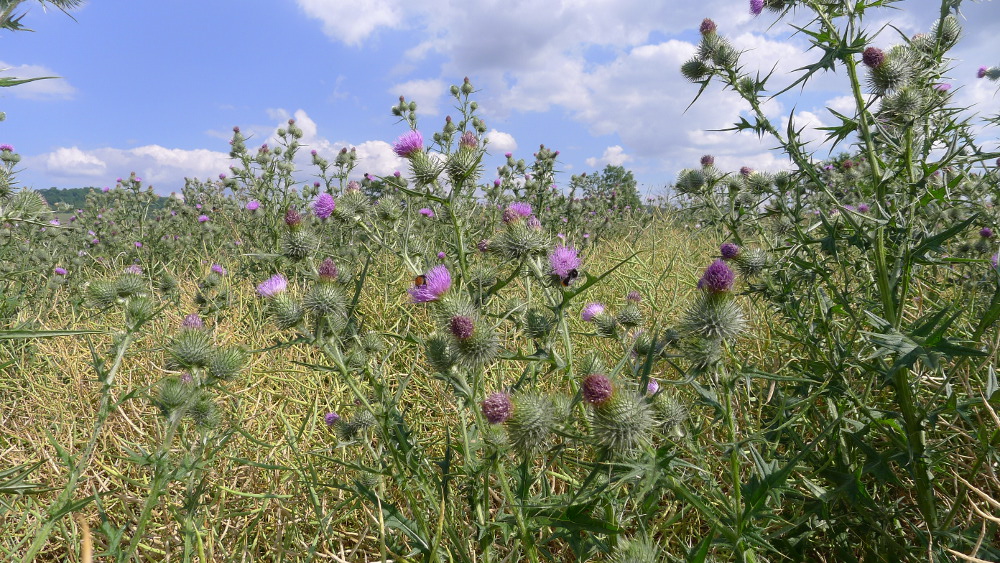
Many autumn-sown crops were growing so poorly and patchily after the wet winter and cold spring that they were ploughed up and replanted.  On a Standish farm, only one of several oil-seed rape fields was considered worth keeping.  Even so, it has produced flush after flush of weeds.  I’m sorry for the farmer, but it has been fabulous for wildlife – full of finches feeding on the weed seeds and abundant  insects for swallows and swifts.  Currently it is over-topped by 6ft high spear thistle (Cirsium vulgare), and so is alive with butterflies and bees.

Spear Thistle in Oil-seed Rape

Mud puddling butterflies, Standish, 18 July 2013

A group of 7 or more butterflies – Small White (Pieris rapae) and Green-veined (Pieris napi), I think – were mud-puddling on the edge of my garden pond.  According to Wikipedia, they do it to obtain nutrients such as salts and amino acids. They did not spread out along the available bank to do this, but congregated in a little group, with much wing shivering whenever a new butterfly flew over or came to join them.

White butterflies mud puddling

I did not observe other butterflies present in the area (Comma and Small Tortoiseshell) engaged in this activity.

Skip to content