Garden tiger moth (Arctia caja) in Gloucester

A single Garden tiger moth (Arctia caja) was spotted today (09/07/13) at 15:15hrs on the Gloucestershire Archives site (OS Map ref: SO835189).

Butterfly was resting on a window on the N side of the Archives building in shade in the gap between the Archives building and the Frith Centre.  When it did fly, it appeared to be having trouble fighting the prevailing wind (which channels through the gap).  It eventually flew downwind into the garden area at the Archives.

Field Meeting at Edge Common 30th June 2013

Linda Moore of GCER led a field meeting on 30th June 2013 mainly to look at flowers of the limestone grassland. Edge Common is an area of undisturbed and unimproved grassland that forms part of the chain of Cotswold Commons on the scarp edge overlooking the Severn vale to the west and the Cotswold plateau to the east. It is well known for its flowers and to a lesser degree for the butterflies it supports.

A wide variety of flowers were in flower, notably several species of Orchids which are at their best at this time of year. Due to the stiff breeze, butterflies were not so numerous but Common Blue, Brown Argus, Skippers and a solitary Marbled White were seen. Mny other invertebrates were apparent, not least quite large numbers of Garden Chafers.

Garden Chafer

Edge Meet IMG_1040

Meadow Pipit

Meadow Pipit IMG_8527

Bee Orchid

Edge Bee Orchid IMG_1033

Cotswold Commons & Beechwoods Bio-Blitz

The Cotswold Commons and Beechwoods Bio-Blitz takes place on Friday 5th and Saturday 6th July 2013 at the Cranham Scouting Centre. Details of the Bio-Blitz below or refer to www.cotswoldnnrbioblitz.weebly.com for more information. Anyone can take part, all that is required is a enthusiasm and a desire to seek out and learn something about the wildlife and natural history of the Cranham Common and Buckholt Wood areas.

Friday 5th is primarily for knowledgeable naturalists, Saturday 6th is open to everyone, especially families from 10 am to 2 pm with guided walks, events and refreshments available.

Cranham Scouting Centre can be found at the lowest point in Cranham village at SO 895 131

Cots Commons001


Cots Commons002

Colour Ringed Tree Pipits in the Forest of Dean

Tree Pipit IMG_3566c

Have you seen any colour ringed Tree Pipits in the Forest of Dean?

Local ringer Rob Husbands is carrying out an RAS (Re-trapping Adults for Survival) study over at least the next 5 years. Tree Pipits have been Red-listed due to a steep national decline and projects of this sort will, it is hoped, help to determine how many birds survive to return to their home ground and for how long.

Rob has trapped and ringed a number of adult birds and so far, 25 pulli (five broods) in the core of the Forest at the following sites – Woorgreens/Crabtree Hill, Staple Edge, Moseley Green, Lightmoor, Edge Hills, Drybrook Road Station and Steam Mills.

Rob needs help primarily with sightings of birds like the one illustrated above, but also with nest finding if anyone is suitably qualified, confident and careful enough to be able to do so.

Contact Andrew Bluett at gnsmembership@btinternet.com with sightings or offers of help which will be passed on to Rob for attention.

Ashleworth and Hasfield Hams on Sunday 9 June

The planned Constant Effort Site bird ringing at Ashleworth Ham (which involves 12 visits at regular intervals through the summer, with the same number of mist nets set up at the same sites, over the same period of time) had to be called off, because the wind hadn’t read the weather forecast, and was much stronger than predicted; you can’t use mist nets effectively if there is any wind at all, as the nets belly out like galleon sails and birds simply bounce off them.  But having risen well before dawn, it seemed a shame to miss the opportunity to review the situation in the hay meadows between the GWT reserve and the Severn, particularly as no hay has been cut so far, nor are any cattle grazing yet.

There is surprising floral diversity between one hay meadow and another: some have never been ploughed and exhibit a wide variety of hay meadow flowers; others were ploughed up (often in the Second World War, or more recently for maize) and even now show a much impoverished flora; some have in the past been agriculturally “improved” and/or subjected to herbicide treatment, often to control docks and other “weeds”, (though many are now under conservation management by the farmers themselves, so that the slow improvement should continue); still others hold water much longer and tend to be invaded by grasses like Tufted Hair Grass (the local name “Bullpate” illustrates the thick tussocky base that farmers hate so much because it’s so hard to uproot) or Reed Canary Grass, that rapidly invades wet open spaces and is no more popular; some fields were still very wet, with some standing water.  The best traditional hay meadows had lost the pink flush of Cuckoo Flower, that was so obvious and attractive a few weeks ago, and was now replaced by a more orange tinge from the Sorrel that has developed in recent weeks; many of these fields also had good showings of the grass Meadow Foxtail and, here and there, the occasional plant of Water Dropwort: I think that at this earlyish stage the latter were all Sulphurworts, but this will need to be checked by better botanists than me.  Many of the fields had good stands of Meadowsweet and Great Burnet, two plants which seem to re-establish themselves quite quickly in these meadows.

Birdwise, the morning began well, with three excited Cuckoos chasing one another and giving all three calls: the usual song, the gurgling call they sing in June, and a third guttural croak; we still don’t know which species they parasite locally, as there simply aren’t enough locally breeding Reed Warblers or Meadow Pipits; maybe Dunnock or Robin??  For breeding waders it was a disappointment however: no sign of Lapwings or Redshanks, no Oystercatchers (though a Song Thrush was doing a passable imitation of the call); only one calling Curlew was heard, though at this time of year, when they probably have small young on the ground, they often go very quiet.  Among other hay meadow species, one might have hoped for Quail or Yellow Wagtail early in the morning in June, but neither showed itself.

Great Spotted Woodpeckers were present, many of them quite noisy, as they no doubt have young birds in holes in the oaks and willows.

As for songbirds, the ringing operations suggest a decline in Sedge Warblers on the reserve itself this year: in all the hedges and rough grassland, only three singing males were found; on the other hand male Whitethroats were singing everywhere, ten at least, often with an aerial song-flight thrown in, and many were churring as though they might have young; one of the other key songsters of the area, the Redstart, was in evidence, with at least three singing males in ancient pollarded willows outside the reserve. Sadly, there was no sign of singing Grasshopper Warblers, after a bumper year last year, nor of Reed Warblers, which in the absence of reeds sometimes sing from withies; but plenty of Willow Warblers were singing, as well as the odd Chiffchaff and Blackcap in the taller hedgerow trees.  And of course, many Skylarks singing strongly overhead, and fair (though not large) numbers of singing Reed Buntings, with their ridiculous grandiloquent three note song.  Maybe the constant wet conditions throughout last summer affected both Reed Buntings and Sedge Warblers last year, preventing them from raising clutches?

Marsh Stitchwort at Highnam

I just thought you might be interested in a report of Marsh Stitchwort (Stellaria palustris) growing at Highnam, specifically in a field adjacent to Lassington Wood.  The reason I decided to report it is that I identified the plant via the Botanical Society of the British Isles’ website (http://www.botanicalkeys.co.uk/flora/content/species.asp?1109) which noted the plant as ‘scarce’.

The precise location was OS map ref: SO 8026 2056. There are a cluster of plants covering about 10 square metres, not in huge abundance but enough for me to notice them.  The habitat is a meadow one, on the western crest of a ridge above the Leadon, the other flora being a mix of buttercups, sorrel and various common grasses.  It hardly seems the ideal location of a wetland plant, but it is only 200m or so away and above the Leadon’s floodplain.

I am in the process of joining the GNS.

Posted on behalf of John Putley.

Letter from the Chair, May 2013

Dear Members

It was good to see many members at the Annual General Meeting, back (after an interval of nearly ten years) at the venue of the GNS Cirencester branch, with the Society’s President, Mrs. Anna Jones, in the Chair. As you will see from the draft Minutes included in this issue of GNS NEWS, there was a full review of the Society’s activities over the past year, together with a series of presentations from Butterfly Conservation on Rough Bank, the new Cotswold grassland reserve to whose purchase GNS made a contribution. The Special General Meeting held alongside the AGM approved an increase in subscriptions to £15 per annum (the first rise in about 20 years, and yet GNS membership remains a real bargain); I hope you will all amend instructions to your bank in line with the new rates, and sign the Gift Aid form. In this way, the Society will be able to maintain its healthy financial situation, without eating into its reserves.

A while ago, I paid tribute in one of these Letters to the outgoing Chief Executive Officer of the Gloucestershire Wildlife Trust, Gordon McGlone; it’s now a pleasure to welcome his successor, Roger Mortlock, who has recently started work. GNS is looking into ways of working even more closely with GWT, and a get-together between GWT staff and Trustees and GNS Executive Committee and Recorders is planned for late May. Watch this space for details of new initiatives!

In the meantime the GNS Executive Committee has made a series of grants for conservation projects: the new county moth recording team have received lap-tops to facilitate and standardise moth recording easier; new moth trapping equipment has been purchased; a Dipper ringing project in the Forest of Dean has been supported, as well as a project for Dormouse boxes. One of our recent grants is near to bearing fruit: the Red Data Book on the county’s bryophytes looks like being a landmark volume in many ways: as a compilation of historic and recent records, as an identification aid, as a guide to conservation of this group; and as a wake-up call to other counties.

This issue of GNS NEWS has a something of a birdy flavour. In a way this is very appropriate, as the current issue is accompanied by a flier allowing members to take advantage of a pre-publication offer for purchase of the new “Birds of Gloucestershire”, to be published later in the year, shortly after the latest national bird Atlas. GNS members have contributed, with other bird-watchers in the county, to the fieldwork for the Gloucestershire publication (the first book on the county’s birds since Chris Swaine’s 1982 volume, now well out of date); GNS has made a substantial financial contribution to the new county avifauna. I am sure Chris would have approved: I looked up to him as the ultimate authority when I was a boy birdwatcher, and used to phone him to report on my most recent observations, in fear and trembling as to whether he would approve my sightings.

In conclusion, another piece of good news: in recent years, that typical element of Severn Vale culture and cuisine, the elver, has declined steeply in numbers, just as its price has taken it well beyond the pockets of most people in the area. This spring has seen the best numbers of elvers in decades, carried upriver on high tide cycles; quite why is not clear, but it is a phenomenon observed throughout western Europe, as may be seen from the Sustainable Eel Group’s website. Perhaps coincidentally (but probably not), the birdwatchers among us have noted much larger numbers of passing Arctic Terns than usual along the river; they don’t seem to be feeding on elvers, nor on the tiny shrimps that have also been present in large numbers. As usual there are hidden links across different fields of natural history and ecology, which we must use our time and ingenuity to fathom out. I wish you all a fascinating summer delving into these cross connections.

Yours sincerely

Mike Smart
Hon Chairman

Ley Park, Blaisdon

A Broad-bodied Chaser at Ley Park today. Birdlife included a Hobby soaring high overhead, at least two Ravens, Great Spotted Woodpeckers feeding young,a singing Tree Pipit, two Spotted Flycatchers, a Garden Warbler and two Siskins.

P1030621

Cinderford Linear Park & Northern Quarter 28th April 2013

On a bright sunny morning Andrew Bluett was joined by eight GNS members for a field meeting of general interest looking at the Cinderford Northern Quarter site and the CinderfordLinearPark (north). The group met opposite the Winner (Skoda) Garage in the Forest Vale Industrial Estate and looked at maps illustrating the relationship of Cinderford Northern Quarter development site with the Linear Park and surrounding areas, then at some historical photographs of the area illustrating the very different landscape that prevailed in the 1950s and early 1960s so that it could be appreciated just how much the environment had changed over the intervening 50 years or so.

20130428 CNQ Meet 1

Historically the valley was an industrial landscape based on coal extraction, both deep mine and opencast, clay extraction (for Coleford Brick & Tile Co) and railway and colliery dram tracks. Large areas in between were either bare where waste material was accumulated or clothed in thin Sheep-cropped grass. This provided an ideal habitat for Woodlark, a few pairs of Wheatear, Chats & Pipits. In the years after World War 2 R J B Christian found some 28 pairs of Woodlark in the valley and adjacent ridges, Snipe and Reed Bunting breeding in the boggy areas and Red Backed Shrike in the plantation edges (Sketches of Dean’s Birds, Christian, 1999).

The group first walked up to the Steam Mills Lake past Dam Green in the Northern Quarter area viewing two very recent, and therefore bare and undeveloped ponds along the way. Whilst there was much fishing activity, a number of water birds were evident including Greylag Goose, Coot, Mallard, Tufted Duck and Lesser Black Backed Gull. From there the party walked down the track towards the central area of the Linear Park as far as Laymore Quag and the large open meadow beyond Lennetshill Plantation. The return was via a secondary track leading to the Forest Vale Industrial Estate road and back to Winner Garage.

This walk which follows the lines of forestry and old railway tracks took in a variety of habitat types, conifer plantation, deciduous and mixed woodland, open scrubby grassland, industrial buildings, the lake and ponds, boggy areas (Laymore Quag) etc and produced a respectable list of species.

Fresh-water or Swan Mussel shells (Anodatea cygnea) were discovered by the lake, the largest being some 10cm long, Pond Skaters were evident on all the water bodies especially in the ditches and puddles, Butterflies were represented only by Small Tortoiseshell. Birds were more abundant with Tree Pipit, Willow Warbler and Chiff Chaff, Carrion Crow, Magpie, Robin, Great, Blue, Long Tailed and Coal Tits, Blackbird and Song Thrush, Buzzard, Wren, Dunnock, Swallow, Blackcap, Lesser Redpoll, Bullfinch, Chaffinch, Goldfinch, Jay, Wood Pigeon, Pied Wagtail, Green and Great Spotted Woodpecker. Neither Raven nor hoped for Goshawk appeared but towards the end of the walk, a solitary Hawfinch flew over towards the Crump Meadow Inclosure.

Juliet Bailey identified a series of flowering plants – Field Horsetail (Equisetum arvense), Pussy Willows (Salix sp), Lesser Celandine (Ficaria verna), Colt’s-foot (Tussilago farfara), Dandelion (Taraxacum aggregate), Field Wood-rush (Luzula campestris), Daisy (Bellis perennis), and Barren Strawberry (Potentilla sterilis). Some remnant Heather was also noted at one point.

It was considered that flowers are very late this year – at least a couple of weeks behind normal, and that the flowers seen on this walk were later than in the Vale by about a week, presumably because of the altitude (approx 140 metres / 450 feet above sea level).
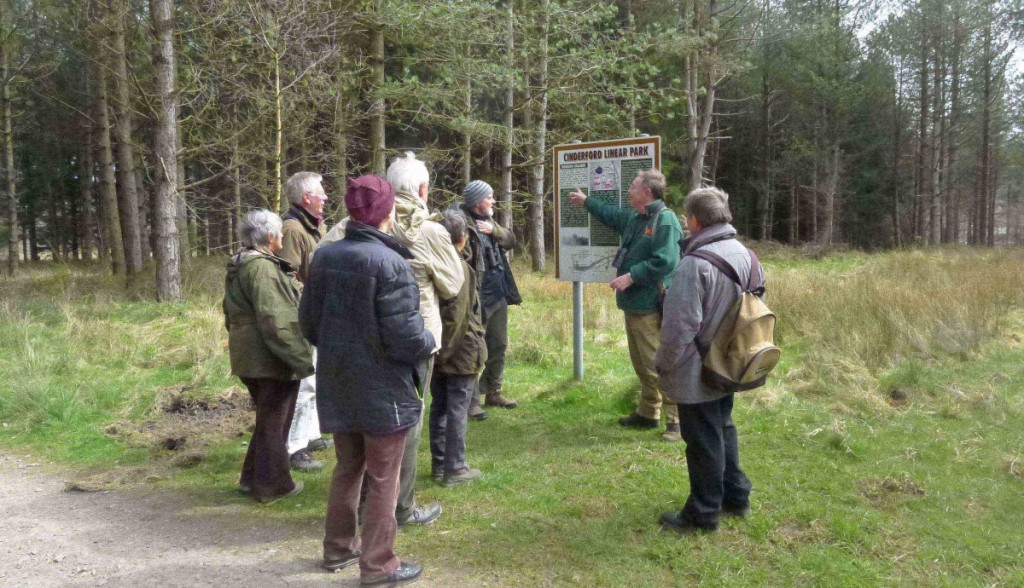
20130428 CNQ Meet 2

The Birds of Gloucestershire – Pre-publication offer

GNS have agreed to promote the pre-publication offer for our forthcoming book, ‘The Birds of Gloucestershire’, which will be launched in the autumn at a retail price of £45. The publishers are offering a pre-publication special offer, whereby people can order one now for just £20 plus p&p.

LUP are a not-for-profit organisation, and all royalties will come back into the county for bird conservation.

Gloucestershire_Pre-Pub_A5_Page_1

Gloucestershire_Pre-Pub_A5_Page_2

Skip to content